
Guide
Does beta-glucan help gut health? What the trials found
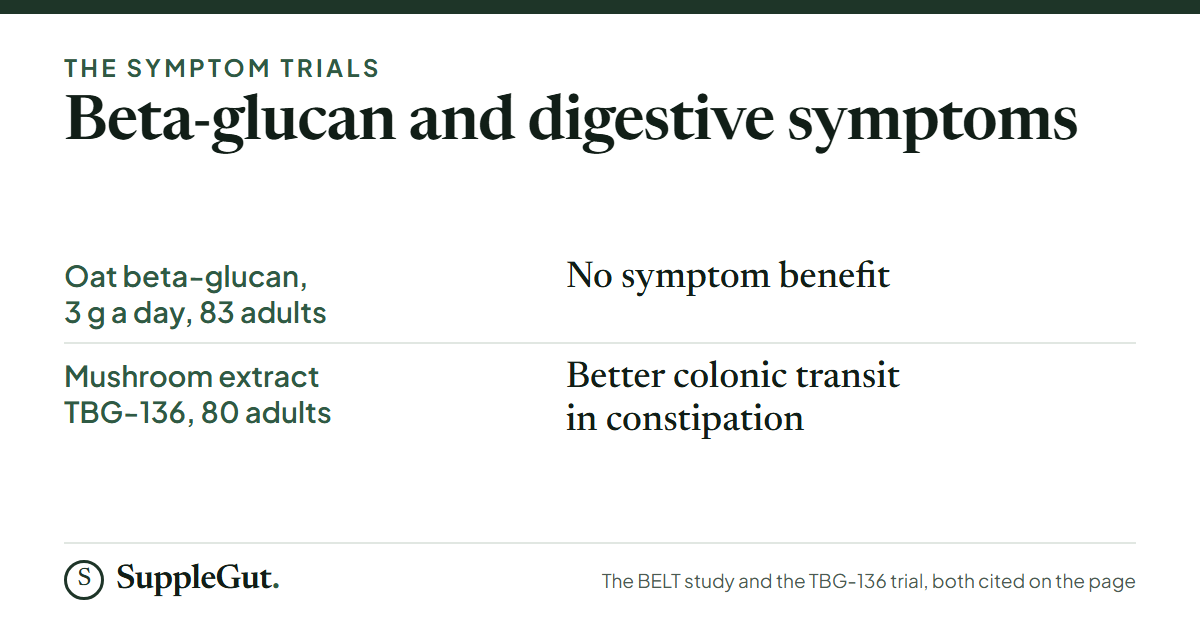
Beta-glucan trials split cleanly into two groups that are often conflated: trials measuring lab markers — fecal short-chain fatty acids, gut bacteria ratios, colonic transit time — and the much rarer trials measuring whether people actually felt fewer digestive symptoms. The two symptom trials that exist used ingredients different from the plain oat or barley beta-glucan sold in most supplements, and the largest, best-controlled trial found no symptom benefit at all.
What "beta-glucan" means here
Beta-glucan is a soluble fiber found in oat and barley bran, and a structurally different form is also extracted from mushrooms and yeast cell walls. The trials below use several different sources — oat, barley, and a Schizophyllum commune mushroom extract called TBG-136 — and one uses a proprietary mixture of beta-glucan plus inositol and digestive enzymes rather than beta-glucan alone. These are not interchangeable, and a result from one source or format doesn't transfer to another.
The strongest constipation result used a mushroom extract, not oat fiber
A randomized, double-blind, placebo-controlled trial gave 80 constipated adults (40 per group, 74 completed) either 80 mg/day of TBG-136 or a placebo for 8 weeks. The TBG-136 group had significantly better rectosigmoid colonic transit time and more defecations than placebo (p=0.011), significantly more Lactobacillus (p<0.05), and a bigger improvement on a living-with-constipation quality-of-life index at 8 weeks (p=0.043) (Kim et al., Journal of Functional Foods). This is a real, well-controlled result — but at a dose (80 mg) roughly 40 times smaller than the 3 g used in most oat beta-glucan research, and from an ingredient not found in typical oat-fiber supplements.
The largest, best-controlled symptom trial found nothing
The BELT Study gave 83 Italian adults 3 g/day of oat beta-glucan (as the OatWell-based Beta Heart ingredient) or an isocaloric placebo in a double-blind, placebo-controlled crossover over two 2-month periods, with 89% compliance. It tracked self-perceived intestinal well-being — weekly defecations, stool consistency, ease and completeness of expulsion, abdominal discomfort, and swelling — at 4 and 8 weeks. None of those measures differed significantly from placebo (p values ranged from 0.26 to 0.92). The same trial did significantly lower LDL cholesterol, by 12.2% at 4 weeks and 15.1% at 8 weeks (both p<0.01), which was its actual primary purpose; three subjects had moderate abdominal discomfort and one had dysphagia (Cicero et al., Nutrients, 2020).
Higher doses mean more side effects, not more benefit
A 263-person, double-blind, placebo-controlled trial tested oat beta-glucan tablets at 1.5 g, 3 g, and 6 g per day against placebo for 12 weeks in adults with high LDL cholesterol. LDL didn't improve significantly at any dose (p=0.23, 0.18, and 0.72). Gastrointestinal adverse events, though, rose with dose: 23.4% at 1.5 g/day, 34.8% at 3 g/day, and 66.7% at 6 g/day, all above the 36.9% seen with placebo (p<0.0001 overall) (Rioux-Labrecque et al., American Journal of Clinical Nutrition, 2023). More beta-glucan made tolerability worse without making anything measurably better.
Lab markers do move — without a symptom read-out
Two trials show beta-glucan changes fermentation and bacterial composition at 3 g/day, without ever asking whether people felt different. In a 48-person, double-blind trial in gastritis patients, 30 days of oat beta-glucan significantly raised fecal acetic, propionic, and hydroxybutyric acid (all p<0.0001 by ANOVA) versus placebo, and C-reactive protein fell in all groups (p<0.02) (Gudej et al., Nutrients, 2021). In a 30-person crossover trial, 3 g/day of high-molecular-weight barley beta-glucan increased Bacteroides from 5.96% to 12.26% of the gut community (p=0.002) and shifted overall bacterial composition (p=0.002), with no gastrointestinal symptom outcome measured at all (Wang et al., Frontiers in Microbiology, 2016). Both are genuine biological effects; neither tells you whether bloating, pain, or bowel habits changed.
The mixture trials aren't placebo-controlled
Two Italian trials tested "Biointol," a mixture of beta-glucan, inositol, and digestive enzymes, not beta-glucan alone. In 90 IBS patients (50 given Biointol, 40 given no therapy at all, not a placebo), Biointol was reported to significantly improve bloating, flatulence, and abdominal pain, with a slight increase in bowel urgency and no effect on other symptoms; no percentages or p-values were reported (Ciacci et al., Minerva Gastroenterologica e Dietologica, 2011). In 43 IBD patients in remission on mesalamine, adding Biointol (23 patients, versus 20 on mesalamine alone) was reported to reduce abdominal pain, bloating, and flatulence and improve general well-being, while the mesalamine-only group saw only a mild reduction in evacuation urgency; again, no percentages or p-values were reported on the page (Gianni et al., European Review for Medical and Pharmacological Sciences). Both compared active treatment against no added treatment rather than a matching placebo, so some of the reported improvement could reflect that patients knew they were getting something extra.
What a 2024 review concluded
A review of oat research across all health outcomes stated plainly that "clinical data for a potential gut barrier effect is lacking," while noting that oat beta-glucan does measurably increase fecal bulk (Mathews & Chu, Nutrients, 2024). That statement, from a reviewer independent of any single trial, matches what the individual trials above show: real, measurable effects on fiber bulk, fermentation byproducts, and bacterial ratios, but no consistent evidence that those changes translate into fewer digestive symptoms for a typical person without constipation.
Seven trials, side by side
| Trial | Ingredient & dose | Design | Result |
|---|---|---|---|
| Kim (TBG-136) | Mushroom beta-glucan, 80 mg/day, 8 wks | RCT, placebo, n=74 | Better transit time, more defecations, better QOL index |
| Cicero (BELT) | Oat beta-glucan, 3 g/day, 8 wks | Crossover RCT, placebo, n=83 | No effect on any GI symptom measure |
| Rioux-Labrecque | Oat beta-glucan, 1.5–6 g/day, 12 wks | RCT, placebo, n=263 | No LDL benefit; GI side effects rose with dose |
| Gudej | Oat beta-glucan, 3 g/day, 30 days | RCT, placebo, n=48 | Fecal SCFAs up significantly; no symptom measure |
| Wang | Barley beta-glucan, 3 g/day, 5 wks | Crossover RCT, n=30 (19 completed) | Bacteroides up significantly; no symptom measure |
| Ciacci (Biointol) | Beta-glucan + inositol + enzymes | RCT, no-therapy control, n=90 | Reported less bloating/pain; not placebo-controlled |
| Gianni/Catanzaro (Biointol) | Beta-glucan + inositol + enzymes, 4 wks | RCT, active-control, n=43 | Reported less bloating/pain; not placebo-controlled |
What this means for choosing a supplement
If constipation specifically is the target, the one placebo-controlled trial with a real effect used 80 mg/day of a mushroom-derived beta-glucan (TBG-136) not commonly sold in mainstream oat-fiber products — check a label for that specific ingredient rather than "beta-glucan" generically. If the goal is general digestive symptoms or bloating, the best-controlled evidence (BELT) found no benefit from plain oat beta-glucan at 3 g/day, and the trials that did report symptom improvement weren't placebo-controlled. Oat and barley beta-glucan at 3 g/day reliably changes fecal chemistry and gut bacteria ratios, which may matter for reasons beyond daily symptoms, but going past 3 g/day up to 6 g/day has only been shown to add gastrointestinal side effects, not benefit.
Common questions
Does beta-glucan help with constipation?
One trial, using a specific mushroom-derived beta-glucan (TBG-136, not the oat or barley beta-glucan in most supplements) at 80 mg/day for 8 weeks, found significantly improved colonic transit time and defecation count in constipated adults. A much larger trial of oat beta-glucan at 3 g/day, testing cholesterol rather than constipation, found no significant effect on defecation frequency, stool consistency, or abdominal discomfort.
Does beta-glucan help with IBS or bloating?
Two small trials of a beta-glucan, inositol, and digestive-enzyme mixture (not pure beta-glucan) reported less bloating, flatulence, and abdominal pain in IBS and IBD-IBS patients, but neither trial was placebo-controlled or blinded — the comparison group simply received no added therapy or continued their existing medication. A 2024 review of oat research concluded that clinical data for a gut-barrier effect from beta-glucan specifically is lacking.
What dose of beta-glucan changes gut bacteria?
3 grams a day of oat beta-glucan significantly increased fecal short-chain fatty acids over 30 days in one trial, and 3 grams a day of high-molecular-weight barley beta-glucan shifted the ratio of Bacteroidetes to Firmicutes bacteria over a 5-week phase in another. Neither trial measured whether those changes came with fewer digestive symptoms.
Does more beta-glucan cause more side effects?
Yes, in the one trial that tested multiple doses head-to-head. Gastrointestinal adverse events rose with dose — 23.4% at 1.5 g/day, 34.8% at 3 g/day, and 66.7% at 6 g/day, all higher than the 36.9% seen with placebo — while cholesterol did not improve significantly at any dose.
Sources
- Kim JH, et al. "TBG-136, a Schizophyllum commune-derived β-glucan benefits gut microbiota and intestinal health: A randomized, double-blind, and placebo-controlled clinical trial." Journal of Functional Foods, 2023. doi.org/10.1016/j.jff.2023.105668
- Cicero AFG, et al. "Middle-Term Effects of an Oat Beta-Glucan-Enriched Supplementation on Lipid Profile, Glycemia and Intestinal Health in Hypercholesterolemic Subjects: The BELT Study." Nutrients, 2020;12(4):1073. pmc.ncbi.nlm.nih.gov/articles/PMC7146517
- Rioux-Labrecque A, et al. "Effect of oat β-glucan tablets on LDL cholesterol and gastrointestinal tolerability." American Journal of Clinical Nutrition, 2023. Summarized at betaglucan.com/research
- Gudej S, et al. "Clinical Outcomes after Oat β-Glucans Dietary Treatment in Gastritis Patients." Nutrients, 2021;13(8):2791. pmc.ncbi.nlm.nih.gov/articles/PMC8400320
- Wang Y, et al. "High Molecular Weight Barley β-Glucan Alters Gut Microbiota Toward Reduced Cardiovascular Disease Risk." Frontiers in Microbiology, 2016;7:129. pmc.ncbi.nlm.nih.gov/articles/PMC4748052
- Ciacci C, et al. "Effect of beta-glucan, inositol and digestive enzymes in GI symptoms of patients with IBS." Minerva Gastroenterologica e Dietologica, 2011;57(4):325–330. pubmed.ncbi.nlm.nih.gov/21796867
- Gianni B, et al. "Effect of beta-glucan, inositol and digestive enzymes in IBD-IBS patients." European Review for Medical and Pharmacological Sciences. europeanreview.org/article/13006
- Mathews R, Chu Y. Review of oat research discussing beta-glucan and gut barrier function. Nutrients, 2024. pubmed.ncbi.nlm.nih.gov/39137936
Not sure which product fits your situation?
This guide covers the mechanics. The quiz takes your specific symptoms, routine and preferences and matches you to one product from the catalog.
Take the quiz →