
Guide
Do digestive enzymes actually work?
Quick answer
Do digestive enzymes actually work? The single-purpose ones do, for the meal they are matched to: lactase for dairy, alpha-galactosidase for beans and vegetables, xylose isomerase for fructose, and a gluten-degrading enzyme for traces of gluten in the stomach, each with a placebo-controlled trial. The broad "digestive enzyme" blends sold for everyday digestion have one 120-person trial in functional dyspepsia and nothing in healthy adults. DAO enzyme has trials in migraine and hives, not in gut symptoms. Betaine HCl re-acidifies a stomach on acid blockers for about an hour; it has no digestion trial.
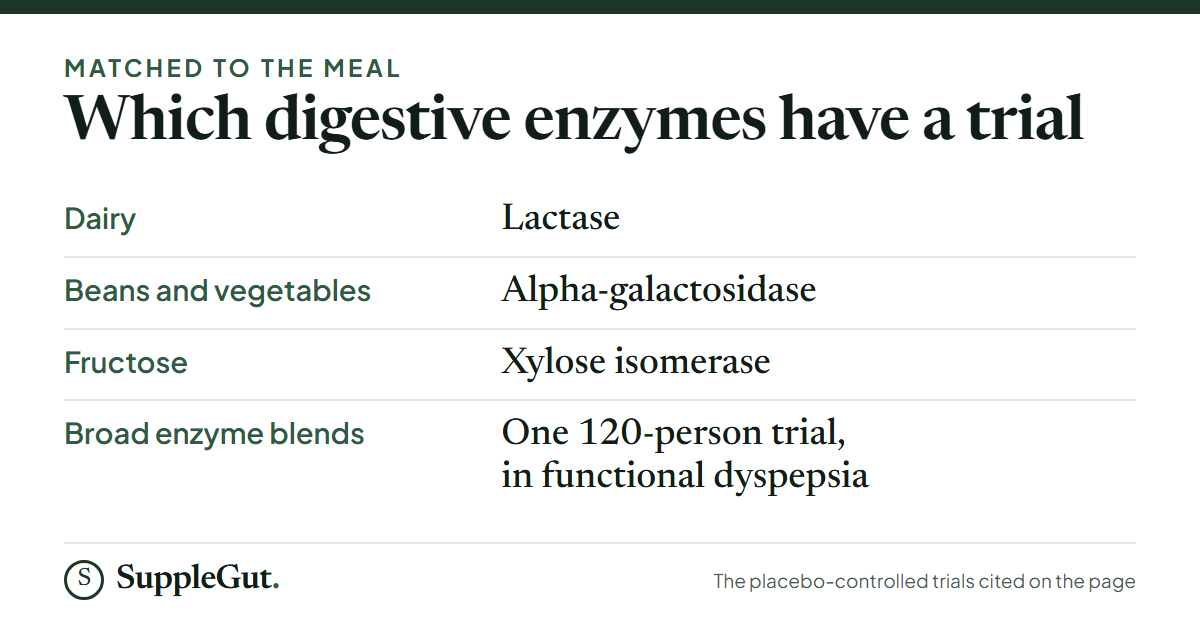
"Digestive enzymes" covers two different products. One kind supplies a single enzyme a person is short of, for a food that causes trouble, and those have been tested the obvious way: give the food, with and without the enzyme, and measure the gas or the symptoms. The other kind is a blend of ten or more enzymes sold for digestion in general, and those have hardly been tested at all. This guide sorts the evidence by which kind it belongs to.
How the evidence ranks
| Enzyme | Best trial | What it showed | When it applies |
|---|---|---|---|
| Lactase | Crossover RCT, 47 adults with lactose intolerance | Symptoms improved; breath hydrogen down 55% | Dairy |
| Alpha-galactosidase | RCT, 52 children, 2 weeks; adult meal challenges | Fewer bloating days, less flatulence; 1,200 GalU cut breath hydrogen | Beans, lentils, cruciferous vegetables |
| Xylose isomerase | RCT, 65 adults with fructose malabsorption | Breath hydrogen 885 vs 2,071; pain and nausea down | Fructose |
| AN-PEP (gluten-degrading) | Crossover RCTs, 12 healthy volunteers and 18 gluten-sensitive adults | Stomach gluten cut from 177 to 22 µg·min/mL | Traces of gluten, not celiac disease |
| Multi-enzyme blend | RCT, 120 adults with functional dyspepsia, 2 months | Dyspepsia scores and pain improved; no p-values in the abstract | Diagnosed functional dyspepsia |
| DAO (diamine oxidase) | RCTs in migraine (100) and chronic hives (22) | Shorter migraines, lower hives score; no gut trial | Not gut symptoms |
| Betaine HCl | Pilot, 6 volunteers on a PPI | Gastric pH down 4.5 units for about 73 minutes | Re-acidifying a blocked stomach; no digestion outcome |
Single enzymes with a food to match
Lactase is the model. In a double-blind crossover of 47 adults with confirmed lactose intolerance, lactase tablets taken with a lactose challenge improved symptom scores and cut cumulative breath hydrogen, the marker of undigested lactose reaching the colon, by 55% against placebo (Baijal et al., JGH Open, 2020). The enzyme replaces the one the person lacks, for the one food that needs it.
Alpha-galactosidase breaks down the sugars in beans, lentils and cruciferous vegetables that human enzymes cannot. A two-week randomized, double-blind trial in 52 children with recurrent gas cut the number of moderate-to-severe bloating days (p=0.03) and the share of days with flatulence (p=0.02) with no adverse events (Di Nardo et al., BMC Gastroenterology, 2013). In adults, 1,200 GalU with a bean meal cut breath hydrogen and flatulence severity in eight volunteers (Di Stefano et al., Digestive Diseases and Sciences, 2007), and eight drops with a test meal reduced flatulence events in 19 people without changing bloating or pain (Ganiats et al., Journal of Family Practice, 1994). Taken daily for IBS instead of with the meal, it did less: a 12-week trial in 125 people with IBS found only a trend, and more people stopped it than stopped placebo, citing abdominal pain and diarrhea (Hillilä et al., Scandinavian Journal of Gastroenterology, 2016).
Xylose isomerase converts fructose to glucose in the gut. In 65 adults with breath-test-confirmed fructose malabsorption, capsules taken with 25 g of fructose cut four-hour breath hydrogen from 2,071 to 885 ppm·min against placebo and reduced abdominal pain (0.7 against 1.3) and nausea (0.2 against 0.6) on a visual scale; bloating fell but not significantly (p=0.053) (Komericki et al., Alimentary Pharmacology & Therapeutics, 2012).
AN-PEP, the gluten-degrading enzyme from Aspergillus niger, was tested by sampling the stomach and small intestine after a gluten-containing meal. In 12 healthy volunteers it cut stomach alpha-gliadin from 389 to 35 µg·min/mL and duodenal levels from 168 to 7 (p<0.001) (Salden et al., Alimentary Pharmacology & Therapeutics, 2015), and in 18 gluten-sensitive adults eating a full meal the high dose cut stomach gluten from 177 to 22 (p=0.001) and duodenal gluten from 14 to 6 (p=0.019) (König et al., Scientific Reports, 2017). Those are measurements of gluten, not of symptoms, and neither trial was in celiac disease; the product pages say the same.
The blends sold for digestion in general
The multi-enzyme capsule (amylase, protease, lipase, cellulase and the rest) is the most-sold kind and the least tested. The one placebo-controlled trial found for this guide gave 120 adults with functional dyspepsia a 200 mg fungal enzyme blend twice a day or placebo for two months and reported better dyspepsia quality-of-life scores, lower pain on a visual scale and better sleep, with no side effects; the abstract gives no p-values (Ullah et al., Biomedicine & Pharmacotherapy, 2023). No placebo-controlled trial of a blend in healthy adults with ordinary post-meal discomfort could be found. A person without an enzyme deficiency and without a matched food has no trial to point to, whatever the label says, and the guide to enzymes vs probiotics for bloating covers how to tell which category a symptom belongs to.
Two enzymes sold for the gut that were tested elsewhere
DAO (diamine oxidase) is sold for "histamine intolerance" gut symptoms. Its randomized trials are in other conditions: in 100 people with episodic migraine and low DAO, one month of the enzyme shortened attacks from 6.1 to 4.8 hours (p=0.022) where placebo did not (Izquierdo-Casas et al., Clinical Nutrition, 2019), and in a 22-person crossover in chronic hives it lowered the weekly urticaria score in people with low DAO (p=0.041) (Yacoub et al., International Archives of Allergy and Immunology, 2018). A 400-person trial of a low-histamine diet with DAO in histamine intolerance is registered as a protocol and has not reported (Duelo et al., Nutrients, 2024). No trial of DAO for gut symptoms was found.
Betaine HCl is sold to "restore stomach acid" for digestion. What it has been shown to do is re-acidify a stomach whose acid has been switched off by a proton pump inhibitor: in six healthy volunteers on rabeprazole, 1,500 mg lowered gastric pH by 4.5 units within about six minutes, and the pH stayed under 3 for about 73 minutes, with no tolerability problems (Yago et al., Molecular Pharmaceutics, 2013). A crossover in healthy volunteers found the same dose restored only about 13% of the absorption of a drug that needs acid (Faber et al., Pharmaceutical Research, 2017). There is no trial of betaine HCl for digestion or symptoms in people who are not on an acid blocker, and "low stomach acid" as a cause of bloating has no trial to test it against.
How to tell whether an enzyme is doing anything
The trials above all use the same test, and a person can run a rough version at home: the same food, on two occasions, with and without the enzyme, judged on the symptom that usually follows. An enzyme that works shows it on the first meal; there is no build-up period, because nothing is being changed except that meal. If a week of a broad blend has not changed anything, the trial evidence gives no reason to expect the second week to.
Signs to stop comparing enzymes and get checked
Greasy, pale or floating stools, weight loss without trying, or digestive symptoms that began after pancreatic or gallbladder problems are reasons to see a clinician before buying an enzyme; prescription pancreatic enzymes are a medical treatment, not a supplement question. Symptoms after wheat need a celiac test before any gluten-degrading enzyme, because none of the AN-PEP trials included celiac disease.
Products in this catalog with the trials above
Common questions
Do digestive enzyme supplements really work?
The single-enzyme products do, for the food they are matched to: lactase cut breath hydrogen by 55% and improved symptoms in 47 adults with lactose intolerance; alpha-galactosidase cut bloating days and flatulence in a 52-child trial; xylose isomerase more than halved breath hydrogen after fructose in 65 adults; the gluten-degrading enzyme AN-PEP cut gluten in the stomach by about 90%. The broad multi-enzyme blends have one 120-person trial in functional dyspepsia and no trial in healthy adults.
How do digestive enzymes work?
Each enzyme breaks one kind of food component into pieces the gut can absorb: lactase splits lactose, alpha-galactosidase splits the sugars in beans, xylose isomerase converts fructose, proteases and lipases work on protein and fat. A supplement helps only when the meal contains that component and the body is not handling it, which is why the trials give the food with and without the enzyme and measure the gas or symptoms that follow.
Do digestive enzymes help with bloating?
When the bloating follows a specific food, the matching enzyme has trial support: alpha-galactosidase reduced bloating days with beans and vegetables, and lactase reduced symptoms with dairy. Xylose isomerase reduced pain and nausea after fructose but its bloating result missed significance (p=0.053). Broad blends have no bloating trial in otherwise healthy adults.
Should you take digestive enzymes every day?
The trials that worked gave the enzyme with the trigger meal. The one trial of daily alpha-galactosidase for IBS over 12 weeks found only a trend and more people stopped it than stopped placebo. There is no build-up effect to wait for; an enzyme either changes the meal it is taken with or it does not.
Does DAO enzyme help histamine intolerance?
Its randomized trials are in migraine (100 people, attacks shortened from 6.1 to 4.8 hours) and chronic hives (22 people, lower weekly score), both in people with low DAO. No trial of DAO for gut symptoms was found; a 400-person trial in histamine intolerance is registered but has not reported.
Does betaine HCl help digestion?
It has been shown to re-acidify the stomach in people whose acid was switched off by a proton pump inhibitor: 1,500 mg lowered gastric pH by 4.5 units for about 73 minutes in six volunteers. There is no trial of it for digestion or symptoms in people not on an acid blocker.
Can gluten-degrading enzymes let a celiac eat gluten?
No. The AN-PEP trials measured gluten left in the stomach and small intestine of healthy and gluten-sensitive volunteers, cutting it by around 90%, and did not include people with celiac disease. Symptoms after wheat need a celiac test before any enzyme.
Sources
- Baijal R, Tandon RK. "Effect of lactase on symptoms and hydrogen breath levels in lactose intolerance: A crossover placebo-controlled study." JGH Open, 2020. pubmed.ncbi.nlm.nih.gov/33490624
- Di Nardo G, et al. "Efficacy and tolerability of α-galactosidase in treating gas-related symptoms in children." BMC Gastroenterology, 2013. pubmed.ncbi.nlm.nih.gov/24063420
- Di Stefano M, et al. "The effect of oral alpha-galactosidase on intestinal gas production and gas-related symptoms." Digestive Diseases and Sciences, 2007. pubmed.ncbi.nlm.nih.gov/17151807
- Ganiats TG, et al. "Does Beano prevent gas? A double-blind crossover study of oral alpha-galactosidase." Journal of Family Practice, 1994. pubmed.ncbi.nlm.nih.gov/7964541
- Hillilä M, et al. "Does oral α-galactosidase relieve irritable bowel symptoms?" Scandinavian Journal of Gastroenterology, 2016. pubmed.ncbi.nlm.nih.gov/26133538
- Komericki P, et al. "Oral xylose isomerase decreases breath hydrogen excretion and improves gastrointestinal symptoms in fructose malabsorption: a double-blind, placebo-controlled study." Alimentary Pharmacology & Therapeutics, 2012. pubmed.ncbi.nlm.nih.gov/23002720
- Salden BN, et al. "Randomised clinical study: Aspergillus niger-derived enzyme digests gluten in the stomach of healthy volunteers." Alimentary Pharmacology & Therapeutics, 2015. pubmed.ncbi.nlm.nih.gov/26040627
- König J, et al. "Randomized clinical trial: Effective gluten degradation by Aspergillus niger-derived enzyme in a complex meal setting." Scientific Reports, 2017. pubmed.ncbi.nlm.nih.gov/29026170
- Ullah H, et al. "Efficacy of digestive enzyme supplementation in functional dyspepsia: A monocentric, randomized, double-blind, placebo-controlled, clinical trial." Biomedicine & Pharmacotherapy, 2023. pubmed.ncbi.nlm.nih.gov/37976892
- Izquierdo-Casas J, et al. "Diamine oxidase (DAO) supplement reduces headache in episodic migraine patients with DAO deficiency: A randomized double-blind trial." Clinical Nutrition, 2019. pubmed.ncbi.nlm.nih.gov/29475774
- Yacoub MR, et al. "Diamine Oxidase Supplementation in Chronic Spontaneous Urticaria: A Randomized, Double-Blind Placebo-Controlled Study." International Archives of Allergy and Immunology, 2018. pubmed.ncbi.nlm.nih.gov/29698966
- Duelo A, et al. "Study Protocol for a Prospective, Unicentric, Double-Blind, Randomized, and Placebo-Controlled Trial on the Efficacy of a Low-Histamine Diet and DAO Enzyme Supplementation in Patients with Histamine Intolerance." Nutrients, 2024. pubmed.ncbi.nlm.nih.gov/39796463
- Yago MR, et al. "Gastric reacidification with betaine HCl in healthy volunteers with rabeprazole-induced hypochlorhydria." Molecular Pharmaceutics, 2013. pubmed.ncbi.nlm.nih.gov/23980906
- Faber KP, et al. "Meal Effects Confound Attempts to Counteract Rabeprazole-Induced Hypochlorhydria Decreases in Atazanavir Absorption." Pharmaceutical Research, 2017. pubmed.ncbi.nlm.nih.gov/28028768
Not sure which product fits your situation?
This guide covers the mechanics. The quiz takes your specific symptoms, routine and preferences and matches you to one product from the catalog.
Take the quiz →