
Guide
What’s the best supplement for gastritis?
Zinc-L-carnosine is the best-supported supplement for gastritis, and mastic gum is the strongest runner-up. Zinc-L-carnosine is the only ingredient here that has been tested in people with gastritis, and it improved both their symptoms and the state of the stomach lining. Mastic gum was tested in a closely related stomach condition, where it beat a dummy pill. Both results are set out below, along with what each trial does and does not show.
Short answer
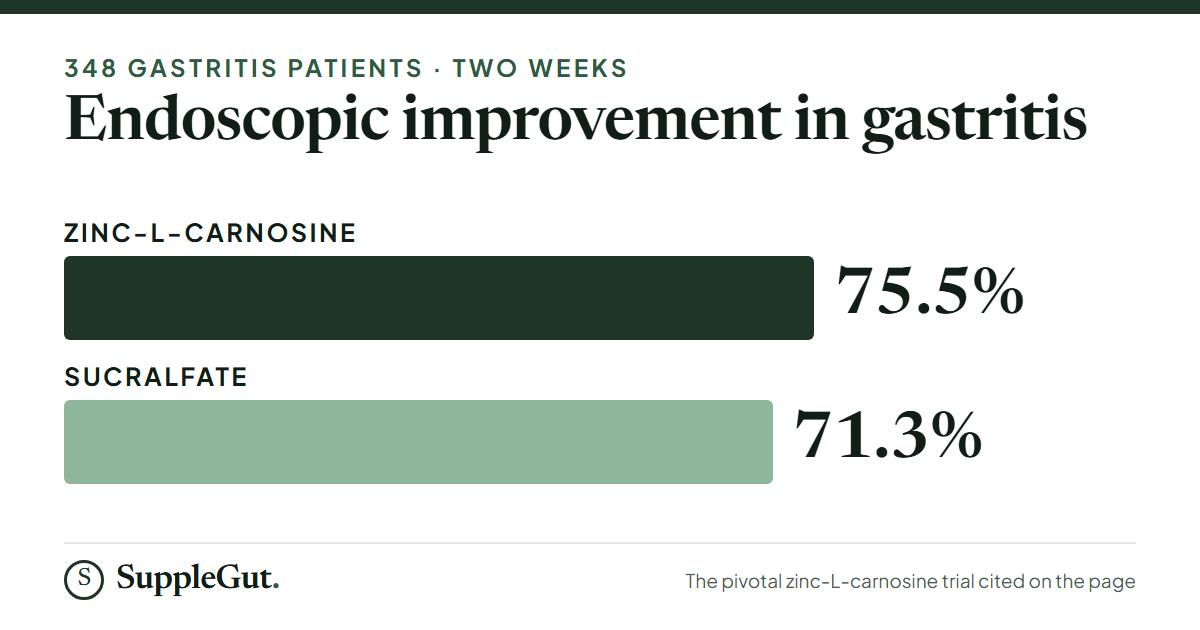
- Start with zinc-L-carnosine, 75–150 mg a day. It is the only ingredient here tested in gastritis patients rather than in a neighboring condition. In a 348-patient trial it matched sucralfate, a prescription stomach-lining protectant, on endoscopic improvement: 75.5% against 71.3%. Give it two to four weeks.
- Add or switch to mastic gum, 350 mg three times daily, if that does nothing. Its trial was in a closely related stomach condition rather than gastritis, and 77% improved markedly against 40% on a dummy pill.
- Take a probiotic only if you are on antibiotics for H. pylori. It raises the chance those antibiotics work and cuts their side effects. It does nothing for gastritis on its own.
- Vitamin C and DGL licorice have no supporting trial for this. The trials either point in opposite directions or were run in a different condition entirely.
None of this replaces treating an H. pylori infection if you have one. See the warning signs further down.
One figure you will meet everywhere gastritis supplements are sold does not appear on this page. The claim that zinc-L-carnosine improved symptoms in 86% of 173 gastritis patients traces to a 1997 paper that is not indexed in PubMed, is absent from the review that tabulates every trial of the ingredient, and is described with incompatible dose arms by the two websites that cite it. We could not retrieve it, so we do not use it. The trials set out below are ones we could read in full.
How the evidence breaks down
| Supplement | Verdict | What the strongest trial found | What holds it back |
|---|---|---|---|
| Zinc-L-carnosine | Best bet | 348 gastritis patients: endoscopic improvement 75.5%, matching prescription sucralfate at 71.3%. A 2024 study adds 77.3% symptom improvement over three months | Compared against another active drug, not a placebo, so the share that would have settled anyway is unknown |
| Mastic gum | Strong runner-up | 148 patients: 77% markedly improved against 40% on placebo. The only proper placebo-controlled win on this page | Patients had functional dyspepsia, not gastritis, and the mastic industry funded the trial |
| Probiotics | Only alongside antibiotics | 45 trials, 6,997 patients: H. pylori clearance 82.3% against 72.1%, side effects 21.4% against 36.3% | Guidelines still advise against routine use, and none of it applies to gastritis without antibiotics |
| Vitamin C | No consistent evidence | One unblinded trial raised H. pylori clearance from 48.8% to 78% | Another trial found vitamin C with E reduced clearance. Alone it cleared 30% in one trial and 0% in another |
| DGL licorice | No gastritis trial | No trial in diagnosed gastritis exists | The positive ulcer results used a six-ingredient antacid, not DGL alone. Three trials of DGL itself found nothing |
Zinc-L-carnosine: the most gastritis-specific evidence
Zinc-L-carnosine (marketed as PepZin GI or similar) is a chelated compound combining zinc and the dipeptide carnosine, developed in Japan as the drug Z-103 and designed to adhere directly to damaged gastric mucosa rather than coat the stomach generally. It is the one ingredient here whose trials were run in gastritis patients rather than borrowed from a neighboring diagnosis.
The pivotal trial gave 348 gastritis patients zinc-L-carnosine 50 mg three times daily or sucralfate 900 mg three times daily for two weeks. Endoscopic improvement reached 75.5% against 71.3%, and symptomatic improvement 81.2% against 78.4%. Because the comparator was an active drug rather than a placebo, there is no way to know how much of either figure is natural resolution over two weeks.
A more recent 2024 study in Acta Biomedica enrolled 200 patients with chronic atrophic gastritis. Its zinc-L-carnosine arm gave 37.5 mg twice daily for three months to 80 patients, 75 of whom were analyzed, and reported symptom improvement or the absence of new symptoms in 77.3%, with 93.7% compliance. Four things temper it: it was open-label, unblinded and had no placebo; the untreated control group reached 40% on the same composite endpoint; the groups differed significantly at baseline on five measures; and the senior author declares a consultancy with the maker of the comparator product. The authors call the results preliminary and write that randomized double-blind studies are mandatory.
The mechanistic evidence comes from cells and rats. The 2007 paper in Gut did find a roughly threefold increase in the migration and proliferation of repair cells, but in cultured cell lines — a human colon cancer line, dog kidney cells and rat intestinal cells, none of them gastric. Its 75% reduction in indomethacin-induced gastric injury was in rats, by gavage. Its human component was 10 healthy volunteers in a crossover measuring small-intestinal permeability, where the placebo period showed a threefold rise and the zinc-carnosine period did not. That is a real result, but it is not gastric healing in gastritis patients. The study was part-funded by Lonza Nutrition, a zinc-carnosine ingredient supplier, and a co-author worked for Lonza.
Mastic gum: good evidence for a closely related condition
Chios mastic gum is a resin from Pistacia lentiscus with a long history of traditional use for stomach complaints, and it has been tested specifically in functional dyspepsia, a condition that overlaps with gastritis symptoms. A 2010 randomized, double-blind, placebo-controlled trial of 148 patients given 350 mg three times daily for three weeks found symptom scores dropped significantly more than placebo, at 14.78 against 19.96, and 77% of the mastic gum group reported marked improvement versus 40% on placebo. Individual symptoms that improved significantly included general stomach pain, stomach pain when anxious, dull upper-abdominal ache, and heartburn.
Two limits belong with those numbers. The patients met Rome II criteria for functional dyspepsia, a diagnosis defined by the absence of structural mucosal disease, so the evidence supports symptom relief in a closely related upper-GI condition rather than gastritis by name. And the trial registry records the sponsor and funder as the Mastic Gum Producers Cooperative, the commercial mastic industry. There was no endoscopic or histological endpoint, and the trial ran three weeks in one country.
Probiotics: a real but narrow role
Probiotics do not treat gastritis or reduce inflammation directly, but they have a well-established, narrower role: improving the success rate of the antibiotic therapy used to eradicate H. pylori, the bacterium responsible for most chronic gastritis. A meta-analysis of 45 randomized trials in 6,997 patients found adding probiotics to eradication therapy raised the eradication rate from 72.08% to 82.31% and cut adverse events from 36.27% to 21.44%. A 2025 network meta-analysis of 91 trials in 13,680 patients found Bifidobacterium longum showed the highest eradication-boosting effect among strains tested, at 81.06% against 64.88%.
Results are not universally positive, and the guidelines read the same literature and decline it. The 2016 Toronto consensus issues two separate recommendations against routine probiotic use, one for reducing adverse events and one for raising eradication rates, grading both as strong recommendations on very-low-quality evidence. Its reasoning is specific: most included trials added probiotics to triple rather than quadruple therapy, formulations are not standardized, and risk of bias was serious mainly through lack of blinding. The 2015 meta-analysis reports the same problems itself, including possible publication bias and heterogeneity of 81.6% in the adverse-event pooling, and the B. longum ranking is an indirect comparison whose confidence interval, 1.18 to 5.49, only just excludes no effect.
One further limit matters here. All of this concerns probiotics taken alongside eradication antibiotics. None of it is evidence that a probiotic improves gastritis symptoms on its own.
In this catalog: Align Probiotic Extra Strength is built on B. longum 35624, the species that ranked highest in the network analysis, though that analysis pooled various preparations rather than this product. Treat it as the closest available match to the strain evidence, not as a gastritis treatment.
Where DGL licorice and vitamin C stand
DGL has one of the longest trial histories in gastric medicine, and no randomized trial has tested it in diagnosed gastritis. Every trial we located enrolled gastric or duodenal ulcer patients. The positive results also belong to a different product than the label suggests: the trials usually cited in DGL’s favor used Caved-S, whose tablets contained DGL 380 mg alongside bismuth subnitrate, aluminum hydroxide gel, magnesium carbonate, sodium bicarbonate and frangula bark, and a six-ingredient antacid’s result cannot be credited to DGL alone. Morgan 1982 compared Caved-S with cimetidine in 100 gastric ulcer patients, single-blind, and found no significant difference in healing; Morgan 1985 was a maintenance study in 82 patients whose ulcers had already healed. The version repeated online — a 1985 trial of 100 duodenal ulcer patients reporting 80% healing against cimetidine’s 76% — does not exist, and merges the 1982 trial’s sample size with the 1985 paper’s year while changing the ulcer site.
The strongest positive result is Turpie 1969, a double-blind trial in 33 gastric ulcer patients given DGL 760 mg three times daily for a month, with healing judged by barium radiology: ulcer size fell 78% against 34% on placebo, and the ulcer niche disappeared in 7 of 16 against 1 of 17. Against that, three double-blind trials of DGL itself found nothing. Bardhan 1978 found gastroscopic healing in 14 of 27 against 16 of 28 on placebo; Feldman 1971 found no advantage in 47 duodenal ulcer patients; Engqvist 1973 found no healing effect in gastric ulcer. The line quoted online as a reviewer’s verdict, that there is no justification for continued use of DGL, is a paraphrase; Bardhan’s own sentence is the more careful judgment that DGL is unlikely to double the placebo healing rate, and the authors decline to conclude it has no activity at all.
Vitamin C’s evidence is similarly split. As an add-on to H. pylori eradication antibiotics, one trial found 500 mg daily raised eradication from 48.8% to 78% in 312 patients. But the backbone was a bismuth quadruple regimen rather than standard triple therapy, no blinding or placebo is reported, and a 48.8% control rate is anomalously low for fourteen days of quadruple therapy, which inflates the apparent benefit. A critique was published in the same journal. Pointing the other way, Chuang 2002 found vitamin C 250 mg with vitamin E 200 mg twice daily lowered eradication in metronidazole-susceptible infections, from 80% to 53.1% — modest doses, so the version of this claim that specifies high-dose vitamin C misstates the trial. A five-year randomized trial in 439 people with serologically defined chronic gastritis found the pepsinogen I/II ratio fell less on 500 mg daily than on 50 mg, at p=0.046, but there was no true placebo group and the endpoint was a blood surrogate rather than histological atrophy. On vitamin C alone, Jarosz 1998 eradicated H. pylori in 8 of 27 patients at 5 g daily, 30%, while a double-blind placebo-controlled Brazilian trial at the same dose eradicated it in nobody.
Broccoli sprouts: a real trial, and why a capsule is not the same thing
Sulforaphane is the one dietary compound here with a randomized trial in H. pylori–infected people that measured the stomach. Yanaka 2009 randomized 48 infected patients to 70 g a day of fresh broccoli sprouts — supplying 420 µmol of the sulforaphane precursor — or to an equal weight of alfalfa sprouts, which contain none, for eight weeks. On broccoli, urease measured by the urea breath test, H. pylori stool antigen and serum pepsinogens I and II all fell; on the placebo sprouts they did not. Two months after the sprouts stopped, every value had returned to where it started. So the effect is real, it is on colonization and inflammation rather than eradication, and it lasts only as long as the eating does.
That result is about a food, and it does not carry over to a broccoli extract capsule on its own terms. Glucoraphanin is the inert precursor; converting it to sulforaphane needs myrosinase, which fresh sprouts carry and which is released the moment they are chewed. An extract has had that enzyme processed out, leaving the conversion to gut bacteria, which varies between people. The trial dose was also 420 µmol a day of precursor from 70 g of sprouts, an amount no capsule on this site documents reaching.
| What the trial used | What a capsule offers |
|---|---|
| 70 g a day of fresh broccoli sprouts, eight weeks | Two capsules a day, duration not studied |
| 420 µmol of sulforaphane precursor, stated and measured | Label figures that do not reconcile — see our read of Sproutly’s broccoli sprout extract capsules, where a 13% standardization, a “700 mg glucoraphanin” claim and a published lab result of 41.2 mg/g cannot all be true at once |
| The plant’s own myrosinase, released on chewing | Conversion left to gut bacteria, which differs person to person |
| People with a confirmed H. pylori infection | Sold to anyone with stomach complaints, infected or not |
If you have a confirmed infection, eradication therapy is the treatment and this is at most something eaten alongside it. If you do not, the trial does not say what sprouts would do for you, because everyone in it was infected.
Signs to stop comparing supplements and get checked
Gastritis diagnosed by endoscopy warrants medical management, particularly testing for and treating H. pylori infection, since untreated chronic gastritis is linked to increased long-term risk of peptic ulcers and gastric cancer. Warning signs that require prompt medical evaluation rather than supplement trial-and-error include vomiting blood or coffee-ground material, black or tarry stools, unintended weight loss, persistent vomiting, or severe abdominal pain. Zinc-L-carnosine and mastic gum are reasonable additions alongside — not replacements for — a diagnosed treatment plan, and probiotics should be positioned specifically as an eradication-therapy adjunct rather than a standalone gastritis treatment.
Products in this catalog
| Product | Category | Cost | What the evidence here supports |
|---|---|---|---|
| Align Probiotic Extra Strength | Probiotic, B. longum 35624 | About $1.69 a capsule | Taken alongside prescribed H. pylori eradication antibiotics, on evidence guidelines rate very low quality and recommend against |
| Doctor’s Best PepZin GI Zinc-L-Carnosine | Zinc-L-carnosine | About $0.40 a day | The ingredient in the two gastritis studies above; the 2024 study is open-label and the pivotal trial had no placebo arm |
| Jarrow Formulas Mastic Gum 1,000 mg | Mastic gum | About $1.07 a day | Tested in functional dyspepsia, not gastritis by name; the one trial was industry-funded |
| Natural Factors Chewable DGL | DGL licorice | About $0.25 a tablet | Nothing for gastritis. Listed for the separate reflux evidence |
Common questions
Does zinc carnosine help gastritis?
It is the one supplement ingredient tested in gastritis patients. In the pivotal 348-patient trial, zinc-L-carnosine 50 mg three times a day for two weeks matched the prescription protectant sucralfate on endoscopic improvement (75.5% against 71.3%) and on symptoms (81.2% against 78.4%). Because the comparator was an active drug, the trial cannot say how much of that was natural recovery; a 2024 open-label study of 200 patients with chronic atrophic gastritis reported 77.3% improved on 37.5 mg twice a day for three months against 40% untreated, with the limits set out above.
Does mastic gum help gastritis?
Its randomized, double-blind, placebo-controlled trial was in functional dyspepsia, a closely related condition defined by the absence of visible stomach-lining disease, not in gastritis by name. In that trial, 148 patients taking 350 mg three times a day for three weeks saw symptom scores fall to 14.78 against 19.96 on placebo, and 77% reported marked improvement against 40%. The trial was funded by the mastic producers’ cooperative and had no endoscopic endpoint.
How long does zinc carnosine take to work?
The trial that matched it against sucralfate measured its result at two weeks; the 2024 chronic atrophic gastritis study ran three months. Two to four weeks at 75 to 150 mg a day is the window the trial evidence supports before judging it.
What is the single best supplement for gastritis?
Zinc-L-carnosine comes closest, but the evidence is weaker than it is usually presented. Its two retrievable gastritis trials are a 348-patient Japanese comparison against sucralfate, where endoscopic improvement was 75.5% versus 71.3%, and a 2024 Italian open-label study in 75 patients with chronic atrophic gastritis. Neither was placebo-controlled. The 173-patient trial quoted across the supplement industry is not indexed in any database we could search and is described with contradictory doses by the two sites that cite it.
Do probiotics cure gastritis?
No, and their one evidenced role sits in an unusual position. Two large meta-analyses found probiotics raise H. pylori eradication rates when added to antibiotics, but the 2016 Toronto consensus issues two separate strong recommendations against adding them, judging the underlying evidence very low quality because of unblinded trials, unexplained heterogeneity and non-standardized formulations. A benefit shown alongside eradication antibiotics is also not evidence of benefit for gastritis symptoms on their own.
Does DGL licorice help gastritis?
No randomized trial of DGL in diagnosed gastritis exists. Every trial we located enrolled gastric or duodenal ulcer patients, and the positive ones used Caved-S, a six-ingredient antacid containing bismuth, aluminum hydroxide, magnesium carbonate and sodium bicarbonate alongside DGL, so their results cannot be credited to DGL. Three double-blind trials of DGL itself found no benefit over placebo.
Does vitamin C help treat gastritis or H. pylori?
The trials disagree. One unblinded trial found 500 mg daily raised eradication from 48.8% to 78%, but that control rate is anomalously low for the bismuth quadruple regimen used, and a published critique followed. Another trial found vitamin C with vitamin E reduced eradication in metronidazole-susceptible infections. Vitamin C on its own eradicated the organism in 30% of patients in one trial and 0% in a double-blind placebo-controlled one.
Sources
- Yanaka A, Fahey JW, Fukumoto A, et al. Dietary sulforaphane-rich broccoli sprouts reduce colonization and attenuate gastritis in Helicobacter pylori-infected mice and humans. Cancer Prevention Research. 2009;2(4):353–360. doi.org/10.1158/1940-6207.CAPR-08-0192
- Efthymakis K, Neri M. The role of zinc L-carnosine in the prevention and treatment of gastrointestinal mucosal disease in humans: a review. Current Research in Pharmacology and Drug Discovery. 2022;3:100094. sciencedirect.com
- Mahmood A, FitzGerald AJ, Marchbank T, et al. Zinc carnosine, a health food supplement that stabilises small bowel integrity and stimulates gut repair processes. Gut. 2007;56(2):168–175. pmc.ncbi.nlm.nih.gov
- Panozzo MP, Rossi S, Franceschi M, et al. L-cysteine and zinc L-carnosine in the therapy of chronic atrophic gastritis: clinical efficacy and tolerability. Acta Biomedica. 2024;95(4):e2024078. mattioli1885journals.com
- PepZin GI clinical evidence page, citing Miyoshi A, et al., Japanese Pharmacology and Therapeutics 1997;25(5):1403–1442. Cited here only as the unverifiable origin of the 86% figure. humanclinicals.org; a second, incompatible description of the same reference appears at naturalmedicinejournal.com
- Dabos KJ, Sfika E, Vlatta LJ, et al. Is Chios mastic gum effective in the treatment of functional dyspepsia? A prospective randomised double-blind placebo controlled trial. Journal of Ethnopharmacology. 2010;127(2):205–209. pubmed.ncbi.nlm.nih.gov; funding recorded at isrctn.com
- Zhang MM, Qian W, Qin YY, He J, Zhou YH. Probiotics in Helicobacter pylori eradication therapy: a systematic review and meta-analysis. World Journal of Gastroenterology. 2015;21(14):4345–4357. wjgnet.com
- Tanashat M, Abuelazm M, Abouzid M, et al. Efficacy of probiotics for Helicobacter pylori eradication: an updated systematic review and network meta-analysis of randomized controlled trials. Clinical Nutrition ESPEN. 2025;65:424–444. pubmed.ncbi.nlm.nih.gov
- Fallone CA, Chiba N, van Zanten SV, et al. The Toronto consensus for the treatment of Helicobacter pylori infection in adults. Gastroenterology. 2016;151(1):51–69. cag-acg.org
- Zojaji H, Talaie R, Mirsattari D, et al. The efficacy of Helicobacter pylori eradication regimen with and without vitamin C supplementation. Digestive and Liver Disease. 2009;41(9):644–647. pubmed.ncbi.nlm.nih.gov; critique: Filik L. Digestive and Liver Disease. 2010;42(8):596. pubmed.ncbi.nlm.nih.gov
- Chuang CH, Sheu BS, Huang AH, Yang HB, Wu JJ. Vitamin C and E supplements to lansoprazole-amoxicillin-metronidazole triple therapy may reduce the eradication rate of metronidazole-susceptible Helicobacter pylori infection. Helicobacter. 2002;7(5):310–316. pubmed.ncbi.nlm.nih.gov
- Sasazuki S, Sasaki S, Tsubono Y, et al. The effect of 5-year vitamin C supplementation on serum pepsinogen level and Helicobacter pylori infection. Cancer Science. 2003;94(4):378–382. ncbi.nlm.nih.gov
- Jarosz M, Dzieniszewski J, Dabrowska-Ufniarz E, et al. Effects of high dose vitamin C treatment on Helicobacter pylori infection and total vitamin C concentration in gastric juice. European Journal of Cancer Prevention. 1998;7(6):449–454. pubmed.ncbi.nlm.nih.gov
- Kamiji MM, de Oliveira RB. Effect of vitamin C administration on gastric colonization by Helicobacter pylori. Arquivos de Gastroenterologia. 2005;42(3):167–172. scielo.br
- Turpie AGG, Runcie J, Thomson TJ. Clinical trial of deglycyrrhizinized liquorice in gastric ulcer. Gut. 1969;10(4):299–302. pmc.ncbi.nlm.nih.gov
- Bardhan KD, Cumberland DC, Dixon RA, Holdsworth CD. Clinical trial of deglycyrrhizinised liquorice in gastric ulcer. Gut. 1978;19(9):779–782. pmc.ncbi.nlm.nih.gov
- Morgan AG, McAdam WA, Pacsoo C, Darnborough A. Comparison between cimetidine and Caved-S in the treatment of gastric ulceration, and subsequent maintenance therapy. Gut. 1982;23(6):545–551. pmc.ncbi.nlm.nih.gov
- Morgan AG, Pacsoo C, McAdam WA. Maintenance therapy: a two year comparison between Caved-S and cimetidine treatment in the prevention of symptomatic gastric ulcer recurrence. Gut. 1985;26(6):599–602. pubmed.ncbi.nlm.nih.gov
- Feldman H, Gilat T. A trial of deglycyrrhizinated liquorice in the treatment of duodenal ulcer. Gut. 1971;12(6):449–451. pmc.ncbi.nlm.nih.gov
- Engqvist A, von Feilitzen F, Pyk E, Reichard H. Double-blind trial of deglycyrrhizinated liquorice in gastric ulcer. Gut. 1973;14(9):711–715. pubmed.ncbi.nlm.nih.gov
Not sure which product fits your situation?
This guide covers the mechanics. The quiz takes your specific symptoms, routine and preferences and matches you to one product from the catalog.
Take the quiz →