
Daily gut routine
Sproutly Broccoli Sprout Extract Capsules
A plant-based sulforaphane capsule aimed at the stomach lining, for people who have worked through the usual options.
What Sproutly’s reviews are worth turns on where you read them. The 4.7 out of 5 and “10,000+ verified reviews” are the maker’s own figures, published on its own store and not checkable anywhere else; the same store says 81% of those reviewers gave five stars. The independent Trustpilot profile for sproutly.store carries 46 reviews at 3.4 out of 5, and Trustpilot notes the company has no recent history of asking for reviews, so even that sample may not be representative. The product is sold direct only, so there is no Amazon or retailer rating to weigh against either number. The themes in the reviews we could read are below, followed by what the evidence and the label actually support.
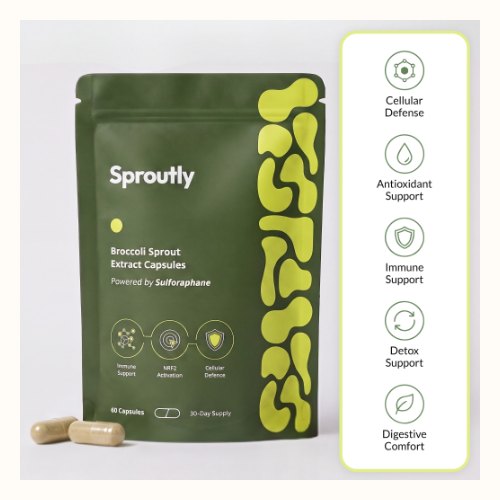
- Format
- Capsule, once a day
- Type
- Food-based
- Cost
- $39.99 a bottle — the maker does not publish how many capsules it holds
- Customer rating
- 4.7 out of 5 from 10,000 ratings from sproutly.store
What customers consistently report
- Bowel regularity improving, which is the most consistent report
- The stomach and gut simply feeling more comfortable day to day
- Change arriving slowly — several reviewers describe noticing nothing for weeks, then a real difference by month two or three
Those are the themes that recur across the reviews. Very low review confidence — the 4.7 and the 10,000-plus review count are the manufacturer’s own figures, shown on its own site and not verifiable against any review platform. The independent Trustpilot profile for the same brand carries 46 reviews at 3.4 out of 5, with a Trustpilot notice that the company has not invited reviews recently. Sold direct only, so no independent retailer rating exists.
| Where the rating comes from | Score | How many | What it counts |
|---|---|---|---|
| sproutly.store (the maker) | 4.7 out of 5 | “10,000+ verified reviews” | Reviews collected and displayed by the seller on its own product page; 81% five-star. No breakdown, no way to check the count. |
| Trustpilot | 3.4 out of 5 | 46 reviews | Independent platform. Trustpilot flags no recent history of asking for reviews, so the sample is small and self-selected. |
| Amazon or another retailer | None | None | Sold direct only, so no third-party retailer rating exists for this product. |
Why it might work
Broccoli sprouts contain glucoraphanin, a precursor that can be converted to sulforaphane. That conversion depends on myrosinase from the plant or on gut bacteria, so an extract capsule has a more conditional mechanism than eating fresh sprouts with their own enzymes. Sulforaphane is the intended active behind the product's stomach-lining focus, and the capsule is a vegan, no-sweetener option. But this product's label does not make the conversion or dose verifiable: the claimed 700 mg glucoraphanin figure does not reconcile with a 13% standardized extract in a two-capsule serving, and no supplement facts panel is published. Research on fresh broccoli sprouts therefore cannot simply be carried over to this capsule, especially without knowing its effective sulforaphane exposure. A biochemical route cannot establish an outcome when effective sulforaphane exposure in this capsule is unknown.
What the research supports
Genuine ingredient evidence, aimed at a narrower problem than the marketing implies. The strongest study is a randomized controlled trial in 48 people infected with H. pylori who ate 70 g a day of broccoli sprouts for eight weeks: markers of infection and gastric inflammation fell on broccoli but not on the placebo sprouts, and returned to baseline two months after stopping. Set against that, another broccoli sprout extract study found no significant effect on some of the same endpoints, and a systematic review concluded there was no clear effect on H. pylori from broccoli as a single agent. It may not apply to this capsule: the trial used fresh sprouts in a food matrix with the plant’s own enzyme, delivering a precursor dose far above anything documented here, in an infected population rather than a general bloating one.
What the label discloses
Manufacturing is claimed to be in an FDA-registered, GMP-certified facility with third-party testing for purity and potency and certificates of analysis available on request, though no lab is named and no certificate is published. The label figures do not reconcile: 700 mg of glucoraphanin from an extract standardized to 13% would require several grams of material, which cannot fit in a two-capsule serving, so treat that number as ambiguous label copy rather than a verified dose. There is no supplement facts panel, no capsule count, and no vitamin C amount. The brand publishes no founder, scientist or named person anywhere, which one reviewer raised directly.
Who this tends to suit
We match this product to people reporting bloating, general abdominal discomfort and abdominal pain. It fits someone whose priority is resetting after a course of antibiotics or an upset, day-to-day comfort or pain and tenderness. Whether it is the best fit for you depends on the rest of your answers — what you have already tried, what format you will take, and anything that has to be ruled out.
Where it may not fit
The label supports vegan, no added sweeteners and minimal ingredient list. We flag this product for anyone pregnant or breastfeeding or taking prescription medication, and the quiz removes it rather than recommending it in those cases. That is a caution about who should be deciding, not a claim about the product. A capsule only works if you will take it once a day, every day.
Side effects and what to be aware of
The maker does not publish how many capsules are in a bottle, so the real cost per day cannot be worked out from the $39.99 price. Its own timeline says the NRF2 pathway is activated within 24 to 48 hours, with improvements in energy and cognition by week 3 or 4 and peak benefits at 8 to 12 weeks, and it describes “up to 30 mg of sulforaphane per serving” as the clinically proven dose; none of that timeline or that dose has trial support we could find on this product, and the most pointed independent review is from someone with chronic gastritis who got no effect and objected to exactly that gap. Sulforaphane can interact with blood thinners such as warfarin and with thyroid medication, which the maker states plainly to its credit. Mustard seed extract is in the formula and mustard is a declarable allergen in several countries, but the page carries no mustard allergen statement.
Common questions
Are Sproutly reviews real?
The 4.7 out of 5 and the “10,000+ verified reviews” are collected and displayed by Sproutly on its own store, so there is no way to check the count or the selection against anything. The independent Trustpilot profile for sproutly.store carries 46 reviews at 3.4 out of 5, and Trustpilot adds that the company has no recent history of asking for reviews, so that sample is small and self-selected too. The product is sold direct only, so no retailer rating exists as a third reading.
Does Sproutly actually work?
No trial has tested this capsule. The strongest evidence behind the ingredient is a randomized controlled trial in 48 people infected with H. pylori who ate 70 g a day of fresh broccoli sprouts for eight weeks: markers of infection and gastric inflammation fell on broccoli but not on placebo sprouts, and returned to baseline two months after stopping. That trial used fresh sprouts with the plant’s own enzyme, at a precursor dose far above anything documented here, in an infected population rather than a general bloating one. A separate systematic review found no clear effect on H. pylori from broccoli as a single agent.
How long does Sproutly take to work?
The maker’s own timeline says the NRF2 pathway activates within 24 to 48 hours, with improvements in energy and cognition by week 3 or 4 and peak benefits at 8 to 12 weeks. None of that timeline has trial support on this product. Among the reviews we could read, the recurring account is the opposite shape: nothing for weeks, then a difference by month two or three.
How much sulforaphane is in Sproutly?
The figures do not reconcile. The store describes “up to 30 mg of sulforaphane per serving” as the clinically proven dose and cites a 13% glucoraphanin concentration for the broccoli seed extract, while its published lab result gives glucoraphanin at 41.2 mg/g. There is no supplement facts panel and no capsule count, so the amount you would actually take cannot be worked out from what is published. Sulforaphane is also not the same thing as glucoraphanin: the conversion depends on myrosinase from the plant or on gut bacteria, and an extract capsule has a more conditional route to it than fresh sprouts do.
Are there side effects or interactions with Sproutly?
Sulforaphane can interact with blood thinners such as warfarin and with thyroid medication, which the maker states plainly on its own page. Mustard seed extract is in the formula — its lab result lists it at 97.2 mg/g — and mustard is a declarable allergen in several countries, but the page carries no mustard allergen statement. There is no supplement facts panel, so the rest of the formula cannot be checked against an allergen or a dose.
What does Sproutly cost?
The bottle is $39.99 and the maker does not publish how many capsules it holds, so a real cost per day cannot be worked out from that price. The serving is two capsules a day.
Before you take this. Speak to a doctor or pharmacist first if you are pregnant or breastfeeding, or taking prescription medication. Nothing on this page is medical advice, and no supplement diagnoses, treats, cures or prevents disease.
Is this the right one for you?
The quiz works out which of the products we have researched fits your symptoms, your routine and what you have already tried — and tells you plainly if none of them do.
Take the quiz →Free. Private. Nothing to sign up for.
Others we researched for the same job
These sit in the same role as Sproutly Broccoli Sprout Extract Capsules — daily gut routine — so they are the sensible things to weigh it against.
See all the products we have researched →
Related reading
Background on how this type of product works, read from the trial evidence.