
Guide
Does Melatonin Cause Heart Failure? What the Headlines Got Right (and Wrong)
Quick answer: No study has shown that melatonin causes heart failure. A large 2025 study found that people with insomnia who used melatonin for a year or more were about 90% more likely to be diagnosed with heart failure over five years. But the research is preliminary, not peer-reviewed, and can only show an association, not cause and effect. Short-term, low-dose melatonin remains considered safe for most healthy adults. Long-term nightly use is where the open questions sit.
The melatonin heart failure study, explained
The headlines trace back to a single research abstract presented at the American Heart Association's Scientific Sessions in November 2025, and re-circulated widely in late August 2026. It has not yet been published as a full, peer-reviewed paper.
Researchers led by Dr. Ekenedilichukwu Nnadi at SUNY Downstate analyzed de-identified electronic health records from the TriNetX Global Research Network. They looked at 130,828 adults with chronic insomnia, average age 56, and compared 65,414 people whose records showed melatonin use for at least a year against a matched group with no recorded melatonin use. Anyone already diagnosed with heart failure, or prescribed other sleep medications such as benzodiazepines, was excluded.
Over five years of follow-up:
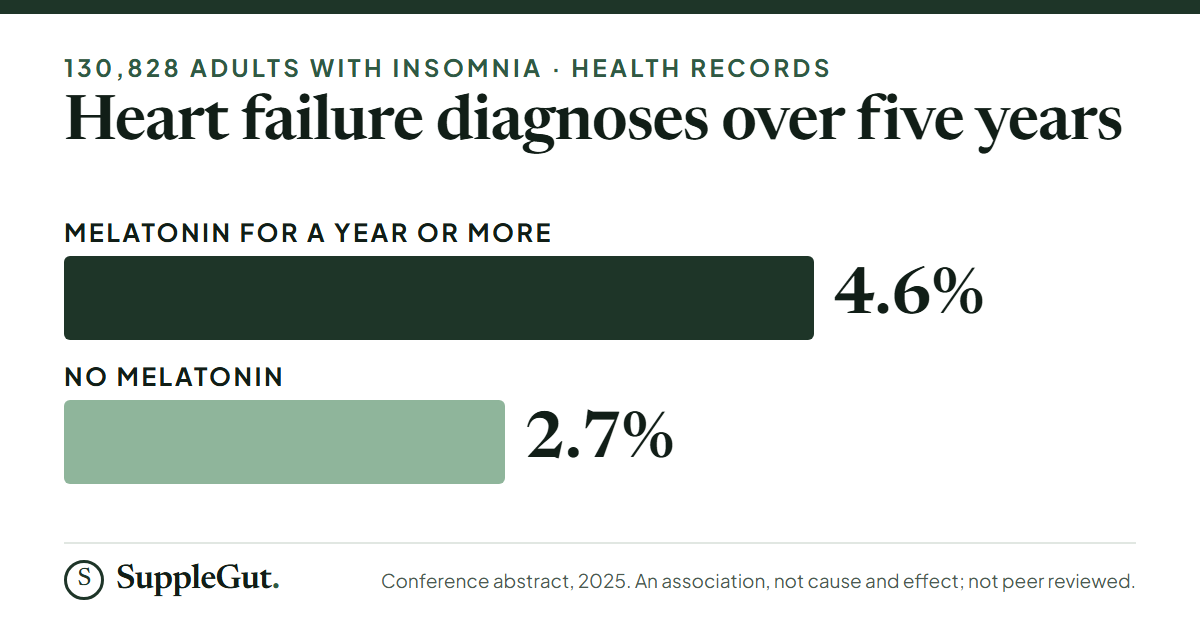
- Heart failure diagnosis: 4.6% of melatonin users vs. 2.7% of non-users, an 89% higher relative risk
- Heart failure hospitalization: 19.0% vs. 6.6%, roughly 3.5 times higher
- Death from any cause: 7.8% vs. 4.3%, about double
The association held in a sensitivity analysis limited to people with at least two melatonin prescriptions filled 90 or more days apart (82% higher heart failure risk).
Those are striking numbers. They are also easy to misread.
Why “90% higher risk” doesn't mean what it sounds like
Relative vs. absolute risk
A 90% relative increase sounds enormous, but the absolute difference was 1.9 percentage points: 4.6% vs. 2.7%. Put another way, for every 100 long-term melatonin users with insomnia, roughly two additional heart failure diagnoses appeared over five years compared with non-users. That's still worth taking seriously, but it is not the “melatonin destroys your heart” story some headlines implied.
Association is not causation
This was an observational study built from medical records. It cannot prove melatonin caused anything. Cardiologists at the University of Rochester, Northwestern Medicine, Nebraska Medicine and the Cleveland Clinic all made the same point after the release: people who need melatonin for a year or more may simply be sicker in ways the data can't capture.
The confounding problem
The study had no information on how severe each person's insomnia was, or whether they had depression, anxiety or other psychiatric conditions. Insomnia itself is an independent risk factor for cardiovascular disease. Severe, persistent insomnia both drives long-term melatonin use and raises heart risk, which means the melatonin group may have been higher-risk from day one, before a single tablet was taken.
The study also couldn't see dosage, formulation, or whether people took their melatonin as prescribed.
The over-the-counter blind spot
This one matters most for U.S. readers. Melatonin use was only counted if it appeared in medical records, which in practice usually means a prescription. Melatonin is prescription-only in the UK but sold over the counter in the U.S., and the researchers couldn't tell which country each patient was in. So an unknown number of American “non-users” may have been taking melatonin from the pharmacy shelf every night. If so, the true difference between groups would be smaller than reported, though it's also possible the effect was diluted rather than created.
It contradicts earlier trials
Small randomized trials in people who already have heart failure have pointed the other way. A 24-week, placebo-controlled trial of 10 mg melatonin in patients with reduced ejection fraction found improved blood vessel function. A 2025 meta-analysis in Clinical Cardiology concluded melatonin may improve cardiac function and quality of life in heart failure patients. And a March 2026 letter in the Journal of Pineal Research from sleep researchers in Pisa argued the abstract's findings sit at odds with the broader safety literature and are best explained by confounding.
None of that proves melatonin is heart-protective either. It means the evidence is contradictory, and a single unpublished abstract shouldn't overturn everything that came before it.
Is melatonin safe to take for sleep?
For most healthy adults, occasional short-term use at low doses (0.5 to 3 mg) is considered safe. The practical takeaways from the cardiologists who reviewed the study are consistent:
- Use the lowest dose that works. Many people take 5 to 10 mg when 0.5 to 1 mg would do. More is not better for sleep, and higher doses are more likely to cause grogginess, headache and vivid dreams.
- Use it for the shortest time that works. Melatonin is best suited to jet lag and short-term circadian disruption, not as a nightly habit for years. One AHA sleep expert noted that melatonin isn't even indicated for chronic insomnia in the U.S.
- Talk to your doctor if you have heart disease. Nothing in the data says heart failure patients must stop melatonin, but the lowest effective dose for the shortest duration is the sensible default.
- Fix the insomnia, not just the symptom. Cognitive behavioral therapy for insomnia (CBT-I) is the first-line treatment and has no cardiovascular question marks attached.
- Check what's actually in the bottle. Because U.S. melatonin is sold as a dietary supplement, independent testing has repeatedly found the real dose can differ widely from the label. Look for third-party certification (USP or NSF).
Melatonin and your gut: the part the headlines skipped
Most melatonin in your body isn't made in your brain. The enterochromaffin cells lining your gastrointestinal tract produce an estimated 400 times more melatonin than the pineal gland. There, it helps regulate gut motility, dampens local inflammation and acts as an antioxidant.
That's why melatonin has been studied for irritable bowel syndrome. A 2022 meta-analysis of four randomized trials found supplementation improved overall IBS severity, abdominal pain and quality of life compared with placebo, though not bloating or sleep. A 2023 double-blind trial of 136 IBS patients taking 6 mg daily for eight weeks reported reductions in abdominal pain frequency and severity, improved stool consistency and better quality of life, in patients both with and without sleep problems. People with IBS also tend to have altered melatonin metabolism, which may partly explain the response.
The trials are small, and doses used for IBS (3 to 6 mg) are higher than the doses recommended for sleep. But if your sleep and gut symptoms travel together, as they often do through the gut-brain axis, melatonin is one of the few supplements with randomized evidence on both sides.
Bottom line
The melatonin heart failure study is a real signal that deserves proper follow-up, ideally a randomized trial. It is not proof of harm. If you take a low dose occasionally, there's no evidence you need to change anything. If you've been taking melatonin every night for years, especially at high doses, that's a reasonable prompt to revisit why, and to talk with your doctor about addressing the underlying sleep problem.
Frequently asked questions
Does melatonin cause heart failure?
No study has shown that it does. A 2025 observational study found an association between long-term use and higher heart failure risk in people with insomnia, but it could not establish cause and effect and has not been peer-reviewed.
How much did the study say melatonin raises heart failure risk?
About 90% in relative terms, which translated to an absolute increase from 2.7% to 4.6% over five years.
Is melatonin bad for your heart?
Current evidence is mixed. Small randomized trials suggest possible benefits for blood vessel function in heart failure patients, while the 2025 records study suggested possible harm with long-term use. Neither is conclusive.
Can I take melatonin if I have heart failure?
Cardiologists haven’t advised heart failure patients to stop, but recommend the lowest effective dose for the shortest time, and checking with your doctor, particularly if you take blood pressure or blood-thinning medication.
What’s the safest melatonin dose?
For sleep, 0.5 to 3 mg taken one to two hours before bed. Doses above 5 mg rarely add benefit and increase side effects.
Does melatonin help IBS?
Small randomized trials and a 2022 meta-analysis suggest it reduces abdominal pain and overall IBS severity, though the evidence base is limited.
Sources
- American Heart Association newsroom: Long-term melatonin use and negative health effects (Nov 2025, re-released Aug 2026)
- Nnadi E, et al. Abstract 4371606, Circulation 2025;152(Suppl_3)
- Colitta A, et al. Navigating Melatonin Safety: Fact, Fiction, and Confounders. J Pineal Res 2026;78(2):e70129
- University of Rochester Medicine: Can Melatonin Cause Heart Failure?
- Northwestern Medicine: Does Taking Melatonin Raise Your Risk of Heart Failure?
- Nebraska Medicine: What to know about melatonin use and heart failure
- Cleveland Clinic: Melatonin and Your Heart
- Hoseini SG, et al. Melatonin and endothelial function in HFrEF: randomized trial. Clin Cardiol 2021
- Sam Daliri A, et al. Melatonin in heart failure: systematic review and meta-analysis. Clin Cardiol 2025;48(3):e70107
- Chen KH, et al. Exogenous melatonin in IBS: meta-analysis of RCTs. J Formos Med Assoc 2022
- Dinevari MT, et al. Melatonin in IBS with and without sleep disorders: RCT. BMC Gastroenterol 2023
This guide is for information only and is not medical advice. Talk to your doctor before starting or stopping any supplement.
Not sure which product fits your situation?
This guide covers the mechanics. The quiz takes your specific symptoms, routine and preferences and matches you to one product from the catalog.
Take the quiz →