
Guide
What’s the best supplement for acid reflux?
Quick answer
What works best for acid reflux? Alginate has the largest trial base: across 14 randomized trials it beat placebo and antacids (odds ratio 4.42) but did not beat a PPI or H2 blocker. Melatonin 3 mg added to omeprazole and a standardized DGL licorice extract each have one positive trial with real limitations. Probiotics, ginger, zinc carnosine, slippery elm and betaine HCl sit on weaker evidence, and in two cases on none.
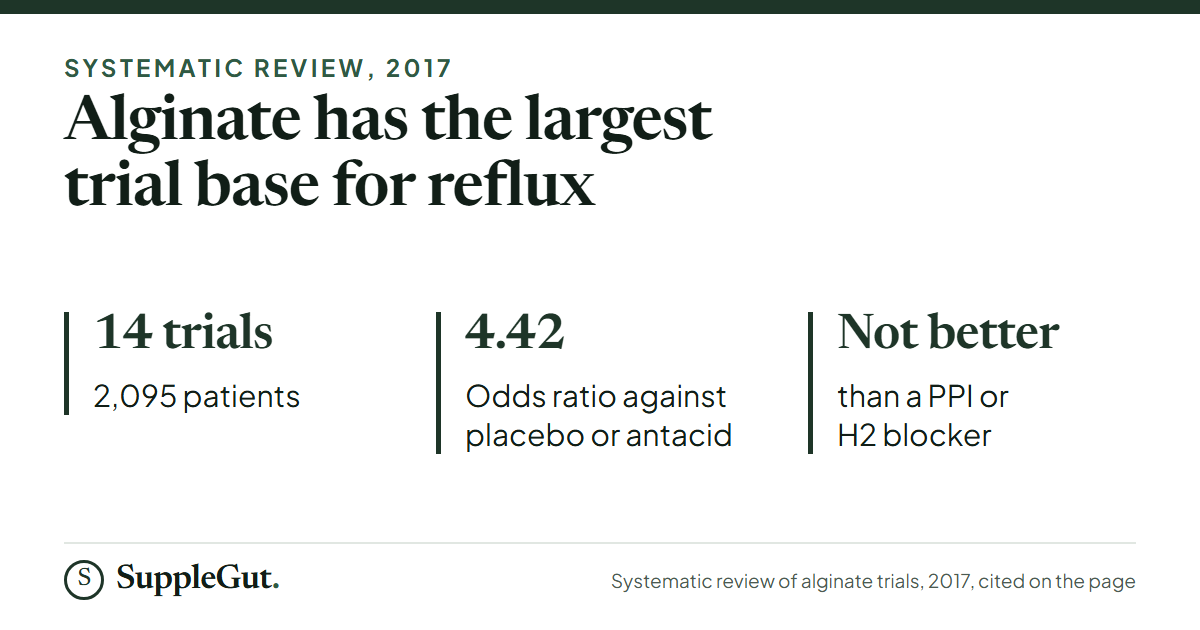
Alginate, the seaweed-derived ingredient in products like Gaviscon Advance, has the largest randomized-trial base of anything sold for reflux. A 2017 systematic review of 14 trials in 2,095 patients found the nine placebo and antacid comparisons favored alginate at an odds ratio of 4.42, while the five comparisons against a PPI or H2 blocker went the other way and did not reach significance. Alginate beats an antacid; it does not replace a drug.
Two other categories have real trials behind them. A 2023 double-blind trial found 3 mg of melatonin added to omeprazole beat omeprazole plus placebo, and a 2025 Phase III trial in 200 adults found a standardized DGL licorice extract improved regurgitation from day seven and heartburn from day fourteen. Both are add-on or standalone-versus-placebo results with real limitations, listed below. Probiotics, ginger, zinc carnosine, slippery elm and betaine HCl sit on weaker ground, and in two cases on nothing at all.
Every figure on this page comes from the trial or review it is attributed to, and the funding source and design weaknesses are stated where they matter.
How the evidence breaks down by tier
| Supplement | Evidence grade | What the trials found |
|---|---|---|
| Alginate | Moderate | 14-trial review, n=2,095: OR 4.42 versus placebo or antacid (from 9 trials, n=900); OR 0.58 and not significant versus PPI or H2 blocker. Add-on results conflict: positive at n=136, null at n=262 and n=120. |
| Melatonin (3 mg) | Weak-moderate | Double-blind add-on trial, 72 completers: symptom score 10.0 versus 15.0 on omeprazole alone. The widely quoted “as good as a PPI” trial had 9 patients per arm, no blinding, and concluded the opposite. |
| DGL licorice (standardized) | Weak-moderate | Phase III trial, n=200: regurgitation improved from day 7, heartburn from day 14. Manufacturer-sponsored, single center, ~20% dropout, no PPI arm. |
| Probiotics | Weak | Review of 13 studies: 11 of 14 comparisons reported benefit, but only 6 studies were randomized, 6 were rated low quality, and most populations were not reflux patients. Funded by a probiotics manufacturer. |
| Zinc carnosine | Very weak | Trials are in gastric ulcer and zinc deficiency, not reflux. Plain zinc added to a PPI in 140 reflux patients showed no benefit over placebo (p=0.086). |
| Ginger | Very weak | Halves gastric emptying time in healthy volunteers with no change in symptoms, and increases lower-sphincter relaxation, which could work against reflux. |
| Slippery elm / marshmallow root | None in humans | No controlled human trial in reflux. The marshmallow evidence is a rat gastric-ulcer study using flower extract. |
| Betaine HCl | None | No trial in reflux patients. The only primary study measured stomach pH in 6 healthy volunteers. |
Alginate: the largest trial base, and the most inconsistent add-on results
Alginate does not suppress acid. It reacts with stomach acid to form a floating gel raft that sits on top of stomach contents and physically blocks reflux from reaching the esophagus. The 2017 review is the strongest single piece of evidence for any reflux supplement, but it needs reading carefully. The headline odds ratio of 4.42 came from nine of the fourteen trials, covering 900 of the 2,095 patients, all against placebo or a standard antacid. The five trials comparing alginate with a PPI or H2 blocker produced an odds ratio of 0.58 in the drugs’ favor. That did not reach statistical significance, but it is not a result anyone should read as parity. Heterogeneity was high, several included trials were open-label, and many date from the 1970s to 1990s.
The add-on question, which is what most people considering a supplement are asking, is unsettled. A 2016 multicenter trial at Danish sites randomized 136 patients whose symptoms persisted on a once-daily PPI and found alginate beat placebo across a seven-day double-blind period, by about one and a half points on its symptom questionnaire and roughly one fewer symptomatic night per week. The manufacturer sponsored it. A larger confirmatory trial published the following year found a strong effect in an exploratory group of 52 patients and then no effect at all in its confirmatory group of 262, where 51% responded on alginate versus 48% on placebo. A 2019 Korean trial of a pure non-bicarbonate alginate in 120 patients also found no difference when added to a PPI. Formulation appears to matter, and alginate is not one interchangeable product.
In this catalog: HartSpan Khelp All-Natural Reflux Support delivers 950 mg of sodium alginate per capsule alongside sodium and calcium, the same mechanism class as the trial products, and is positioned as an add-on for night-time reflux rather than a replacement for a prescribed treatment.
Melatonin: better evidence as an add-on than as a substitute
Melatonin is often sold for reflux on the back of a single 2010 study, and that study does not support the claim made for it. Read the paper itself and it enrolled 36 people in four groups of nine, only 27 of whom had reflux; there was no blinding, no placebo, and no allocation concealment; the omeprazole comparison arm took 20 mg twice daily, not the 20 mg once daily usually quoted; no symptom scores are reported anywhere in it; and the authors state plainly that omeprazole alone worked better than melatonin alone. It should not be cited as evidence that a supplement matches a prescription drug.
The evidence that does hold up is narrower and more useful. A 2023 double-blind Iranian trial randomized 78 patients with mild-to-moderate reflux, 72 of whom completed four weeks, to omeprazole plus 3 mg of sublingual melatonin at night or omeprazole plus placebo. The melatonin group finished with a symptom score of 10.0 against 15.0 for placebo, with 4 rather than 13 people still reporting heartburn, and better quality-of-life scores. It received no funding and declared no conflicts. The limits are real: one center, four weeks, mild-to-moderate disease only, and no large replication. The proposed mechanism is raised lower-esophageal-sphincter tone and modestly reduced acid secretion, which is separate from melatonin’s familiar sleep effect. A separate 2025 records study of long-term melatonin use produced the heart failure headlines of late 2026; what the melatonin heart failure study actually found covers what it measured and where it falls short.
In this catalog: Thorne Melaton-3 is a single-ingredient, NSF Certified for Sport capsule at exactly 3 mg, the dose used in both trials, with nothing else in it. Treat it as something to try alongside an existing treatment, not instead of one.
DGL licorice: one good trial, on an extract most products do not use
Deglycyrrhizinated licorice has glycyrrhizin removed, which is what avoids the blood-pressure risk of ordinary licorice while keeping the fraction thought to support the protective mucus layer of the stomach and esophagus. The best evidence is a 2025 Phase III double-blind trial at a single Mumbai hospital that randomized 200 adults to 150 mg a day of a standardized extract sold as GutGard or a matching placebo for 28 days. Regurgitation frequency separated from placebo by day seven and heartburn frequency by day fourteen, and the reflux quality-of-life score favored the extract at day 28.
Four things temper it. The trial was sponsored by the extract’s manufacturer, which also gave input on the protocol. Roughly a fifth of participants dropped out, leaving 78 and 87 of the original 100 per arm at day 28. The day-28 quality-of-life difference reached significance only after adjusting for baseline imbalance; the raw totals did not. And there was no PPI arm, so the trial says nothing about using DGL in place of a drug. Because the result belongs to one specific standardized extract, generic DGL products do not inherit it.
In this catalog: Natural Factors Chewable DGL delivers 400 mg of 10:1 DGL extract per chewable tablet. It is not the standardized extract from the 2025 trial, so treat it as a low-cost way to try the DGL mechanism rather than a match for that trial’s result.
Where probiotics, ginger, and zinc carnosine stand
The evidence for probiotics in reflux is thin. The most cited support is a 2020 systematic review in which 11 of 14 comparisons across 13 studies reported some benefit. Inside that number: only six of the thirteen studies were randomized, seven blinded patients, six were rated low quality on the Jadad scale, the populations were mostly healthy adults, pregnant women, or people with functional dyspepsia rather than reflux patients, and the authors wrote that heterogeneity made a meta-analysis impossible. The review was funded by DuPont Nutrition & Biosciences and both authors were DuPont employees at the time; DuPont manufactures probiotics.
Zinc carnosine has a mucosal-protective mechanism, but its randomized evidence is in gastric ulcer and zinc deficiency, not reflux. The one reflux trial of zinc we could find is negative: 50 mg of elemental zinc added to pantoprazole in 140 patients for three months improved symptoms in both arms, with no significant difference between them (p=0.086). A randomized trial of zinc acetate in 34 people with refractory chronic cough, most of whom had reflux, met its futility criterion. There is no published zinc-carnosine trial in reflux-related cough, despite that claim circulating widely.
Ginger’s prokinetic effect is real but does not translate into symptom relief. Twenty-four healthy volunteers given 1,200 mg of ginger halved their gastric half-emptying time, 13.1 minutes against 26.7 on placebo, with no significant difference in any gastrointestinal symptom. More awkwardly for reflux specifically, 1 g of ginger powder in 14 healthy men increased lower-esophageal-sphincter relaxation at 90, 150 and 180 minutes, a mechanism that could make reflux worse rather than better. The “7.5 times better than placebo” figure attached to ginger online is a misread: it is an odds ratio of 7.50 pooled from two studies of multi-ingredient ginger-containing supplements, not a 7.5-fold improvement, and not attributable to ginger alone.
What has essentially no evidence for reflux
Betaine HCl with pepsin is promoted on the theory that too little stomach acid causes reflux. No clinical trial tests it for reflux symptoms. The only primary study is a pilot in six healthy volunteers with drug-induced low stomach acid, which measured gastric pH rather than symptoms, had no control group, and was supported by a grant from Genentech. Deliberately increasing stomach acid also carries the risk the product claims to fix.
Slippery elm and marshmallow root have a plausible coating mechanism and long traditional use, and no controlled human trial in reflux or laryngopharyngeal reflux. The nearest human study for slippery elm is an uncontrolled 16-week study in 43 Australian adults taking a seven-ingredient formula, which reports no p-values and cannot attribute anything to slippery elm. The marshmallow claim that it performs comparably to omeprazole comes from a rat gastric-ulcer study using flower rather than root extract, in which no direct statistical comparison against omeprazole was made for ulcer index, and the one measure that was compared directly came out significantly worse than omeprazole.
Signs to stop comparing supplements and get checked
Everything above assumes ordinary diet-and-routine-driven reflux. Difficulty or pain swallowing, unintended weight loss, vomiting blood or black stools, symptoms lasting more than a few weeks despite treatment, or reflux starting suddenly after age 50 are reasons to see a clinician rather than trial another supplement. A proper workup also rules out things a supplement cannot address, including H. pylori infection, Barrett’s esophagus, and medication side effects. Alginate, DGL and melatonin are reasonable additions alongside a diagnosed treatment plan, not replacements for one, and that is how the trials above tested them. Anyone taking melatonin nightly over a long period should also read the evidence on long-term melatonin use and heart failure risk.
Products in this catalog
| Product | Category | Cost | Best for |
|---|---|---|---|
| HartSpan Khelp All-Natural Reflux Support | Alginate | $54.00 for 60 capsules, about $0.90 a capsule | Night-time reflux persisting on an existing PPI or H2 blocker |
| Thorne Melaton-3 | Melatonin | $16.00 for 60 capsules, about $0.27 a day | A low-cost add-on where reflux is worse at night |
| Natural Factors Chewable DGL | DGL licorice | $22.37 for 180 tablets, about $0.12 to $0.37 a day | A chewable, before-meals way to try the DGL mechanism |
Common questions
What is the single best-evidenced supplement for acid reflux?
Alginate has the largest trial base. A 2017 systematic review pooled 14 randomized trials in 2,095 patients, and the nine placebo or antacid comparisons within it favored alginate at an odds ratio of 4.42. The same review found alginate did not beat PPIs or H2 blockers. Trials adding alginate on top of a PPI have been inconsistent, with one positive 136-patient trial and a larger 262-patient trial finding no benefit.
Does melatonin work as well as a PPI for reflux?
No, and the study behind that claim does not show it. The often-cited 2010 trial included only 27 reflux patients in three arms of nine, was unblinded, used omeprazole at 20 mg twice daily rather than once, reported no symptom scores, and its authors concluded omeprazole alone worked better than melatonin alone. The stronger evidence is a 2023 double-blind trial where melatonin added to omeprazole beat omeprazole plus placebo.
Do probiotics help with acid reflux?
The evidence is thin and conflicted. A 2020 systematic review of 13 studies found 11 of 14 comparisons reported some benefit, but only six of the 13 studies were randomized, six were rated low quality, most populations were not reflux patients, and the authors said heterogeneity made a meta-analysis impossible. Both authors were employees of a probiotics manufacturer that funded the review.
Is DGL licorice effective for reflux?
One standardized extract has a good trial behind it. A 2025 Phase III double-blind trial randomized 200 adults and found regurgitation improved from day seven and heartburn from day fourteen versus placebo. The manufacturer sponsored it, roughly a fifth of participants dropped out, and there was no PPI comparison arm. Generic or non-standardized DGL products do not inherit that result.
Does alginate help acid reflux?
It has the largest trial base of any reflux supplement. In the 2017 review, alginate beat placebo or a plain antacid across nine trials (900 patients, odds ratio 4.42), but in five trials against a PPI or H2 blocker the drugs did better (odds ratio 0.58, not statistically significant). As an add-on to a PPI the results conflict: a 136-patient trial found a benefit, the 262-patient confirmatory group of a later trial found none (51% against 48% on placebo), and a 120-patient Korean trial of a non-bicarbonate alginate found no difference.
Does ginger help acid reflux?
Ginger speeds stomach emptying (1,200 mg halved gastric half-emptying time in 24 volunteers) but produced no symptom difference, and 1 g of ginger powder increased lower-esophageal-sphincter relaxation in 14 men, a mechanism that could make reflux worse. The "7.5 times better than placebo" figure online is an odds ratio pooled from two studies of multi-ingredient supplements, not a result for ginger alone.
Does zinc carnosine help acid reflux?
Its randomized evidence is in gastric ulcer and zinc deficiency, not reflux. The one reflux trial of zinc found (50 mg of elemental zinc added to pantoprazole in 140 patients for three months) showed no significant difference from the PPI alone, and a 34-person trial of zinc acetate in refractory chronic cough met its futility criterion. No published zinc-carnosine trial in reflux-related cough exists, despite the claim circulating.
Does betaine HCl help acid reflux?
There is no trial evidence that it does. The only primary study we could find dosed six healthy volunteers and measured stomach pH, not reflux symptoms. Deliberately increasing stomach acid also carries the risk the product claims to address.
Sources
- Leiman DA, Riff BP, Morgan S, et al. Alginate therapy is effective treatment for GERD symptoms: a systematic review and meta-analysis. Diseases of the Esophagus. 2017;30(5):1–9. pmc.ncbi.nlm.nih.gov
- Reimer C, Lødrup AB, Smith G, Wilkinson J, Bytzer P. Randomised clinical trial: alginate (Gaviscon Advance) vs. placebo as add-on therapy in reflux patients with inadequate response to a once daily proton pump inhibitor. Alimentary Pharmacology & Therapeutics. 2016;43(8):899–909. pubmed.ncbi.nlm.nih.gov
- Coyle C, et al. Randomised clinical trial: addition of alginate-antacid (Gaviscon Double Action) to proton pump inhibitor therapy in patients with breakthrough symptoms. Alimentary Pharmacology & Therapeutics. 2017. onlinelibrary.wiley.com
- Kim JH, Lee YC, Kim EH, et al. The clinical efficacy of a pure alginate formulation (Lamina G) for controlling symptoms in individuals with reflux symptoms. Gut and Liver. 2019;13(6):642–648. gutnliver.org
- Kandil TS, Mousa AA, El-Gendy AA, Abbas AM. The potential therapeutic effect of melatonin in gastro-esophageal reflux disease. BMC Gastroenterology. 2010;10:7. bmcgastroenterol.biomedcentral.com
- Malekpour H, Noori A, Abdi S, et al. Is the addition of sublingual melatonin to omeprazole superior to omeprazole alone in the management of gastroesophageal reflux disease symptoms: a clinical trial. Turkish Journal of Gastroenterology. 2023;34(12):1206–1211. pmc.ncbi.nlm.nih.gov
- Raj JP, Saxena U, Belhekar MN, et al. Efficacy and safety of GutGard in managing gastroesophageal reflux-related symptoms: a randomised, double-blind, placebo-controlled trial. Complementary Medicine Research. 2025;32(1):26–36. pmc.ncbi.nlm.nih.gov
- Cheng J, Ouwehand AC. Gastroesophageal reflux disease and probiotics: a systematic review. Nutrients. 2020;12(1):132. pmc.ncbi.nlm.nih.gov
- Shafaghi A, Hasanzadeh J, Mansour-Ghanaei F, Joukar F, Yaseri M. The effect of zinc supplementation on the symptoms of gastroesophageal reflux disease: a randomized double-blind clinical trial. Middle East Journal of Digestive Diseases. 2016;8(4):289–296. pmc.ncbi.nlm.nih.gov
- Balasubramanian A, et al. Efficacy and tolerability of zinc acetate for treatment of chronic refractory cough: pilot randomised futility trial. ERJ Open Research. 2023;9(2):00678-2022. pmc.ncbi.nlm.nih.gov
- Wu KL, Rayner CK, Chuah SK, et al. Effects of ginger on gastric emptying and motility in healthy humans. European Journal of Gastroenterology & Hepatology. 2008;20(5):436–440. pubmed.ncbi.nlm.nih.gov
- Lohsiriwat S, Rukkiat M, Chaikomin R, Leelakusolvong S. Effect of ginger on lower esophageal sphincter pressure. Journal of the Medical Association of Thailand. 2010;93(3):366–372. pubmed.ncbi.nlm.nih.gov
- Martin Z, Spry G, Hoult J, et al. What is the efficacy of dietary, nutraceutical, and probiotic interventions for the management of gastroesophageal reflux disease symptoms? A systematic literature review and meta-analysis. Clinical Nutrition ESPEN. 2022;52:340–352. pubmed.ncbi.nlm.nih.gov
- Yago MR, Frymoyer AR, Smelick GS, et al. Gastric re-acidification with betaine HCl in healthy volunteers with rabeprazole-induced hypochlorhydria. Molecular Pharmaceutics. 2013;10:4032–4037. pmc.ncbi.nlm.nih.gov
- Ried K, Travica N, Dorairaj R, Sali A. Herbal formula improves upper and lower gastrointestinal symptoms and gut health in Australian adults with digestive disorders. Nutrition Research. 2020;76:37–51. pubmed.ncbi.nlm.nih.gov
- Zaghlool SS, Abo-Seif AA, Rabeh MA, Abdelmohsen UR, Messiha BAS. Gastro-protective and anti-oxidant potential of Althaea officinalis and Solanum nigrum on pyloric ligation/indomethacin-induced ulceration in rats. Antioxidants. 2019;8(11):512. pmc.ncbi.nlm.nih.gov
Not sure which product fits your situation?
This guide covers the mechanics. The quiz takes your specific symptoms, routine and preferences and matches you to one product from the catalog.
Take the quiz →