
Discomfort and cramping
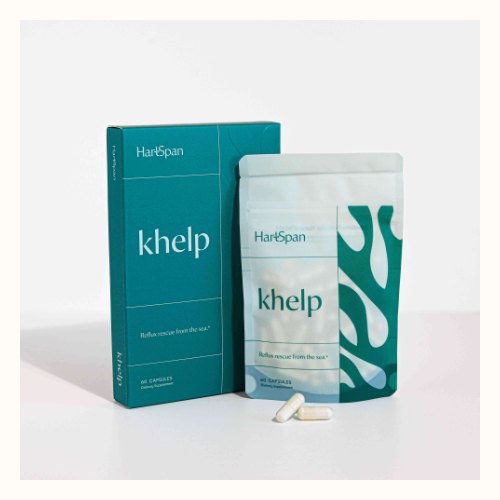
HartSpan Khelp All-Natural Reflux Support
A single-ingredient alginate capsule that forms a physical raft barrier over stomach contents, built around the supplement category with the strongest randomized-trial evidence for reflux relief.
Khelp reviews: the 4.8 out of 5 comes from 598 reviews collected on HartSpan’s own site through Okendo, so there is no independent retailer pool to check it against. What the capsule contains is disclosed exactly: 950 mg of sodium alginate, 170 mg of sodium and 70 mg of calcium per serving, vegan, with no aluminum or sugar. The ingredient, alginate, has the largest trial base of anything sold for reflux (14 randomized trials in 2,095 patients in the 2017 review) and the most inconsistent results as an add-on to acid-suppressing drugs; this capsule itself has not been tested in a published trial. It is taken after meals and before bed, so it is not a once-a-day product, and it is the most expensive of the three reflux options in this catalog per capsule. The reviews, the alginate trials and the label are set out below.
- Format
- Capsule
- Type
- Alginate (mucosal barrier)
- Cost
- $54.00 for 60 capsules, about $0.90 a capsule
- Customer rating
- 4.8 out of 5 from 598 ratings from HartSpan
What customers consistently report
- Fast-acting relief, often compared favorably to Tums for speed but with a longer-lasting effect
- Reported to help where standard PPI therapy was underperforming, particularly for nighttime symptoms
- Valued as a non-drug option perceived as gentler for extended use
Why it might work
Alginate does not work like an acid-suppressing drug. Sodium alginate reacts with stomach acid to form a floating, gel-like raft that sits on top of stomach contents and physically blocks reflux from reaching the esophagus. This capsule discloses 950 mg of sodium alginate per serving alongside 170 mg sodium and 70 mg calcium, ingredients consistent with the alginate-plus-carbonate formulations used in the clinical literature. Because the mechanism is physical rather than pharmacological, it is positioned by the brand as compatible with long-term use and with pregnancy, though that claim comes from the manufacturer rather than an independent regulatory body and we do not treat it as established.
What the research supports
A 2017 systematic review pooled 14 randomized trials covering 2,095 patients. Within it, the nine trials that compared alginate against placebo or a standard antacid gave an odds ratio of 4.42 in alginate’s favor, drawn from 900 of those patients. The five trials that compared alginate against a PPI or H2 blocker pointed the other way at an odds ratio of 0.58, which did not reach significance but does not support alginate as a replacement for either drug. Heterogeneity was high in both pools and several of the included trials were open-label or dated from the 1970s to 1990s. As an add-on, a 2016 Danish multicenter trial randomized 136 patients whose symptoms persisted on a once-daily PPI and found a small advantage over placebo across a seven-day double-blind period, roughly one and a half points on its symptom questionnaire and about one fewer symptomatic night a week; the manufacturer of the alginate tested sponsored it. A larger 2017 confirmatory add-on trial in 262 patients found no benefit at all, and a 2019 Korean trial of a pure non-bicarbonate alginate in 120 patients also found no difference when added to a PPI. The honest reading is that alginate has the largest trial base of anything sold for reflux and the most inconsistent add-on results, and that formulation differs between products. This capsule has not itself been tested in a published trial.
What the label discloses
The label discloses exact milligram amounts for sodium alginate at 950 mg, total sodium at 170 mg, and calcium at 70 mg. The product is marketed as vegan, with no added aluminum or sugar. No independent third-party lab testing certification is stated on the listing itself.
Who this tends to suit
This product fits people whose main complaint is nighttime reflux, regurgitation, or heartburn that persists despite an existing PPI or H2 blocker, and who want an add-on rather than a replacement for a diagnosed treatment plan. It suits those looking for a non-drug mechanism they can take after meals as needed rather than a once-daily preventive.
Where it may not fit
This is a capsule taken after meals and before bed, generally more than once a day, so it does not suit someone wanting a true once-a-day product. It is also the most expensive of the three reflux options here on a per-capsule basis. It is not a substitute for diagnosis or treatment of GERD, ulcers, or Barrett’s esophagus.
Side effects and what to be aware of
Alginate products contain sodium and calcium compounds, which anyone on a sodium-restricted diet should account for — this label discloses 170 mg of sodium per serving. As with any reflux product, new or worsening difficulty swallowing, unintended weight loss, or vomiting blood are reasons to see a clinician rather than continue self-treating.
Common questions
Are Khelp reviews real?
The 4.8 out of 5 comes from 598 reviews collected on HartSpan’s own site through the Okendo review widget. There is no independent retailer rating pool to check it against, so the count and the selection cannot be verified elsewhere.
Does Khelp work for reflux?
This capsule has not itself been tested in a published trial. Its ingredient, alginate, has: a 2017 systematic review pooled 14 randomized trials in 2,095 patients, and the nine that compared alginate against placebo or an antacid gave an odds ratio of 4.42 in alginate’s favor. The five that compared it against a PPI or H2 blocker did not support it as a replacement, and the add-on trials are inconsistent: a small 2016 advantage over placebo, then a larger 2017 trial and a 2019 Korean trial that found no benefit.
What is in Khelp?
Per serving: 950 mg of sodium alginate, 170 mg of sodium and 70 mg of calcium. It is marketed as vegan, with no added aluminum or sugar. Those ingredients are consistent with the alginate-plus-carbonate formulations used in the clinical literature. No independent third-party lab testing is stated on the listing.
How does Khelp work?
Not like an acid-suppressing drug. Sodium alginate reacts with stomach acid to form a floating gel raft that sits on top of the stomach contents and physically blocks reflux from reaching the esophagus. Because the mechanism is physical rather than pharmacological, the brand positions it for long-term use; that claim comes from the manufacturer rather than a regulator.
How do you take Khelp?
After meals and before bed, generally more than once a day, so it does not suit someone who wants a once-a-day product. It is also the most expensive of the three reflux options in this catalog on a per-capsule basis.
What are the side effects of Khelp?
Alginate products contain sodium and calcium compounds; this label discloses 170 mg of sodium per serving, which anyone on a sodium-restricted diet should count. New or worsening difficulty swallowing, unintended weight loss or vomiting blood are reasons to see a clinician rather than keep self-treating. It is not a substitute for diagnosis or treatment of GERD, ulcers or Barrett’s esophagus.
Before you take this. Speak to a doctor or pharmacist first if you are pregnant or breastfeeding. Nothing on this page is medical advice, and no supplement diagnoses, treats, cures or prevents disease.
Is this the right one for you?
The quiz works out which of the products we have researched fits your symptoms, your routine and what you have already tried — and tells you plainly if none of them do.
Take the quiz →Free. Private. Nothing to sign up for.
Others we researched for the same job
These sit in the same role as HartSpan Khelp All-Natural Reflux Support — reflux support — so they are the sensible things to weigh it against.
See all the products we have researched →
Related reading
Background on how this type of product works, read from the trial evidence.