
Guide
Does Gutlex Work? The Science Behind Japan’s Postbiotic
Quick answer: Gutlex is a postbiotic drink built around LEX, a fermented soybean extract that has been used in Japanese clinics since 1984. The logic is sound: instead of sending live bacteria on a risky trip through your stomach acid, it delivers the finished compounds those bacteria would have produced. Small Japanese studies on LEX show improvements in gut-health markers and constipation scores, and most early customers report less bloating and more regular digestion within a few weeks. If you've had disappointing results from probiotics, Gutlex is one of the more logical things to try next. See current pricing and bundles →
What Gutlex actually is
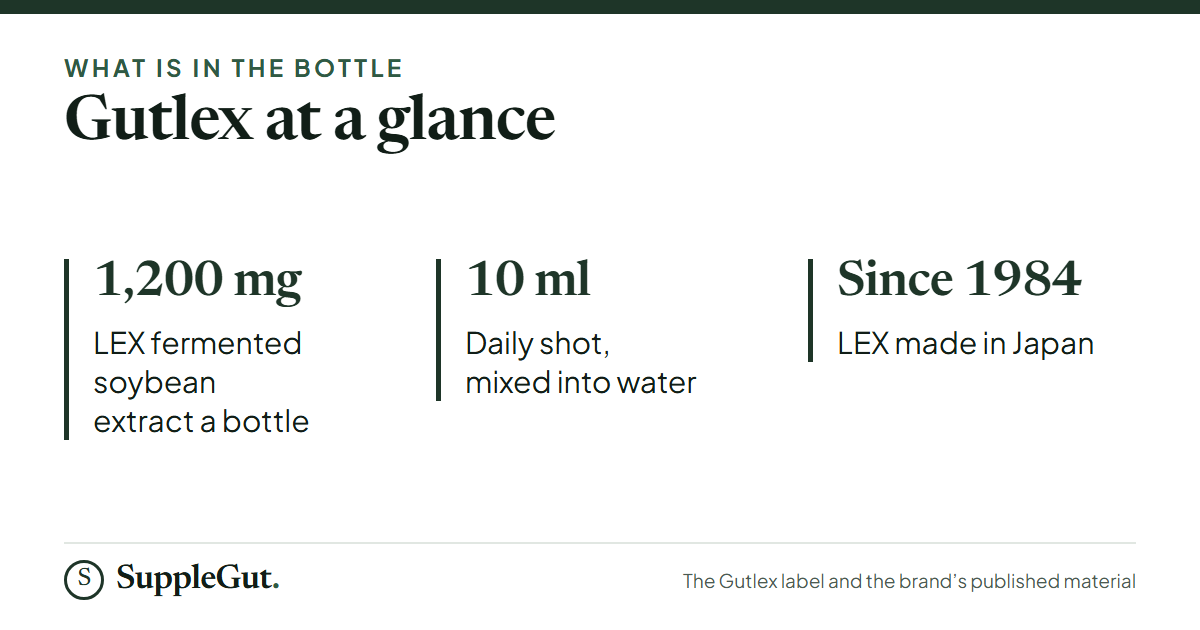
Gutlex is a 10 ml daily shot you mix into water. Each bottle contains 1,200 mg of Lactobacillus fermentation soybean extract, plus citric acid, lactic acid and water. That's the whole ingredient list. It's dairy-free, sugar-free, gluten-free, non-GMO and needs no refrigeration.
The active ingredient, LEX, is made by fermenting non-GMO soybeans with 16 proprietary Lactobacillus strains (including L. paracasei, L. plantarum and L. brevis) for a week, then maturing the ferment for 12 months. The bacteria are then filtered out. What's left is the extract: short-chain fatty acids, peptides, amino acids and other metabolites the bacteria produced along the way.
That last step is what makes Gutlex a postbiotic rather than a probiotic. Understanding why that matters is the key to answering “does Gutlex work?”
How a postbiotic differs from a probiotic
Probiotics have a delivery problem. For a live-bacteria capsule to help you, the organisms have to survive stomach acid and bile, reach the colon alive, find a niche among the trillions of bacteria already living there, and then start producing beneficial compounds. Every step is a place the effect can be lost.
A prebiotic takes the opposite approach, feeding the bacteria already there; the one human milk oligosaccharide prebiotic in this catalog is kēpos. Postbiotics do not depend on survival. The International Scientific Association for Probiotics and Prebiotics defined the category in 2021 as preparations of inactivated microorganisms and/or their components that confer a health benefit. Because nothing needs to be alive, postbiotics are stable at room temperature, unaffected by stomach acid, and can be taken alongside antibiotics, which would kill a probiotic on contact.
This isn't just theory. In one of the largest trials of a postbiotic to date, published in The Lancet Gastroenterology & Hepatology in 2020, 443 people with IBS took either a heat-inactivated Bifidobacterium strain or placebo for eight weeks. Significantly more people on the postbiotic reported meaningful improvement in overall symptoms and abdominal pain, with side effects no different from placebo. Different organism, same principle: the bacteria don't need to be alive to help. Testing which pathways are actually active in your gut is the other way to approach the same question.
Gutlex takes this a step further by delivering the metabolites themselves, not just dead cells. Those metabolites are the compounds a healthy microbiome makes for you: short-chain fatty acids that feed the gut lining and calm inflammation, and peptides that support the tight junctions holding your gut barrier together.
What the research on LEX shows
LEX has been sold in Japan (under the brand name Lactis) and used in clinical settings there for four decades. The company behind it reports that more than 2,700 Japanese medical facilities stock it. Most of the research is Japanese, and much of it is company-sponsored, so treat it as encouraging rather than conclusive. Two published human studies are worth knowing about.
Constipation and gut environment. A 2020 pilot study gave LEX for four weeks to 30 Japanese women aged 30 to 50 who were prone to constipation. Researchers tracked urinary 3-indoxyl sulfate, a marker of how much protein is being fermented by unhelpful bacteria in the colon. Every single participant improved on this marker, and constipation assessment scores and subjective wellbeing improved too.
Microbiome stability under stress. A 2022 study followed 13 college endurance runners through two races. In the race without LEX, their gut microbiome shifted measurably. In the race with LEX, that shift didn't happen, and urinary markers of yeast and fungal activity dropped. It's a small study, but it points to LEX doing something the marketing claims: helping the microbiome hold its balance when it's under pressure.
Neither study is a large placebo-controlled trial, but they line up with what customers report and with the broader postbiotic evidence. For a supplement ingredient, 40 years of clinical use plus peer-reviewed human data is a stronger foundation than most.
What real customers say
Gutlex only launched in the US recently, so the review base is still small, which is normal for a new brand. The product page shows 116 reviews with 76% five-star and 17% four-star ratings, and a further handful on Trustpilot.
The consistent themes across those reviews:
- Bloating. The most common report by far. Several people say the “heavy feeling” after meals disappeared within the first two to three weeks.
- Regularity. One reviewer who started with constipation describes regular morning bowel movements after three weeks.
- Post-antibiotic recovery. Multiple reviewers took Gutlex during or after antibiotics and say they skipped the weeks-long “rebuilding” period they'd come to expect.
- Heartburn. A minority, but a few people say reflux improved.
- Skin. A surprising number mention calmer skin or fewer breakouts, which fits with the gut-skin axis research even though nobody bought it for that.
The less positive reviews mostly say the same two things: it's expensive, and they haven't felt a difference yet after a week or two. Both are fair. Postbiotics work on the gut environment gradually, and Gutlex's own guidance is that most people notice changes in one to two weeks with full results over a 30-day course.
Who Gutlex is most likely to help
Based on the mechanism, the research and the reviews, Gutlex makes most sense if you:
- Get bloating or discomfort after meals that probiotics haven't fixed
- Struggle with constipation or irregular digestion
- Are on or recovering from antibiotics and want to protect your gut without the probiotic-antibiotic timing headache
- Have food sensitivities and want to support your gut barrier
- Want something shelf-stable and simple: one bottle in your water, no fridge, no capsules
It's less likely to be your first choice if you're already doing well on a probiotic that works for you, or if you need something for an acute problem today. Gutlex is a four-week project, not a rescue remedy.
Cost, dosing and the guarantee
One bottle a day, mixed into 8 to 12 oz of water, drunk in one go or sipped through the day. The 15-day starter box is $49.99, the 30-day course is $95, and the 90-day course is $270.75, which works out to roughly $3 to $3.30 a day. US shipping is free.
The guarantee is what makes trying it low-risk: if you complete a full 30-day course and don't see improvement in your digestion, Gutlex refunds you, provided you've filled in their progress surveys along the way. Given that most people who see results see them within that window, a 30-day course is the sensible starting point. Check current bundle pricing →
Side effects
Because there are no live bacteria, Gutlex is gentle. The main thing to know is that some people feel mild digestive changes in the first week or two as the gut environment adjusts. The extract is made from soybeans, so if you have a diagnosed soy allergy, check with your doctor before starting. As with any supplement, do the same if you're pregnant, breastfeeding, or managing a medical condition.
The bottom line
Does Gutlex work? The honest answer is that it has a better chance than most gut supplements, and for a clear reason: it delivers the finished product rather than hoping live bacteria survive the journey. The ingredient has 40 years of clinical use behind it, small human studies showing real changes in gut markers, and early customers reporting exactly the benefits the mechanism predicts. Add a 30-day money-back guarantee and there's very little downside to finding out whether it works for you.
Try Gutlex with the 30-day guarantee →
Frequently asked questions
How long does Gutlex take to work?
Most customers report changes in one to two weeks, with full results across a 30-day course. Consistency matters more than timing of day.
Is Gutlex a probiotic?
No. It’s a postbiotic: the beneficial compounds produced by 16 Lactobacillus strains during fermentation, with the bacteria themselves removed. That’s why it doesn’t need refrigeration and works alongside antibiotics.
Can I take Gutlex with antibiotics?
Yes. Since there are no live bacteria to kill, antibiotics don’t affect it, and several reviewers report smoother recovery when using it during a course.
Does Gutlex contain soy?
Yes. LEX is made from fermented soybeans. The fermentation breaks down most allergenic proteins, but anyone with a soy allergy should consult their doctor first.
Is Gutlex legit?
The US brand is new, but the LEX ingredient has been made in Japan since 1984, has published human research, and the company offers a 30-day money-back guarantee.
What’s the difference between Gutlex and a regular probiotic?
Probiotics deliver live bacteria that must survive digestion and colonize your gut. Gutlex delivers the metabolites those bacteria would produce, skipping the survival step entirely.
Sources
- Salminen S, et al. The International Scientific Association of Probiotics and Prebiotics (ISAPP) consensus statement on the definition and scope of postbiotics. Nat Rev Gastroenterol Hepatol. 2021;18(9):649–667.
- Fukuchi M, et al. Effect of lactic acid bacteria-fermented soy milk extract (LEX) on urinary 3-indoxyl sulfate in Japanese healthy adult women: an open-label pilot study. Nutr Diet Suppl. 2020;12:329–340.
- Yasutake T, et al. The impact of a competitive event and the efficacy of a lactic acid bacteria-fermented soymilk extract on the gut microbiota and urinary metabolites of endurance athletes: an open-label pilot study. PLoS One. 2022;17(1):e0262906.
- Andresen V, et al. Heat-inactivated Bifidobacterium bifidum MIMBb75 (SYN-HI-001) in the treatment of irritable bowel syndrome: a multicentre, randomised, double-blind, placebo-controlled clinical trial. Lancet Gastroenterol Hepatol. 2020;5(7):658–666.
- Gutlex product page and customer reviews, gutlex.com.
These statements have not been evaluated by the Food and Drug Administration. This product is not intended to diagnose, treat, cure or prevent any disease. This article is for informational purposes and is not a substitute for advice from your physician.
Not sure which product fits your situation?
This guide covers the mechanics. The quiz takes your specific symptoms, routine and preferences and matches you to one product from the catalog.
Take the quiz →