
Guide
Does Kēpos Actually Work? The Science Behind Human Milk Prebiotics
Quick answer
Yes, and the reason it works is unusually well documented. Kēpos is a daily prebiotic powder built around two nutrients found in human milk: human milk oligosaccharides (HMOs) and lactoferrin, both recreated through precision fermentation so no actual milk is involved. HMOs are the compounds nature uses to build a healthy microbiome from scratch, and in adult trials they reliably boost beneficial Bifidobacteria within two weeks and improve bowel habits, bloating and quality of life in people with IBS. Kēpos is the first company to put them in a clinically relevant dose for adults, with a 4.7-star average across 480+ reviews. If bloating, irregularity or food sensitivity is your problem and fiber-based prebiotics have made it worse, this is the one to try. See current pricing and the 30-day guarantee →
What Kēpos actually is
Kēpos for Digestion is a flavorless powder you take once a day, dry or stirred into anything cold. A tub holds 30 scoops. The ingredient list has two entries and nothing else: kpHMO™, the brand's proprietary blend of human milk oligosaccharides, and effera®, a bio-identical human lactoferrin. No fillers, sweeteners, binders or flavorings.
Both ingredients are made by precision fermentation, the same process used to make insulin, rennet and most vitamins. Microbes are engineered to produce the exact molecule, then filtered out. The result is structurally identical to what human milk contains, but it is manufactured in cGMP, FDA-registered US facilities and purity-tested at the University of Chicago, which has partnered with the company for four years of research. It is sugar-free, gluten-free, soy-free, low-FODMAP certified and contains only trace lactose.
That “human milk” framing sounds odd for an adult product until you understand what HMOs do.
How HMOs differ from fiber prebiotics
Most prebiotics are plant fibers like inulin, FOS or psyllium. They feed gut bacteria, but they feed all of them, including the gas-producing species that cause bloating and cramping.
HMOs are different. They are complex sugars that are effectively “padlocked”: only certain beneficial bacteria, chiefly Bifidobacteria, carry the enzymes to unlock and digest them. Harmful and gas-producing microbes can't use them at all. This is why a breastfed infant's gut fills with Bifidobacteria rather than pathogens, and it is why HMOs can rebalance an adult microbiome without the side effects of ordinary fiber.
HMOs also act as decoys. Their structure mirrors the sugar molecules lining your gut wall, so pathogens bind to the HMO instead of your intestinal cells and get flushed out. And they pass through stomach acid intact, which live probiotics largely fail to do.
Lactoferrin adds a second mechanism. It binds free iron in the gut, starving pathogens of a nutrient they need to multiply, while making iron more available to you. Bovine lactoferrin from cow's milk has been studied for decades; Kēpos uses a human-identical version that the body recognizes as its own, without the immune reactivity some people get from dairy proteins.
What the research shows
HMOs are among the most studied nutrients in pediatric science, but the adult evidence is what matters here, and it is stronger than for almost any other gut supplement ingredient.
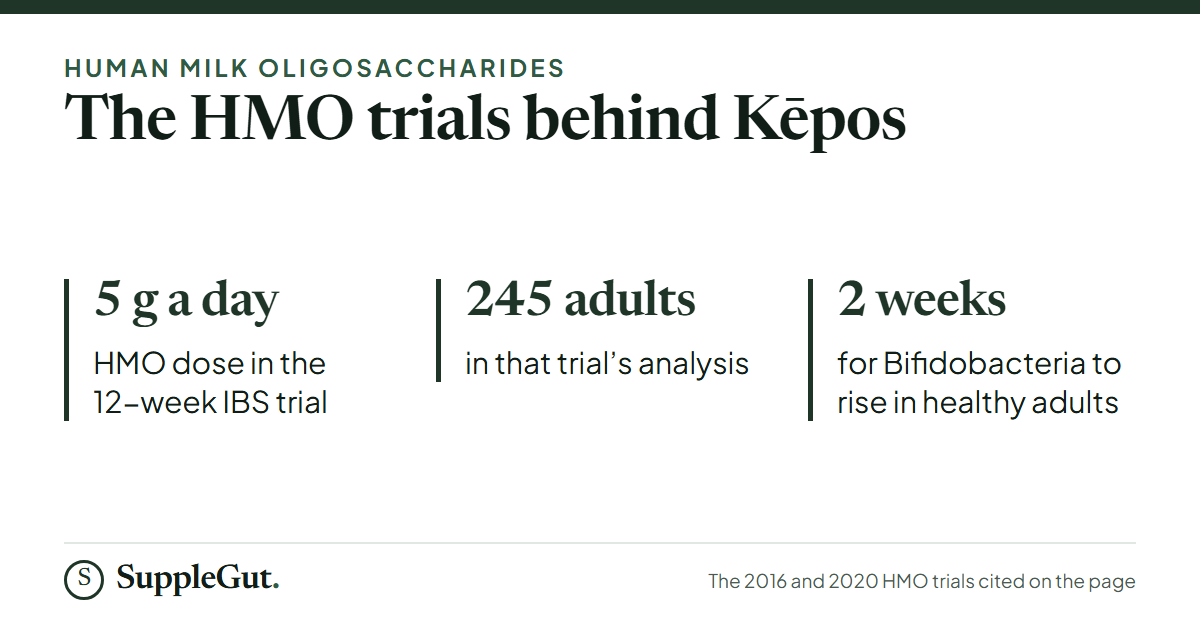
Healthy adults. In a 2016 randomized, placebo-controlled trial published in the British Journal of Nutrition, 100 healthy adults took the HMOs 2'-fucosyllactose and lacto-N-neotetraose for two weeks. Bifidobacteria increased significantly at every dose tested, with no meaningful change in gut symptoms even at 20 grams a day, far above what Kēpos delivers.
IBS, all subtypes. The landmark study is a 2020 multicenter trial led by the University of North Carolina and published in Clinical and Translational Gastroenterology. Adults with physician-diagnosed IBS took 5 grams of HMOs daily for 12 weeks; 245 were included in the analysis. Across constipation-, diarrhea- and mixed-type IBS, participants saw significant reductions in abnormal stool consistency, overall symptom severity, abdominal pain and bloating, plus a meaningful improvement in quality of life. Most of the change arrived within the first four weeks.
Placebo-controlled confirmation. A separate 2020 randomized, double-blind trial in Neurogastroenterology & Motility gave 61 IBS patients the same HMOs or placebo for four weeks. HMOs roughly tripled Bifidobacteria relative to placebo and were well tolerated, though the short trial didn't separate on overall symptom scores.
The pattern across all three: HMOs consistently and selectively increase beneficial bacteria in adults, do so without the bloating that plagues fiber prebiotics, and translate into real symptom improvement in the longer IBS study. That is exactly the case Kēpos is built on.
What real customers say
Kēpos launched in 2025 and has already shipped over a million doses. Its product page carries 480+ verified-buyer reviews averaging 4.7 out of 5, and more than 700 clinicians share it with patients through the FrontrowMD platform without compensation.
The themes are consistent. Reduced bloating comes up most often, including from people who report years of failed attempts with probiotics, fiber and colostrum. Regularity is the second theme: predictable, comfortable bowel movements, often within one to two weeks. Several reviewers with long-standing IBS, reflux or food intolerances describe eating gluten and dairy again. A smaller group mentions steadier energy through the day.
Two practical notes recur. The powder is naturally slightly sweet, which most people like and a few find surprising, and some experience a few days of digestive adjustment in week one before things settle. Independent review platforms have little coverage, so the on-site reviews are the main data set.
Who Kēpos is most likely to help
The best candidates are people with chronic bloating or irregular stools who have already tried probiotics without lasting results, and anyone whose IBS, SIBO or sensitive gut reacts badly to fiber-based prebiotics. If you would rather find out what your own microbiome is doing before choosing anything, an RNA-based gut test is the more thorough starting point. It is also an option for people who find the dairy load or the bloating of bovine colostrum a problem.
If your digestion is already fine and you're after a general “gut health” boost, the evidence for feeding Bifidobacteria still applies, but you'll notice less.
Cost, dosing and the guarantee
A tub of 30 servings is $89.99 one-time, or $2.99 a day. New subscribers get the first month at 47% off ($47.69, or $1.58 a day), then 15% off every subsequent order with free shipping and automatic cashback; you can pause or cancel any time. Kēpos is HSA/FSA eligible, which can trim another 30% for US buyers.
Take one scoop a day. If you have SIBO or a very reactive gut, start with a half or quarter scoop and build up over one to two weeks. The company recommends at least three months for full benefits, though most reviewers report changes inside the first 30 days.
Every order carries a 30-day money-back guarantee, so the first month is effectively a risk-free trial. Check the latest pricing and bundles →
Side effects
HMOs and lactoferrin have been consumed by infants throughout human history and tested in hundreds of adult trials with no known drug interactions. The most common effect is mild gas or altered stools in the first week as the microbiome shifts, which resolves as you continue. People with a true dairy allergy should check with their doctor first, though no dairy proteins are used in manufacturing.
Bottom line
Kēpos’s core ingredient is among the best-evidenced prebiotics for selectively growing beneficial gut bacteria in adults, delivered in the doses the trials used, alongside a bio-identical lactoferrin, a two-ingredient label, low-FODMAP certification and a 30-day guarantee. If bloating and irregularity have resisted everything else, this is where to go next. Try Kēpos with the 30-day guarantee →
FAQ
Does Kēpos contain actual human milk?
No. Its two ingredients are made by precision fermentation and are structurally identical to compounds found in human milk. No human or animal milk is used.
How is Kēpos different from a probiotic?
Probiotics add live bacteria that often fail to survive digestion or colonize the gut. Kēpos is a prebiotic: it feeds the beneficial bacteria you already have, so they multiply and crowd out the rest.
How long does Kēpos take to work?
Trials show Bifidobacteria rising within two weeks, and most reviewers report less bloating and better regularity inside 30 days. Kēpos recommends three months for full effect.
Is Kēpos safe for IBS, SIBO or IBD?
It is low-FODMAP certified and designed specifically for sensitive guts. HMOs feed bacteria that produce almost no gas, unlike inulin or FOS. Start at a half scoop if you’re very reactive.
Can I take Kēpos with other supplements or medication?
Yes. No drug interactions have been reported in the clinical literature, though check with your doctor if you take prescription medication.
Is Kēpos worth the price?
HMOs are among the most expensive supplement ingredients to manufacture, which is why the tub costs more than a fiber prebiotic. With the first-month discount and the 30-day guarantee, you can find out for yourself for under $50 with nothing at risk.
Sources
- Elison E, et al. Oral supplementation of healthy adults with 2'-O-fucosyllactose and lacto-N-neotetraose is well tolerated and shifts the intestinal microbiota. Br J Nutr. 2016;116(8):1356–1368.
- Palsson OS, et al. Human milk oligosaccharides support normal bowel function and improve symptoms of irritable bowel syndrome: a multicenter, open-label trial. Clin Transl Gastroenterol. 2020;11(12):e00276.
- Iribarren C, et al. Human milk oligosaccharide supplementation in irritable bowel syndrome patients: a parallel, randomized, double-blind, placebo-controlled study. Neurogastroenterol Motil. 2020;32(10):e13920.
- Kēpos Biotech Inc. Product information, ingredients, reviews and pricing. trykepos.com.
These statements have not been evaluated by the Food and Drug Administration. This product is not intended to diagnose, treat, cure or prevent any disease. Consult a healthcare professional before starting any supplement.
Not sure which product fits your situation?
This guide covers the mechanics. The quiz takes your specific symptoms, routine and preferences and matches you to one product from the catalog.
Take the quiz →