Guide
Does Sequoia Soothe work? Four ingredients with trials at other doses, and no trial of the powder
Quick answer
Does Sequoia Soothe work? No trial of Sequoia Soothe itself was found. Glutamine helped IBS symptoms in two trials at 15 g a day, against 2.5 g in two scoops here, and zinc carnosine kept gut permeability from rising in trials of 10 and 8 volunteers; neither tested reflux or throat symptoms. The brand’s review widget shows 4.75 from 95 reviews, most of them from people describing reflux or LPR.
Sequoia Soothe is a flavorless powder in a jar, taken as two scoops once a day in water, and sold for throat and esophageal discomfort, acid reflux and laryngopharyngeal reflux (LPR). Its panel holds four plant or amino acid ingredients and one mineral pair, each with its own amount. This page sets out the label, the trials behind each ingredient and where their doses differ from the jar, the reviews, the price per day and the refund terms.
Two scoops, line by line
The jar is labeled “Botanical for Digestive Soothing & Integrity” and “Professional Grade,” and the brand’s page says it was designed by a registered dietitian. The Supplement Facts panel names a serving as 2 scoops, approximately 3.85 g, with 30 servings per container:
| Ingredient as printed | Per serving | % Daily Value |
|---|---|---|
| Slippery elm (Ulmus rubra) bark | 1,000 mg | not established |
| Deglycyrrhizinated licorice (DGL) extract (Glycyrrhiza glabra root) | 300 mg | not established |
| L-glutamine | 2,500 mg | not established |
| Zinc (as zinc L-carnosine complex) | 7.5 mg | 68% |
| Copper (as copper gluconate) | 0.5 mg | 56% |
The panel lists no proprietary blend and states no other ingredients, and the powder has no sweetener; the brand calls it “intentionally flavorless.” The zinc figure is elemental zinc. The weight of the zinc L-carnosine complex that supplies it is not printed. If all of the zinc came from the complex, which is roughly 22% zinc by weight, the complex would weigh near 33 mg, but that is an estimate from the molecular formula, not a figure from the label. The brand’s FAQ describes the serving as “approximately 4 grams,” where the panel says 3.85 g.
The brand states the powder is vegan and free of gluten, nuts, soy and dairy at the product level, and says it is not a certified gluten-free or nut-free facility. It also says every batch is tested for identity, purity and potency by two named outside labs; no certificate or lot report was available to read.
A formula nobody has put in a trial
A search of PubMed for the product name, and for slippery elm combined with zinc carnosine, returned no results. The brand cites no study of its own powder; its page calls the formula “clinically-dosed,” which is the brand’s description, and the testimonials on the page are customer quotes. None of the ingredients is a branded, trial-backed form: the panel shows no GutGard, no PepZin GI and no other named extract. What exists is evidence on the ingredients one at a time, covered next.
Four ingredients, four sets of trials, four dose gaps
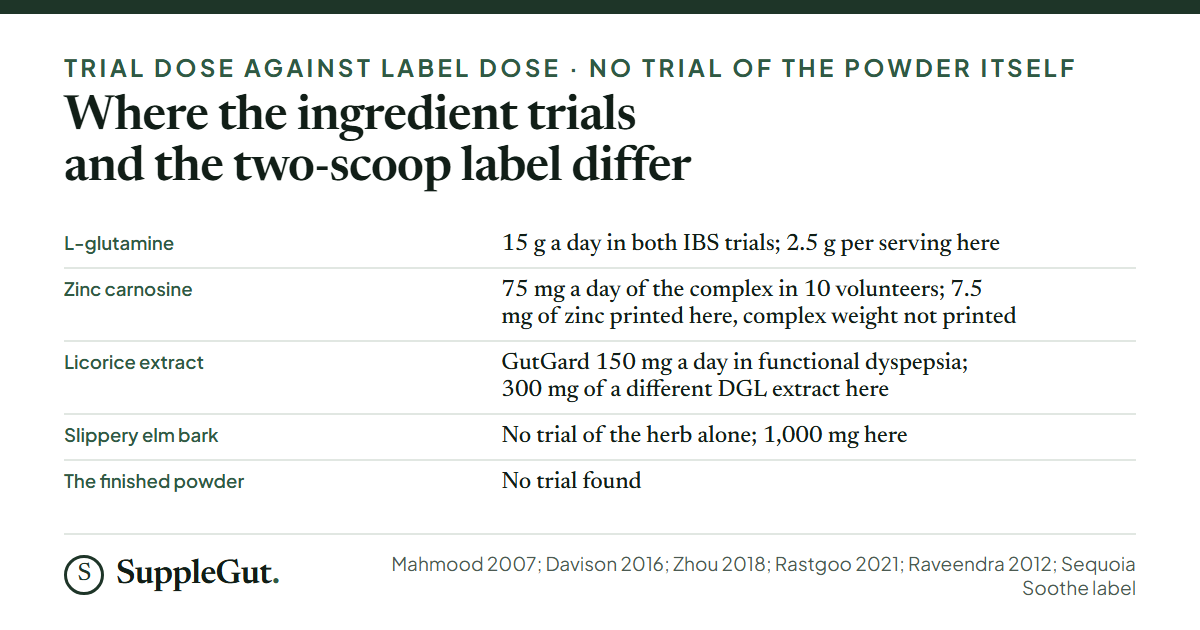
L-glutamine, 2,500 mg here. The largest trial enrolled people with IBS and diarrhea that began after an infection and who had raised gut permeability. They took 5 g three times a day, 15 g in all, for eight weeks. Of the 106 who finished, the main goal (a drop of at least 50 points on the IBS severity score) was reached by 79.6% on glutamine and 5.8% on placebo (Zhou et al., Gut, 2018). A second trial gave 15 g a day with a low-FODMAP diet for six weeks; 50 adults were enrolled, 22 per group finished, and 88% on glutamine improved by more than 45% against 60% on placebo (Rastgoo et al., Frontiers in Nutrition, 2021). Both used six times the glutamine in a serving of Sequoia Soothe, and both studied IBS, not the throat or esophagus.
Zinc carnosine, 7.5 mg of zinc here. Two small crossover trials in healthy volunteers looked at gut permeability. In 10 volunteers, five days of the anti-inflammatory drug indomethacin raised the lactulose:rhamnose ratio from 0.35 to 0.88, and no significant rise appeared when 37.5 mg of zinc carnosine was taken twice a day alongside it (Mahmood et al., Gut, 2007). In 8 volunteers, 14 days of zinc carnosine or of colostrum cut the permeability rise after heavy exercise by 70% (Davison et al., American Journal of Clinical Nutrition, 2016). The first trial used 75 mg a day of the complex, about double the estimated amount in this powder. A search for zinc carnosine trials in dyspepsia, gastritis, reflux or throat symptoms turned up H. pylori treatment add-ons and an infant regurgitation study, but no trial of the ingredient alone for adult reflux or throat symptoms.
Slippery elm bark, 1,000 mg here. We found no randomized trial of slippery elm alone for the throat, esophagus or stomach. The evidence is from mixed formulas: an open-label pilot of 31 people with IBS on formulas that contained slippery elm with other herbs, with no comparison group (Hawrelak & Myers, 2010), and a 16-week pre-post study of 43 adults on a powder combining curcumin, aloe, slippery elm, guar, pectin, peppermint oil and glutamine (Ried et al., 2020). Neither can show what slippery elm contributed.
DGL licorice extract, 300 mg here. A search for trials of deglycyrrhizinated licorice in dyspepsia returned none. The nearest is a placebo-controlled study of GutGard, a standardized Glycyrrhiza glabra extract, at 75 mg twice a day for 30 days in functional dyspepsia, where total symptom scores fell more than on placebo at days 15 and 30 (Raveendra et al., 2012). That is a branded extract at 150 mg a day in another condition, and the label does not say Sequoia Soothe’s DGL is the same material.
Taken together: the strongest ingredient evidence (glutamine) was at six times this dose and in IBS, and the zinc carnosine trials were small, short and about gut permeability. The trials above tested the ingredients, not the powder, and not reflux or throat symptoms.
Throat and LPR: claims the brand makes
The brand’s pages describe the powder for “throat and esophageal discomfort,” acid reflux, LPR, a sour or acidic stomach and everyday digestive discomfort. They say slippery elm coats the lining of the throat, esophagus and stomach, that DGL supports the protective mucus layer, and that glutamine supports the tight junctions between gut cells. We found no trial that tested any of these effects in the throat or esophagus. Slippery elm does form a gel when mixed with water, which is the basis for the coating description; whether that gel reaches or stays on the esophagus has not been measured in the studies above. The page’s own disclaimer says the product is not intended to diagnose, treat, cure or prevent any disease and is not a replacement for medical care.
Mixing it, timing it, and spacing it from medicines
The directions are to stir two scoops into 4 to 8 oz of cool or warm water and sip it once a day, at least 30 minutes before a meal or at least 1 hour after one. First-time users start with 1 scoop a day for 3 days and then move to 2. The brand’s FAQ says to take it at least 2 hours away from other medicines, 4 hours away from thyroid medicine and at least 1 hour away from acid-reducing medicines. One reviewer says fitting those gaps around meals and medicines left room for about 5 doses a week, and another says drinking it first thing on an empty stomach made them vomit. No trial has tested how long it takes for any effect to appear.
Side effects, pregnancy and the licorice and lead statements
The brand’s FAQ says the ingredients have not been studied in pregnancy and are therefore not advised for people who are pregnant or breastfeeding, and asks for a check with an OB-GYN or healthcare provider first. It asks anyone on medication to check with a provider before adding a supplement. It says DGL does not raise blood pressure because glycyrrhizin has been removed, which is the brand’s statement; we did not find a test of this powder for it. The FAQ also says lead is “present at a very low level” and links a California Proposition 65 disclosure page. The jar’s side panel was not legible in any photo, so any warning printed there could not be read. Among the reviews, the complaints about the powder itself are an unpleasant taste or dislike of powders, one report of more throat clearing and irritation after taking it, and the vomiting on an empty stomach noted above. One reviewer said it caused no stomach upset.
What the 95 reviews show
The brand’s product page runs a Judge.me review widget showing 4.75 out of 5 from 95 reviews. This is the brand’s own page; no Amazon, Walmart, Target or Trustpilot rating exists to compare it with, and the brand says it sells only on its site and TikTok Shop. We could read 79 of the 95 reviews: 65 were five stars, 10 four, 3 three, 1 two and none one star, and 74 were marked verified buyer. The 79 read include 6 from 2025 and 73 from 2026, with none dated between the end of 2025 and the middle of 2026.
Of those 79, about 18 mention reflux or GERD, 10 mention LPR, 11 mention the throat and 6 mention stopping or cutting back on a PPI or other acid reducer. Praise centers on less throat clearing and less burning, a mild taste when sipped in warm water, and a powder that blends easily. Several reviewers say they also follow the brand’s diet and lifestyle plan, so a change cannot be assigned to the powder alone. The complaints are price and the amount in a jar, taste or the powder format for some, a slow or unnoticed effect for others, and the dosing gaps from food and medicines. One reviewer says a free month of the FLORA app that the page promised did not arrive.
Cost per day, the pre-selected plan and the refund terms
| Purchase route | Price | Servings | Per day |
|---|---|---|---|
| 1 jar, one time | $67.00 | 30 | $2.23 |
| 3 jars, one time | $180.00 | 90 | $2.00 |
| 1 jar, monthly subscription (25% off) | $50.25 | 30 | $1.68 |
| 3 jars, subscription every 3 months (30% off) | $140.70 | 90 | $1.56 |
The product page opens with Subscribe selected and the three-month option checked: $140.70 charged for three jars ($46.90 each), delivered every 3 months, with a banner for “25% Off For Life.” “Buy Once” at $67.00 is a collapsed tab. The page also lists bonuses with the brand’s own dollar values, a 14-Day Digestive Reset program ($47), a cookbook and meal plan ($35) and a free month of the FLORA app ($22). The page says a subscription can be cancelled or paused anytime with no long-term commitment. The cancellation-policy page linked in the footer returned a not-found error when read, so the written cancellation terms could not be read.
The page advertises a 30-day money-back guarantee. The refund policy attaches conditions: use the product consistently for at least 14 days, follow the 14-Day Digestive Reset plan alongside it, and email within 30 days of purchase. Opened and unopened jars are sent to a Florida address at the customer’s cost, original shipping, taxes and duties are not refunded, and approved refunds return to the original payment method within 10 business days. The 79 reviews we read had no complaint about unwanted charges; Trustpilot has no profile for the brand to check.
Sequoia Soothe and EsoRepair side by side
Both are sold for throat and esophageal comfort and share slippery elm, DGL, glutamine and zinc carnosine, but the formats and amounts differ.
| Sequoia Soothe | EsoRepair | |
|---|---|---|
| Format | Flavorless powder, 2 scoops in water | 2 mL liquid, once a day |
| Panel lines | 5 | 11, including hyaluronic acid and alginate |
| Slippery elm | 1,000 mg bark | 40 mg mucilage |
| L-glutamine | 2,500 mg | 45 mg |
| DGL licorice | 300 mg | 90 mg |
| Zinc carnosine | 7.5 mg of zinc, complex weight not printed | 75 mg zinc-L-carnosine |
| Trial of the finished product | None found | None found |
| One-time price per day | $2.23 | $2.33 |
| Review score | 4.75 from 95, brand’s own widget | 4.5 from 296 on Trustpilot; 3.9 from 1,003 on Amazon |
The ingredients that overlap are at different weights, and the trial doses above apply to neither label. The closest trial the EsoRepair guide covers involves hyaluronic acid with chondroitin, which Sequoia Soothe does not contain. The EsoRepair guide also sets out how that brand’s FAQ and panel differ. The EsoRepair page has its label.
Who Sequoia Soothe suits
- Someone who wants a plain powder with every amount printed, taken once a day between meals, and who accepts that the finished formula has no trial.
- Someone willing to space it from medicines: 2 hours from most, 4 from thyroid medicine, 1 from acid reducers.
- Someone not pregnant or breastfeeding, given the brand’s statement, and who buys one jar to try rather than the pre-selected three-jar plan.
For a single ingredient with its own page, Doctor’s Best PepZin GI is zinc-L-carnosine and Natural Factors Chewable DGL is licorice. Glutamine on its own is covered in the Wellah glutamine guide, and the reflux guide sets out the options with their trials.
The products in this catalog
Common questions
Has Sequoia Soothe been studied in people with reflux or LPR?
No. A PubMed search for the product and for its slippery elm and zinc carnosine pairing returned nothing. The ingredients have trials of their own, in IBS (glutamine at 15 g a day), in volunteers whose gut permeability was pushed up by a drug or by hard exercise (zinc carnosine), and in functional dyspepsia (a different licorice extract). None of them tested throat or esophageal symptoms.
How much of each ingredient is in a serving of Sequoia Soothe?
Two scoops, about 3.85 g, hold slippery elm bark 1,000 mg, DGL licorice extract 300 mg, L-glutamine 2,500 mg, zinc 7.5 mg as zinc L-carnosine complex and copper 0.5 mg as copper gluconate. The panel prints each amount separately and lists no other ingredients. It prints the zinc, not the weight of the complex that supplies it.
Can Sequoia Soothe be taken alongside a PPI or other acid reducer?
The brand’s FAQ describes it as something to take in addition to acid-reducing medicines, at least 1 hour apart from them, and says to check with a healthcare provider before adding any supplement while on medication. Several reviewers say they used it while cutting back on a PPI or Pepcid. The brand does not claim it replaces a prescription.
When is Sequoia Soothe taken, and how far from thyroid medicine?
The brand says to sip it once a day in 4 to 8 oz of cool or warm water, at least 30 minutes before a meal or at least 1 hour after one. Its FAQ asks for at least 2 hours from other medicines, 4 hours from thyroid medicine and 1 hour from acid reducers. New users start with 1 scoop a day for 3 days before moving to 2.
What does a day of Sequoia Soothe cost on each purchase route?
One 30-serving jar is $67.00 one time, about $2.23 a day. Three jars one time are $180.00 ($2.00). A monthly subscription is $50.25 a jar ($1.68). The three-jar subscription that the page opens with is $140.70 every 3 months ($46.90 a jar, about $1.56 a day).
What conditions apply to the 30-day refund, and what happens on the cancellation page?
The refund policy asks for at least 14 days of consistent use and for the brand’s 14-Day Digestive Reset plan to be followed, with an email inside 30 days. Return shipping is paid by the customer and original shipping is not refunded. The cancellation-policy page linked in the footer returned a not-found error when read, so no written cancellation terms were available; the product page says cancel or pause anytime.
Is Sequoia Soothe sold on Amazon?
The brand says it sells only on its own site and its official TikTok Shop, and that listings on Amazon are not its product. A search of Amazon for the name with zinc carnosine returned no matching listing. The review score on this page therefore comes from the brand’s own Judge.me widget.
How does Sequoia Soothe differ from EsoRepair?
Sequoia Soothe is a flavorless powder with five panel lines, including slippery elm 1,000 mg and glutamine 2,500 mg per serving. EsoRepair is a 2 mL liquid with eleven actives, including hyaluronic acid and alginate, and much smaller amounts of slippery elm and glutamine on its panel. Neither finished product has a trial. The EsoRepair guide has its label and terms.
Sources
- Zhou Q, Verne ML, Fields JZ, et al. “Randomised placebo-controlled trial of dietary glutamine supplements for postinfectious irritable bowel syndrome.” Gut, 2018;68(6):996–1002. PubMed 30108163
- Rastgoo S, Ebrahimi-Daryani N, Agah S, et al. “Glutamine Supplementation Enhances the Effects of a Low FODMAP Diet in Irritable Bowel Syndrome Management.” Frontiers in Nutrition, 2021;8:746703. PubMed 34977110
- Mahmood A, FitzGerald AJ, Marchbank T, et al. “Zinc carnosine, a health food supplement that stabilises small bowel integrity and stimulates gut repair processes.” Gut, 2007;56(2):168–175. PubMed 16777920
- Davison G, Marchbank T, March DS, et al. “Zinc carnosine works with bovine colostrum in truncating heavy exercise-induced increase in gut permeability in healthy volunteers.” American Journal of Clinical Nutrition, 2016;104(2):526–536. PubMed 27357095
- Raveendra KR, Jayachandra, Srinivasa V, et al. “An Extract of Glycyrrhiza glabra (GutGard) Alleviates Symptoms of Functional Dyspepsia: A Randomized, Double-Blind, Placebo-Controlled Study.” Evidence-Based Complementary and Alternative Medicine, 2012;2012:216970. PubMed 21747893
- Hawrelak JA, Myers SP. “Effects of two natural medicine formulations on irritable bowel syndrome symptoms: a pilot study.” Journal of Alternative and Complementary Medicine, 2010;16(10):1065–1071. PubMed 20954962
- Ried K, Travica N, Dorairaj R, Sali A. “Herbal formula improves upper and lower gastrointestinal symptoms and gut health in Australian adults with digestive disorders.” Nutrition Research, 2020;76:37–51. PubMed 32151878
- Sequoia Soothe: product page, Supplement Facts panel image, FAQ and refund policy. sequoiasoothe.com, FAQ, refund policy
- Judge.me review widget on the Sequoia Soothe product page (rating, count and the reviews read).
Which of these fits you?
Three minutes with the quiz turns this background into one named product, with the reasons shown.
Take the quiz →