
Guide
Does UNI KEY Bile Builder work? A six-ingredient bile capsule with no trial of its own
Quick answer
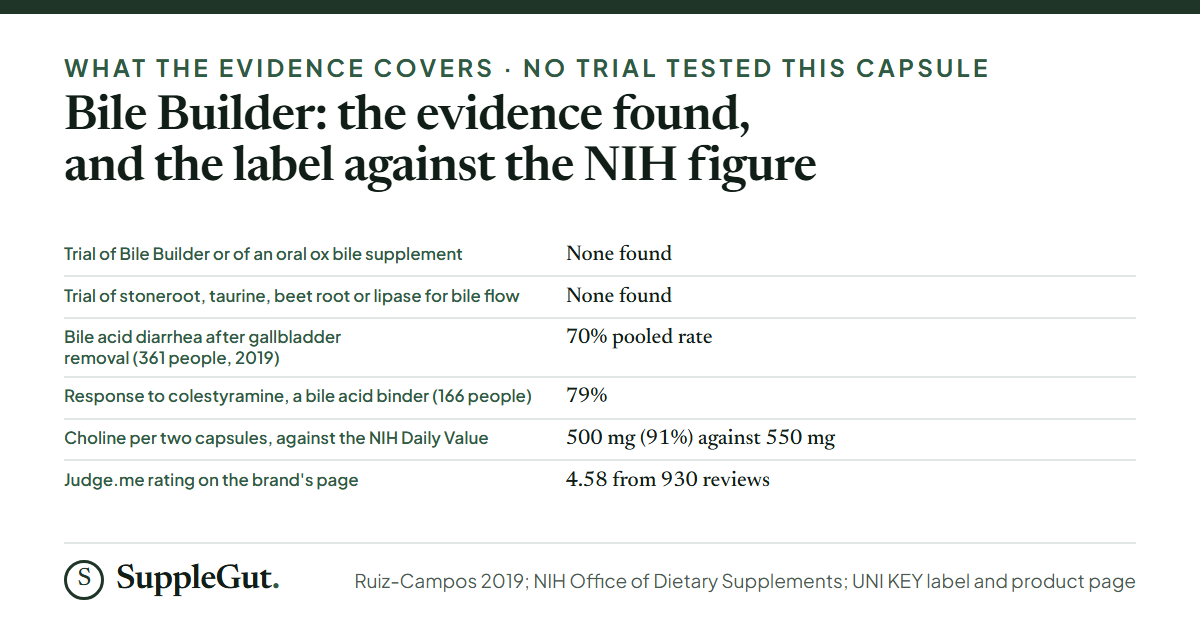
Does UNI KEY Bile Builder work? No trial of Bile Builder, or of any oral ox bile supplement, was found, and none of its other ingredients has a trial for bile flow or symptoms after gallbladder removal. The one strong body of evidence on diarrhea after gallbladder removal concerns drugs that bind bile acids, which is the opposite direction to adding bile salts. The brand's own review widget shows 4.58 from 930 reviews.
UNI KEY Health Bile Builder is a gelatin capsule with six listed ingredients: choline, taurine, ox bile extract, beet root, stoneroot and a fat-digesting enzyme. The brand sells it as gallbladder support, for people with or without a gallbladder. This page covers the label, what research exists on its ingredients and on digestion after gallbladder removal, the reviews, the price and the refund terms.
What Bile Builder is, and what it is not
The bottle reads “Bile Builder” with the tagline “Ultimate Gallbladder Support” and “Dietary Supplement, 120 Capsules.” It is made for UNI KEY Health Systems of Hayden, Idaho, a company whose page says it has operated since 1992. The panel is headed Supplement Facts, so it is sold as a dietary supplement rather than a drug, and every active ingredient has its own amount: there is no proprietary blend.
| Ingredient (as printed) | Per 2 capsules | Per capsule |
|---|---|---|
| Choline (as choline bitartrate) | 500 mg (91% DV) | 250 mg |
| Taurine | 250 mg | 125 mg |
| Ox bile extract | 100 mg | 50 mg |
| Beet root powder | 100 mg | 50 mg |
| Stoneroot powder (Collinsonia canadensis) | 60 mg | 30 mg |
| Lipase enzyme (1,500 USP) | 24 mg | 12 mg |
The other ingredients are gelatin (the capsule), magnesium stearate and silicon dioxide. A bottle holds 60 servings of two capsules. The label says it contains no sugar, starch, dairy, soy, gluten, salt, artificial colors, artificial flavors or preservatives. It does not address egg, tree nuts, fish or sesame, and it is not vegan or vegetarian, because the ox bile and the gelatin are animal products. The brand says the ox bile is grass-fed and sourced from Argentina.
The product has no laxative herb and no antimicrobial framing. The page does use detox language, and it describes stoneroot as used traditionally for gallstones and to avoid constipation from bile salt supplements; both are the brand’s statements. The bottle carries “3rd party lab tested” and “cGMP certified” badges without naming a laboratory, and the page says each batch is tested for purity, potency and heavy metals. No certificate or NSF or USP mark was seen.
Is there a trial of Bile Builder or of oral ox bile?
None was found. PubMed has no study of Bile Builder, and ClinicalTrials.gov lists none. A search for ox bile in people who have had a gallbladder removed returned nine records, and none is a human trial of an oral ox bile supplement: they cover microbiology, chemistry and an old imaging study. A search specifically for randomized trials of ox bile supplements returned nothing. The ox bile extract is generic, with no branded or patented form that carries its own research.
The label gives the weight of ox bile extract, 50 mg a capsule, but not how much of it is bile acid. The dose of actual bile salts therefore cannot be checked against anything.
Digestion after gallbladder removal, and why adding bile salts is a different direction
Bile is made in the liver and released into the small intestine to break fat into absorbable droplets. The gallbladder stores it and releases it in a pulse when a meal arrives. After the gallbladder is removed, bile flows continuously instead. Many people notice no change; some have bloating, loose stools or trouble with fatty meals. The brand’s idea is that supplying ox bile and the raw materials for making bile helps with fat digestion.
The most-studied explanation for persistent diarrhea after gallbladder removal points the other way. In some people too much bile acid reaches the colon, where it draws in water and speeds transit; this is called bile acid diarrhea, and it is treated with drugs that bind bile acids. A 2019 systematic review and meta-analysis combined eight studies and a new series, 361 people with chronic watery diarrhea and a previous gallbladder removal. The pooled rate of bile acid diarrhea was 70% (95% confidence interval 56 to 82%, with large differences between studies), and 79% of those treated with the binder colestyramine responded, across five studies of 166 patients (Ruiz-Campos et al., Alimentary Pharmacology & Therapeutics, 2019). A 2011 clinical inquiry reached a similar conclusion, that a trial of a bile acid binder can help patients with diarrhea after gallbladder removal (Danley and St Anna, Journal of Family Practice, 2011).
Bile Builder does the opposite of a binder: ox bile extract is a source of bile salts. No study was found that tests or compares the two approaches, so the binder evidence says nothing about whether this capsule helps or harms. It only shows that loose stools after gallbladder removal have a cause for which the evidence points away from adding bile.
For symptoms in general, a 2026 narrative review of nutrition after gallbladder removal found that bloating, diarrhea and dyspepsia are common but that incidence and cause vary, and that most advice is extrapolated from other surgical populations and needs testing in trials of people who have had this surgery (Guo et al., Frontiers in Surgery, 2026). That is a non-systematic review, not a trial.
The other ingredients: choline, taurine, beet root, stoneroot and lipase
Choline. The panel prints 500 mg per two capsules and 91% of the Daily Value. The NIH Office of Dietary Supplements gives the choline Daily Value as 550 mg for adults, Adequate Intakes of 550 mg for men and 425 mg for women, and a Tolerable Upper Intake Level of 3,500 mg a day. It lists fishy body odor, vomiting, sweating, salivation, low blood pressure and liver toxicity as effects of high intakes, and says typical supplement amounts range from 10 mg to 250 mg. The brand says its 500 mg is ten times the choline of other popular brands and matches the NIH figure for liver health. The NIH figure is a nutrient-adequacy intake, and no trial of choline bitartrate for bile flow, with or without a gallbladder, was found.
The arithmetic on the label is worth checking. 500 divided by 550 is 91%, so the percentage treats the 500 mg as choline itself. Choline bitartrate is about 41% choline by weight, so 500 mg of choline would take roughly 1.2 g of the salt, while the six printed amounts add up to 1,034 mg per two capsules. If 500 mg is instead the weight of the bitartrate, the choline is about 205 mg, or 37% of the Daily Value. The panel does not say which, so the amount of choline per capsule is unclear. On the printed figures, three capsules a day supply 750 mg from the choline line and six supply 1,500 mg, both under the 3,500 mg upper intake level.
Taurine and beet root. Taurine is an amino acid used in the body to conjugate bile acids. The brand says beet root contains betaine, which helps promote thin, free-flowing bile, and describes betaine as a rich source of hydrochloric acid. Those are brand statements; betaine hydrochloride and the betaine in beet root are different substances, and 100 mg of beet root powder is a small amount. No trial of taurine or beet root for bile flow or symptoms after gallbladder removal was found.
Stoneroot. Stoneroot (Collinsonia canadensis) is a traditional herb. PubMed has five records on it, a 1999 phytochemistry paper, a 2013 cell-line screen and two notes from 1887 and 1888, and no clinical trial.
Lipase. Lipase is the enzyme that digests fat. The panel prints “1,500 USP” beside the name and 24 mg as the amount, without saying whether the units are per serving or per capsule. No trial of lipase from this product, or in this combination, was found. Digestive enzymes as a group are covered on the Digestzymes page in this catalog’s digestive enzyme listings.
How to take it
The bottle says: “For adults, take one to two capsules with each meal or as directed by a health care professional.” The brand’s page is more specific: one capsule per meal if you have a gallbladder, two per meal if you do not, adjusted as needed for digestion. It is a with-meals product, so three meals means three to six capsules a day. At those doses the ox bile extract comes to 150 mg a day at one capsule per meal and 300 mg a day at two. The panel’s serving size is two capsules, which is why the table above shows both per-serving and per-capsule amounts.
Side effects and who should check first
The two label faces read carry one line of caution, “Keep out of reach of children,” plus a note not to use the product if the seal is missing. The label prints no pregnancy, nursing, medication, age or medical-condition warning, and no warning for people with gallstones or bile-duct problems, although the brand’s copy is aimed at people with gallbladder trouble. Other faces of the bottle were not photographed.
Reviewers on the brand’s page report stomach pain, cramps, nausea and heartburn, constipation, and in some cases worse diarrhea. Single reviews describe a kidney-stone episode 17 days in, an allergic reaction and a defective capsule. Bile salts can themselves irritate the gut, and a doctor is the person to ask first if you have gallstones, liver or bile-duct disease, are pregnant or nursing, or take medicines. The brand’s page also invites you to adjust the dose by how you feel; starting at the lowest labeled dose is within the label’s own directions.
What the reviews say
The only rating found is on the brand’s own page, a Judge.me review widget showing 4.58 out of 5 from 930 reviews: 757 five-star, 62 four, 49 three, 19 two and 43 one-star (81%, 7%, 5%, 2% and 5%). The weighted average of those counts is 4.58. Searches of Amazon, iHerb and Target found no listing for the product, so there is no retailer rating, and no Trustpilot figure was read. The brand replies to reviews, usually with a short thank-you.
Judge.me’s public feed returned 580 of the 930 reviews. Of those, 343 are flagged as verified buyers and 237 are not. By year, the 580 break down as 104 from 2020, 161 from 2021, 115 from 2022, 88 from 2023, 62 from 2024, 27 from 2025 and 23 from 2026. Reviews are not marked as incentivized in the page markup, and the page’s styling hides the labels Judge.me can show for how a review was collected.
- Praise: fat digestion without a gallbladder. Reviewers who had the organ removed describe eating fat without trouble and noticing a difference within days.
- Praise: less bloating, gas and loose stools. Several describe diarrhea stopping after a few weeks, and one says symptoms returned after stopping.
- Praise: customer service. Reviewers call the company responsive and helpful.
- Complaint: no effect. Of the 45 one- and two-star reviews in the 580, 13 say it did nothing, and some describe returning it for a refund.
- Complaint: stomach upset. Pain, cramps, nausea, reflux and heartburn, including some within the first doses.
- Complaint: bowel changes. Constipation, including at a reduced dose, and diarrhea that got worse.
Reviews cannot show whether a reviewer’s symptoms had the cause the capsule is aimed at, and the page is the brand’s own. They are one pool of experience, not a trial.
Price, the subscription and the refund terms
A 120-capsule bottle is $46.95 one time. The cost per day depends on the dose: at one capsule with each of three meals it is a 40-day supply, $1.17 a day; at two capsules with each meal it is a 20-day supply, $2.35 a day. A subscription takes 15% off, for $39.91 a bottle, or $1.00 and $2.00 a day, and ships every 30, 60 or 90 days. A one-time purchase is available. Shipping is free over $99 within the US.
The brand’s page states a 90-day money-back guarantee. The refund policy adds terms: contact customer service first for a return authorization number; send items back within five days of receiving it; the customer pays return shipping; returns without authorization can carry a 15% handling fee; and opened items can be eligible only for store credit. The page wording and the policy wording are not identical on opened bottles and return shipping. No renewal-warning wording or cancellation steps were read for the subscription, and none of the 580 reviews read complains about unwanted subscription charges.
Bile Builder vs Nutricost Ox Bile
Nutricost Ox Bile is one ingredient: ox bile at 125 mg a capsule, sold as 240 capsules at about $0.08 a capsule on its Amazon listing. Bile Builder carries 50 mg of ox bile extract a capsule alongside the other five ingredients, at about $0.39 a capsule for the one-time price. At one capsule per meal, Bile Builder supplies 150 mg of ox bile extract a day; one Nutricost capsule per meal supplies 375 mg. Neither label states the bile acid content of its extract, and neither product has a trial of its own.
The practical difference is the added ingredients, which Bile Builder prints with amounts and Nutricost does not contain. Nutricost’s rating is on Amazon, and Bile Builder’s is on the brand’s own page, so the two scores come from different kinds of source.
Who Bile Builder is for
- Someone who wants a multi-ingredient formula with every amount printed and is comfortable that no ingredient has a trial for this use.
- Someone without a gallbladder whose trouble is fat at meals, the situation most of the praise in the reviews describes.
- Someone willing to adjust from one to two capsules per meal and to stop if stomach pain, constipation or looser stools appear.
Someone whose main problem is urgent, watery stools after gallbladder removal has a documented cause to raise with a doctor, because the evidence there concerns bile acid binders. For a single-ingredient bile product, see Nutricost Ox Bile; for another gallbladder-support formula, the Dr. Berg gallbladder formula.
The products in this catalog
Common questions
Does UNI KEY Bile Builder work?
No trial of Bile Builder or of an ox bile supplement was found. On the brand's review widget it holds 4.58 from 930 reviews, with 62 one- or two-star reviews, most describing no effect, stomach pain or constipation. Reviewers without a gallbladder most often praise fat digestion and fewer loose stools.
What is in Bile Builder?
Two capsules hold choline 500 mg (as choline bitartrate), taurine 250 mg, ox bile extract 100 mg, beet root powder 100 mg, stoneroot powder 60 mg and lipase 24 mg, in a gelatin capsule with magnesium stearate and silicon dioxide. There is no proprietary blend, no laxative herb and no sweetener.
How many Bile Builder capsules do you take with a meal?
The bottle says one to two capsules with each meal. The brand's page says one per meal if you have a gallbladder and two per meal if you do not, adjusted to your digestion. That is three to six capsules a day, or 150 to 300 mg of ox bile extract.
How much does Bile Builder cost per day?
A 120-capsule bottle is $46.95 one time, which is $1.17 a day at one capsule with each of three meals and $2.35 a day at two capsules with each meal. The 15% subscription is $39.91 a bottle, or $1.00 and $2.00 a day. Shipping is free over $99.
Does Bile Builder cause side effects?
Some reviewers report stabbing stomach pain, nausea, heartburn, constipation or worse diarrhea, and one reports a kidney-stone episode; others report none. The label prints no warnings beyond keeping it from children and checking the seal, so ask a doctor first if you have gallstones, bile-duct or liver disease, or take medicines.
Can you get a refund on Bile Builder?
The brand states a 90-day money-back guarantee. Its refund policy asks you to contact customer service for an authorization number first, says the customer pays return shipping, notes a possible 15% handling fee for returns without authorization, and says opened items can be eligible only for store credit.
Bile Builder vs Nutricost Ox Bile: what is the difference?
Nutricost is a single ingredient, ox bile at 125 mg a capsule. Bile Builder has 50 mg of ox bile extract a capsule plus choline, taurine, beet root, stoneroot and lipase, and costs more per capsule. Neither has a trial of the finished product. The Nutricost page has its label.
Sources
- Ruiz-Campos L, et al. Systematic review and meta-analysis of bile acid diarrhea and colestyramine response after cholecystectomy. Alimentary Pharmacology & Therapeutics, 2019. PubMed 30585336
- Danley T, St Anna L. “Postcholecystectomy diarrhea: what relieves it?” Journal of Family Practice, 2011. PubMed 21977493
- Guo C, et al. Nutritional management after cholecystectomy: a narrative review. Frontiers in Surgery, 2026. PubMed 42719560
- NIH Office of Dietary Supplements. Choline fact sheet for health professionals (Daily Value 550 mg; upper intake level 3,500 mg). ods.od.nih.gov
- UNI KEY Health: Bile Builder product page, Supplement Facts and directions label images, and refund policy. unikeyhealth.com
- Judge.me review widget on the Bile Builder product page: rating, star counts and review feed. unikeyhealth.com
Not sure which product fits your situation?
This guide covers the mechanics. The quiz takes your specific symptoms, routine and preferences and matches you to one product from the catalog.
Take the quiz →