
Guide
What’s the best supplement for loose stools and urgency?
Quick answer
What is the best supplement for loose stools and urgency? It depends on why the stools are loose. For diarrhea-predominant IBS, the largest trial of a finished product is Bio-Kult’s 14-strain formula (400 people, 16 weeks); single strains with IBS trials include Lactobacillus plantarum 299v, Bifidobacterium bifidum MIMBb75 and B. longum 35624, and enteric-coated peppermint oil has the most trials of all. For loose stools during or after antibiotics, Saccharomyces boulardii and L. rhamnosus GG. For IBS that began after a stomach bug, glutamine at 15 g a day has one striking trial. Psyllium helps IBS of any bowel habit; bran makes it worse.
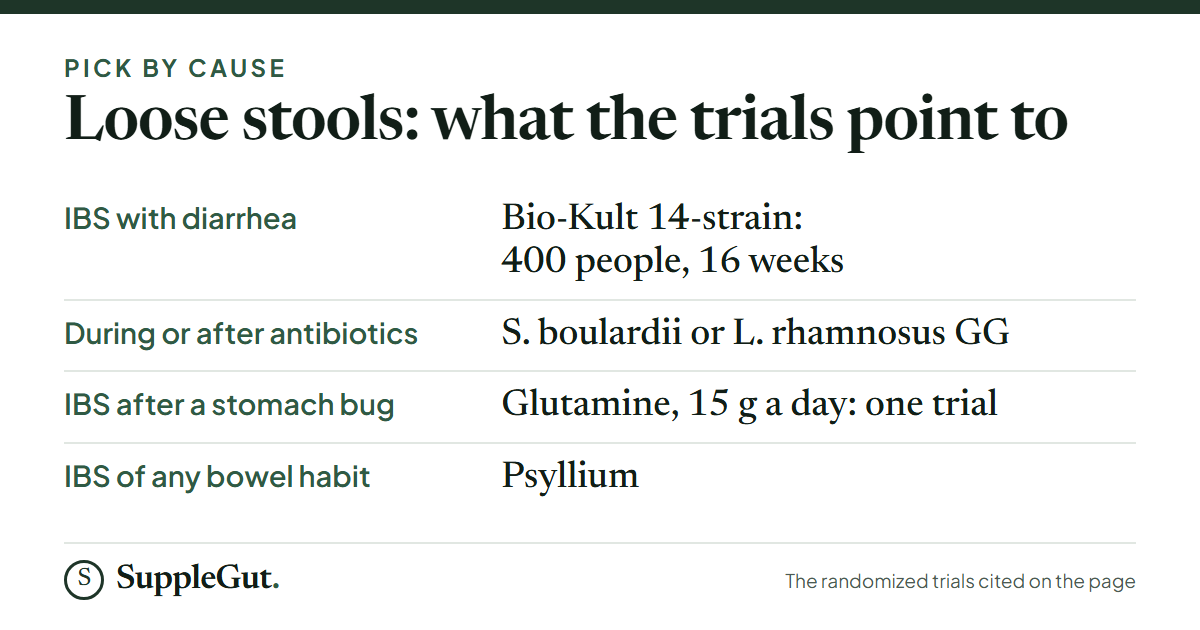
Loose stools and urgency have several causes with different evidence: IBS with diarrhea, a course of antibiotics, the aftermath of a gut infection, and food-driven diarrhea from lactose or other sugars. The trials below are sorted by which of those they were run in, because a probiotic that prevents antibiotic diarrhea has not been shown to calm IBS, and the reverse is also true.
How the evidence ranks
| Supplement | Best trial | What it showed | Suits |
|---|---|---|---|
| Bio-Kult 14-strain formula | RCT, 400 adults with IBS-D, 16 weeks | Pain severity down 69% vs 47%; moderate-to-severe symptoms 14% vs 48% | Diarrhea-predominant IBS |
| Enteric-coated peppermint oil | Meta-analysis, 9 RCTs, 726 IBS patients | Global symptoms RR 2.23; pain RR 2.14 | IBS with cramping and urgency |
| L. plantarum 299v | RCT, 214 IBS patients, 4 weeks | Pain and frequency down; 78% rated it good or excellent vs 8% | IBS, any bowel habit |
| B. bifidum MIMBb75 (Kijimea) | RCT, 122 IBS patients, 4 weeks; heat-inactivated form, 443 patients, 8 weeks | Adequate relief 47% vs 11%; responders 34% vs 19% | IBS, any bowel habit |
| B. longum 35624 (Align) | RCT, 362 women with IBS, 4 weeks | 108 CFU beat placebo on pain, bloating and global symptoms | IBS, any bowel habit |
| S. boulardii (Florastor) | Meta-analysis, 27 trials, 5,029 adults | Antibiotic-associated diarrhea RR 0.47 | Loose stools on antibiotics |
| L. rhamnosus GG (Culturelle) | Meta-analysis, 12 trials, 1,499 people | AAD 22.4% to 12.3%; significant in children, not adults overall | Antibiotics, mainly children |
| L-glutamine, 5 g three times a day | RCT, 106 people with post-infectious IBS-D, 8 weeks | Responders 80% vs 6%; stools 2.9 vs 5.4 a day | IBS-D that began after a gut infection |
| Psyllium, 10 g a day | RCT, 275 IBS patients, 12 weeks | Adequate relief 57% vs 35% at one month | IBS, any bowel habit |
| Partially hydrolyzed guar gum | Open RCT, 188 IBS patients, 12 weeks | 60% success vs 40% on bran | IBS where bran or psyllium was not tolerated |
Diarrhea-predominant IBS: the trials that named the subtype
Most probiotic trials in IBS accept any bowel habit. The one large trial that enrolled diarrhea-predominant IBS specifically tested Bio-Kult’s 14-strain formulation in 400 adults with moderate-to-severe IBS-D for 16 weeks. Abdominal pain severity fell by 69% against 47% on placebo (p<0.001), the IBS Symptom Severity Score fell by 145 points, and the share still rated moderate-to-severe dropped from 100% to 14% on the probiotic against 48% on placebo. No serious adverse events were reported. The manufacturer supplied the product and funded the trial (Ishaque et al., BMC Gastroenterology, 2018).
If the diarrhea began after a stomach infection, one trial stands apart. 106 people with post-infectious IBS-D and raised intestinal permeability took 5 g of L-glutamine three times a day or placebo for eight weeks: 79.6% on glutamine reached the primary endpoint (a 50-point fall in symptom severity) against 5.8% on placebo, daily bowel movements fell to 2.9 against 5.4, and permeability normalized. Adverse events were low and similar in both groups (Zhou et al., Gut, 2019). It is a single trial in a specific group, at a dose of 15 g a day that most glutamine labels do not suggest.
IBS of any bowel habit: single strains with a trial
Lactobacillus plantarum 299v, one capsule a day for four weeks in 214 people with IBS, reduced pain severity and daily pain frequency against placebo (p<0.05), and 78.1% rated the effect excellent or good against 8.1% on placebo (Ducrotté et al., World Journal of Gastroenterology, 2012).
Bifidobacterium bifidum MIMBb75, the Kijimea strain, was tested live in 122 people with IBS for four weeks: 47% reported adequate relief against 11% on placebo, and 57% were responders against 21% (Guglielmetti et al., Alimentary Pharmacology & Therapeutics, 2011). The heat-inactivated form was then tested in 443 people for eight weeks, with 34% reaching the combined pain-and-relief endpoint against 19% (risk ratio 1.7, p=0.0007) and no difference in adverse events; the manufacturer funded it (Andresen et al., Lancet Gastroenterology & Hepatology, 2020). Check which form the bottle contains.
Bifidobacterium longum 35624, the Align strain, beat placebo on pain, bloating and global symptoms at 108 CFU a day in 362 women with IBS of any subtype over four weeks; a higher and a lower dose did not (Whorwell et al., American Journal of Gastroenterology, 2006).
Enteric-coated peppermint oil has the most trials of any option here: nine randomized trials in 726 people with IBS, relative risk 2.23 for global improvement and 2.14 for abdominal pain, with heartburn the commonest side effect (Khanna, MacDonald & Levesque, Journal of Clinical Gastroenterology, 2014). It treats the cramping and urgency rather than stool form.
Loose stools on antibiotics
This is the best-evidenced use of any probiotic, and the two organisms are different. Saccharomyces boulardii, a yeast that antibiotics do not kill, cut antibiotic-associated diarrhea by about half across 27 randomized trials in 5,029 adults (relative risk 0.47, 95% CI 0.35 to 0.63) and was judged safe, with no serious adverse effects (McFarland, World Journal of Gastroenterology, 2010). Lactobacillus rhamnosus GG reduced antibiotic-associated diarrhea from 22.4% to 12.3% across 12 trials in 1,499 people, but the effect was significant in children and not in adults overall, apart from the four trials of people on H. pylori treatment (Szajewska & Kołodziej, Alimentary Pharmacology & Therapeutics, 2015). For an adult on antibiotics, the yeast has the stronger case. Culturelle vs Florastor sets the two side by side.
Fiber: psyllium yes, bran no
Gel-forming soluble fiber improves the consistency of loose stool as well as softening hard stool (McRorie, Nutrition Today, 2015), and the IBS trial bears that out. 275 people with IBS of any subtype took 10 g a day of psyllium, bran or placebo for 12 weeks: psyllium gave adequate relief to 57% in the first month against 35% on placebo, while bran did not beat placebo and more people on bran dropped out because their symptoms got worse (Bijkerk et al., BMJ, 2009). Partially hydrolyzed guar gum is the gentler alternative when psyllium is not tolerated: 5 g a day for 12 weeks gave a 60% success rate against 40% on bran in 188 people with IBS, in an open-label trial (Parisi et al., Digestive Diseases and Sciences, 2002).
Loose stools after particular foods
Diarrhea that follows milk is lactose; in 47 adults with confirmed lactose intolerance, lactase tablets with a lactose load improved symptoms and cut breath hydrogen by 55% (Baijal et al., JGH Open, 2020). Diarrhea that follows sugar-free sweets or large portions of fruit is a question for the food diary rather than the supplement shelf; no trial of a supplement for it was found.
Signs to stop comparing supplements and get checked
Loose stools with blood, black stools, fever, unintended weight loss, waking at night to pass stool, diarrhea that began after 50, or more than two weeks of new diarrhea need a clinician first. Diarrhea after a course of antibiotics that does not settle within days is a reason to be tested for C. difficile, not to keep trying probiotics.
Products in this catalog with the trials above
Common questions
What is the best probiotic for IBS-D?
The largest trial that enrolled diarrhea-predominant IBS specifically tested Bio-Kult’s 14-strain formula: 400 adults, 16 weeks, pain severity down 69% against 47% on placebo, and the share still moderate-to-severe down to 14% against 48%. Single strains with IBS trials of any subtype include L. plantarum 299v (214 people), B. bifidum MIMBb75 (122 live, 443 heat-inactivated) and B. longum 35624 (362 women).
What is the best probiotic for diarrhea from antibiotics?
Saccharomyces boulardii for adults: across 27 randomized trials in 5,029 people it cut antibiotic-associated diarrhea by about half (relative risk 0.47). Lactobacillus rhamnosus GG reduced it from 22.4% to 12.3% across 12 trials, but the effect was significant in children and not in adults overall.
Does glutamine help IBS-D?
In one trial of 106 people whose IBS-D began after a gut infection, 5 g of glutamine three times a day for eight weeks brought 79.6% to the response threshold against 5.8% on placebo and cut daily bowel movements from 5.4 to 2.9. It is a single trial in that specific group at 15 g a day.
Does psyllium help with loose stools?
In the 275-person IBS trial, 10 g a day of psyllium gave adequate relief to 57% in the first month against 35% on placebo, across all bowel-habit subtypes. Bran did not beat placebo and made more people worse. Soluble, gel-forming fiber firms loose stool as well as softening hard stool.
Does peppermint oil help urgency?
Enteric-coated peppermint oil has nine randomized trials in 726 people with IBS, with the chance of global improvement and of pain improvement more than doubled. It acts on cramping and urgency rather than on stool form, and heartburn is its commonest side effect.
When should loose stools be checked by a doctor?
Blood or black stools, fever, unintended weight loss, waking at night to pass stool, new diarrhea after 50, or more than two weeks of new diarrhea. Diarrhea after antibiotics that does not settle within days should be tested for C. difficile.
Sources
- Ishaque SM, et al. "A randomized placebo-controlled clinical trial of a multi-strain probiotic formulation (Bio-Kult) in the management of diarrhea-predominant irritable bowel syndrome." BMC Gastroenterology, 2018. pubmed.ncbi.nlm.nih.gov/29801486
- Zhou Q, et al. "Randomised placebo-controlled trial of dietary glutamine supplements for postinfectious irritable bowel syndrome." Gut, 2019. pubmed.ncbi.nlm.nih.gov/30108163
- Ducrotté P, et al. "Clinical trial: Lactobacillus plantarum 299v (DSM 9843) improves symptoms of irritable bowel syndrome." World Journal of Gastroenterology, 2012. pubmed.ncbi.nlm.nih.gov/22912552
- Guglielmetti S, et al. "Randomised clinical trial: Bifidobacterium bifidum MIMBb75 significantly alleviates irritable bowel syndrome and improves quality of life." Alimentary Pharmacology & Therapeutics, 2011. pubmed.ncbi.nlm.nih.gov/21418261
- Andresen V, et al. "Heat-inactivated Bifidobacterium bifidum MIMBb75 (SYN-HI-001) in the treatment of irritable bowel syndrome: a multicentre, randomised, double-blind, placebo-controlled clinical trial." Lancet Gastroenterology & Hepatology, 2020. pubmed.ncbi.nlm.nih.gov/32277872
- Whorwell PJ, et al. "Efficacy of an encapsulated probiotic Bifidobacterium infantis 35624 in women with irritable bowel syndrome." American Journal of Gastroenterology, 2006. pubmed.ncbi.nlm.nih.gov/16863564
- Khanna R, MacDonald JK, Levesque BG. "Peppermint oil for the treatment of irritable bowel syndrome: a systematic review and meta-analysis." Journal of Clinical Gastroenterology, 2014. pubmed.ncbi.nlm.nih.gov/24100754
- McFarland LV. "Systematic review and meta-analysis of Saccharomyces boulardii in adult patients." World Journal of Gastroenterology, 2010. pubmed.ncbi.nlm.nih.gov/20458757
- Szajewska H, Kołodziej M. "Systematic review with meta-analysis: Lactobacillus rhamnosus GG in the prevention of antibiotic-associated diarrhoea in children and adults." Alimentary Pharmacology & Therapeutics, 2015. pubmed.ncbi.nlm.nih.gov/26365389
- Bijkerk CJ, et al. "Soluble or insoluble fibre in irritable bowel syndrome in primary care? Randomised placebo controlled trial." BMJ, 2009. pubmed.ncbi.nlm.nih.gov/19713235
- Parisi GC, et al. "High-fiber diet supplementation in patients with irritable bowel syndrome (IBS): a multicenter, randomized, open trial comparison between wheat bran diet and partially hydrolyzed guar gum (PHGG)." Digestive Diseases and Sciences, 2002. pubmed.ncbi.nlm.nih.gov/12184518
- Baijal R, Tandon RK. "Effect of lactase on symptoms and hydrogen breath levels in lactose intolerance: A crossover placebo-controlled study." JGH Open, 2020. pubmed.ncbi.nlm.nih.gov/33490624
- McRorie JW. "Evidence-Based Approach to Fiber Supplements and Clinically Meaningful Health Benefits, Part 2." Nutrition Today, 2015. pmc.ncbi.nlm.nih.gov/articles/PMC4415970
Not sure which product fits your situation?
This guide covers the mechanics. The quiz takes your specific symptoms, routine and preferences and matches you to one product from the catalog.
Take the quiz →