
Guide
Which 3 tongue signs are linked to gut health?
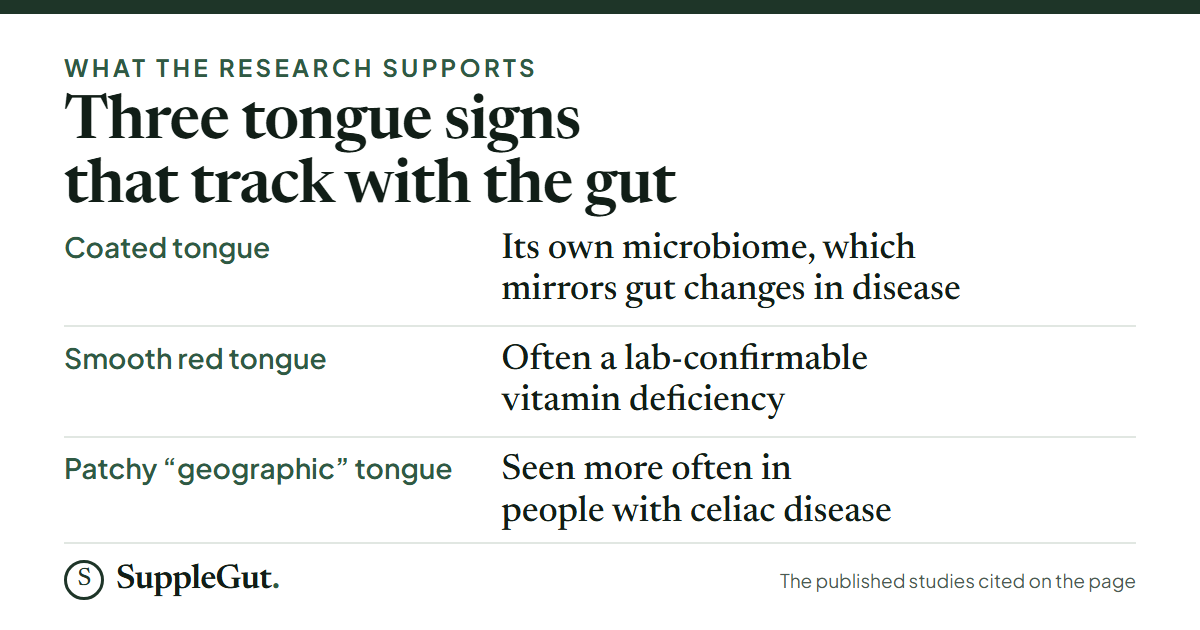
Traditional Chinese medicine maps zones of the tongue to specific organs, and a coated tongue is widely treated as a gut diagnosis. That organ map hasn’t held up well under formal testing. Three narrower, testable things about the tongue do track with the gut in published research. A coated tongue carries its own microbiome that mirrors gut changes in disease. A smooth red tongue is often a lab-confirmable vitamin deficiency. A patchy “geographic” tongue shows up more often in people who turn out to have celiac disease.
The organ-zone tongue map has weak reliability, even within its own tradition
A 2009 review of the reliability of traditional East Asian medicine diagnoses looked specifically at how consistently practitioners agree on tongue findings and found “considerable variability” in reported results across the studies it reviewed, with a range of factors affecting how reproducible tongue diagnosis actually is between examiners (O’Brien & Birch, Journal of Alternative and Complementary Medicine, 2009). That inconsistency is part of why researchers in the field have spent years trying to build camera-based, automated tongue-imaging systems — an attempt to replace human judgment calls with something measurable. None of that validates the underlying claim that a specific tongue zone reports on a specific organ; it's a separate, narrower research question about whether two people looking at the same tongue reach the same conclusion, and the honest answer in the literature is: not reliably.
What a coated tongue's own microbiome can track
Separately from the organ-map tradition, researchers have started sequencing what actually lives in tongue coating and comparing it to what's happening in the stomach and gut. In 35 patients with chronic gastritis, the species composition and overall diversity of the tongue-coating microbiome were significantly correlated with the gastric-fluid microbiome collected during the same endoscopy (Cui et al., BMC Medical Genomics, 2022). A related study went further, classifying gastritis patients by how far their stomach lining changes had progressed: superficial gastritis, atrophic gastritis, or intestinal metaplasia. The tongue-coating microbiome shifted along with that progression closely enough that the researchers proposed one specific bacterium, Campylobacter concisus, as a candidate non-invasive marker. They confirmed its presence in both tongue coating and gastric fluid by PCR in a separate validation group (Cui et al., Protein & Cell, 2019).
A smaller study split 27 people with type 2 diabetes into a yellow-coating group (13 people) and a non-yellow-coating group (14 people) and sequenced both their tongue coating and their stool. Lactobacillus was more abundant in both the tongue coating and the gut of the yellow-coating group, and several other gut genera differed between the two groups as well (Wang et al., Heliyon, 2023). A 2025 narrative review separately notes two earlier papers that tied a bacterium called Bacillus to yellow tongue coating specifically in gastritis patients, and a third that found people with type 2 diabetes had a larger area of yellow coating, thicker fur, and a more bluish tongue than people without it (AlBeshri, Saudi Dental Journal, 2025).
All of this is correlational, from small studies, in people who already had a diagnosed condition. None of it means a yellow or coated tongue on its own tells you that you have gastritis or diabetes — it means researchers found a statistical link worth studying further in people who were already being tested for those conditions by other means.
A smooth, glossy tongue is often a lab-confirmable deficiency
Atrophic glossitis — a tongue that loses its normal texture and turns smooth, glossy, and often sore or red as the small papillae on its surface flatten out — has a clearer evidence trail than coating color. In a case-control study of 236 people with atrophic glossitis against 208 matched healthy controls, blood testing found:
| Deficiency found | Share of the 236 atrophic glossitis patients |
|---|---|
| Vitamin B12 deficiency | 68.2% (161/236) |
| Ferritin (iron-related) deficiency | 14.0% (33/236) |
| Folate deficiency | 4.7% (11/236) |
| At least one of the above | 76.3% (180/236) |
Patients found to be B12-deficient were treated with oral mecobalamin (a form of B12) at 1,500 micrograms a day for at least a month. Papillae atrophy resolved partially or completely, and among 112 patients followed for six months or more the improvement held, with 15 cases showing partial recurrence (Chen, Tang & Bao, BMC Oral Health, 2022). A smooth tongue doesn't diagnose the cause of a B12 or iron shortfall on its own: conditions ranging from atrophic gastritis to celiac disease to a low-B12 diet can all produce the same tongue finding. It is a real enough sign that a blood panel checking B12, folate and ferritin is a reasonable next step, not an overreaction.
A patchy, map-like tongue and celiac disease
Geographic tongue — smooth, irregular red patches with a raised white or yellow border, that shift location over time — has its own, separate research trail. A study compared 60 people with geographic tongue to 60 healthy controls using celiac blood markers: 9 of the 60 geographic-tongue patients (15%) tested positive for IgA tissue transglutaminase antibodies, and biopsies confirmed celiac disease in all 9. Only 2 of those 9 reported any gastrointestinal symptoms. The differences between groups were statistically significant across four separate antibody markers (Cigic et al., Journal of Oral Pathology & Medicine, 2016).
A separate, more recent retrospective study of 100 Polish patients with geographic tongue found Candida yeast accompanying the condition in 13 of them (13%), and noted that large-dose nutritional supplementation with zinc, iron, or vitamins D and B did not change the course of the condition in the patients who tried it (Ślebioda et al., Healthcare, 2025). Read together: geographic tongue is a real reason to ask about celiac screening, especially with no obvious GI symptoms to explain it, and not a condition that supplementing your way through tends to resolve.
Thick white patches that scrape off — where a probiotic can plausibly help
The tongue's surface is the primary site where Candida yeast establishes itself in the mouth, and the classic “thrush” presentation — curdy white-yellow plaques that scrape off, leaving a red, raw surface underneath — starts there in most cases (Vila et al., Journal of Fungi, 2020). This is the one tongue finding in this guide where a supplement has been tested against the finding itself, not just against a related lab marker. A 2026 review of probiotics for oral fungal infection found the trial evidence heterogeneous and inconsistent overall, and concluded probiotics belong as an add-on to standard antifungal treatment, not a substitute for it — but it did find real human trial data:
| Strain / product | Trial | Result |
|---|---|---|
| Lactobacillus rhamnosus SP1 (in milk) | Triple-blind trial, 36 elderly denture wearers, 6 months | Significant reduction in Candida counts versus placebo |
| Lactobacillus plantarum-enriched powder | Human trial, 4 weeks | Significantly reduced salivary Candida DNA versus placebo |
| Lactobacillus rhamnosus L8020 | Immunosuppressed mice, not a human trial | Over 95% reduction in tongue C. albicans colonization |
(Kłosek et al., Nutrients, 2026)
None of the three strains above is the strain in any product in this catalog. The honest connection to what's actually sold here is one step removed: thrush and coating often follow a course of antibiotics, which is the same disruption that Lactobacillus rhamnosus GG (the strain in Culturelle) and the yeast probiotic Saccharomyces boulardii (sold as Florastor) have real trial evidence for addressing — specifically antibiotic-associated diarrhea, not oral Candida directly. Taking one of those during or after an antibiotic course is a reasonable way to support the gut side of that disruption; it is not the same claim as the SP1 or L8020 trial results above, and this catalog doesn't carry a product that has been tested against thrush itself.
What none of this means
A tongue finding is a cue to get a specific, cheap test — a B12/folate/ferritin panel, celiac serology, or a clinical look at a white patch — not a diagnosis by itself, and not something to self-treat with supplements before that test happens. Persistent white patches that don't scrape off, a sore that doesn't heal within two weeks, or any tongue change alongside unexplained weight loss are reasons to see a doctor or dentist directly rather than working through a guide like this one.
Products in this catalog relevant to antibiotic-related tongue changes
Common questions
What does your tongue say about your gut?
Three things with research behind them, and one without. A coated tongue carries a microbiome that tracked the stomach microbiome in 35 gastritis patients sampled at endoscopy; a smooth, glossy tongue was a vitamin B12 deficiency in 68% of 236 people with it; and a patchy, map-like tongue came with biopsy-confirmed celiac disease in 9 of 60 people tested. The traditional organ-zone map of the tongue has not held up: examiners do not reliably agree on what they see.
What does a white coated tongue mean for gut health?
On its own, nothing diagnostic. Coating that scrapes off to leave a raw surface is the classic sign of oral Candida, which often follows antibiotics. A coating that does not scrape off, a sore that lasts more than two weeks, or any change with unexplained weight loss is a reason to see a doctor or dentist rather than a supplement question.
What does a yellow tongue mean?
In one 27-person study of people with type 2 diabetes, the yellow-coating group had more Lactobacillus in both tongue coating and stool, and two earlier papers tied a Bacillus species to yellow coating in gastritis patients. All of it is correlational, from small studies, in people who already had a diagnosis; a yellow coating does not tell you that you have either condition.
Does a smooth tongue mean a vitamin deficiency?
Often. In 236 people with atrophic glossitis, 68.2% were B12 deficient, 14% were low in ferritin and 4.7% in folate, and 76.3% had at least one. Oral B12 at 1,500 micrograms a day for at least a month resolved the tongue changes partially or completely in those who were deficient. A B12, folate and ferritin blood panel is the reasonable next step.
Is geographic tongue linked to celiac disease?
In a study of 60 people with geographic tongue, 9 (15%) tested positive for tissue transglutaminase antibodies and all 9 had celiac disease confirmed on biopsy; only 2 of them had gut symptoms. It is a reason to ask about celiac screening. A separate 100-patient study found that large doses of zinc, iron or vitamins D and B did not change the course of geographic tongue.
Can a probiotic clear a white tongue?
Trials of specific strains (Lactobacillus rhamnosus SP1 in 36 elderly denture wearers over six months, a Lactobacillus plantarum powder over four weeks) reduced Candida counts against placebo, and a 2026 review concluded probiotics belong as an add-on to antifungal treatment, not a substitute. None of those strains is in a product in this catalog.
Sources
- O’Brien KA, Birch S. “A review of the reliability of traditional East Asian medicine diagnoses.” Journal of Alternative and Complementary Medicine, 2009;15(4):353–366. pubmed.ncbi.nlm.nih.gov/19388857
- Cui J, et al. “Species composition and overall diversity are significantly correlated between the tongue coating and gastric fluid microbiomes in gastritis patients.” BMC Medical Genomics, 2022;15:60. pmc.ncbi.nlm.nih.gov/articles/PMC8932003
- Cui J, et al. “Tongue coating microbiome as a potential biomarker for gastritis including precancerous cascade.” Protein & Cell, 2019;10(7):496–509. academic.oup.com/proteincell/article/10/7/496/6759321
- Wang X, et al. “Distinct microbiome of tongue coating and gut in type 2 diabetes with yellow tongue coating.” Heliyon, 2023;10(1):e22615. pmc.ncbi.nlm.nih.gov/articles/PMC10756968
- AlBeshri S. “Perspectives on tongue coating: etiology, clinical management, and associated diseases — a narrative review.” Saudi Dental Journal, 2025;37(7–9):41. pmc.ncbi.nlm.nih.gov/articles/PMC12367605
- Chen H, Tang X, Bao Z. “Vitamin B12 deficiency may play an etiological role in atrophic glossitis and its grading: a clinical case-control study.” BMC Oral Health, 2022;22:456. pmc.ncbi.nlm.nih.gov/articles/PMC9617421
- Cigic L, et al. “The prevalence of celiac disease in patients with geographic tongue.” Journal of Oral Pathology & Medicine, 2016. onlinelibrary.wiley.com/doi/10.1111/jop.12450
- Ślebioda Z, et al. “Clinical Characteristics and Risk Factors of Geographic Tongue: A Retrospective Analysis of 100 Polish Patients.” Healthcare, 2025;13(11):1299. pmc.ncbi.nlm.nih.gov/articles/PMC12155342
- Vila T, et al. “Oral Candidiasis: A Disease of Opportunity.” Journal of Fungi, 2020;6(1):15. pmc.ncbi.nlm.nih.gov/articles/PMC7151112
- Kłosek M, et al. “Does Probiotic Intake Enhance the Efficacy of Oral Fungal Infection Treatment?” Nutrients, 2026;18(9):1433. mdpi.com/2072-6643/18/9/1433
Not sure which product fits your situation?
This guide covers the mechanics. The quiz takes your specific symptoms, routine and preferences and matches you to one product from the catalog.
Take the quiz →