Daily gut routine
Bigelow Lemon Ginger Plus Probiotics Herbal Tea
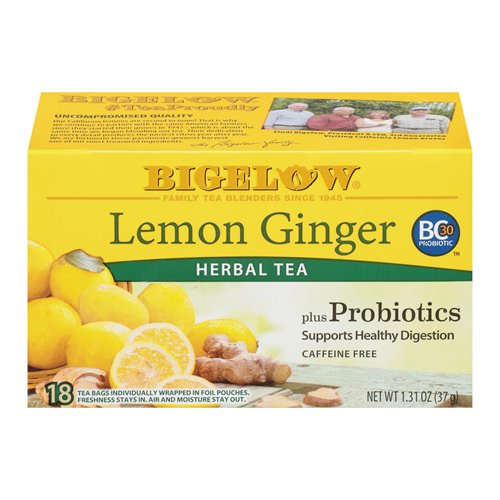
A caffeine-free lemon, ginger and licorice herbal tea with the BC30 probiotic (Bacillus coagulans GBI-30, 6086) in foil-wrapped bags, with no CFU printed.
- Format
- Tea
- Type
- Probiotic and herbal
- Cost
- $0.20 a day
- Customer rating
- 4.7 out of 5 from 9,016 ratings from Amazon
What customers consistently report
- A lemon-ginger flavor that works hot or iced
- Settling the stomach and easing bloating or indigestion
- A caffeine-free cup for the evening
Those are the themes that recur across the reviews. High review confidence — the 4.7 from 9,016 Amazon ratings is independent of the brand’s site and sits close to Target’s 4.66 from 3,703 reviews; the brand’s own widget shows 4.28 from 58 reviews.
The mechanism, as the brand describes it
Ginger is thought to speed gastric emptying and act on nausea pathways; in one 11-person dyspepsia trial 1.2 g of ginger quickened emptying without changing symptoms. Lemon, lemongrass, lemon verbena and rose hips mainly supply flavor and plant polyphenols. B. coagulans GBI-30 is a spore former, so it is expected to survive hot water and stomach acid, and in the tea-specific lab study spores came through brewing and a gut simulation; how it acts in people is not established beyond the small IBS trials. Licorice root contains glycyrrhizin, which in large or long-term amounts raises blood pressure and lowers potassium. The organism and the order of ingredients can be checked on the box; the CFU, the ginger amount and the licorice amount cannot.
What has actually been tested
No study has tested this tea. The probiotic, Bacillus coagulans GBI-30, 6086, was tested in two small capsule trials in irritable bowel syndrome (44 people, abdominal pain and bloating scores improved within the group; 52 people with diarrhea-predominant IBS, fewer daily bowel movements), both described by their authors as preliminary. Ginger trials are of capsules and powder, mostly for nausea, and no trial of licorice or ginger tea for a gut symptom was found. A laboratory study of a different B. coagulans herbal tea found the spores survived brewing and a simulated gut, but it does not measure this product.
What the panel prints, and what it leaves out
The label names the probiotic with its strain code, so it can be traced to published trials, but it prints no CFU count, so the dose cannot be compared with any trial. The brand says the probiotic is protected from heat by a natural shell and gives no survival figure. Ginger is listed seventh, after flavors, lemon verbena and rose hips, with no amounts for any herb; the list includes natural flavors with soy lecithin and licorice root with no printed warning.
Herb entries for what is in it: Ginger, Licorice. Each one gives the plant, what the traditions use it for, the trials, doses and the safety record.
When it makes sense
We match this product to people reporting general abdominal discomfort. It fits someone whose priority is a steady daily routine or handling meals. Lemon Ginger Plus Probiotics Herbal Tea can match on symptoms and still lose to something else once your history, your format and your medicines are in.
Where it falls short of the brief
The dietary claims the label makes are gluten-free and no added sweeteners. A tea only works if you will take it as often as the label directs.
Side effects and what to be aware of
A minority of reviewers say the flavor is artificial, weak or not lemon or ginger, several say the recipe changed in the last year or two, and some report stomach upset or throat irritation that they attribute to the probiotic. Several reviewers also ask whether the probiotic survives boiling water. No warning is printed on the pages read, although licorice root is in the list.
Questions people ask
Does Bigelow Lemon Ginger plus Probiotics tea work?
No trial of this tea exists. The probiotic strain, Bacillus coagulans GBI-30, 6086, improved abdominal pain and bloating scores in a 44-person IBS pilot and cut daily bowel movements in a 52-person IBS-D pilot, both as daily capsules. Bigelow prints no CFU count, so whether a cup matches those doses cannot be checked. Amazon reviewers often say it settles the stomach (55 of 59 digestion mentions are positive).
What is in Bigelow Lemon Ginger plus Probiotics tea?
Lemongrass, lemon peel, cinnamon, natural ginger and lemon flavors with other natural flavors (soy lecithin), lemon verbena, rose hips, ginger, licorice root, BC30 (Bacillus coagulans GBI-30, 6086) and citric acid, in that order, with no per-bag amounts. Each 18-bag box weighs 37 g, about 2 g a bag.
Do the probiotics in Bigelow tea survive boiling water?
Bigelow says the probiotic is protected from heat and acidity by a natural shell and that it needed one that survives boiling water, with no survival figure or CFU count. A laboratory study of a different tea containing the same species found spores survived brewing and a gut simulation, but it did not test Bigelow’s product.
How much does Bigelow Lemon Ginger plus Probiotics tea cost per cup?
About $0.20 a cup: $21.95 for 108 bags on the brand site, $21.12 on Amazon, and $3.79 for 18 bags at Target, about $0.21 a cup.
Bigelow Lemon Ginger plus Probiotics side effects and who should avoid it?
No warning is printed on the pages read. Some reviewers report stomach upset or throat irritation, and the list includes licorice root, whose glycyrrhizin can raise blood pressure and lower potassium with long or heavy use. It lists soy lecithin in the flavors.
Would it come out on top for you?
Answer the quiz to see whether Lemon Ginger Plus Probiotics Herbal Tea fits your case or whether a product in the same role fits better.
Take the quiz →Free. Private. Nothing to sign up for.
Its peers in the catalog
Daily gut routine: that is the job Bigelow Lemon Ginger Plus Probiotics Herbal Tea does, and these are the other entries doing it.
See all the products we have researched →
Further reading
The guides behind the category, written from the trials rather than the labels.