Guide
Does Bigelow Lemon Ginger Plus Probiotics tea work? A named strain, no printed count and no trial of the bag
Quick answer
Does Bigelow Lemon Ginger Plus Probiotics tea work? We found no trial of the tea itself. Its probiotic, Bacillus coagulans GBI-30, 6086, was tested as a daily capsule in two small IBS trials of 44 and 52 people, and both authors called the results preliminary. The label prints no CFU, ginger is seventh of ten ingredients with no amounts, and licorice root is listed with no warning. Amazon shows 4.7 from 9,016 ratings.
Bigelow Lemon Ginger Plus Probiotics Herbal Tea is a caffeine-free bag of lemongrass, lemon peel, cinnamon and other plants with a named strain of Bacillus coagulans added, sold in boxes of 18 foil-wrapped bags. The box says it “supports healthy digestion.” This page goes through the ten-item ingredient list, what the label does and does not say about the probiotic, the trials behind its strain and behind ginger, the licorice root in the list, what reviewers on three sites report, and the price per cup.
Ten ingredients in label order, with ginger seventh
The brand page and the Amazon listing print the same list, in this order: lemongrass, lemon peel, cinnamon, natural ginger and lemon flavors with other natural flavors (soy lecithin), lemon verbena, rose hips, ginger, licorice root, BC30 (Bacillus coagulans GBI-30, 6086) and citric acid. Ginger is the seventh of the ten entries, after the flavors, lemon verbena and rose hips. Ingredient lists run from largest amount to smallest, so the order places ginger well down the bag, though it gives no figure. No per-bag amount is printed for any item, herb or probiotic.
Two entries are worth reading closely. The fourth is a flavor line, “natural ginger and lemon flavors with other natural flavors,” with soy lecithin in brackets, which is how the label names soy; no separate “Contains” line turned up on the pages read. The eighth is licorice root, covered under side effects below. The brand and retailers also describe the tea as gluten-free, kosher (parve), non-GMO and caffeine-free, and the nutrition table (per 8 fl oz) shows zero calories, zero sugar and 25 mg of potassium (1% of the daily value).
The box front prints a net weight of 1.31 oz (37 g) for 18 bags. That works out to about 2.06 g a bag, a total for all ten ingredients together. For scale, the label of the Traditional Medicinals Organic Ginger Tea prints 1,500 mg of ginger rhizome in a bag. Bigelow’s box leaves the ginger share of its 2.06 g unstated.
The probiotic: a named strain, no count, and a heat question
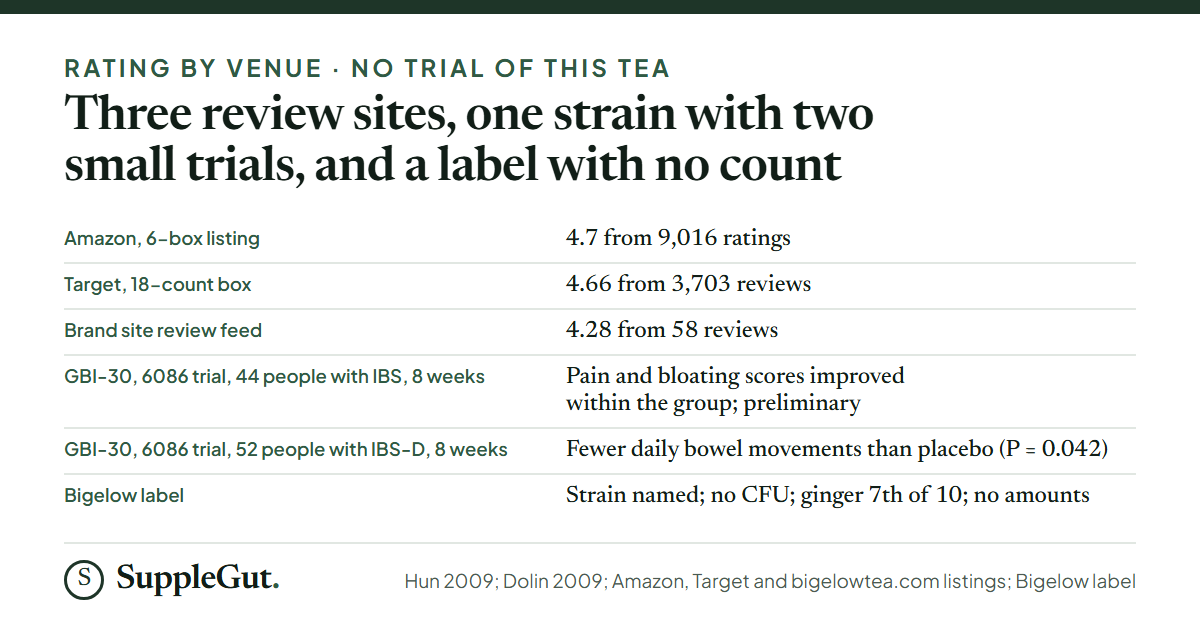
The organism is printed as “BC30 (Bacillus coagulans GBI-30, 6086).” BC30 is the trademark of the ingredient maker Ganeden for that strain, and the Amazon listing calls it “the probiotic Ganeden BC30.” The strain code matters because trials are strain-specific, and this one has published trials. What the label leaves out is the count: no CFU (colony-forming units, the usual tally of live cells) is printed on the box front, the brand page, the Amazon listing or the brand’s probiotic blog post. The box back and sides were not seen. How counts are read is covered in the CFU guide.
B. coagulans forms spores, a tough resting form of the cell. The brand’s blog post says it needed “a type of probiotic that would help support digestive health while also surviving the boiling water,” and that this one “is protected from heat and acidity by a natural shell.” Those are the brand’s statements, and the post gives no survival percentage or count to go with them. Some reviewers ask the same question in their own words, including whether the strain survives boiling water.
The one tea-specific measurement is a laboratory study of a different product: a herbal tea made with the same ingredient, GanedenBC30, run through a gut-simulation model (Polo et al., Journal of Functional Foods, 2022). Per its abstract, the spores came through the infusion well, simulated digestion reduced viability slightly (about 94.8% still viable), and the strain settled in the model’s mucus-layer compartments and was still present four days after the tea stopped. It was a laboratory model of its own tea bag, so it shows the species can survive brewing and says nothing about how many cells a Bigelow bag holds (Polo et al., 2022).
The two small capsule trials of strain GBI-30, 6086
Two randomized, double-blind, placebo-controlled trials tested this strain in irritable bowel syndrome (IBS). Both gave it once a day for eight weeks, and both were given in a capsule or similar dose form, not a tea:
- 44 people with IBS. Abdominal pain and bloating scores improved from baseline in the strain group at all seven weekly comparisons (P < 0.01); in the placebo group only pain scores at weeks 6 and 8 changed significantly. Baseline scores differed between the groups, so only within-group changes were analyzed, and the author called the data preliminary (Hun, Postgraduate Medicine, 2009).
- 52 people with diarrhea-predominant IBS (61 enrolled). Average bowel movements per day fell more than on placebo (P = 0.042). Large variability at baseline kept the authors from assessing severity and quality-of-life scores, and they called it a small pilot study (Dolin, Methods and Findings in Experimental and Clinical Pharmacology, 2009).
A third trial of the strain, in 80 healthy children aged 6 to 8, gave 1 billion CFU a day for three months and reported fewer upper-respiratory symptoms and less flatulence than placebo (Food Research International, 2019). All three are of a daily dose of the strain itself, and the tea label gives no count to set beside any of them. The Triple Mint guide sets out the same two limits for another B. coagulans tea and lists the trials of other named strains.
The trials are small, date from 2009 and measured gut symptoms in people with IBS. Nothing in them speaks to a healthy person drinking a cup for general digestion, which is how the box describes the tea.
Ginger: the trials used capsules and powder, and none tested this tea
No trial of Bigelow Lemon Ginger Plus Probiotics Tea was found. A PubMed search for the brand with probiotic tea or Bacillus coagulans returned nothing, and a ClinicalTrials.gov search found no registered study. Everything below concerns ingredients in other forms.
Ginger has a sizable record, mostly for nausea and almost all of it with capsules or powder:
- 11 people with functional dyspepsia took 1.2 g of ginger in capsules in a crossover. Stomach half-emptying time was 12.3 minutes against 16.1 on placebo (P ≤ 0.05), and symptoms did not differ (Hu et al., World Journal of Gastroenterology, 2011).
- A systematic review of ginger in digestive conditions found that divided daily doses of about 1,500 mg or less were beneficial for nausea, with too few studies to say more for other gut disorders (Nikkhah Bodagh et al., Food Science & Nutrition, 2019).
- For pregnancy nausea, 12 randomized trials in 1,278 women showed lower nausea scores than placebo (mean difference 1.20, 95% CI 0.56 to 1.84), with no significant change in vomiting; the authors rated the evidence low quality (Viljoen et al., Nutrition Journal, 2014).
- After surgery, 14 randomized trials in 1,506 patients showed lower nausea scores at 2, 6 and 12 hours, with no significant difference in vomiting or antiemetic use (Lu et al., International Journal of Nursing Studies, 2021).
Those trials had specified ginger doses; this tea’s box does not. The ginger tea guide lays the trial doses beside a bag with a printed ginger weight. For the other plants in the Bigelow list (lemongrass, lemon peel, lemon verbena, rose hips, cinnamon), no human gut trial turned up in the searches run, and the brand cites none.
Brewing a cup the way the directions say
The brand’s directions: start with fresh cold water, bring it to a rolling boil, pour it over one tea bag, steep 4 minutes and remove the bag. Amazon’s listing gives 3 to 5 minutes, and for iced tea, 6 bags in one quart of boiling water brewed for 7 to 10 minutes. The bag is one cup. No daily amount is stated, and the box does not say whether to drink it with food. The brand describes the bags as plastic-free and compostable. A 4-minute steep in boiling water is the setting the brand’s survival statement refers to, and the box prints no count to show what remains.
Side effects, the licorice root and the missing warning line
No warning, pregnancy line, medication line or age line appears on the brand page, the box front or Amazon’s “Important information” block, which carries only the generic dietary-supplement disclaimer. The box’s rear and side panels were not seen. Licorice root is in the list, with no amount and no warning printed beside it.
Licorice contains glycyrrhizin, which gut bacteria convert to glycyrrhizic acid and then to glycyrrhetic acid; glycyrrhetic acid blocks an enzyme (11-beta-hydroxysteroid dehydrogenase type 2) that otherwise keeps cortisol from acting like the salt-retaining hormone aldosterone. A 2020 review of clinical trials concluded that chronic use of licorice can lead to low potassium and high blood pressure, and that some people are more sensitive to it than others (Kwon et al., Journal of Medicinal Food, 2020). A 2017 toxicology review named hypertension and low-potassium disorders as licorice’s most important side effects, said it needs caution in pregnancy, and listed older age, female sex, anorexia nervosa and existing low potassium among the things that raise the risk (Nazari et al., Phytotherapy Research, 2017). Both are reviews of licorice in general, not of tea, and the amount in a Bigelow bag is not printed, so these findings cannot be turned into a number for a cup.
On the review sites, the brand’s own review feed groups 13 mentions under “causes stomach issues,” 11 under “probiotics upset stomach” and 11 under “some throat irritation.” Amazon’s summary counts 59 mentions of digestive effects, 55 of them positive and 4 negative. The usual effects of probiotics and when people stop are in the probiotic side effects guide.
What reviewers report on Amazon, Target and the brand’s own site
The three sites sit close together except for the brand’s own feed:
- Amazon: 4.7 out of 5 from 9,016 ratings on the six-box listing: 85% five-star, 9% four, 3% three, 1% two and 2% one.
- Target: 4.66 from 3,703 reviews on the 18-count box, with 83% five-star.
- bigelowtea.com: 4.28 from 58 reviews on a review app the brand hosts: 45 five-star, 2 four, 1 three, 2 two and 8 one-star, of which 24 are marked verified buyer.
Amazon’s summary of review text counts 358 mentions of flavor (286 positive, 72 negative), 336 of taste (298 positive, 38 negative), 78 of value for money (63 positive, 15 negative), 65 of soothing (63 positive) and 29 of caffeine-free (25 positive). Praise falls into three groups: a lemon-and-ginger flavor that works hot or iced, a stomach that settles or feels less bloated, and a caffeine-free cup for the evening.
The complaints are specific. The brand’s review feed lists “not enough ginger” 23 times, “formula taste changes” 23 times and “artificial taste” 22 times in its 58 reviews. Some reviewers say the flavor comes from added flavoring and not real ginger; the label lists both a ginger flavor (fourth) and ginger itself (seventh). Several reviewers say the tea changed: one 2026 review dates a bland taste to “late 2025,” and others from 2023 and 2024 describe a new recipe that tastes different or irritates the throat. The brand pages read do not announce a reformulation, so these are reviewers’ accounts. A few reviewers report stomach upset they attribute to the probiotic. Amazon’s full review pages need a sign-in, so only the summary snippets were read there.
The brand’s refund policy offers an exchange or refund within 30 days if you are not satisfied, and says shipping is non-refundable. The brand store has no subscription, and no billing complaint turned up.
Price per cup
| Where | Price | Bags | Per cup |
|---|---|---|---|
| Brand site, case of six boxes | $21.95 | 108 | $0.20 |
| Amazon, one-time purchase | $21.12 | 108 | $0.20 |
| Amazon, Subscribe & Save | $20.06 | 108 | $0.19 |
| Target, one box | $3.79 | 18 | $0.21 |
All four routes land within two cents of each other. The brand offers 10% off a first purchase for an email signup, and the tea is also sold in many grocery chains. At one cup a day, a 108-bag case lasts about 15 weeks.
Bigelow beside Triple Mint probiotic tea and beside a capsule
Against Triple Mint. The Traditional Medicinals Organic Triple Mint Daily Probiotic Tea also contains B. coagulans, but it names the species only, while Bigelow names the strain, GBI-30, 6086. Neither prints a CFU count or herb amounts. Triple Mint has four ingredients (lemon balm, peppermint, spearmint and the probiotic) in a 1.5 g bag with a printed caution line that includes a drowsiness warning; Bigelow has ten ingredients in a 2.06 g bag and prints no caution. Triple Mint steeps 10 minutes and is directed up to three cups a day; Bigelow steeps 3 to 5 minutes and gives no daily amount. Amazon shows 4.8 from 1,976 ratings for Triple Mint and 4.7 from 9,016 here, and the Amazon price per cup is $0.37 against $0.20. Neither tea has been tested in a trial as a brewed cup.
Against a capsule. A B. coagulans capsule such as Thorne Bacillus Coagulans prints an amount, 133 mg a capsule, and names the species. A capsule is a defined daily dose that matches the form used in the strain trials; a bag has an unstated count that may change with brewing. No study compares a probiotic tea with a capsule.
Who this tea suits
- Someone who wants a caffeine-free lemon and ginger cup, hot or iced, at about 20 cents a bag, which is what the reviews praise most.
- Someone content to take the probiotic without a printed count, knowing the strain’s trials were of daily capsules and the tea itself has none.
- Someone who has weighed the licorice root, particularly if they have high blood pressure, low potassium or are pregnant, and who has checked with a practitioner, since the box prints no line on it.
- Someone avoiding soy, since soy lecithin is named in the flavors.
To start from a symptom instead, the which probiotic guide and the quiz are the places to begin.
The products in this catalog
Common questions
Has any study tested Bigelow Lemon Ginger Plus Probiotics tea?
No. A PubMed search and a ClinicalTrials.gov search found no study of the tea. Its strain, Bacillus coagulans GBI-30, 6086, was tested in IBS trials of 44 and 52 people, both with a daily capsule-type dose and both described by their authors as preliminary or a pilot.
Which probiotic is in the Bigelow tea, and is a CFU count printed?
The label names BC30 (Bacillus coagulans GBI-30, 6086), which is a deposited strain with published trials. No CFU count is printed on the box front, the brand page or the Amazon listing, so the dose cannot be compared with any trial.
Can a probiotic live through a cup of boiling water?
The brand says its probiotic is “protected from heat and acidity by a natural shell” and gives no survival figure. A laboratory study of a different tea made with the same ingredient found the spores came through brewing and a gut simulation. It did not test Bigelow’s bag.
Is there real ginger in this tea, and how much?
The list has both “natural ginger and lemon flavors” (fourth) and ginger (seventh of ten). No per-bag amount is printed for any item; the whole bag weighs about 2.06 g. Some reviewers say the ginger is faint, and 23 of the 58 reviews on the brand’s feed carry a “not enough ginger” theme.
Does the licorice root in Bigelow lemon ginger tea matter for blood pressure?
Reviews of licorice report that long-term or heavy intake of its glycyrrhizin can lead to high blood pressure and low potassium, and that some people are more sensitive. The amount in a bag is not printed and the pages read show no warning line, so no figure can be given for a cup.
Did Bigelow change the recipe of this tea?
Several reviewers on the brand’s feed say the taste changed, including one 2026 review that dates it to late 2025. The brand pages read do not announce a reformulation, so these are reviewers’ accounts. The ingredient list on the brand page and on Amazon is identical.
How much does one cup of this tea cost?
About $0.20: $21.95 for 108 bags on the brand site, $21.12 on Amazon ($20.06 with Subscribe & Save, $0.19) and $3.79 for 18 bags at Target ($0.21).
How does it differ from Traditional Medicinals Triple Mint probiotic tea?
Bigelow names its strain (GBI-30, 6086) and lists ten ingredients with no caution line. Triple Mint names the species only, lists four ingredients, prints a drowsiness caution and steeps for 10 minutes. Neither prints a CFU count.
Sources
- Hun L. “Bacillus coagulans significantly improved abdominal pain and bloating in patients with IBS.” Postgraduate Medicine, 2009;121(2):119–124. PubMed 19332970
- Dolin BJ. “Effects of a proprietary Bacillus coagulans preparation on symptoms of diarrhea-predominant irritable bowel syndrome.” Methods and Findings in Experimental and Clinical Pharmacology, 2009;31(10):655–659. PubMed 20140275
- GanedenBC30 in 80 healthy school-aged children (1 × 10⁹ CFU a day for three months). Food Research International, 2019. PubMed 31554075
- Polo A, Cappello C, Carafa I, et al. “A novel functional herbal tea containing probiotic Bacillus coagulans GanedenBC30: an in vitro study using the Simulator of the Human Intestinal Microbial Ecosystem (SHIME).” Journal of Functional Foods, 2022. doi.org/10.1016/j.jff.2021.104873
- Hu ML, Rayner CK, Wu KL, et al. “Effect of ginger on gastric motility and symptoms of functional dyspepsia.” World Journal of Gastroenterology, 2011;17(1):105–110. PubMed 21218090
- Nikkhah Bodagh M, Maleki I, Hekmatdoost A. “Ginger in gastrointestinal disorders: A systematic review of clinical trials.” Food Science & Nutrition, 2019;7(1):96–108. PubMed 30680163
- Viljoen E, Visser J, Koen N, Musekiwa A. “A systematic review and meta-analysis of the effect and safety of ginger in the treatment of pregnancy-associated nausea and vomiting.” Nutrition Journal, 2014;13:20. PubMed 24642205
- Lu C, Chen X, Yan X, He J, Nie Z. “The preventive and relieving effects of ginger on postoperative nausea and vomiting: A systematic review and meta-analysis of randomized controlled trials.” International Journal of Nursing Studies, 2021;125:104094. PubMed 34700257
- Kwon YJ, Son DH, Chung TH, Lee YJ. “A Review of the Pharmacological Efficacy and Safety of Licorice Root from Corroborative Clinical Trial Findings.” Journal of Medicinal Food, 2020;23(1):12–20. PubMed 31874059
- Nazari S, Rameshrad M, Hosseinzadeh H. “Toxicological Effects of Glycyrrhiza glabra (Licorice): A Review.” Phytotherapy Research, 2017;31(11):1635–1650. PubMed 28833680
- Bigelow Tea: product page, ingredient list, directions, price and refund policy; probiotic blog post. bigelowtea.com
- Amazon listing for Bigelow Lemon Ginger Plus Probiotics Herbal Tea, 6-pack (ASIN B002XWSNCA): ingredient field, price, ratings and review summary. amazon.com
- Target listing for the 18-count box: price, rating and reviews. target.com
Which of these fits you?
Three minutes with the quiz turns this background into one named product, with the reasons shown.
Take the quiz →