Guide
Does Yogi Lemon Ginger tea work? Ginger first in a 1,971 mg six-herb bag, and no trial of the tea
Quick answer
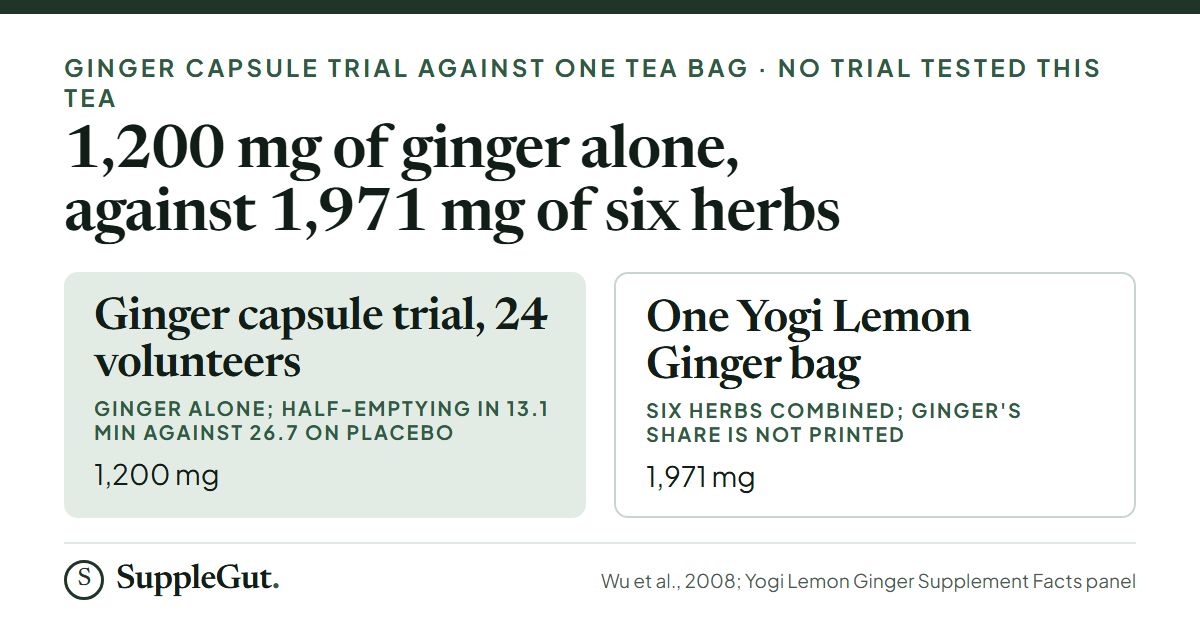
Does Yogi Lemon Ginger tea work? No trial of this tea was found. Ginger is listed first, and in the gastric emptying trial 1,200 mg of ginger in capsules halved the time to empty half a meal (13.1 against 26.7 minutes in 24 volunteers). A Yogi bag holds 1,971 mg of six herbs together, with no amount printed for ginger. Licorice root is in the blend, and Amazon shows 4.7 from 3,114 ratings.
Yogi Lemon Ginger is a caffeine-free organic tea bag of ginger root, lemongrass, licorice root, lemon peel, peppermint leaf and black pepper, sold in 16-bag boxes under the line “the sweet and zesty way to a soothed stomach.” Its panel prints one total for the bag, 1,971 mg of herbs, and does not split it. This page sets that total beside the ginger trials, then covers the licorice in the blend, the steeping directions, the box warning, the reviews and the cost of a cup.
One blend of six herbs on a tea bag with a Supplement Facts panel
The box front reads “Supports healthy digestion” and “Herbal Supplement,” which is why a tea bag carries a Supplement Facts panel and not a food nutrition table. The brand’s image of the panel gives a serving as one tea bag making 8 fl oz:
| Line on the panel | Per tea bag |
|---|---|
| Proprietary blend of herbs | 1,971 mg |
| Organic ginger root, lemongrass, licorice root, lemon peel, peppermint leaf, black pepper | No separate amounts |
| Other ingredients | Organic lemon flavor, citric acid |
The box weighs 36 g across 16 bags, or 2.25 g a bag. With 1.971 g of herbs, that leaves about 0.28 g for the lemon flavor and citric acid, which is our arithmetic and not a printed figure. The ingredient list on the brand’s page and on Amazon runs ginger root, lemongrass, lemon flavor, licorice root, lemon peel, peppermint leaf, black pepper and citric acid. Lists run from most to least by weight, so by that reading ginger is the largest herb, though the brand does not say its list is in weight order.
The brand lists USDA Organic (certified by QAI, as printed on the panel), Non-GMO Project Verified, vegan, OU Kosher and certified B Corp. Amazon’s bullets add gluten-free and “no artificial flavors or sweeteners.” No testing for potency or contaminants is stated. The panel marks every herb “daily value not established.”
What the ginger trials used against what a bag could hold
A PubMed search on the product name with tea, digestion, nausea and dyspepsia found no trial of Yogi Lemon Ginger, and none for any ginger tea. The brand’s claim is a quoted line, “ginger and peppermint have been used by herbalists worldwide to support healthy digestion and soothe an upset stomach,” followed by the standard FDA disclaimer. The ginger research sits in capsules and extracts.
The trial that best fits the brand’s word “digestion” measured how fast the stomach empties. In 24 healthy volunteers, 1,200 mg of ginger in capsules or placebo was taken before a soup meal, in a crossover design. Half the meal left the stomach in 13.1 minutes with ginger against 26.7 minutes with placebo (P < 0.01), and contractions in the lower stomach were more frequent. Symptoms did not differ between the two arms (Wu et al., European Journal of Gastroenterology & Hepatology, 2008). A trial in 11 people with functional dyspepsia used 1.2 g of ginger capsules and found half-emptying at 12.3 minutes against 16.1 on placebo, again with no change in symptoms (Hu et al., World Journal of Gastroenterology, 2011). A 1993 crossover trial reached the opposite result, with ginger not changing the emptying rate (Phillips et al., Anaesthesia, 1993).
Set against the bag, the 1,200 mg dose is the point. A Yogi bag holds 1,971 mg of all six herbs, so ginger would need about 61% of the blend to reach the capsule dose, and the lemon flavor and citric acid sit on top of that weight. Steeping for 7 minutes also pulls only part of what is in a bag into the cup, and no study measured how much ginger reaches this one. The ginger tea guide sets the same trial doses beside a single-herb ginger bag.
The symptom trials used extracts, not tea
Two trials in people with dyspepsia, an unsettled upper stomach with fullness, pain or nausea, tested ginger products against placebo. In 126 patients, two capsules a day of a ginger and artichoke leaf extract for 4 weeks beat placebo for nausea, epigastric fullness, pain and bloating (Giacosa et al., Evidence-Based Complementary and Alternative Medicine, 2015). That is a combination extract, not ginger alone. In 80 adults with mild to moderate functional dyspepsia, 480 mg a day of a steamed ginger extract improved symptom scores against placebo over 12 weeks (P < 0.001), and two of the authors work at a pharmaceutical company’s institute, with the funding not read here (Baek et al., Food & Function, 2025).
A Cochrane review of non-Chinese herbal medicines for functional dyspepsia (41 trials, 4,477 participants) lists the ginger and artichoke extract as possibly helpful, with a risk ratio of 1.64 (95% confidence interval 1.27 to 2.13) from the one study of 126 participants, at low certainty (Báez et al., Cochrane Database of Systematic Reviews, 2023). None of these products is the tea in the bag.
Licorice root is fourth in the ingredient list
Licorice root sits after ginger, lemongrass and lemon flavor, with no amount of its own inside the 1,971 mg. One extract has been tested for dyspepsia: a flavonoid-enriched Glycyrrhiza glabra extract at 75 mg twice a day for 30 days lowered symptom scores against placebo in 54 enrolled patients (Raveendra et al., Evidence-Based Complementary and Alternative Medicine, 2012). The Cochrane review above lists it at moderate certainty from that one study, with 50 patients analyzed. It was an extract, not a tea, and nothing in the bag tells you how it compares.
The other side of licorice is glycyrrhizin. A toxicology review names hypertension and low potassium as the most important side effects of licorice and glycyrrhizin (Nazari et al., Phytotherapy Research, 2017), and a review of licorice root trials says chronic use can lead to low potassium and high blood pressure, with some people more sensitive than others (Kwon et al., Journal of Medicinal Food, 2020). Those reviews describe heavy or long use of the ingredient and did not test this tea. The general warning on the panel is the only licorice-relevant caution printed.
Peppermint, lemongrass, lemon peel and black pepper
Peppermint is in the blend as leaf, with no amount printed. The IBS trials of peppermint used oil in capsules, and the peppermint tea guide covers what is and is not known about the leaf. Lemongrass searches returned reviews, rodent work and test-tube work, including essential oils against Helicobacter pylori in vitro, and we could find no human gut trial. The same holds for lemon peel and black pepper. Piperine from black pepper slowed gastric emptying and transit in rats and mice, which is an animal result. These herbs have a traditional place in digestive teas, and no measured effect on a person’s gut is on record for them.
Seven minutes in boiling water, one bag or two
The directions on the box: bring water to a boil, pour it over one bag and steep for 7 minutes. For a stronger tea, use 2 tea bags. A serving is one bag in 8 fl oz, and the brand gives no daily amount and no timing, apart from pairing the tea on its page with a gentle, clockwise stomach massage. The tea has no caffeine, and the bags are compostable. Reviewers drink it hot or cold, and some add honey.
The box warning, and the allergen line that is not on the box
The warning on the panel and in Amazon’s safety field reads: consult your healthcare provider prior to use if you are pregnant or nursing, taking any medication or if you have a medical condition. That covers many readers, and it is the only warning printed. The blend holds no stimulant laxative herb and no caffeine.
The brand’s label and page carry no “contains” line, free-from line or facility statement. Amazon’s attribute table adds “Peanuts may contain,” a line that does not appear on the brand’s panel or page, and its source is unclear. Anyone with a peanut allergy can put that question to the brand.
In the featured Amazon reviews we read, no pattern of side effects stood out.
3,114 Amazon ratings, and an empty review widget on the brand’s page
Amazon shows 4.7 out of 5 from 3,114 ratings on the 16-count box, sold and shipped by Amazon.com, with a star split of 83% five-star, 11% four, 3% three, 1% two and 2% one. iHerb shows 4.6 from 8,297 reviews on its search card. The brand’s own review app returns no reviews for this tea, so there is no brand-hosted score to set beside those. Amazon’s summary of review text counts 126 mentions of taste (108 positive, 18 negative), 31 of digestion (28 positive, 3 negative), 12 of soothing (all positive), 16 of ginger strength (10 positive, 6 negative) and 13 of value (9 positive, 4 negative). The Amazon “see all reviews” page needs sign-in, so only the summary and the featured reviews were read.
- Praise: a strong ginger and lemon flavor that needs no sweetener; nausea, bloating and an upset stomach easing; a calming cup, with several reviewers liking the saying printed on each bag’s tag.
- Complaints: a flavor that runs too faint or too gingery depending on the reviewer, and one buyer who had not realized the tea holds other herbs as well as ginger.
A cup from a 16-bag box, by route
| Where | Price | Bags | Per cup |
|---|---|---|---|
| Amazon, one time | $3.68 | 16 | $0.23 |
| Amazon, Subscribe & Save | $3.50 | 16 | $0.22 |
| iHerb | $4.91 | 16 | $0.31 |
| Brand site | $6.99 | 16 | $0.44 |
The brand’s page sells one box at a time, with free shipping on orders over $35 and no subscription. It publishes a 60-day satisfaction guarantee for US purchases from the brand or authorized sellers, with a refund or replacement on request. Amazon’s Subscribe & Save is Amazon’s own program, and its listing gives food safety as the reason it does not take returns, while damaged or defective items can be refunded or replaced.
Lemon Ginger beside Stomach Ease and a one-herb ginger tea
The Yogi Stomach Ease tea is the same brand’s other digestion bag, and the Stomach Ease guide goes through its panel. The Traditional Medicinals ginger tea holds one ingredient, ginger rhizome at 1,500 mg a bag. Bigelow’s Lemon Ginger Plus Probiotics is another lemon and ginger tea with licorice in it, and its probiotic is covered in a separate guide.
| Yogi Lemon Ginger | Yogi Stomach Ease | TM ginger | |
|---|---|---|---|
| Herbs | Six, led by ginger | Seven, with fennel printed separately | Ginger rhizome |
| Printed per bag | Blend 1,971 mg | Fennel 337 mg; blend 1,361 mg | 1,500 mg |
| Licorice root | Fourth in list | Listed first | None |
The practical difference is what each label lets you check. A single-herb bag gives one plant at a known weight, which can be set beside the capsule doses. Lemon Ginger gives a total for six herbs and an ingredient order, and no trial compares the three teas.
Who this cup suits
- Someone who wants a lemon and ginger flavor with peppermint and spice in one bag, with no sweetener and no caffeine.
- Someone comfortable with licorice root in the blend and not in a group the label’s warning singles out.
- Someone choosing by price per cup, with the same bag sold from $0.22 to $0.44 a cup depending on the route.
A reader who wants a known weight of ginger can compare the single-herb ginger tea above, and the quiz starts from symptoms and goals.
The products in this catalog
Common questions
Does Yogi Lemon Ginger tea help with nausea or an upset stomach?
No trial of this tea turned up in PubMed. The brand says it supports healthy digestion and soothes an upset stomach, and it does not claim nausea relief. Reviewers on Amazon mention nausea and bloating, and 28 of 31 mentions of digestion in Amazon’s review summary are positive.
How much ginger is in one bag?
The label does not print it. Ginger root is the first of six herbs in a 1,971 mg proprietary blend, along with lemongrass, licorice root, lemon peel, peppermint leaf and black pepper. For a bag to match the 1,200 mg of ginger used in the capsule trials, ginger would have to be about 61% of the blend by weight.
Is there licorice in Yogi Lemon Ginger tea, and does the warning apply to me?
Yes, organic licorice root is the fourth item in the ingredient list, with no amount printed. The panel tells anyone who is pregnant, nursing, taking any medication or living with a medical condition to consult a healthcare provider first. Published reviews link glycyrrhizin from licorice to higher blood pressure and lower potassium, mainly at heavy or long use.
Is this a tea or a supplement?
It is a tea bag, and the box also reads “Herbal Supplement” and carries a Supplement Facts panel. One bag makes an 8 fl oz cup. The panel gives the blend as 1,971 mg per bag and no daily amount.
How much does a cup cost?
A 16-bag box is $3.68 on Amazon, about $0.23 a cup, and $4.91 on iHerb, about $0.31. On the brand’s own site it is $6.99, about $0.44 a cup. Amazon’s Subscribe & Save price is $3.50, about $0.22.
How long should the tea steep, and can you use two bags?
The box says to bring water to a boil and steep for 7 minutes, and to use 2 tea bags for a stronger tea. A serving is one bag in 8 fl oz, and the brand gives no daily amount. The tea has no caffeine.
How does it differ from Yogi Stomach Ease?
Lemon Ginger leads with ginger, lemongrass and lemon peel in a 1,971 mg blend and prints no amount for any single herb. Stomach Ease prints fennel at 337 mg and puts six other herbs, led by licorice, in a 1,361 mg blend. Both carry licorice root and the same consult-a-provider warning, and neither has a trial of the tea.
Sources
- Wu K-L, Rayner CK, Chuah S-K, Changchien C-S, et al. “Effects of ginger on gastric emptying and motility in healthy humans.” European Journal of Gastroenterology & Hepatology, 2008;20(5):436–440. PubMed 18403946
- Hu M-L, Rayner CK, Wu K-L, Chuah S-K, et al. “Effect of ginger on gastric motility and symptoms of functional dyspepsia.” World Journal of Gastroenterology, 2011;17(1):105–110. PubMed 21218090
- Phillips S, Hutchinson S, Ruggier R. “Zingiber officinale does not affect gastric emptying rate. A randomised, placebo-controlled, crossover trial.” Anaesthesia, 1993;48(5):393–395. PubMed 8317647
- Giacosa A, Guido D, Grassi M, Riva A, et al. “The effect of ginger (Zingiber officinalis) and artichoke (Cynara cardunculus) extract supplementation on functional dyspepsia: a randomised, double-blind, and placebo-controlled clinical trial.” Evidence-Based Complementary and Alternative Medicine, 2015;2015:915087. PubMed 25954317
- Baek HI, Ha NR, Kim C, Im TJ, et al. “Efficacy and safety of steamed ginger extract for gastric health: a randomized, double-blind, placebo-controlled multi-center clinical trial.” Food & Function, 2025;16(18):7316–7329. PubMed 40878144
- Báez G, Vargas C, Arancibia M, Papuzinski C. “Non-Chinese herbal medicines for functional dyspepsia.” Cochrane Database of Systematic Reviews, 2023;6:CD013323. PubMed 37323050
- Raveendra KR, Jayachandra, Srinivasa V, Sushma KR, et al. “An extract of Glycyrrhiza glabra (GutGard) alleviates symptoms of functional dyspepsia: a randomized, double-blind, placebo-controlled study.” Evidence-Based Complementary and Alternative Medicine, 2012;2012:216970. PubMed 21747893
- Nazari S, Rameshrad M, Hosseinzadeh H. “Toxicological effects of Glycyrrhiza glabra (licorice): a review.” Phytotherapy Research, 2017;31(11):1635–1650. PubMed 28833680
- Kwon Y-J, Son D-H, Chung T-H, Lee Y-J. “A review of the pharmacological efficacy and safety of licorice root from corroborative clinical trial findings.” Journal of Medicinal Food, 2020;23(1):12–20. PubMed 31874059
- Yogi Lemon Ginger: product page, Supplement Facts panel image, box image and satisfaction guarantee. yogi-life.com; Amazon listing (ASIN B000QYCJMW) with ingredient list, safety information, price, ratings and review summary. amazon.com
Still deciding between products?
The guide gives the background. For a single answer, the quiz asks about your symptoms, your routine and what you have tried, then names one product.
Take the quiz →