
Daily gut routine
Good Bacteria Rotating Synbiotic
A once-a-day unflavored powder sachet whose prebiotic, probiotic and postbiotic blend changes every week over a 28-day cycle.
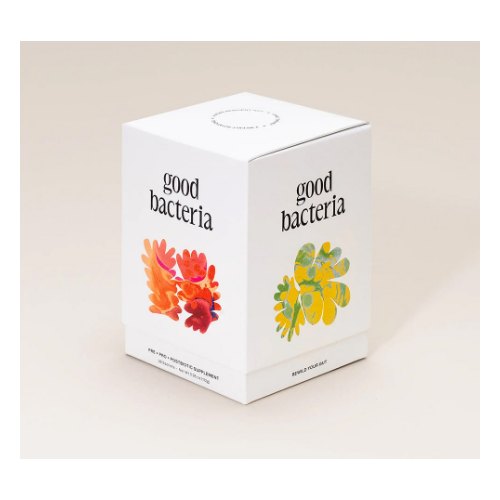
- Format
- Powder, once a day
- Type
- Probiotic, prebiotic and postbiotic
- Cost
- $2.29 a day
- Customer rating
- 4.4 out of 5 from 40 ratings from Amazon
What the accounts we could find say
- Less bloating within the first weeks
- A tasteless powder that mixes into water or a smoothie
- Weekly sachet packs that make the rotation simple
There is not enough independent feedback here to call those themes reliable. Low review confidence — the 5.0 from 124 reviews is shown only on the brand’s own page and has no review under four stars, Amazon’s independent 4.4 rests on 40 ratings, and Trustpilot shows one review.
Why it might work
The prebiotic blend (acacia fiber, fructooligosaccharides and green banana powder) is fermented by gut bacteria and is meant to feed them. FOS studies find more Bifidobacterium at doses above 5 g, and this whole blend is 3 g with the split not printed. The weekly probiotic blends carry lactobacilli in Weeks 1 and 2 (LGG in both) and bifidobacteria (BB-12) in Weeks 3 and 4, and the postbiotic is 100 mg of heat-inactivated L. reuteri every day. The brand’s idea is that changing strains each week adds variety; no trial of that idea was found. The label does not let you check how much of any single strain you receive.
What the research supports
No trial of this product or of its weekly rotation was found. Some strains in the formula have their own trials, such as BB-12 in 1,248 adults with infrequent bowel movements (more days with a bowel movement at 1 or 10 billion CFU), but this label does not print amounts per strain and counts in AFU rather than CFU, so those doses cannot be compared. Meta-analyses of probiotics for bloating and irritable bowel syndrome find some benefit with low to very low certainty, in people with those conditions.
What the label discloses
Every strain on all four weekly panels carries a strain designation, such as LGG, BB-12, LA-5 and a set of UAL codes, but only a blend weight and a blend count are printed (7, 12, 15 and 12 billion AFU across the four weeks). The brand states third-party testing and a GMP facility without naming a laboratory. The page shows two different Week 2 panels, and the 3 g fiber claim sits beside a panel that prints 2 g of dietary fiber.
Who this tends to suit
We match this product to people reporting bloating, irregular bowel habits, general abdominal discomfort and gas. It fits someone whose priority is a steady daily routine, day-to-day comfort or regularity. Whether it is the best fit for you depends on the rest of your answers — what you have already tried, what format you will take, and anything that has to be ruled out.
Where it may not fit
The label supports gluten-free, no added sweeteners, dairy-free and vegan. We flag this product for anyone pregnant or breastfeeding, and the quiz removes it rather than recommending it in those cases. That is a caution about who should be deciding, not a claim about the product. A powder only works if you will take it once a day, every day.
Side effects and what to be aware of
Reviewers on the brand’s site, where all 124 reviews are four or five stars, mention gas, cramping or loose stools in the first weeks, and some report no change yet. The label’s only warning is the pregnancy and nursing line on the page. The brand states a first-order 28-day money-back guarantee on its policy page while its product page says 90 days.
Common questions
Does Good Bacteria Rotating Synbiotic work?
No trial of the finished product or of weekly rotation was found. Some of its strains have trials of their own, such as BB-12 in 1,248 adults with infrequent bowel movements, but the label prints no per-strain amounts, so those doses cannot be matched. Reviewers on the brand’s page, which has 124 reviews and none below four stars, mostly report less bloating and more regular digestion within two to four weeks.
Is Good Bacteria safe, and does it have side effects?
The label’s only warning is to consult a healthcare provider if pregnant, nursing or planning pregnancy. Several reviewers report gas, cramping, gurgling or loose stools in the first weeks, and the brand itself describes a month of adjustment. The panel lists organic rice hulls as the only other ingredient.
How does the weekly rotation work?
Each box holds four weekly packs of seven 4 g sachets. Each week’s panel prints a different five-strain probiotic blend (7, 12, 15 and 12 billion AFU), the same 3 g prebiotic blend of acacia fiber, FOS and green banana powder, and the same 100 mg inactivated L. reuteri postbiotic. The brand says one sachet daily, mixed into a cool drink or food, not hot.
How much does Good Bacteria cost?
A 28-day box is $64 one time ($2.29 a day) on the brand site. Subscribing takes 15% off the first order ($54.40) and 10% off repeat orders ($57.60, $2.06 a day). Amazon lists the one-month box at $59.23, sold by a third party.
Good Bacteria vs Seed: which has more evidence?
No head-to-head trial was found, and Good Bacteria has no trial of its own product; its panels print blend counts in AFU rather than per-strain CFU, while Seed DS-01 prints 24 strains with codes and has a trial of the finished product. Reviewers who switched from Seed or AG1 on the brand’s page say they chose it for the weekly rotation and a lower monthly cost.
Before you take this. Speak to a doctor or pharmacist first if you are pregnant or breastfeeding. Nothing on this page is medical advice, and no supplement diagnoses, treats, cures or prevents disease.
Is this the right one for you?
The quiz works out which of the products we have researched fits your symptoms, your routine and what you have already tried — and tells you plainly if none of them do.
Take the quiz →Free. Private. Nothing to sign up for.
Others we researched for the same job
These sit in the same role as Good Bacteria Rotating Synbiotic — daily gut routine — so they are the sensible things to weigh it against.
See all the products we have researched →
Related reading
Background on how this type of product works, read from the trial evidence.