
Guide
Does Good Bacteria work? Four weekly blends, counts in AFU, and what the strain trials cover
Quick answer
Does Good Bacteria work? We could find no trial of Good Bacteria Rotating Synbiotic or of rotating strains week to week. Its four weekly blends each name five strains, including BB-12 (studied alone in 1,248 adults) and LA-5 with BB-12 (200 people with IBS, together only in Week 3), but the panels print only blend counts in AFU (7, 12, 15 and 12 billion), not per-strain CFU, so no trial dose can be matched. The 3 g prebiotic blend is below the 5 g where FOS trials saw larger Bifidobacterium gains. The brand site shows 5.0 from 124 reviews with none under four stars; Amazon shows 4.4 from 40.
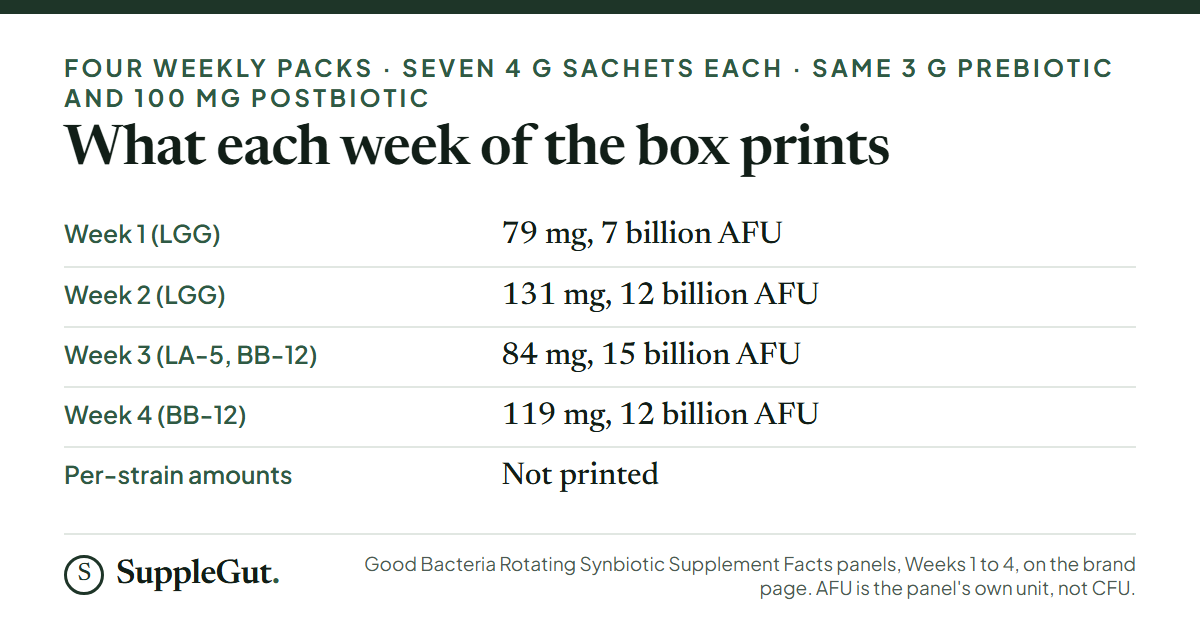
Good Bacteria Rotating Synbiotic is an unflavored powder in a 4 g sachet, taken once a day. A box holds 28 sachets in four weekly packs, and each week’s pack carries a different five-strain probiotic blend, on top of a 3 g prebiotic blend and a 100 mg inactivated postbiotic that stay the same. This page sets out what the four panels print, what trials exist for the strains and the fibers, why the label’s counts cannot be set against trial doses, how the review pools differ, and what the brand’s published terms say.
What Good Bacteria is, and what it is not
The brand sells one product, described on its page as a rotating probiotic system that delivers “a new blend of prebiotics, probiotics, and a postbiotic each week”. Each week has its own Supplement Facts panel. Every panel shares the same serving (one 4 g sachet, 10 calories, 4 g carbohydrate, no sugars), the same GB Prebiotic Blend of 3 g (organic acacia fiber, fructooligosaccharides or FOS, and organic green banana powder, with no grams printed for each) and the same GB Postbiotic of 100 mg (Limosilactobacillus reuteri, trade name PostLreu12). The only other ingredient listed is organic rice hulls. Subtracting the printed weights leaves about 0.8 g of each sachet for the rice hulls and anything else.
What changes is the probiotic blend. Its weight is printed as 79, 131, 84 and 119 mg across the four weeks, with counts of 7, 12, 15 and 12 billion AFU. Every strain on every panel carries a strain designation, a code or trademarked name, which is more than many multi-strain products print. What no panel prints is an amount for any single strain. It is not a single-strain product, it is not a fiber supplement with a probiotic added, and it is not sold as a treatment for a condition: the page makes structure and function claims with the FDA disclaimer.
The four weeks and the strains
The panel for each week lists five organisms. The table gives them with the blend weight and count.
| Week | Blend weight and count | Strains as printed |
|---|---|---|
| 1 | 79 mg, 7 billion AFU | L. acidophilus UALa-01, L. paracasei L.CASEI 431, L. rhamnosus LGG, L. reuteri UALre-16, L. plantarum Lpla33 |
| 2 | 131 mg, 12 billion AFU | L. acidophilus UALa-01, L. rhamnosus LGG, L. gasseri UALg-05, L. paracasei UALpc-04, L. fermentum Lfer67 |
| 3 | 84 mg, 15 billion AFU | L. plantarum UALp-05, L. acidophilus LA-5, B. bifidum UABb-10, B. lactis BB-12, L. gasseri UALg-05 |
| 4 | 119 mg, 12 billion AFU | L. acidophilus UALa-01, L. rhamnosus Lrha-51, L. casei UALc-03, B. lactis BB-12, L. plantarum Lpla33 |
The two best-known strains appear in only some weeks. LGG is in Weeks 1 and 2 only. BB-12 is in Weeks 3 and 4. LA-5 is in Week 3 only, so Week 3 is the only week where it sits beside BB-12. The brand’s text says the product is “powered by strains studied in over 200 clinical trials, including BB-12 and LGG”, which is a brand claim and does not say in which weeks each appears. Averaged over the 28 days, the daily count works out to 11.5 billion AFU, by our arithmetic.
AFU is not CFU
Most probiotic labels state colony-forming units, CFU: the number of cells that can multiply into a colony on a culture plate. The panels here state AFU, defined on the panel as “Active Fluorescent Units: a measure of viable cells using flow cytometry”. Flow cytometry counts individual cells by their fluorescence while a plate counts only the ones that grow, so the two methods measure related but different things, and the label prints no conversion between them. A count of 15 billion AFU therefore cannot be read as 15 billion CFU. The guide to how many CFU you need covers how trial doses are stated.
The consequence is simple. The trials of individual strains state a dose of that strain alone in CFU. This label states one count for five strains together, in a different unit, so no trial dose can be matched to it, and the product cannot be said to sit at, above or below any of them.
The trial of the product itself
There is none. We searched PubMed and ClinicalTrials.gov under the product name and under the rotating-synbiotic description and found no record of a trial. The brand’s science page lists 57 or more references, among them work on fermented foods and diet and on BB-12 safety, and each is about a class of ingredient or a single strain, not this finished formula. The page also refers to “ongoing trials” by independent research organizations without naming one or giving a registry number. No trial of rotating strains week to week, which is the product’s premise, turned up either. The brand’s reasoning is that variety helps; whether it does has not been tested in the records we searched.
The evidence for the strains
Most of the printed designations, among them the UAL codes, Lpla33, Lfer67 and Lrha-51, have little or no published human gut data under those codes. The strains that do have trials are these.
BB-12. In a randomized, double-blind, placebo-controlled trial, 1,248 healthy adults with infrequent bowel movements and abdominal discomfort took BB-12 alone at 1 or 10 billion CFU a day for four weeks. The primary end point, gastrointestinal well-being, was not significant. More people on BB-12 gained at least one bowel movement day a week (odds ratio 1.55, 95% CI 1.22 to 1.96), average frequency was higher than on placebo, and the two doses acted alike (Eskesen et al., British Journal of Nutrition, 2015).
LA-5 with BB-12. A 2026 trial in 200 adults with IBS without constipation, run for 84 days, found an IBS global response at day 28 of 19.3% against 8.9% on placebo (p = 0.048), persisting to day 84, with better pain, distension and quality-of-life scores and no significant difference in adverse events (Ghoshal et al., Journal of Gastroenterology and Hepatology, 2026). The abstract does not state the dose. The participants had IBS, and in this product the two strains are together only in Week 3.
LGG. A meta-analysis of 12 trials in 1,499 people found antibiotic-associated diarrhea in 12.3% on LGG against 22.4% without it (relative risk 0.49, 95% CI 0.29 to 0.83, low certainty); in adults alone the result was not significant (relative risk 0.48, 95% CI 0.20 to 1.15). That outcome is diarrhea after antibiotics, not bloating or regularity (Szajewska and Kolodziej, Alimentary Pharmacology & Therapeutics, 2015).
UABb-10 and UALa-01. UABb-10, in Week 3, was tested inside a four-strain product at 15 billion CFU a day in 94 adults with functional constipation for four weeks. The constipation score did not differ between groups, and both groups improved by more than 20%; stool frequency and consistency normalized faster on the probiotic. UALa-01, in Weeks 1, 2 and 4, has a 12-week trial in 55 postmenopausal women whose outcomes were bone and calcium measures, with no gut outcome.
At the class level, a meta-analysis of 43 trials in IBS and constipation found probiotics reduced persisting symptoms (relative risk 0.79, 95% CI 0.70 to 0.89) and synbiotics did too (0.78, 0.67 to 0.92), while the authors wrote that which strains work “remains unclear” (Ford et al., American Journal of Gastroenterology, 2014). A later meta-analysis of 82 trials in 10,332 people with IBS found combination probiotics beneficial for global symptoms and for bloating, each with very low certainty, and certainty low to very low across almost all analyses (Goodoory et al., Gastroenterology, 2023). Both reviews enrolled people with IBS or constipation.
The prebiotic blend and the fiber figure
The prebiotic is 3 g of acacia fiber, FOS and green banana powder combined, with no split printed. A meta-analysis of eight trials of FOS (213 people on FOS, 175 controls) found Bifidobacterium counts rose more at doses above 5 g (a pooled 1.116) than at 5 g or less (0.521), with no difference in gastrointestinal symptoms against comparators. The whole blend here is under that 5 g line and FOS is only part of it. We read no trial of the acacia or green banana amounts, which are not printed.
The brand’s page says “3g fiber”, while the panels print the 3 g prebiotic blend beside a Dietary Fiber line of 2 g (8% of the Daily Value), and on one copy of the Week 1 panel the fiber line reads 1 g. A blend weight and a dietary fiber weight are different numbers on the same panel, and the brand does not explain the gap.
The postbiotic
Each sachet contains 100 mg of inactivated L. reuteri sold under the name PostLreu12. We found no human trial under that name. The one randomized trial of an inactivated L. reuteri that turned up used a different strain (DSM 17648) as an add-on to H. pylori eradication, a different condition. The postbiotic is therefore an ingredient with no direct evidence behind it here, and it is in every sachet regardless of the week.
Two different Week 2 panels
The product page shows two sets of panel images. Weeks 1, 3 and 4 match between the sets in their organisms, but the second set’s Week 2 image repeats the organisms of Week 1 at Week 2’s weight and count (131 mg, 12 billion AFU). The first set’s Week 2 image lists L. acidophilus UALa-01, LGG, L. gasseri UALg-05, L. paracasei UALpc-04 and L. fermentum Lfer67, which matches the page’s own Week 2 text, so the table above uses it. Which version is on the sachets is not stated on the page.
How to take Good Bacteria
The brand says one sachet a day, on an empty stomach or with the first meal, poured into a drink or food, mixed well and consumed within 30 minutes. It advises against hot food or drink to preserve the organisms. The powder is shelf-stable with no refrigeration, to be kept cool and dry. The packs run Week 1 to Week 4 in order, and the brand recommends committing to at least three cycles, which is about 12 weeks. The brand’s page claims reduced bloating within one week and improved digestion and regularity within two weeks, marked with an asterisk. Reviewers describe the first month as an adjustment period, which matches the page’s own “What to expect” text.
Side effects and who should not take it
The only warning we found is a line in the page’s FAQ: people who are pregnant, nursing or planning pregnancy are advised to consult a healthcare provider first. We found no warning about medicines, immune conditions or age on the page or in the four panel images, and no advice to start slowly.
Reviewers on the brand site and on Trustpilot report gas, cramping, a gurgling feeling or loose stools in the first weeks, with a few describing constipation followed by diarrhea. The complaints appear mostly in 4 and 5 star reviews, from people who stayed on it. Others report no change yet after the first weeks. For class-level safety, the IBS meta-analysis above found adverse events no more common than on placebo.
What the reviews say
Three pools, read separately. The brand’s own site shows 5.0 from 124 reviews: 118 five-star, 6 four-star, and nothing under four stars. The widget marks 117 as verified buyers, and the brand’s terms say reviews are not removed solely for being negative. It is still the seller’s own page. Amazon shows 4.4 from 40 ratings (64% five-star, 18% four, 18% three, none lower), with the review text behind a sign-in; the one-month listing names a third-party seller and the three-month names Good Bacteria. Trustpilot has one review, four stars, on an unclaimed profile whose displayed score is 3.6, a figure that does not match a single four-star review.
In the brand-site reviews we read, 35 of 124 mention bloating and 18 mention regularity or bowel movements, by our count. The recurring praise is less bloating, easier bowel movements, a powder with no taste that mixes into water, a smoothie or yogurt, and the weekly pack format that makes rotation simple; several reviewers say they switched from Seed or AG1. The recurring complaint is the early adjustment period, and a smaller set say they have noticed nothing yet. We found no price complaints on the brand site. Reddit could not be read for this page, so the picture is the three pools above.
The subscription and refund terms
The brand says subscriptions are delivered monthly, can be rescheduled or canceled at any time, and bill recurring charges until canceled, with cancellation online or by email. The refund terms appear in two places and differ. The product page says “90 day risk-free guarantee”. The Shipping and Refund Policy says 28 days, first orders only: a full refund within 28 days of delivery of a first order, one refund per household, with opened or used products not refundable unless defective or damaged, and returns of probiotic products accepted only for a documented quality or safety issue. A three- or six-month bundle requires all boxes returned unopened. Amazon marks the product non-returnable. We found no reports of charges after canceling on the brand widget or Trustpilot, which is an absence of data rather than evidence either way.
Who Good Bacteria is for
- Someone who wants a powder with a prebiotic, a probiotic and a postbiotic in one sachet and is comfortable with a count printed in AFU and no per-strain amounts.
- Someone interested in the weekly-rotation idea who accepts that it has not been tested.
- Someone who will take it daily for at least three cycles, checking the refund window that applies to the order first.
Where a per-strain amount in CFU matters, the Culturelle Digestive Daily Probiotic is a single-strain LGG product, and Seed DS-01 is a multi-strain capsule with a trial of the finished product, covered in the DS-01 guide. For a prebiotic fiber on its own, NOW Foods Acacia is acacia fiber alone. The probiotic chooser and the quiz start from symptoms.
Cost
A 28-day box is $64 one time on the brand site, which is $2.29 a day. Per day by route:
| Route | Price | Per day |
|---|---|---|
| Brand site, one-time box | $64.00 | $2.29 |
| Brand site, 1-month subscription, first order | $54.40 | $1.94 |
| Brand site, 1-month subscription, recurring | $57.60 | $2.06 |
| Brand site, 3-month subscription, first / recurring | $144.00 / $163.20 | $1.71 / $1.94 |
| Brand site, 6-month subscription, first / recurring | $249.60 / $307.20 | $1.49 / $1.83 |
| Amazon, 1-month box | $59.23 | $2.12 |
| Amazon, 1-month Subscribe & Save | $53.99 | $1.93 |
| Amazon, 6-month box | $329.00 | $1.96 |
The 3- and 6-month boxes list at the same $2.29 a day as a single box before the subscription discounts. At the one-time price, three cycles cost $192.
The products in this catalog
Common questions
Does Good Bacteria Rotating Synbiotic work?
No trial of the finished product or of weekly rotation was found. Some of its strains have trials of their own, such as BB-12 in 1,248 adults with infrequent bowel movements, but the label prints no per-strain amounts and counts in AFU rather than CFU, so those doses cannot be matched. On the brand’s page 124 reviews have nothing under four stars and mostly describe less bloating; Amazon shows 4.4 from 40 ratings.
What is AFU, and how is it different from CFU?
AFU stands for Active Fluorescent Units, which the panel defines as a measure of viable cells using flow cytometry. CFU counts cells that grow into colonies on a culture plate, so the two are different methods and the label prints no conversion. The four weeks print 7, 12, 15 and 12 billion AFU for five strains together, while strain trials state CFU for one strain.
How does the weekly rotation work?
Each box holds four weekly packs of seven 4 g sachets. Each week’s panel prints a different five-strain blend, while the 3 g prebiotic blend of acacia fiber, FOS and green banana powder and the 100 mg inactivated L. reuteri postbiotic stay the same. The brand says one sachet a day, mixed into a drink or food and consumed within 30 minutes, not hot. No trial of rotating strains was found.
Does Good Bacteria cause gas or other side effects?
Several reviewers report gas, cramping, a gurgling feeling or loose stools in the first weeks, and the brand describes a first month of adjustment. The label’s only warning is to consult a healthcare provider if pregnant, nursing or planning pregnancy. We found no warning about medicines or immune conditions on the page or panels.
How much does Good Bacteria cost, and what is the refund policy?
A 28-day box is $64 one time, or $2.29 a day. A one-month subscription is $54.40 on the first order ($1.94 a day) and $57.60 after ($2.06), and Amazon lists the box at $59.23. The product page states a 90 day guarantee, while the refund policy states 28 days for first orders only, so the two figures disagree; Amazon marks the product non-returnable.
Good Bacteria or Seed DS-01: which has the stronger evidence?
No head-to-head trial was found. Seed DS-01 has a trial of the finished product, run by the brand, while Good Bacteria has none; Good Bacteria prints a strain designation for every strain but only blend counts in AFU. Reviewers on the brand’s page who switched from Seed say they chose Good Bacteria for the weekly rotation and a lower monthly cost. See the Seed DS-01 page for its label.
How reliable are the Good Bacteria reviews?
The 5.0 from 124 reviews is on the brand’s own site, with 118 five-star and 6 four-star and none lower. The independent figure is Amazon’s 4.4 from 40 ratings, and Trustpilot holds a single review. The brand site’s reviews are consistent in praising less bloating, and they also describe an early adjustment period.
Sources
- Eskesen D, Jespersen L, Michelsen B, et al. Bifidobacterium lactis BB-12 and defecation frequency in healthy adults with low defecation frequency and abdominal discomfort: randomized, double-blind, placebo-controlled trial. British Journal of Nutrition, 2015. PMID 26382580
- Ghoshal UC, et al. Bifidobacterium lactis BB-12 with Lactobacillus acidophilus LA-5 in irritable bowel syndrome without constipation: randomized, double-blind, placebo-controlled trial of 200 patients. Journal of Gastroenterology and Hepatology, 2026. PMID 41255078
- Szajewska H, Kolodziej M. Systematic review with meta-analysis: Lactobacillus rhamnosus GG in the prevention of antibiotic-associated diarrhoea. Alimentary Pharmacology & Therapeutics, 2015. PMID 26365389
- Goodoory VC, et al. Probiotics in irritable bowel syndrome: systematic review and meta-analysis of 82 randomized trials. Gastroenterology, 2023. PMID 37541528
- Ford AC, et al. Prebiotics, probiotics and synbiotics in irritable bowel syndrome and chronic idiopathic constipation: systematic review and meta-analysis. American Journal of Gastroenterology, 2014. PMID 25070051
- Fructooligosaccharides and gut microbiota: meta-analysis of eight randomized trials. Nutrients, 2022. PMID 36014803
- Four-strain probiotic including UABb-10 in functional constipation, randomized trial of 94 adults. Journal of Digestive Diseases, 2019. PMID 31271261
- L. acidophilus UALa-01 in postmenopausal women, randomized trial of 55. Frontiers in Nutrition, 2024. PMID 39010860
- Brand page: label panels, directions, claims and price. itsgoodbacteria.com/products/rotating-synbiotic; science page itsgoodbacteria.com/pages/science; Shipping and Refund Policy itsgoodbacteria.com/policies/shipping-policy; Terms of Service itsgoodbacteria.com/policies/terms-of-service
- Amazon listings: price and ratings. amazon.com/dp/B0GR1FYDXN; Trustpilot profile trustpilot.com/review/itsgoodbacteria.com
Not sure which product fits your situation?
This guide covers the mechanics. The quiz takes your specific symptoms, routine and preferences and matches you to one product from the catalog.
Take the quiz →