Discomfort and cramping
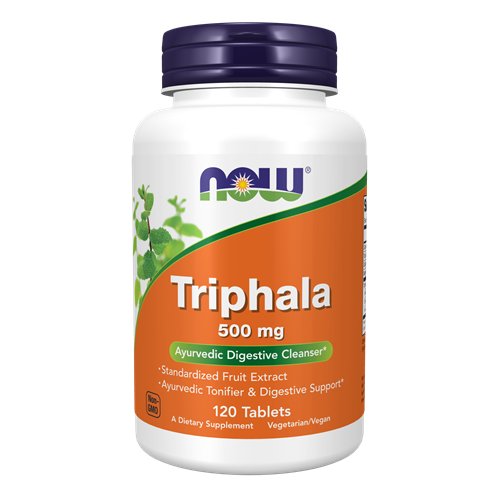
NOW Foods Triphala 500 mg Tablets
A once-a-day, two-tablet Ayurvedic triphala fruit extract standardized to tannins, with 200 mg of magnesium and 120 mg of calcium added.
- Format
- Tablet, once a day
- Type
- Herbal, traditional herbal and magnesium
- Tradition
- Ayurvedic formula
- Cost
- $0.20 per day at two tablets ($12.24 for 120 at Amazon and Vitacost); $0.18 on Amazon Subscribe & Save
- Customer rating
- 4.6 out of 5 from 302 ratings from Amazon
What buyers keep saying
- Easy to swallow with no taste or aftertaste
- A mild effect on regularity and digestion
- A low price for 120 tablets
Those are the themes that recur across the reviews. Moderate review confidence — 4.6 from 302 Amazon ratings and 4.61 from 259 Vitacost reviews are independent of NOW, though the Vitacost reviews were imported from iHerb; NOW’s own page shows no score.
How it is meant to work
Triphala combines the fruits of amla, bibhitaki (belleric myrobalan) and haritaki (chebulic myrobalan), which are rich in tannins and other polyphenols; the traditional use is as a mild bowel and digestive tonic. Tannins are what the label standardizes to (at least 40 percent), but the label does not say how those tannins relate to any effect on the bowel. This tablet also carries 200 mg of magnesium as magnesium oxide, a form the NIH says is commonly reported to cause loose stools at higher doses, so the label does not separate the effect of the fruit extract from the effect of the magnesium. Per-fruit amounts and the extraction ratio are not printed, so the dose of each fruit cannot be compared with any trial.
On the label
The label gives one amount (1,000 mg) for three fruit extracts, with a minimum of 40 percent tannins and no per-fruit amounts, plus 200 mg of magnesium as oxide and 120 mg of calcium. NOW states GMP certification but the product pages do not state heavy-metal testing or name a testing lab, and no Prop 65 warning or country of manufacture appears on the pages read.
The encyclopedia pages for its herbs: Triphala, Amla, Bibhitaki, Haritaki. Each gives the plant, its traditional uses, the human trials and the safety record.
The evidence, such as it is
The evidence here is for triphala as a class, not this tablet. A 4-week placebo-controlled pilot in 31 healthy adults using 2,000 mg a day of triphala found no consistent change in gut bacteria across people, and a 20-person safety study at 2,500 mg a day of triphala extract found no serious adverse effects. No placebo-controlled trial of triphala alone for constipation turned up in PubMed, and this label gives 1,000 mg of extract a day, below both trial doses.
Who it fits
In the quiz it comes up for people who describe irregular bowel habits and constipation. The goal it serves is regularity or a steady daily routine. The rest of your answers decide whether it is the one for you: what you have tried before, the format you will stick with, and anything that rules it out.
When something else fits better
On diet, the label backs gluten-free, dairy-free and vegan. The quiz sets Triphala 500 mg Tablets aside for anyone pregnant or breastfeeding or taking prescription medication and leaves that call to a doctor or pharmacist. It only helps if the tablet is taken once a day, every day.
Side effects, and who should check first
Reviewers’ most common negative is that they noticed no effect; a few report cramping, diarrhea or nausea. The label advises consulting a physician if pregnant or nursing, taking medication, or with a medical condition, and says for adults only.
Common questions
Does NOW Triphala work?
Reviewers are split in the way triphala reviews usually are. Many describe gentle regularity and easier digestion, and a notable share of 3-star reviews say they noticed no difference. The label is for 1,000 mg of mixed fruit extract a day, and PubMed shows no placebo-controlled trial of triphala alone for constipation, so the evidence is for the class rather than this tablet.
Is NOW Triphala safe?
The label says for adults only and to consult a physician if pregnant or nursing, taking medication, or with a medical condition. A 20-person safety study of 2,500 mg a day of a triphala extract for 4 weeks found no serious adverse effects. Some reviewers report cramping, diarrhea or nausea. Heavy metals are a documented concern for Ayurvedic products as a group, and this product’s pages do not state heavy-metal testing.
What are the side effects of NOW Triphala?
Reviewers mention stomach cramping, loose stools, nausea and heartburn, each from a small number of people. Each serving also contains 200 mg of magnesium as magnesium oxide, and the NIH notes magnesium oxide commonly causes diarrhea at higher doses.
How much does NOW Triphala cost?
The 120-tablet bottle is $12.24 at Amazon and Vitacost, which is 60 two-tablet servings or about $0.20 a day. Amazon Subscribe & Save is $11.02, about $0.18 a day. NOW’s own site has listed it at $19.99.
NOW Triphala vs Banyan Botanicals or Himalaya triphala?
NOW prints a single 1,000 mg extract amount standardized to at least 40 percent tannins and adds 120 mg of calcium and 200 mg of magnesium per serving. Banyan prints a 1,000 mg blend of the three whole fruits per two tablets, and Himalaya prints 438 mg of chebulic myrobalan leaf powder plus 250 mg of triphala extract in one caplet; neither adds minerals.
If you are pregnant or breastfeeding, or taking prescription medication. Ask a doctor or pharmacist before Triphala 500 mg Tablets; this page describes the product and the evidence, it does not prescribe.
Is it the one for your symptoms?
A few questions about your symptoms and routine, and the quiz tells you whether Triphala 500 mg Tablets or another product is the closer match.
Take the quiz →Three minutes, no account.
Others we researched for the same job
These sit in the same role as NOW Foods Triphala 500 mg Tablets — discomfort and cramping — so they are the sensible things to weigh it against.
See all the products we have researched →
Related reading
Longer reads on the mechanism and the evidence for products like this one.