Guide
Does Pure Indian Foods triphala powder work? Herbs listed by volume, about $0.09 a day, and a metal test with no lab named
Quick answer
Does Pure Indian Foods triphala powder work? No trial tested this powder, and we found no placebo-controlled trial of triphala alone for constipation or IBS. The panel lists amla, bibhitaki and haritaki at 1/6 teaspoon each in a half-teaspoon serving the brand puts at about 1,300 mg, against 2,000 mg a day in a 4-week microbiome pilot. It costs about $0.09 a day at one serving, and the pouch says it is lab tested for heavy metals without naming a lab or a result. Vitacost shows 4.82 from 132 reviews, all imported from iHerb, and the brand’s Loox widget shows 5.0 from 46.
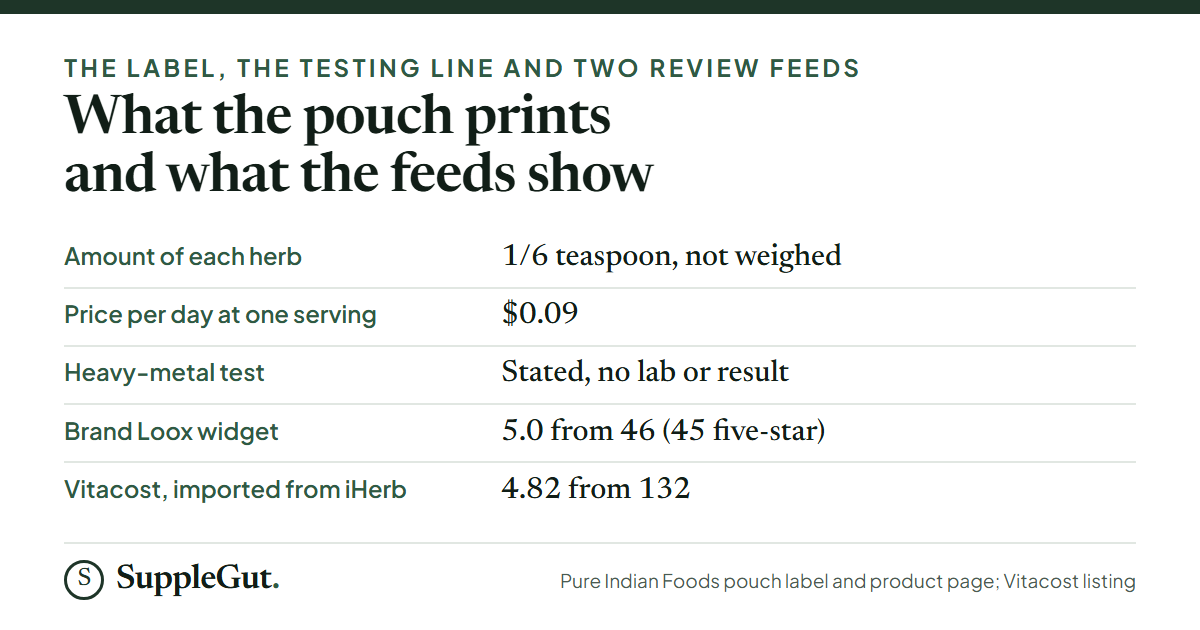
Pure Indian Foods sells triphala as a loose powder of equal parts amla, bibhitaki and haritaki fruit, 8 oz to the pouch, and its label directs half a teaspoon in warm water. The panel lists each fruit as 1/6 teaspoon, a volume and not a weight, and the pouch states a heavy-metal test without naming a lab. This page covers the panel, the price per day beside four other triphala products, what triphala trials used, the testing line and two review feeds of different sizes.
A panel written in teaspoons
The pouch carries Supplement Facts with a serving of 1/2 teaspoon. Each fruit has its own line, so this is not a proprietary blend:
| Line on the panel | Per 1/2 teaspoon |
|---|---|
| Organic amla fruit (Emblica officinalis) | 1/6 tsp |
| Organic bibhitaki fruit (Terminalia bellirica) | 1/6 tsp |
| Organic haritaki fruit (Terminalia chebula) | 1/6 tsp |
| Other ingredients | None; no flow agents |
Equal volume does not guarantee equal weight. A weight appears only on the brand’s product page, which says one serving is “approximately 1300mg.” If the three powders weighed the same, each would be near 430 mg. The pouch prints no servings per container. The 227 g in the pouch divided by 1,300 mg gives about 175 servings, our arithmetic and not a printed figure. Emblica officinalis is the older name for Phyllanthus emblica, the name some labels use.
The brand’s page adds details the pouch does not: haritaki of the Vijaya variety from the Himalayas, amla and bibhitaki from India, and processing kept below 104°F. It does not say where the powder is milled or packed. The pouch states organic certification by NJDA with the USDA Organic seal, and Vitacost lists several further organic certifiers. No GMP statement is made.
Taken in warm water, as the label directs
The label says to take 1/2 teaspoon mixed with warm water, or as directed, and calls the powder fully water-soluble. It prints no frequency and no timing with food. Ayurveda, the traditional medicine of India (our overview), uses triphala as a churna, the word for a powder of dried herbs, and the powder in water is the form the tradition describes. The brand page says the formula is documented in the Charaka Samhita and the Sushruta Samhita, two classical texts, and calls triphala churna the “nectar of life.” A review in the literature also places the formula in those texts (PubMed 28696777), though it is a secondary source and not a reading of the texts themselves.
The brand page also uses the language of doshas. It calls triphala tridoshic, meaning that the tradition holds it to balance vata, pitta and kapha, and the pouch says amla cools pitta, bibhitaki supports kapha and haritaki supports vata. Those are the tradition’s own claims, stated by the brand, and we found no trial that measured a dosha. The page lists uses well beyond the glass of water: a rounded teaspoon at breakfast and after dinner for filling capsules, lemon milk starting at a level teaspoon and rising to up to two tablespoons, ghee for people the tradition calls pitta types, and eye, hair and face rinses. Fifteen of the 132 Vitacost reviews mention skin, face, hair, bath or eye use.
Price per day beside other triphala products
| Product | Per-day figure | At this serving |
|---|---|---|
| Pure Indian Foods powder | $0.09 | One 1/2 tsp serving ($14.99 for 8 oz) |
| NOW Foods tablets | $0.20 | Two tablets ($12.24 for 120) |
| Himalaya caplets | $0.33 | One caplet ($19.99 for 60) |
| Planetary Herbals tablets | $0.37 | Two tablets twice a day ($16.45 for 180) |
| Banyan Botanicals tablets | $0.51 | Two tablets ($22.99 for 90) |
The powder has the lowest per-day figure in the table, and the doses behind each figure differ, so it is a price at each label’s own serving and not a price per milligram. At Vitacost the 8 oz pouch is $14.16, about $0.08 a day. The brand page’s higher use of two rounded teaspoons a day would come to about 5.2 g on the 1,300 mg assumption, which makes a pouch last about 44 days and costs about $0.34 a day. The brand shows no subscription on the product page and a 14-day return window after delivery, with a refund less shipping.
What the triphala trials used
We found no trial of this powder and no placebo-controlled trial of triphala alone for constipation or IBS. The constipation study most often cited followed 34 patients for 14 days in an open-label design with no control group. The product was an Ayurvedic powder of isabgol husk, senna extract and triphala extract, and weekly bowel movements rose from 10.19 to 18.29 while stool form scores rose from 2.97 to 4.61 (Journal of Ayurveda and Integrative Medicine, 2011). The senna and psyllium mean it cannot be credited to triphala. A 2018 review of triphala in functional gut disorders concluded that it holds potential for lower gut symptoms and described mild laxative properties, as a narrative review and not a trial (Chinese Medicine, 2018).
The one placebo-controlled study of the swallowed herb studied gut bacteria. In 31 healthy adults, 2,000 mg a day of triphala, manjistha or placebo for 4 weeks left no bacterial group changed in everyone; among completers (9 on triphala, 11 on placebo) there were trends toward a lower Firmicutes-to-Bacteroidetes ratio and more Akkermansia muciniphila in both herb groups (Journal of Alternative and Complementary Medicine, 2020). One serving here, at about 1,300 mg, sits below that dose. A second registered study, of triphala powder with the VSL#3 probiotic in older adults, is listed as terminated (NCT03907501). Our guide Does triphala work? reads the field as a whole.
Triphala’s best-studied use is a different one. A meta-analysis of 7 trials of triphala mouthrinse against chlorhexidine found pooled differences in gingival index of −0.29 and plaque index of −0.43, with very high heterogeneity (I² 91.8% and 96.1%), and concluded the two were equally effective (PubMed 32383334). A rinse is not a swallowed powder.
The heavy-metal statement
The pouch, the brand page and Vitacost all print one line: “This product has been lab tested for heavy metals, and it complies with U.S. federal and state laws.” The line does not name a lab, the metals tested (lead, mercury, arsenic and cadmium are not listed), the limits applied, a batch or a result, and we found no certificate of analysis on the brand’s site. A reader can treat it as the company’s statement that a test occurred. By comparison, Banyan Botanicals states third-party testing for arsenic, cadmium, lead and mercury across its products, and also posts no certificate.
The published numbers on metals in Ayurvedic products come from a 2008 JAMA survey of 193 medicines bought on the internet, in which 20.7% (95% CI 15.2 to 27.1) had detectable lead, mercury or arsenic, 40.6% of the metal-containing (rasa shastra) products against 17.1% of the others (Saper et al.). It screened finished medicines of many kinds by x-ray fluorescence, and a plain fruit powder falls outside that survey’s main finding. What a buyer can check here is the Latin names, the Supplement Facts panel and the organic certification, and a certificate can be requested from the company. Our guide on Ayurvedic supplement safety lists the rest.
Safety and regulation
The pouch asks anyone pregnant, lactating or with a medical condition to consult a physician before taking an herbal supplement, and the brand page adds taking any medication. No California Prop 65 warning appears on the pouch, brand page or Vitacost. A 2018 review describes triphala as mildly laxative, and 4 of the 132 Vitacost reviews mention cramps, loose stool or feeling sick. The pouch has no “contains” or facility statement for milk, wheat, egg, soy, tree nuts, fish or sesame. In the United States the powder is a dietary supplement under the 1994 law known as DSHEA, so the FDA does not approve it before sale.
Two review feeds of different sizes
The brand’s page runs the Loox review app and shows 5.0 from 46 reviews: 45 five-star and 1 four-star. Loox states that reviews are submitted by independent customers and do not represent the opinions of Pure Indian Foods, and the feed is hosted by the brand. Vitacost’s Judge.me widget shows 4.82 from 132 reviews: 115 five-star, 13 four, 2 three, 1 two and 1 one. Every one of the 132 carries the badge “review collected from another provider” and the note that it was originally posted on iHerb. Five-star reviews make up 98% of the brand-hosted feed and 87% of the Vitacost feed. We found no Amazon listing for this product, and Trustpilot holds a single brand-wide review, mostly about the brand’s ghee.
We counted words across the 132 Vitacost reviews. Quality, pure, fresh or potent appear in 55; digest, gut or stomach in 38; bitter, astringent or sour in 25; price or value in 15; and constipation, regularity or similar in 14. Three say it did nothing.
- Praise: quality and purity, a powder that blends into water or a smoothie, and a digestive and regularity effect.
- Complaints: a bitter, astringent taste that honey or sugar does not hide for some, no effect for a few, and a strength that four reviewers link to cramps, loose stool or nausea.
Who the powder suits
- Someone who wants triphala in its traditional powder form, mixed into warm water or a smoothie, with each fruit named on its own line.
- Someone comparing price per day, with the lowest figure among the triphala products above.
- Someone who wants to set the amount themselves, since the label prints a serving and no frequency.
A reader who prefers a pre-measured tablet can compare the Banyan Botanicals tablets, which print a 1,000 mg blend weight, or the NOW Foods tablets.
The catalog entries behind this guide
Common questions
Does Pure Indian Foods triphala work for constipation?
The brand does not sell it for constipation; its page speaks of cleansing and balancing. Reviewers report regularity, with 14 of 132 Vitacost reviews using words such as constipation, regularity or elimination. One open-label study of an Ayurvedic powder that also held senna and psyllium husk (34 people) showed more weekly bowel movements, and no placebo-controlled trial of triphala alone was found.
Is the powder tested for heavy metals?
The pouch, the brand page and Vitacost say “This product has been lab tested for heavy metals, and it complies with U.S. federal and state laws.” They name no lab, no metals, no limits and no batch, and we found no certificate on the brand’s site.
How much should I take, and when?
The pouch says to take 1/2 teaspoon mixed with warm water, or as directed, and prints no frequency. The brand page suggests a rounded teaspoon at breakfast and after dinner when filling capsules, and lemon milk starting at a level teaspoon. The trials we found ran 14 days to 4 weeks.
Why is the label in teaspoons and not milligrams?
The panel prints each herb as 1/6 teaspoon in a 1/2 teaspoon serving, so the three fruits are equal in volume. The brand page puts a serving at about 1,300 mg, which would be near 430 mg a fruit if the herbs weighed the same. Equal volume does not guarantee equal weight, so the per-herb weights are not known.
Why do the brand’s reviews and Vitacost’s differ?
The brand’s Loox widget shows 45 five-star and 1 four-star among 46 reviews. Vitacost’s 132 reviews, all imported from iHerb, split 115 five-star, 13 four, 2 three, 1 two and 1 one. They are different groups of buyers on different platforms, and the brand-hosted feed is the smaller of the two.
How much does it cost per day?
The 8 oz pouch is $14.99 at pureindianfoods.com and $14.16 at Vitacost. At the brand’s serving that is about 175 servings, or $0.09 a day at one half-teaspoon. The brand page’s two-rounded-teaspoons-a-day use would be about $0.34.
Sources
- Open-label study of an Ayurvedic formula of isabgol husk, senna extract and triphala extract in functional constipation (34 patients, 14 days). Journal of Ayurveda and Integrative Medicine, 2011. PubMed 22022157
- Review of triphala in functional gastrointestinal disorders, particularly IBS. Chinese Medicine, 2018. PubMed 30034512
- Four-week placebo-controlled pilot of triphala and manjistha on the gut microbiome in 31 healthy adults (NCT03477825). Journal of Alternative and Complementary Medicine, 2020. PubMed 32955913
- Registered study of triphala powder with VSL#3 in older adults, terminated. ClinicalTrials.gov NCT03907501
- Meta-analysis of triphala mouthrinse against chlorhexidine (7 randomized trials). International Journal of Dental Hygiene, 2020. PubMed 32383334
- Review placing triphala in the Charaka and Sushruta Samhitas. PubMed 28696777
- Saper RB, Phillips RS, Sehgal A, et al. “Lead, mercury, and arsenic in US- and Indian-manufactured Ayurvedic medicines sold via the Internet.” JAMA, 2008;300(8):915–923. PubMed 18728265
- Pure Indian Foods: Organic Triphala Powder product page and pouch label images (panel, directions, heavy-metal statement, uses, returns, reviews). pureindianfoods.com
- Vitacost listing for Pure Indian Foods Organic Triphala Powder, 8 oz (price, certifications, imported reviews). vitacost.com
Which product is right for you?
This page explains how the products work. The quiz does the matching: it takes your symptoms, routine and preferences and names one product.
Take the quiz →