Guide
Does NOW Triphala work? A 1,000 mg fruit extract with 200 mg of magnesium, and what the trials used
Quick answer
Does NOW Triphala work? No trial tested this tablet, and we found no randomized trial of triphala alone for constipation. Each two-tablet serving holds 1,000 mg of fruit extract and 200 mg of magnesium as magnesium oxide, a form the NIH lists among those that cause loose stools, so any bowel effect cannot be separated from the magnesium. Amazon shows 4.6 from 302 ratings, and 5 of the 19 reviewers who mention effectiveness are negative. The product pages state no heavy-metal testing.
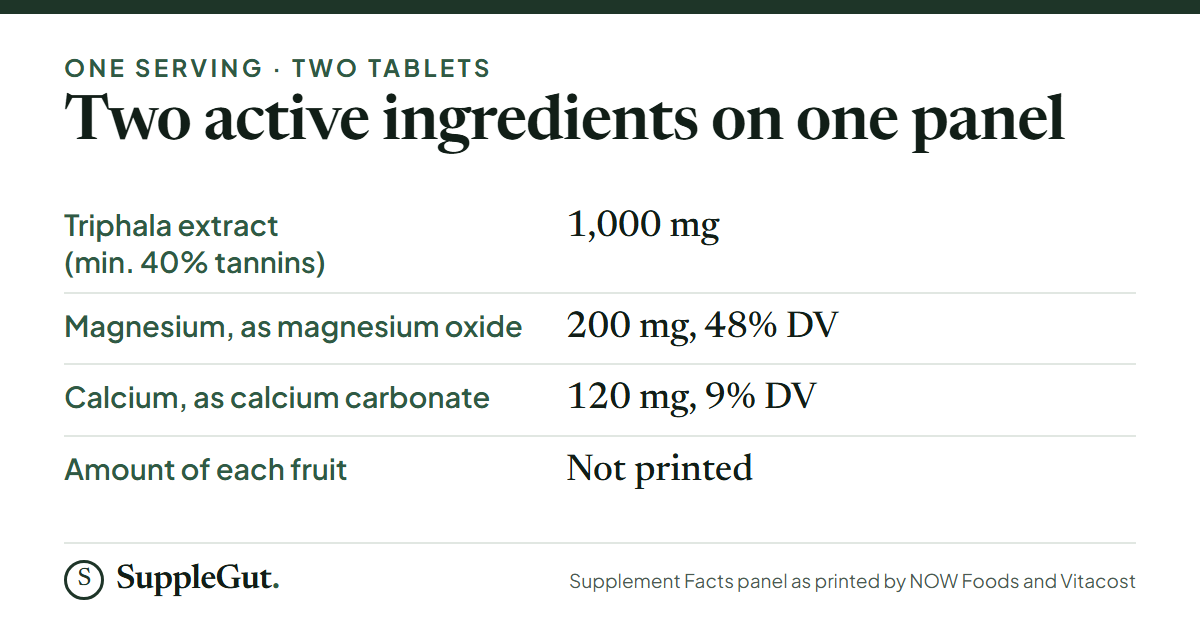
NOW Foods sells triphala as a 120 count tablet, and two tablets carry 1,000 mg of a mixed amla, bibhitaki and haritaki fruit extract. Two things set it apart from the other triphala tablets we read: the same serving holds 200 mg of magnesium as magnesium oxide, and it has the lowest price per day.
What one serving prints
| Per two tablets | Amount | Daily Value |
|---|---|---|
| Triphala extract (min. 40% tannins) | 1,000 mg | Not established |
| Magnesium (from magnesium oxide) | 200 mg | 48% |
| Calcium (from calcium carbonate) | 120 mg | 9% |
| Calories, carbohydrate | 5, 1 g | Under 1% for carbohydrate |
The bottle holds 60 servings. The extract line gives one amount for all three fruits, and NOW names them with Latin binomials: Emblica officinalis for amla, Terminalia bellerica for the fruit it calls Behada, and Terminalia chebula for Harada. A minimum of 40% tannins on 1,000 mg works out to at least 400 mg of tannins a serving, though the pages do not name the assay. No extract ratio and no split between the fruits is printed, so the dose of any single fruit cannot be put beside a trial.
The calcium carbonate and magnesium oxide are added as nutrients. Neither is a bhasma, the calcined mineral preparation that some traditional Ayurvedic products contain by design.
Magnesium oxide in a triphala tablet
The NIH fact sheet on magnesium says that high doses from supplements often cause diarrhea, and that magnesium oxide is among the forms most often reported to do so, through the osmotic pull of unabsorbed salts. The adult upper limit for supplemental magnesium is 350 mg a day, and this label’s 200 mg is 57% of it, so the amount sits inside the limit. It is also enough to be a variable of its own.
That matters for the question in the title. Most people take triphala hoping for a softer, more regular stool. A tablet that contains both a fruit extract used for the bowel and a mineral known to loosen stools can produce one, and a reviewer cannot tell from the result which ingredient did it. The label does not separate the two, and neither does any study we found. Anyone who takes another magnesium product adds the two amounts together.
The tradition, in NOW’s words
Triphala is Sanskrit for three fruits, and the herb page covers the formula in full. Ayurveda, the traditional medicine of India, uses it as a gentle bowel and digestive tonic. NOW labels the tablet an “Ayurvedic Digestive Cleanser” and an “Ayurvedic Tonifier & Digestive Support,” and says the three fruits have been used in Ayurvedic herbalism for thousands of years. It adds that triphala has been shown to be a potent free radical scavenger, a laboratory description, not a bowel outcome.
NOW’s pages use none of the dosha vocabulary (vata, pitta, kapha) that Banyan Botanicals’ triphala page leans on, and name no symptom. The tradition’s claim is general: a tonic for digestion. Reviewers supply the symptom, and most of them mean constipation.
What the triphala trials used, against 1,000 mg
PubMed holds 16 randomized trials of triphala. None used a NOW product, a search for NOW Foods with triphala returned nothing, and the 11 triphala studies on ClinicalTrials.gov name no NOW product either. The closest to this tablet in design is a four-week, double-blind, placebo-controlled pilot at UC Davis: 31 healthy adults were randomized to 2,000 mg a day of triphala, manjistha or placebo, and 9, 9 and 11 were analyzed. No bacterial group moved the same way in everyone, the responses were “highly personalized,” and both herbs trended toward more Akkermansia muciniphila (Peterson et al., 2020). The abstract reports no stool-habit result.
An open-label safety study gave 20 healthy volunteers 2,500 mg a day of a triphala water extract for four weeks and found no serious adverse effects (Phetkate et al., 2020). The study usually cited for constipation followed 34 patients on a formula that also held isabgol (psyllium) husk and senna extract, so it cannot be credited to triphala (Munshi et al., 2011). A review of triphala in functional gut disorders, including irritable bowel syndrome, concluded that the herb holds potential and that trials are needed (Tarasiuk et al., 2018). A registered trial of triphala with the probiotic mix VSL#3, planned for 75 people, was terminated, and we read no results. Our fuller read is in Does triphala work?
NOW’s 1,000 mg of extract is half the pilot dose and 40% of the safety-study dose. The trials tested other preparations in healthy adults, so they show what triphala studies have measured, not what this tablet does.
Metals, testing and how this is regulated
The product pages we read state GMP certification (an A-rated NPA program and an Intertek certification) and list no heavy-metal testing, no laboratory and no certificate of analysis. NOW describes batch testing for metals in its own accredited labs for protein powders and has posted certificates for a prenatal vitamin, but we found nothing of that kind for this tablet. We also found no California Proposition 65 warning on the pages and no country of manufacture. The label does print Latin names and a full Supplement Facts panel, which are the other two things a buyer can check.
The wider survey data describe the category, not this tablet. Of 193 Ayurvedic medicines bought online, 20.7% (95% CI 15.2 to 27.1) had detectable lead, mercury or arsenic, 21.7% of the US-made and 19.5% of the Indian-made, and products built on metal preparations (rasa shastra) were far likelier to, 40.6% against 17.1% (Saper et al., JAMA, 2008). An earlier survey of 70 products had also found metals in some (Saper et al., JAMA, 2004). The guide to Ayurvedic supplement safety sets out the checklist.
In the United States this tablet is a dietary supplement under the 1994 law known as DSHEA, so the FDA does not approve it before sale. No state licenses Ayurvedic practitioners. In India, Ayurveda is a state-recognized system with a degree (BAMS) and a national ministry, AYUSH. The label says for adults only and asks anyone who is pregnant or nursing, taking medication or living with a medical condition to consult a physician.
Taking it, and what reviewers report from the first week
The directions are two tablets a day between meals, taken together as one serving. NOW gives no length of time for a fair test. A few Vitacost reviewers describe cramping, diarrhea or nausea, one with heartburn after a week, and one reports seeing near-whole tablets. Each is a single report. Given the magnesium, loose stools are a plausible reaction to the mineral as well as the fruit.
Ratings on Amazon and Vitacost
Amazon shows 4.6 from 302 ratings: 80% five-star, 9% four, 4% three, 4% two and 3% one. Among the 19 reviewers there who mention effectiveness, 5 are negative. Vitacost shows 4.61 from 259 reviews, but its review app flags all 259 as collected from another provider, and the ones we read were originally posted on iHerb. NOW’s own page shows no score. Neither retailer is NOW, so both are independent of the brand.
Praise gathers around a tablet that is easy to swallow with no taste, a mild effect on regularity (“less harsh than a laxative” is one reviewer’s phrase), and the price for 120 tablets. The most common complaint is that nothing changed, concentrated in the three-star reviews. A three-star reviewer asked how to be sure of the metal content, and another disliked cellulose as a filler.
Prices and purchase terms
| Route | Price | Per day, one serving |
|---|---|---|
| Amazon, 120 tablets | $12.24 | $0.20 |
| Amazon Subscribe & Save (10% off) | $11.02 | $0.18 |
| Vitacost, 120 tablets | $12.24 | $0.20 |
| NOW site (archived copy) | $19.99 | $0.33 |
For comparison at each label’s own serving, Himalaya’s caplet is $0.33 a day, Planetary Herbals’ is $0.37 and Banyan’s 90 count at two tablets is $0.51. Amazon lists the NOW bottle as not returnable because it is ingestible, unless damaged or defective. We read no NOW or Vitacost subscription terms and found no billing complaints.
Who NOW’s tablet suits
- Readers who want a once-a-day, two-tablet routine at a low daily cost.
- Readers who want a standardized extract, with a stated tannin minimum rather than whole fruit powder.
- Readers comparing triphala tablets who want to know that this one adds calcium and magnesium; Banyan’s tablet, Himalaya’s caplet and Planetary Herbals’ tablet have their own panels to read beside it.
The full label, price and review record sit on the product page.
The catalog entries behind this guide
Common questions
Does NOW Triphala work for constipation?
We found no trial of this tablet and no randomized trial of triphala alone for constipation. On Amazon, 5 of the 19 reviewers who mention effectiveness were negative. Each serving also holds 200 mg of magnesium as magnesium oxide, which the NIH says often causes diarrhea at high doses, so a reviewer’s looser stool could come from either ingredient.
How much magnesium is in NOW Triphala?
Two tablets print 200 mg of magnesium as magnesium oxide, 48% of the Daily Value, and 120 mg of calcium as calcium carbonate. The 350 mg adult upper limit for magnesium from supplements is set by the NIH, and 200 mg is 57% of it. Anyone who takes another magnesium product adds the two amounts together.
Is NOW Triphala tested for heavy metals?
The Amazon, Vitacost and archived NOW product pages we read state GMP certification and no heavy-metal testing, and we found no certificate of analysis for this product. NOW describes metal testing for other products, such as protein powders, in its own labs. A buyer who wants a result can ask NOW for one.
How does the 1,000 mg dose compare with the trials?
A four-week placebo-controlled pilot used 2,000 mg a day of triphala in healthy adults, and a safety study used 2,500 mg a day of a water extract. NOW’s 1,000 mg is half and 40% of those amounts, and it is an extract with a tannin minimum, which the trial products may not have been.
How much does NOW Triphala cost per day?
The 120 tablet bottle is $12.24 at Amazon and Vitacost, which is 60 servings at one two-tablet serving a day, about $0.20. Amazon Subscribe & Save at $11.02 is about $0.18 a day. An archived copy of NOW’s own page listed $19.99, about $0.33 a day.
Does NOW Triphala contain gluten, dairy or soy?
NOW states the tablets are not manufactured with wheat, gluten, soy, milk, egg, fish, shellfish or tree nut ingredients, and that they are made in a GMP facility that processes other ingredients containing these allergens. Sesame and peanut are not mentioned. The other ingredients are cellulose, stearic acid from a vegetable source, silica and a vegetarian coating.
Sources
- Peterson et al. Four-week double-blind placebo-controlled pilot of triphala and manjistha on the gut microbiome in healthy adults (NCT03477825). Journal of Alternative and Complementary Medicine, 2020. PMID 32955913. pubmed.ncbi.nlm.nih.gov/32955913
- Phetkate et al. Open-label phase I safety study of a triphala aqueous extract in healthy adults. Journal of Integrative Medicine, 2020. PMID 31680053. pubmed.ncbi.nlm.nih.gov/31680053
- Munshi et al. Open-label study of a formula containing isabgol husk, senna extract and triphala extract in functional constipation. Journal of Ayurveda and Integrative Medicine, 2011. PMID 22022157. pubmed.ncbi.nlm.nih.gov/22022157
- Tarasiuk et al. Review of triphala in functional gastrointestinal disorders. Chinese Medicine, 2018. PMID 30034512. pubmed.ncbi.nlm.nih.gov/30034512
- ClinicalTrials.gov. Triphala with VSL#3, NCT03907501 (terminated). clinicaltrials.gov/study/NCT03907501
- Saper RB, Phillips RS, Sehgal A, et al. “Lead, mercury, and arsenic in US- and Indian-manufactured Ayurvedic medicines sold via the Internet.” JAMA, 2008;300(8):915–923. PMID 18728265. pubmed.ncbi.nlm.nih.gov/18728265
- Saper RB, Kales SN, Paquin J, et al. “Heavy metal content of ayurvedic herbal medicine products.” JAMA, 2004. PMID 15598918. pubmed.ncbi.nlm.nih.gov/15598918
- NIH Office of Dietary Supplements. Magnesium: fact sheet for health professionals. ods.od.nih.gov
- FDA. Dietary supplements and the Dietary Supplement Health and Education Act of 1994. fda.gov/food/dietary-supplements; Ministry of Ayush, Government of India. ayush.gov.in
- NOW Foods: Triphala 500 mg Tablets product page (archived copy: label, directions, certifications, price). web.archive.org
- Vitacost: NOW Foods Triphala, 120 tablets (Supplement Facts, warnings, price, reviews). vitacost.com
- Amazon: NOW Supplements Triphala 500 mg listing, ratings and review summary. amazon.com/dp/B000AMY1AS
Still deciding between products?
The guide gives the background. For a single answer, the quiz asks about your symptoms, your routine and what you have tried, then names one product.
Take the quiz →