
Daily gut routine
Pique Pu’er Black Tea
A fermented pu’er tea in dissolvable crystals, for people who would rather drink something than swallow a capsule.
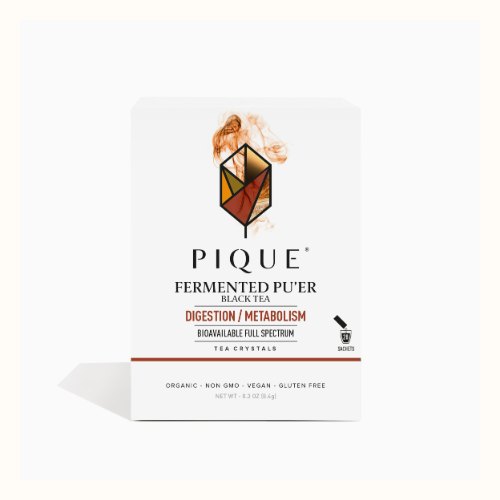
- Format
- Tea, once a day
- Type
- Food-based
- Cost
- $2.79 a day
- Customer rating
- 4.9 out of 5 from 446 ratings from piquelife.com
What customers consistently report
- Calm, level energy without the jitters of coffee
- Less gas and bloating with consistent daily use, including from people managing IBS
- The crystals dissolving instantly, which makes it easy to keep up while traveling
Those are the themes that recur across the reviews. Low review confidence — the 4.9 from 446 reviews sits on the brand’s own page. An Amazon listing exists but its rating could not be read, and the only independent figure found was a brand-level Trustpilot score of 4 out of 5 with no count published.
Why it might work
Fermented pu'er tea supplies tea polyphenols, including the compounds altered during fermentation, which can reach the gut and interact with gut bacteria and bile-acid metabolism. That is the biological logic behind using it as a drink for comfort rather than as a probiotic capsule. This product has one ingredient, organic pu'er tea, and the dissolvable crystals make it straightforward to take while traveling; it also does not claim to contain tested probiotic strains. The important missing piece is quantity. Each sachet is only 0.6 g, with no published polyphenol or theabrownin content and no stated daily dose, so it cannot be matched to research on whole-leaf tea or isolated compounds. An interesting tea-to-gut pathway cannot prove benefit from crystals with no stated daily dose or measured active content.
What the research supports
Thin, and thinner than the marketing suggests. There is no trial on this tea, and Pique cites none. The supporting literature is on pu-erh tea generally: a small human pilot on citrus pu-erh reported shifts in gut bacteria over three weeks, and the mechanistic work on theabrownin acting through gut bacteria and bile acids is in mice. None of it applies neatly, because those studies used whole-leaf infusions or isolated compounds at doses Pique does not publish for its 0.6 g sachet.
What the label discloses
Simple, but almost nothing is quantified. The ingredient list is one line — organic pu’er tea and nothing else — which is a real point in its favor. There is no supplement facts panel, no polyphenol or theabrownin content, and no CFU. The product is marketed on probiotic support, and Pique states plainly that it does not test for probiotic strains in its pu’er teas, describing them as an undefined mix of bacteria, fungi and microbes from fermentation. Screening for toxins is claimed on-page but no lab, method or certificate is named, and cGMP manufacturing is not stated.
Who this tends to suit
We match this product to people reporting bloating, gas and general abdominal discomfort. It fits someone whose priority is day-to-day comfort or a steady daily routine. Whether it is the best fit for you depends on the rest of your answers — what you have already tried, what format you will take, and anything that has to be ruled out.
Where it may not fit
The label supports vegan, dairy-free, no added sweeteners and minimal ingredient list. We flag this product for anyone pregnant or breastfeeding or taking prescription medication, and the quiz removes it rather than recommending it in those cases. That is a caution about who should be deciding, not a claim about the product. A tea only works if you will take it once a day, every day.
Side effects and what to be aware of
Price is the single most common complaint, on the brand’s own page and on Amazon alike — about $2.07 a serving, and $2.43 if you buy it through Amazon. It is caffeinated, and comparable to coffee by the brand’s own description. There is no published daily dose, so how much to drink is left to you. Do not brew it with boiling water; the maker specifies 180°F or below.
Before you take this. Speak to a doctor or pharmacist first if you are pregnant or breastfeeding, or taking prescription medication. Nothing on this page is medical advice, and no supplement diagnoses, treats, cures or prevents disease.
Is this the right one for you?
The quiz works out which of the products we have researched fits your symptoms, your routine and what you have already tried — and tells you plainly if none of them do.
Take the quiz →Free. Private. Nothing to sign up for.
Others we researched for the same job
These sit in the same role as Pique Pu’er Black Tea — daily gut routine — so they are the sensible things to weigh it against.
See all the products we have researched →
Related reading
Background on how this type of product works, read from the trial evidence.