
Guide
How many gut supplements have real clinical trial evidence?
Quick answer
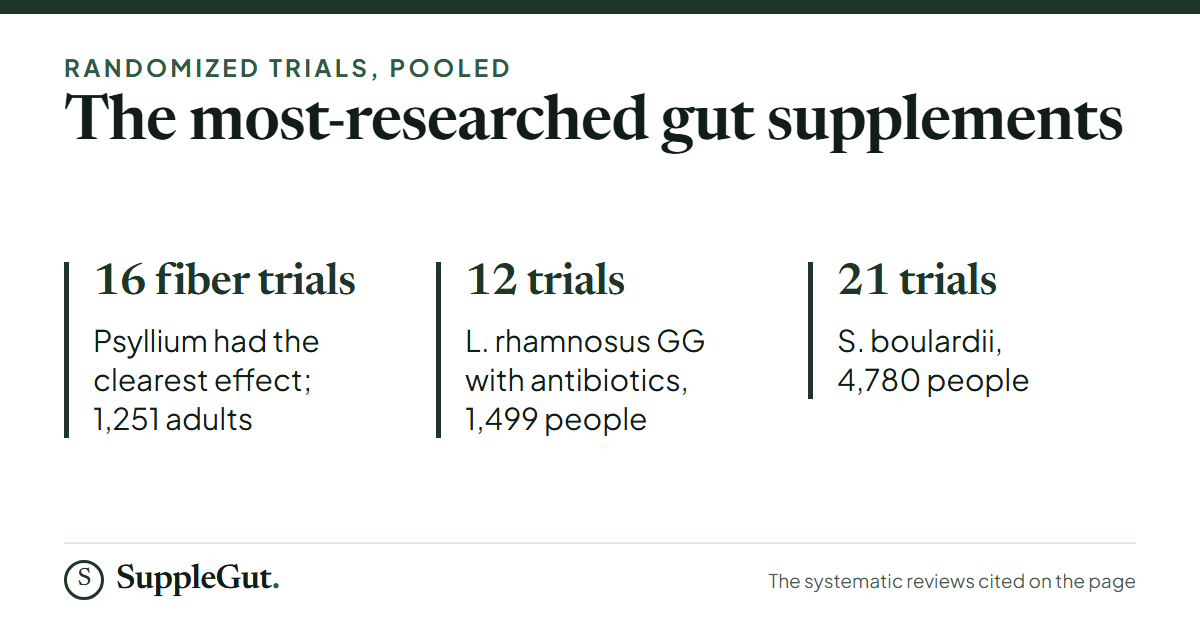
Which gut supplements have the most clinical research? Psyllium fiber (the clearest effect in a meta-analysis of 16 randomized fiber trials in 1,251 adults), Lactobacillus rhamnosus GG (146 registered studies; 12 antibiotic-diarrhea trials in 1,499 people), Saccharomyces boulardii (21 trials in 4,780 people) and the De Simone Formulation sold as Visbiome (ulcerative colitis maintenance trials) lead the list. The rest of this page goes through each in turn.
1. Psyllium fiber
A 2022 systematic review pooled 16 randomized controlled trials in 1,251 adults and found fiber supplementation produced a bowel-movement response in 66% of participants versus 41% on control (relative risk 1.48). Psyllium specifically performed better than the fiber average: relative risk 1.82 and an average of 3.08 more bowel movements a week. Across the fiber trials of four weeks or longer, whole-gut transit time fell by 18.4 hours, and the benefit concentrated above 10 g/day (van der Schoot et al., American Journal of Clinical Nutrition, 2022). The 2023 AGA/ACG clinical guideline grades fiber as a "conditional" recommendation for chronic constipation — behind polyethylene glycol's "strong" rating, but ahead of options with thinner evidence (AGA/ACG Guideline, Gastroenterology, 2023). More on the timeline in our psyllium husk guide.
2. Lactobacillus rhamnosus GG (LGG)
LGG is the single most-studied probiotic strain in human trials — a 2020 audit of clinical trial registries counted 146 registered studies using it, more than any other strain (second place, Bifidobacterium animalis BB-12, had 55) (Dronkers, Ouwehand & Rijkers, Heliyon, 2020). For one specific use — preventing antibiotic-associated diarrhea — a meta-analysis of 12 randomized trials in 1,499 people found LGG cut the rate from 22.4% to 12.3% (Szajewska & Kolodziej, Alimentary Pharmacology & Therapeutics, 2015).
3. Saccharomyces boulardii
This probiotic yeast (not a bacterium, so it survives antibiotic courses that kill bacterial probiotic strains) has a similarly sized evidence base for the same use: a meta-analysis of 21 trials in 4,780 people found it cut antibiotic-associated diarrhea from 18.7% to 8.5% (Szajewska & Kolodziej, Alimentary Pharmacology & Therapeutics, 2015). Both this and the LGG trial base above come from the same two meta-analyses run by the same authors on the same antibiotic-diarrhea question, which makes them directly comparable in a way that most probiotic head-to-heads aren't. Preparations with no live organisms in them are unaffected by an antibiotic course for a different reason again — what the research on the Gutlex postbiotic shows covers that class.
4. The De Simone Formulation (sold as Visbiome, formerly VSL#3)
This 8-strain, high-dose probiotic blend has one of the more substantial trial records for ulcerative colitis maintenance specifically, not general gut health:
| Trial | Patients | Result |
|---|---|---|
| Gionchetti et al., 2000 | 40 | 15% relapsed on the formulation vs. 100% on placebo over 9 months (P<0.001) |
| Mimura et al., 2004 | 36 | 85% in remission at 1 year vs. 6% on placebo (P<0.0001) |
| Tursi et al., 2010 | 144 | 63.1% improved ≥50% on the UCDAI score vs. 40.8% on placebo; 47.7% reached remission at 8 weeks vs. 32.4% on placebo |
A 2014 meta-analysis pooling this and other trials concluded the formulation is more effective than placebo for inducing and maintaining ulcerative colitis remission, though it noted the trial base is still smaller than for standard drug therapies (Shen, Zuo & Mao, Inflammatory Bowel Diseases, 2014).
Every trial above tested the original "De Simone Formulation." In 2016, the company behind the original formulation exited its VSL#3 licensing deal, and the VSL#3-branded product sold today uses a different, unstudied strain blend. The original formulation is now sold under the Visbiome brand in the US and Canada. A US court found VSL Pharmaceuticals liable for false advertising over this exact confusion, a verdict upheld on appeal in 2021. In practice: none of the trial results above apply to a VSL#3-branded product bought after 2016.
5. Enteric-coated peppermint oil
A 2014 meta-analysis pooled 9 randomized controlled trials in 726 IBS patients and found peppermint oil produced significantly greater improvement in overall IBS symptoms and abdominal pain than placebo (Khanna, MacDonald & Levesque, Journal of Clinical Gastroenterology, 2014). The coating matters here more than for most supplements: peppermint oil that dissolves in the stomach instead of the small intestine is more likely to cause heartburn instead of the intended effect, so the formulation studied used enteric or targeted-release coating specifically. The enteric-coated capsule in this catalog is set against the six-plant liquid it is most often weighed up with in IBgard vs Iberogast.
What this ranking doesn't tell you
Trial count measures how much research exists, not which ingredient is strongest for your situation, or how any of them compare to unlisted options like standard IBS or IBD medications. LGG and S. boulardii's numbers above are specific to preventing antibiotic-associated diarrhea, not general digestion. The De Simone Formulation's trials are specific to ulcerative colitis maintenance in patients already on standard treatment, not everyday gut health. None of this is a substitute for a clinician's read on your specific symptoms and history.
It also does not tell you whether the product on the shelf delivers what the trial used. An ingredient can be well studied while the capsule built on it is not: sulforaphane from broccoli sprouts has a randomized trial in 48 H. pylori–infected people that moved colonization and inflammation markers, but that trial fed 70 g a day of fresh sprouts, with the plant's own myrosinase doing the conversion, and no extract capsule on this site documents reaching the dose it used. The Sproutly entry is the worked example: strong ingredient literature, a label whose own figures do not reconcile. Read a ranking like this one as being about ingredients, and check the product separately.
Products in this catalog
Sources
- van der Schoot A, et al. "The Effect of Fiber Supplementation on Chronic Constipation in Adults: An Updated Systematic Review and Meta-Analysis of Randomized Controlled Trials." American Journal of Clinical Nutrition, 2022;116(4):953–969. pmc.ncbi.nlm.nih.gov/articles/PMC9535527
- AGA/ACG Clinical Practice Guideline. Gastroenterology, 2023;164(7):1086–1106. pubmed.ncbi.nlm.nih.gov/37211380
- Dronkers TMG, Ouwehand AC, Rijkers GT. "Global analysis of clinical trials with probiotics." Heliyon, 2020;6(7):e04467. pmc.ncbi.nlm.nih.gov/articles/PMC7371762
- Szajewska H, Kolodziej M. "Systematic review with meta-analysis: Lactobacillus rhamnosus GG in the prevention of antibiotic-associated diarrhea in children and adults." Alimentary Pharmacology & Therapeutics, 2015;42(10):1149–1157. pubmed.ncbi.nlm.nih.gov/26365389
- Szajewska H, Kolodziej M. "Systematic review with meta-analysis: Saccharomyces boulardii in the prevention of antibiotic-associated diarrhea." Alimentary Pharmacology & Therapeutics, 2015;42(7):793–801. pubmed.ncbi.nlm.nih.gov/26216624
- Gionchetti P, et al. "Oral bacteriotherapy as maintenance treatment in patients with chronic pouchitis." Gastroenterology, 2000;119(2):305–309. pubmed.ncbi.nlm.nih.gov/10930365
- Mimura T, et al. "Once daily high dose probiotic therapy (VSL#3) for maintaining remission in recurrent or refractory pouchitis." Gut, 2004;53(1):108–114. pubmed.ncbi.nlm.nih.gov/14684584
- Tursi A, et al. "Treatment of relapsing mild-to-moderate ulcerative colitis with the probiotic VSL#3 as adjunctive to a standard pharmaceutical treatment." American Journal of Gastroenterology, 2010;105(10):2218–2227. pubmed.ncbi.nlm.nih.gov/20517305
- Shen J, Zuo Z-X, Mao A-P. "Effect of probiotics on inducing remission and maintaining therapy in ulcerative colitis, Crohn's disease, and pouchitis." Inflammatory Bowel Diseases, 2014;20(1):21–35. academic.oup.com →
- Khanna R, MacDonald JK, Levesque BG. "Peppermint oil for the treatment of irritable bowel syndrome: a systematic review and meta-analysis." Journal of Clinical Gastroenterology, 2014;48(6):505–512. pubmed.ncbi.nlm.nih.gov/24100754
Not sure which product fits your situation?
This guide covers the mechanics. The quiz takes your specific symptoms, routine and preferences and matches you to one product from the catalog.
Take the quiz →