
Viral cleanses
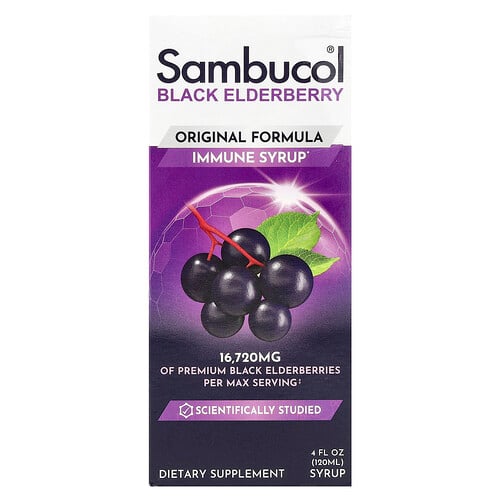
Sambucol Black Elderberry Original Syrup
The best-known elderberry syrup, with the most-quoted trial and the least-quoted one.
- Format
- Liquid
- Type
- Immune and antiviral botanical
- Cost
- ~$0.94 a day at the daily dose, ~$3.76 on the label’s intensive-use dose
- Customer rating
- 4.7 out of 5 from 12,083 ratings from Amazon
What customers consistently report
- Tasting good enough that children will take it, which is the most common reason people stay with it
- A measured two-teaspoon syrup being simpler than counting capsules
- A clean label — gluten-free, dairy-free, vegan and kosher, with no artificial colors or flavors
Those are the themes that recur across the reviews. High review confidence on volume — 12,083 Amazon ratings at 4.7, a figure Amazon shares across the bottle sizes of the Original syrup, plus 1,895 Walmart reviews as a second check.
Why it might work
Black elderberry supplies anthocyanins, plant pigments that can be studied for interactions with microbes and immune signaling. Sambucol gives this plant preparation in syrup: each 10 mL serving states 3.8 g of black elderberry extract, and the heat-processed fruit syrup is easy to take rather than a complicated blend. The main mechanistic bridge to the gut remains laboratory work on elderberry anthocyanins and named gut species; it is a reason for research, not evidence that a syrup will change someone's microbiome or symptoms. The one short human study with a microbiome endpoint found no significant overall shift. Its antiviral framing is no firmer: the earlier positive respiratory trial used far more syrup than the daily label dose, while a later trial at the same 60 mL a day found no benefit. The high sugar content at each serving is also material. Mechanism cannot resolve conflicting evidence or demonstrate that this high-sugar product is more than a hypothesis.
Why this sits on a gut-health site
The gut evidence for elderberry is thin. The only human study with a gut endpoint gave 18 overweight adults 355 grams of elderberry juice a day for a week and found no significant shift in the microbiome overall; the phylum-level changes that get quoted appeared only after both arms were pooled together and two outlying participants were removed. The idea that elderberry anthocyanins feed gut bacteria has at least been tested on elderberry specifically, with named gut species, rather than borrowed from other berries — but that work is in the laboratory, not in people. No trial has tested elderberry against bloating, irregularity or any digestive complaint. There is one useful gut fact here, and it runs in the product’s favor. The elderberry poisoning story that circulates online is a real event: in 1983, 11 people in Monterey County vomited within fifteen minutes of drinking home-pressed juice made from a wild elder crushed together with its leaves and branches. All of them recovered and their blood cyanide came back normal. Analysis of commercial elderberry juice finds cyanogenic glycosides below the limit of quantification, so that warning belongs to home preparation with raw or non-fruit parts of the plant, not to a heat-processed syrup like this one.
What the research supports
This is the clearest example in the catalog of why the phrase clinically tested needs reading carefully. The trial usually cited is a 2004 randomized, double-blind, placebo-controlled study in 60 people, where symptoms resolved about four days earlier — but it used 60 mL a day, six times this label’s daily dose and half again the intensive dose. A later randomized, double-blind, placebo-controlled trial run under an FDA investigational new drug application, in 87 people with laboratory-confirmed influenza, used the same 15 mL four times daily and found no benefit: 5.3 days to symptom resolution against 4.9 on placebo. Every individual symptom — aches, sore throat, cough, congestion — also ran numerically longer on elderberry, though none of those differences reached significance and we will not present them as if they did. One comparison did: among the patients who were not also taking oseltamivir, elderberry alone took 7.3 days to symptom relief against 5.1 on placebo alone, and that gap was significant. An air-travel trial in 312 people sits in between, with fewer cold days but no significant difference in the number of episodes and a p-value reported inconsistently between its own abstract and results.
What the label discloses
The label is fully published: 3.8 g of black elderberry extract per 10 mL serving, plus glucose syrup, water, citric acid and potassium sorbate — no proprietary blend. It declares gluten-free, dairy-free, soy-free and nut-free, no artificial colors or flavors, and kosher certification. No third-party certifier, NSF or USP mark, or heavy-metal testing program is named. Worth knowing about the brand: the maker faced two consumer class actions in California, one of which challenged the developed by a world renowned virologist claim on the label. The company defeated that suit in June 2025, with the court relying on survey evidence that buyers were not misled.
Where it may not fit
The label supports vegan, gluten-free and dairy-free. We flag this product for anyone pregnant or breastfeeding or taking prescription medication, which is a caution about who should be deciding, not a claim about the product. A liquid only works if you will take it as often as the label directs.
Side effects and what to be aware of
Cost relative to bottle size is the recurring complaint, and the arithmetic backs it up: the label’s intensive dose is four servings a day, which empties a 7.8 fl oz bottle in under six days and works out around $3.48 a day. The label says not suitable for children under four. No pregnancy or breastfeeding statement was found on the listings we checked, and the medication warning is generic with no drug class named. It contains glucose syrup, with 8 g of total sugars a serving.
Before you take this. Speak to a doctor or pharmacist first if you are pregnant or breastfeeding, or taking prescription medication. Nothing on this page is medical advice, and no supplement diagnoses, treats, cures or prevents disease.
Is this the right one for you?
The quiz works out which of the products we have researched fits your symptoms, your routine and what you have already tried — and tells you plainly if none of them do.
Take the quiz →Free. Private. Nothing to sign up for.
Others we researched for the same job
These sit in the same role as Sambucol Black Elderberry Original Syrup — viral cleanses — so they are the sensible things to weigh it against.
See all the products we have researched →
Related reading
Background on how this type of product works, read from the trial evidence.