
Guide
Does Elvera work? An elderberry capsule, a GLP-1 ad story, and what the studies measured
Quick answer
Does Elvera work? No trial of Elvera was found, and no randomized trial of elderberry for constipation. The panel prints 1,200 mg of elderberry extract with no species, part or standardization, plus 90 mg of vitamin C and 10 mg of zinc. The closest studies are a 9-week open microbiome study at 600 mg a day with no bowel outcome, and a transit trial of a tea that also contained senna. Reviews split: 4.53 from 341 on the brand’s own feed, 1.9 from 17 on Trustpilot, where 16 are one-star and most concern billing.
Elvera Gut Support Complex is a 60-capsule bottle of elderberry extract with vitamin C and zinc, taken as two capsules a day and sold at tryelvera.com. It is marketed for regularity, constipation and bloating, and its ads lead with a story about constipation on GLP-1 drugs such as Ozempic. This page sets out what the panel prints, what the studies of elderberry measured, what the ad stories claim, what reviewers on two kinds of platform report, and what the brand’s own billing terms say.
What Elvera is, and what is on the label
The Supplement Facts panel has three lines for a serving of two vegetable capsules: elderberry extract 1,200 mg, vitamin C 90 mg and zinc 10 mg. Each has its own amount, so there is no proprietary blend, and hypromellose (the capsule) is the only other ingredient. The panel prints no daily value for any of the three, no warning beyond the FDA disclaimer, no allergen statement and no probiotic strains, because there are no bacteria in it. A “3rd Party Tested” badge is on the panel, but we found no laboratory named and no certificate of analysis.
What the panel does not print matters for an extract. It gives no species, no plant part, no extract ratio and no standardization. The brand’s web copy and ads go further than the panel: they say 10% anthocyanins (which would be 120 mg of anthocyanins a serving), zinc citrate and buffered vitamin C. None of those three phrases is on the panel image, and we found no assay behind the 10% figure. The home page also describes “eight powerful, scientifically backed herbs”, which does not match a three-line panel.
The trial of the product itself
We searched PubMed and ClinicalTrials.gov for Elvera and for elderberry with zinc and vitamin C in constipation, and found no trial of the product. The brand’s own figures are survey claims on its pages: 83% felt more balanced within 30 days, 92% reported less bloating and discomfort and 74% stopped using laxatives, footnoted to a 30-day internal customer survey, with the home page citing a four-week independent customer panel. Neither gives a number of respondents.
The evidence for elderberry
We found no randomized trial of elderberry extract for constipation or bloating, and no trial of zinc at 10 mg or vitamin C at 90 mg for either. A PubMed search combining elderberry or Sambucus with constipation returns one paper, covered below. The closest human work is about the gut microbiome, not about bowel habit.
The ELDERGUT study was a 9-week open study (3 weeks of baseline, 3 of intervention, 3 of washout) of a purified European black elderberry extract with stated polyphenol and anthocyanin content, taken as 300 mg twice a day, 600 mg in all. The abstract reports that it was well tolerated, that microbiome trajectories were highly individualized, with a shift in diversity measures on starting and on stopping, and that Akkermansia kept rising in a subset of participants after supplementation ended. It reports no stool frequency or constipation outcome. The label dose of 1,200 mg is twice the study dose, but the study used a standardized extract and this panel prints no standardization (Reider et al., 2022). Two funders are listed, the Christian Doppler Research Association and IPRONA AG.
A randomized, placebo-controlled crossover trial gave 18 overweight or obese adults elderberry juice twice a day for one week in each period. Ruminococcaceae and Bifidobacterium rose, Bacteroides fell, and blood glucose after a test meal fell. The outcomes were microbiota and glucose, in juice rather than capsules, and stool frequency was not one of them (Teets et al., 2024).
The one paper that pairs elderberry with constipation tested a tea containing anise, fennel, Sambucus nigra and Cassia angustifolia, which is senna. In 20 people with chronic constipation, colonic transit time was 15.7 hours on the compound and 42.3 hours on placebo (P<0.001) over 5 days per period. Senna is a stimulant laxative, so the result cannot be credited to elderberry (Picon et al., 2010).
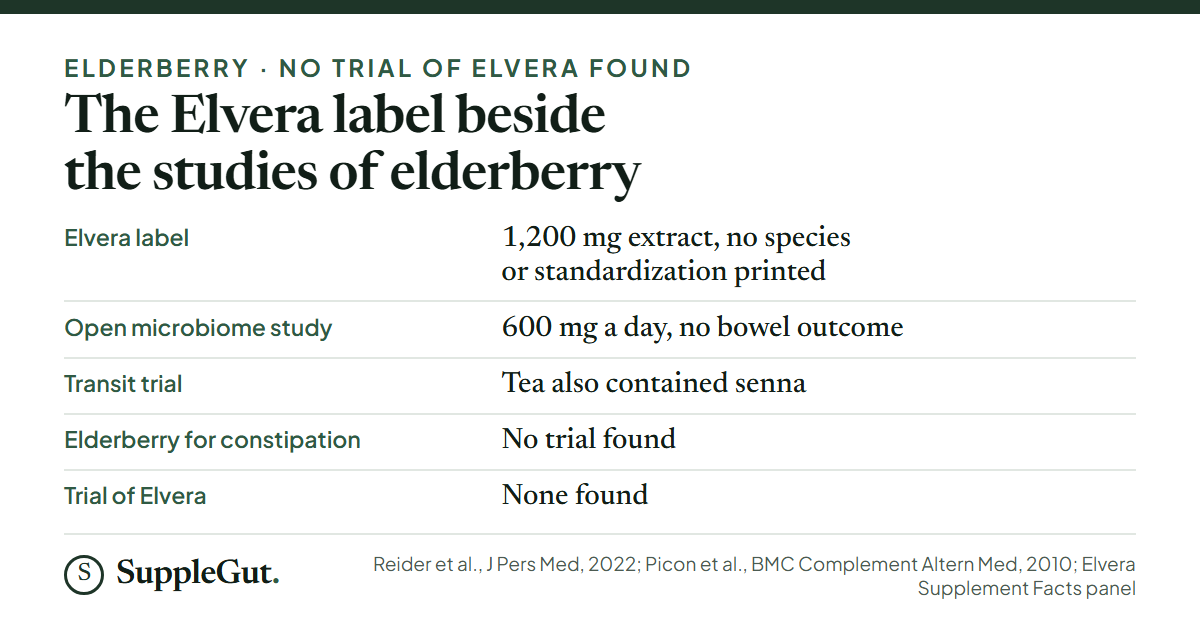
The chart above lays the label beside these studies. The shift in bacteria seen in the elderberry studies is the step the brand’s argument depends on; the link from that shift to bowel movements has not been tested in the studies we found.
The GLP-1 setting, and the ad stories
Constipation is a recognized effect of GLP-1 drugs. A systematic review and meta-analysis of randomized trials found constipation in 7.39% of GLP-1 receptor agonist users, a risk ratio of 2.41 against placebo, with semaglutide carrying the highest risk ratio for constipation (Joy et al., 2026). We found no trial of elderberry in people taking a GLP-1 drug.
The ads we read in Meta’s ad library link to tryelvera.com from three pages: “Elvera” and two person-named pages, “Margaret Coleman” and “Natural Health Finds”. The person-named pages run long first-person stories of about 11,000 characters. We checked no practitioner license and found no verified doctor behind either page; the stories use different narrator names within the same page, and one says it is written under a pseudonym. The claims in them, recorded as claims:
- A narrator described as a board-certified endocrinologist says she prescribed Ozempic to 314 patients, then became constipated on it herself: twelve days without a bowel movement, an emergency room visit and a warning about a colostomy.
- Her stool panel is quoted as showing butyrate at 6.8 micromoles per gram against a stated normal of 20 to 30, and a transit time of 112 hours against a stated normal of 30 to 40. After 12 weeks on two capsules every evening, the story gives butyrate of 23.8 and a transit time of 38 hours.
- The product is credited to an 81-year-old woman growing elderberries in Pennsylvania, and described as “cold-extracted heirloom elderberry” with “full clinical dose of anthocyanins”.
- The studies cited in the story are described as showing a “sustained expansion” of Akkermansia and gut diversity up “nearly 50 percent”. The 50 percent figure is not in the ELDERGUT abstract, and we did not open the full text.
- The offer closes with three bottles for $67.20 and “over 100,000 women” taking Elvera. The brand’s review counts, listed below, do not reach that.
The brand’s FAQ page also carries an unsigned advertorial headed as a gastroenterologist’s answers to 15 questions about constipation, whose last answer recommends Elvera. Its home page quotes an “integrative medicine” doctor with no practice or license given. None of these figures traces to a trial of Elvera.
How to take Elvera
The serving is two capsules once a day, 30 servings to the bottle. The product page does not say whether to take it with food; the ads say with dinner. With no trial of the product there is no studied time to effect. Reviewers who give timing say a couple of weeks to three or four weeks, and the brand’s ads say two to three weeks.
Side effects and who should not take it
We found no pregnancy, nursing, medication or age statement on the label image we read; the back of the bottle was not legible in the images. The brand’s FAQ page says to check with a doctor first if you take blood thinners or immunosuppressants or have a serious chronic condition. The home page calls it safe for daily use without harsh side effects. Reviewers mostly describe it as gentle, with no cramps; a small number report loose, urgent stools. Constipation that lasts, or comes with pain, blood in the stool or weight loss, needs a clinician, whatever is taken for it.
What the reviews say
The two kinds of platform disagree sharply. The brand’s own review feed (Judge.me, on the product page) shows 4.53 from 341 reviews: 259 five-star, 45 four-star, 15 three-star, 4 two-star and 18 one-star, with 275 marked as verified buyers. Trustpilot shows 1.9 from 17 reviews, 16 of them one-star and one five-star (a review about a shirt, not this product). The Trustpilot profile is unclaimed and no company reply appears under any review. We found no Better Business Bureau profile for Elvera, and the brand says it is not sold on Amazon.
The brand’s own figures for its reviews do not agree with each other: its home page says 4.8 from 3,761 reviews, its FAQ page says 10,000+ reviews, and the one feed we could read holds 341. Product images and the home page also give customer totals of 93,000+ and 91,000+, and an ad says over 100,000.
In the brand feed, reviewers praise more regular bowel movements (about 64 reviews mention regularity), less bloating and gas (about 24) and a gentle effect, and some say they stopped taking a laxative. Two say it helped constipation from a GLP-1 drug. The most common complaint, in both places, is billing: 13 of the 22 one- and two-star reviews on the brand feed and most of the Trustpilot reviews are about unexpected recurring shipments, difficulty cancelling, refunds or unanswered email. About five of the low-star brand reviews report no effect. Others mention late delivery, shipping from China and cost.
Billing, subscription and refund terms
The terms of service say that by enrolling in a subscription you consent to being charged every 30 days, or another period stated at checkout, until you cancel. Cancelling takes an email to support@tryelvera.com at least 24 hours before the shipment date, or the account dashboard. The product page offers “Automatic Refills” with no price or interval shown. One bottle can be bought one time instead, and the one-time price is the standard price below.
The refund policy and terms give a 30-day money-back guarantee on first-time purchases, usually with no return required, with shipping fees non-refundable and one refund per product type per customer. The shipping policy page, a product-page image and some ads say 60 days. Second and later subscription orders are not refundable unless damaged, defective, wrong, or charged after a timely cancellation; the terms state that the buyer waives any right to a refund on opened second or later subscription orders. Order cancellation is allowed within 6 hours of placement, and a $2.00 restocking fee may apply. Support is by email only; we found no phone number or street address on the pages we read. The terms name the operator as Elverax, MB, and do not say where it is based.
Who Elvera is for
- Someone who wants elderberry extract, vitamin C and zinc in one capsule, knowing the extract is unspecified and no trial links it to bowel movements.
- A buyer who will choose the one-time purchase, set a reminder for the 24-hour cancellation window if they subscribe, and keep the order confirmation.
- Someone not on blood thinners or immunosuppressants, or who has checked with a doctor first.
The constipation options with trial evidence, including fiber, are in the constipation guide, and psyllium vs magnesium sets out the two with the most data. Psyllium is on the NOW Psyllium Husk Powder page and magnesium oxide on the Nature Made Magnesium Oxide page. For another elderberry product, see Sambucol Black Elderberry Original Syrup. The quiz matches a product to your main symptom.
Cost
One 30-day bottle is $42.00 at the standard price, $1.40 a day. The product page also shows an “Autumn Special Deal” of $33.60 for one bottle ($1.12 a day), three bottles for $67.20 under Buy 2 Get 1 Free ($0.75 a day) and five bottles for $100.80 under Buy 3 Get 2 Free ($0.67 a day). Shipping is listed as free. The store lists the same product twice more, at $45.00 and in a Spanish language version at $42.00.
The products in this catalog
Common questions
Does Elvera work?
No trial of Elvera was found, and no randomized trial of elderberry extract for constipation. On the brand’s own review feed 76% of 341 reviews are five-star, and many describe more regular bowel movements within two to four weeks; Trustpilot shows 1.9 from 17 reviews, mostly about billing. The brand’s survey figures, such as 74% stopping laxatives, come with no number of respondents.
What is in Elvera, and what is not on the label?
The panel lists elderberry extract 1,200 mg, vitamin C 90 mg and zinc 10 mg per two capsules, with hypromellose as the capsule. It prints no elderberry species, plant part or standardization. The brand’s web copy says 10% anthocyanins, zinc citrate and buffered vitamin C; none of those phrases is on the panel image.
Is Elvera safe, and what are the side effects?
We found no pregnancy, nursing, medication or age statement on the label image. The brand’s FAQ page says to check with a doctor first if you take blood thinners or immunosuppressants or have a serious chronic condition. Most reviewers call it gentle, and a few report loose, urgent stools.
How do I cancel an Elvera subscription or get a refund?
The terms say to cancel by emailing support@tryelvera.com at least 24 hours before the shipment date. A first order has a 30-day money-back guarantee on the refund policy, while the shipping page and some ads say 60 days. Second and later subscription orders are not refundable once opened. Trustpilot shows 16 one-star reviews of 17 about unexpected charges and cancellation, and one bottle can be bought one time instead.
How much does Elvera cost?
One 30-day bottle is $42.00 at the standard price, $1.40 a day. The product page also shows $33.60 for one bottle, $67.20 for three bottles ($0.75 a day) and $100.80 for five ($0.67 a day). The price of the Automatic Refills subscription is not shown on the page.
Does elderberry help constipation from Ozempic or other GLP-1 drugs?
We found no trial of elderberry in people taking a GLP-1 drug. A meta-analysis of randomized trials found constipation in 7.39% of GLP-1 users, a risk ratio of 2.41 against placebo. The ad stories on tryelvera.com present their own stool numbers as results; they are claims, not trial data.
How does Elvera compare with a laxative such as MiraLAX?
MiraLAX is an over-the-counter drug with a Drug Facts panel; Elvera is a dietary supplement with a Supplement Facts panel and no laxative ingredient listed. No trial compares them, and the one transit trial of a product containing elderberry also contained senna, a stimulant laxative. The options with trial evidence are in the constipation guide.
Sources
- Reider S, Watschinger C, Längle J, et al. “Short- and Long-Term Effects of a Prebiotic Intervention with Polyphenols Extracted from European Black Elderberry-Sustained Expansion of Akkermansia spp.” Journal of Personalized Medicine, 2022;12(9):1479. doi.org/10.3390/jpm12091479
- Teets C, Ghanem N, Ma G, et al. “A One-Week Elderberry Juice Intervention Augments the Fecal Microbiota and Suggests Improvement in Glucose Tolerance and Fat Oxidation in a Randomized Controlled Trial.” Nutrients, 2024;16(20):3555. doi.org/10.3390/nu16203555
- Picon PD, Picon RV, Costa AF, et al. “Randomized clinical trial of a phytotherapic compound containing Pimpinella anisum, Foeniculum vulgare, Sambucus nigra, and Cassia augustifolia for chronic constipation.” BMC Complementary and Alternative Medicine, 2010;10:17. doi.org/10.1186/1472-6882-10-17
- Joy B, Ramsamooj A, Ibrahim S, et al. “Exploring the rates of Gastrointestinal adverse effects among five GLP-1 receptor agonists: A systematic review and Meta-Analysis of randomized controlled trials.” Endocrine, 2026;91(1):23. doi.org/10.1007/s12020-025-04494-3
- Elvera: Supplement Facts panel, directions, price and claims (tryelvera.com); FAQ page; brand review feed on the product page.
- Elvera policies: terms of service, refund policy and shipping policy.
- Trustpilot profile for tryelvera.com; Better Business Bureau search for Elvera.
- Meta Ad Library, United States, search for tryelvera.com (facebook.com/ads/library).
Not sure which product fits your situation?
This guide covers the mechanics. The quiz takes your specific symptoms, routine and preferences and matches you to one product from the catalog.
Take the quiz →