
Guide
What’s the best supplement for a stress-related gut?
Quick answer
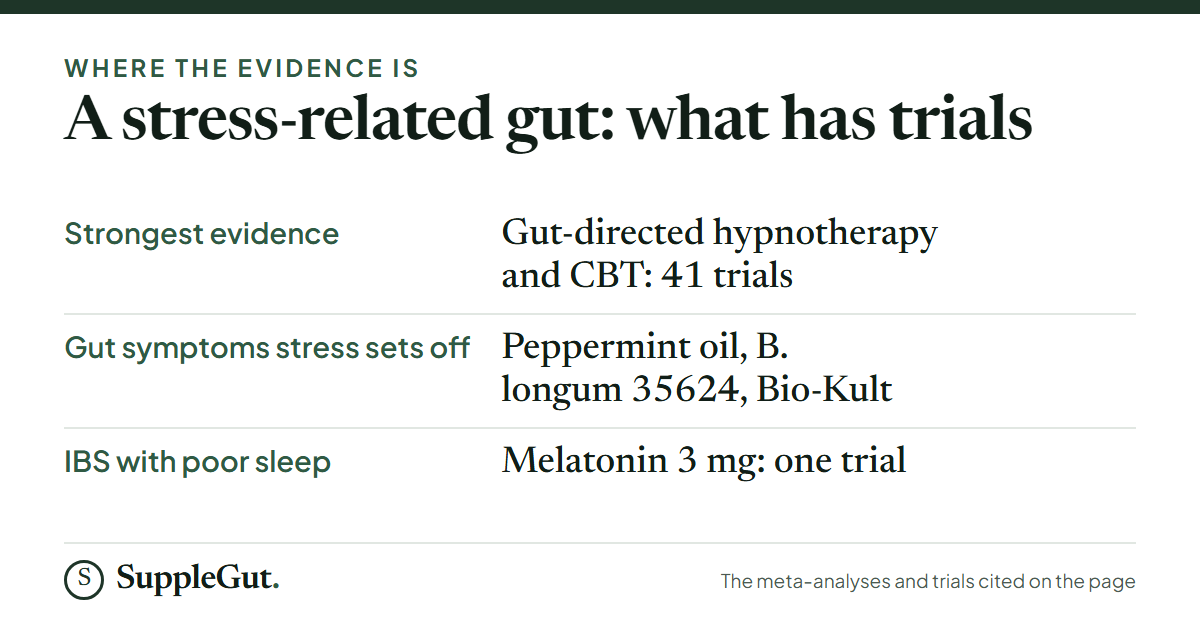
What is the best supplement for a stress-related gut? The strongest evidence for stress-driven gut symptoms is not a supplement: gut-directed hypnotherapy and cognitive behavioral therapy cut the chance of IBS symptoms persisting by about a third across 41 trials. Among supplements, the ones that help the gut symptoms stress sets off have IBS trials behind them (enteric-coated peppermint oil, B. longum 35624, the Bio-Kult 14-strain formula), and melatonin at 3 mg has one trial in people with IBS and poor sleep. Probiotics have a small pooled effect on anxiety itself; chamomile extract has trials in generalized anxiety; magnesium’s anxiety evidence is rated poor.
"Stress gut" covers two questions that get run together: does anything sold as a supplement reduce the stress, and does anything calm the symptoms that stress sets off. The trials answer them separately, and this guide keeps them separate. Where a product has evidence for the gut symptom but not for the stress, it says so.
How the evidence ranks
| Option | Best evidence | What it showed | Which question it answers |
|---|---|---|---|
| Gut-directed hypnotherapy or CBT | Network meta-analysis, 41 RCTs, 4,072 IBS patients | Symptoms persisting: RR 0.67 (hypnotherapy), 0.62 (CBT) | Both: the stress and the symptoms |
| Enteric-coated peppermint oil | Meta-analysis, 9 RCTs, 726 IBS patients | Global symptoms RR 2.23; pain RR 2.14 | The symptoms |
| B. longum 35624 (Align) | RCT, 362 women with IBS, 4 weeks | 108 CFU beat placebo on pain, bloating and global symptoms | The symptoms |
| Bio-Kult 14-strain formula | RCT, 400 adults with IBS-D, 16 weeks | Pain severity down 69% vs 47% | The symptoms |
| Melatonin, 3 mg at bedtime | RCT, 40 IBS patients with poor sleep, 2 weeks | Abdominal pain score 2.35 vs 0.70 change; sleep unchanged | The symptoms, in poor sleepers |
| Probiotics as a class | Meta-analysis, 34 controlled trials | Anxiety d = −0.10; depression d = −0.24 | The stress, slightly |
| Chamomile extract, 1,500 mg a day | Two-phase RCT, 179 people with generalized anxiety disorder | 58% responded open-label; lower symptoms than placebo over 26 weeks | The stress, at a pharmaceutical-grade dose |
| Magnesium | Systematic review, 18 studies | "Suggestive" benefit in anxiety-prone groups; evidence quality poor | The stress, weakly |
| Caraway oil and L-menthol (FDgard) | RCT, 95 adults with functional dyspepsia, 4 weeks | Post-meal distress down at 24 hours (p=0.039) | The symptoms, when they sit above the navel |
The best-evidenced option is not a pill
A network meta-analysis of 41 randomized trials in 4,072 people with IBS found that gut-directed hypnotherapy cut the chance of symptoms persisting (relative risk 0.67, 95% CI 0.49 to 0.91), and that face-to-face and self-administered cognitive behavioral therapy did about the same (0.62 and 0.61), with no approach clearly better than another (Black et al., Gut, 2020). A 2024 update across 42 trials in 5,220 people found the same for abdominal pain specifically: self-guided CBT relative risk 0.71, face-to-face hypnotherapy 0.77 (Goodoory et al., Gastroenterology, 2024). For a gut that flares with stress, that is the evidence base to start from. Nothing below matches it.
Supplements for the symptoms stress sets off
The supplements with trials here are the IBS ones, and each treats a symptom rather than the stress.
Enteric-coated peppermint oil has the largest base: nine randomized trials in 726 people with IBS, relative risk 2.23 for global improvement and 2.14 for abdominal pain, with heartburn the commonest side effect (Khanna, MacDonald & Levesque, Journal of Clinical Gastroenterology, 2014). It suits the cramping, urgent kind of stress gut.
Bifidobacterium longum 35624, the Align strain, beat placebo on pain, bloating and global symptoms at 108 CFU a day in 362 women with IBS over four weeks (Whorwell et al., American Journal of Gastroenterology, 2006). Bio-Kult’s 14-strain formula did the same in 400 adults with diarrhea-predominant IBS over 16 weeks, pain severity down 69% against 47% on placebo, in a manufacturer-funded trial (Ishaque et al., BMC Gastroenterology, 2018). Neither trial measured stress or anxiety as an outcome.
Melatonin is the one option tested in the overlap of a bad gut and bad sleep. 40 people with IBS and sleep disturbance took 3 mg at bedtime or placebo for two weeks: the abdominal pain score fell by 2.35 points on melatonin against 0.70 on placebo (p<0.001) and rectal pain threshold rose, while sleep itself, bloating, stool pattern, anxiety and depression did not change (Song et al., Gut, 2005). A pain effect without a sleep effect, in a small two-week trial.
When the stress symptom sits above the navel, as fullness, early satiety or nausea, the relevant trial is caraway oil with L-menthol in 95 adults with functional dyspepsia: post-meal distress fell against placebo within 24 hours (p=0.039), about three-quarters of the severely symptomatic improved substantially by four weeks against half on placebo, and adverse events were mild; the maker funded it (Chey et al., Clinical and Translational Gastroenterology, 2019).
Supplements for the stress itself
Probiotics as a class have a real but small effect. A meta-analysis of 34 controlled trials found probiotics reduced depression scores (d = −0.24) and anxiety scores (d = −0.10, p=0.03), with larger effects in people with a psychiatric diagnosis and no effect from prebiotics (Liu, Walsh & Sheehan, Neuroscience & Biobehavioral Reviews, 2019). A separate pooling of 10 trials in 685 people found an effect on depressive symptoms in diagnosed depression but none on anxiety (Chao et al., Frontiers in Neurology, 2020). An effect size of −0.10 is close to nothing a person would notice; none of these trials used the strains in the gut products above.
Chamomile has trials, at a dose a tea does not reach. 179 people with moderate-to-severe generalized anxiety disorder took 1,500 mg a day of a pharmaceutical-grade extract for eight weeks open-label, and 58% responded, with adverse events in 11.7% and none serious (Keefe et al., Phytomedicine, 2016). The 93 responders were then randomized to continue or switch to placebo for 26 weeks, and those on chamomile kept significantly lower anxiety scores (p=0.0032) with similar low adverse-event rates (Mao et al., Phytomedicine, 2016). Three 500 mg capsules of standardized extract a day is not a cup of chamomile tea, which has no trial of its own here.
Magnesium is sold for stress more than any other mineral, and the systematic review of 18 studies found the evidence "suggestive" of a benefit on subjective anxiety in anxiety-prone groups (mild anxiety, premenstrual syndrome, postpartum, hypertension), with no study measuring a validated stress outcome and the overall quality of evidence rated poor (Boyle, Lawton & Dye, Nutrients, 2017). Its better-supported gut use is as an osmotic for constipation, covered in what works for constipation.
Signs to stop comparing supplements and get checked
Gut symptoms with unintended weight loss, blood in the stool, fever, waking at night with pain or diarrhea, or a start after 50 need a clinician regardless of how stressful life is. Anxiety or low mood that is itself the main problem, or that comes with thoughts of self-harm, is a reason to talk to a doctor now rather than to a supplement page.
Products in this catalog with the trials above
Common questions
What is the best supplement for stress-related stomach problems?
For the symptoms, the IBS options with trials: enteric-coated peppermint oil (nine trials, 726 people), Bifidobacterium longum 35624 (362 women), the Bio-Kult 14-strain formula (400 adults with IBS-D), and melatonin 3 mg for IBS with poor sleep (40 people). For the stress itself, probiotics as a class have a small pooled effect on anxiety (d = −0.10) and chamomile extract at 1,500 mg a day has trials in generalized anxiety disorder. Gut-directed hypnotherapy and CBT outrank all of them.
Do probiotics help with anxiety and stress?
Slightly, on average. Across 34 controlled trials, probiotics reduced anxiety scores by an effect size of −0.10 and depression scores by −0.24, with bigger effects in people with a psychiatric diagnosis; prebiotics did nothing. A separate pooling of 10 trials found an effect on depressive symptoms but none on anxiety. The strains in those trials are not the ones in the IBS products.
Does magnesium help a nervous stomach?
The stress evidence is thin: a systematic review of 18 studies called the anxiety benefit "suggestive" in anxiety-prone groups and rated the evidence quality poor, with no study measuring a validated stress outcome. Magnesium’s better-supported gut use is as an osmotic for constipation.
Does chamomile help anxiety?
At 1,500 mg a day of a pharmaceutical-grade extract, yes in the trials: 58% of 179 people with generalized anxiety disorder responded over eight weeks, and responders who continued for 26 weeks kept lower anxiety scores than those switched to placebo (p=0.0032), with low adverse-event rates in both groups. Chamomile tea has no trial of its own.
Does melatonin help IBS?
In 40 people with IBS and sleep disturbance, 3 mg at bedtime for two weeks cut the abdominal pain score by 2.35 points against 0.70 on placebo and raised the rectal pain threshold, while sleep, bloating, stool pattern, anxiety and depression did not change. A pain effect in a small short trial.
What works better than supplements for a stress gut?
Gut-directed hypnotherapy and cognitive behavioral therapy: across 41 randomized trials in 4,072 people with IBS, they cut the chance of symptoms persisting to about two-thirds of control (relative risk 0.67 and 0.62), and a 2024 analysis of 42 trials found the same for abdominal pain.
Sources
- Black CJ, et al. "Efficacy of psychological therapies for irritable bowel syndrome: systematic review and network meta-analysis." Gut, 2020. pubmed.ncbi.nlm.nih.gov/32276950
- Goodoory VC, et al. "Effect of Brain-Gut Behavioral Treatments on Abdominal Pain in Irritable Bowel Syndrome: Systematic Review and Network Meta-Analysis." Gastroenterology, 2024. pubmed.ncbi.nlm.nih.gov/38777133
- Khanna R, MacDonald JK, Levesque BG. "Peppermint oil for the treatment of irritable bowel syndrome: a systematic review and meta-analysis." Journal of Clinical Gastroenterology, 2014. pubmed.ncbi.nlm.nih.gov/24100754
- Whorwell PJ, et al. "Efficacy of an encapsulated probiotic Bifidobacterium infantis 35624 in women with irritable bowel syndrome." American Journal of Gastroenterology, 2006. pubmed.ncbi.nlm.nih.gov/16863564
- Ishaque SM, et al. "A randomized placebo-controlled clinical trial of a multi-strain probiotic formulation (Bio-Kult) in the management of diarrhea-predominant irritable bowel syndrome." BMC Gastroenterology, 2018. pubmed.ncbi.nlm.nih.gov/29801486
- Song GH, et al. "Melatonin improves abdominal pain in irritable bowel syndrome patients who have sleep disturbances: a randomised, double blind, placebo controlled study." Gut, 2005. pubmed.ncbi.nlm.nih.gov/15914575
- Chey WD, et al. "A Novel, Duodenal-Release Formulation of a Combination of Caraway Oil and L-Menthol for the Treatment of Functional Dyspepsia: A Randomized Controlled Trial." Clinical and Translational Gastroenterology, 2019. pubmed.ncbi.nlm.nih.gov/30939487
- Liu RT, Walsh RFL, Sheehan AE. "Prebiotics and probiotics for depression and anxiety: A systematic review and meta-analysis of controlled clinical trials." Neuroscience & Biobehavioral Reviews, 2019. pubmed.ncbi.nlm.nih.gov/31004628
- Chao L, et al. "Effects of Probiotics on Depressive or Anxiety Variables in Healthy Participants Under Stress Conditions or With a Depressive or Anxiety Diagnosis." Frontiers in Neurology, 2020. pubmed.ncbi.nlm.nih.gov/32528399
- Keefe JR, et al. "Short-term open-label chamomile (Matricaria chamomilla L.) therapy of moderate to severe generalized anxiety disorder." Phytomedicine, 2016. pubmed.ncbi.nlm.nih.gov/27912871
- Mao JJ, et al. "Long-term chamomile (Matricaria chamomilla L.) treatment for generalized anxiety disorder: A randomized clinical trial." Phytomedicine, 2016. pubmed.ncbi.nlm.nih.gov/27912875
- Boyle NB, Lawton C, Dye L. "The Effects of Magnesium Supplementation on Subjective Anxiety and Stress: A Systematic Review." Nutrients, 2017. pubmed.ncbi.nlm.nih.gov/28445426
Not sure which product fits your situation?
This guide covers the mechanics. The quiz takes your specific symptoms, routine and preferences and matches you to one product from the catalog.
Take the quiz →