
Guide
How many constipation treatments have strong clinical evidence?
"What works for constipation" gets answered two different ways online: a list of ten things that might help, or a graded medical guideline that says which options have strong trial support and which don't. This guide uses the second kind — the 2023 gastroenterology guideline that sorts common treatments into "strong" and "conditional" recommendations, plus the trials behind two of the conditional options.
Short answer
Five treatments carry a strong recommendation in the 2023 AGA/ACG guideline: polyethylene glycol (PEG), sodium picosulfate, linaclotide, plecanatide and prucalopride. Fiber (including psyllium), lactulose, senna, magnesium oxide and lubiprostone carry a conditional recommendation — not a failure, but less consistent evidence across trials.
Of the options sold as supplements rather than prescriptions, psyllium has the strongest result: in the review that pooled 16 fiber trials, 66% of participants responded to fiber against 41% on control, and psyllium did better than fiber as a whole, averaging about 3 more bowel movements a week. The benefit appeared only after at least 4 weeks of daily use above 10 g/day. Magnesium oxide has one small placebo-controlled trial behind it, in 34 people.
Every figure here is sourced below.
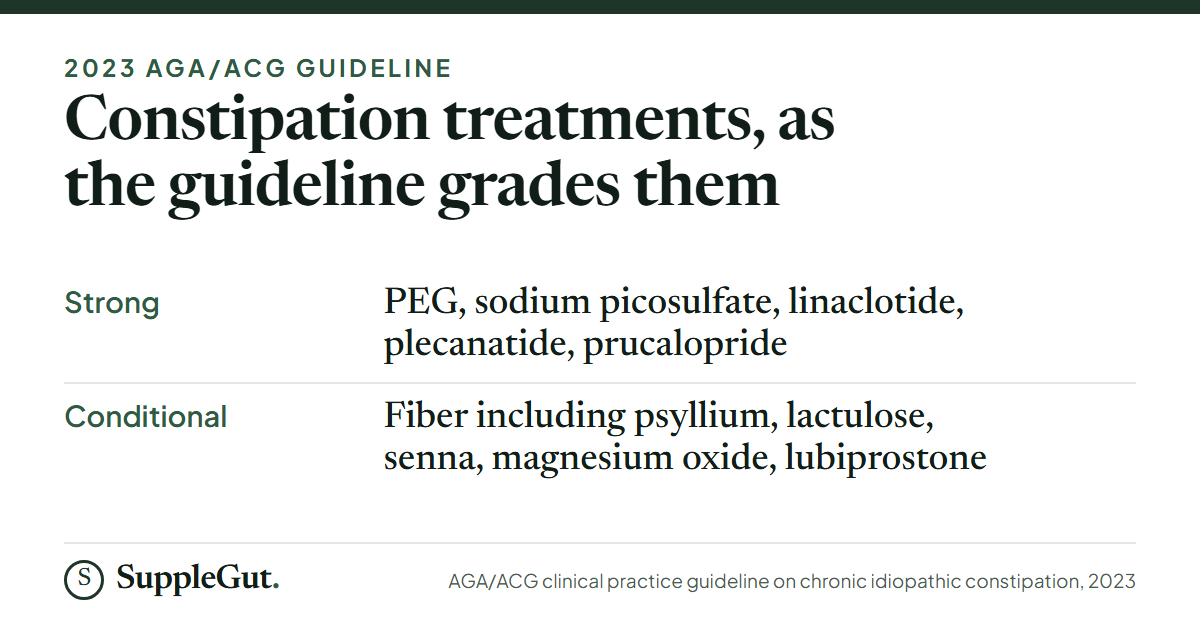
The guideline's two tiers
In 2023, the American Gastroenterological Association and American College of Gastroenterology published a joint clinical practice guideline grading the trial evidence behind treatments for chronic idiopathic constipation. It split them into two tiers (AGA/ACG Clinical Practice Guideline, Gastroenterology, 2023):
| Strong recommendation | Conditional recommendation |
|---|---|
| Polyethylene glycol (PEG) | Fiber, including psyllium |
| Sodium picosulfate | Lactulose |
| Linaclotide | Senna |
| Plecanatide | Magnesium oxide |
| Prucalopride | Lubiprostone |
"Conditional" doesn't mean the option failed in trials — it means the panel found the evidence less consistent across studies, or response varying more from person to person, than for the strong-tier options. Fiber and magnesium oxide, the two categories with catalog products below, both sit in the conditional tier alongside lactulose and senna.
How the classes compare head-to-head
A 2019 network meta-analysis pooled 33 randomized trials across 17,214 patients to rank constipation treatments against each other rather than each against placebo alone (Luthra et al., Lancet Gastroenterology & Hepatology, 2019). At four weeks, stimulant laxatives — the class that includes bisacodyl and senna — ranked as the most effective for achieving regular bowel movements. That's a faster, harsher-acting category than the fiber and magnesium options below, and it isn't stocked in this catalog; weighing a stimulant laxative against a gentler daily option is a question for a pharmacist or clinician, not a label comparison.
Fiber: the most-studied conditional option
Psyllium is the best-evidenced fiber for this. A 2022 review of 16 fiber trials in 1,251 adults found fiber produced a bowel-movement response in 66% of participants versus 41% on control. Psyllium on its own did better, with a relative risk of 1.82, averaging 3.08 more bowel movements a week, but only after at least 4 weeks of consistent daily use above 10 g/day (van der Schoot et al., American Journal of Clinical Nutrition, 2022). The full timeline — including why the first bowel movement and long-term regularity run on different clocks — is in our psyllium husk guide.
Magnesium oxide: one small placebo-controlled trial
A 2019 randomized, double-blind, placebo-controlled trial gave 34 women with Rome IV-diagnosed chronic constipation either magnesium oxide (0.5 g three times a day, 1.5 g total) or a lactose placebo for 28 days, tracking bowel-movement response, stool consistency on the Bristol scale, colonic transit time and quality of life (Mori et al., Journal of Neurogastroenterology and Motility, 2019). It's a small, single-site trial in one demographic group — the kind of evidence base that's consistent with a conditional rather than strong recommendation.
That trial used magnesium oxide. Magnesium citrate and other forms are commonly sold for "digestive support" or relaxation, but that's a different compound with its own absorption profile — a citrate product doesn't inherit the oxide trial's results just because both say "magnesium" on the label.
The other supplements people search for, and their trials
The guideline grades treatment classes, not every product sold for constipation. These are the supplement options that come up most often, with the best trial behind each.
Kiwifruit
The largest trial of a food for constipation: 184 adults (60 with functional constipation, 61 with IBS-C, 63 healthy) ate two green kiwifruits a day or took 7.5 g of psyllium for four weeks each, in a crossover. Kiwifruit added 1.5 complete bowel movements a week in functional constipation and 1.7 in IBS-C, improved abdominal comfort in both, and caused no significant adverse events (Gearry et al., American Journal of Gastroenterology, 2023). A smaller crossover of two gold kiwifruit a day against the same psyllium dose found more weekly complete bowel movements and less straining (Bayer et al., Nutrients, 2022). Both trials used whole fruit; a kiwifruit powder or chewable is a different dose of a different preparation.
Prunes
One crossover trial of 40 adults compared 50 g of dried plums twice a day against 11 g of psyllium twice a day, each matched at 6 g of fiber a day, for three weeks each. Prunes produced more complete spontaneous bowel movements and better stool consistency than psyllium; straining and the global constipation score did not differ, and both were well tolerated (Attaluri et al., Alimentary Pharmacology & Therapeutics, 2011).
Probiotics
A meta-analysis of 14 randomized trials in 1,182 adults with functional constipation found probiotics shortened gut transit time by 12.4 hours and added 1.3 bowel movements a week overall. The effect depended on the organism: Bifidobacterium lactis added 1.5 a week, while Lactobacillus casei Shirota added none (Dimidi et al., American Journal of Clinical Nutrition, 2014). A probiotic bought for constipation should name a B. lactis strain on the label.
Partially hydrolyzed guar gum (PHGG)
The evidence is thinner than the fiber’s reputation. A four-week randomized trial of 5 g a day in 52 long-term-care residents with chronic constipation found less laxative use in the PHGG group in weeks three and four but no difference in bowel frequency or stool form (Chan et al., Journal of Nutrition, Health & Aging, 2022). An earlier trial of 10 g a day for 15 days in 64 hospitalized adults found no effect on defecation frequency or laxative need beyond a high-fiber diet (Belo et al., Arquivos de Gastroenterologia, 2008). PHGG’s better-supported use is IBS: an open randomized trial in 188 people with IBS found 5 g a day for 12 weeks gave a 60% success rate against 40% on wheat bran, with more people switching to PHGG than away from it (Parisi et al., Digestive Diseases and Sciences, 2002).
Oat beta-glucan
The soluble fiber in oat and barley bran has its own placebo-controlled constipation trial and a separate set of trials on IBS symptoms; both are set out in does beta-glucan help gut health?, along with the mushroom beta-glucans that get conflated with it.
Magnesium citrate
The placebo-controlled constipation trial in the guideline used magnesium oxide at 1.5 g a day. No equivalent placebo-controlled trial of a magnesium citrate supplement for chronic constipation was found in the search for this guide, so a citrate powder rests on the oxide trial by analogy and on its own osmotic mechanism, not on a trial of its own.
Signs to stop comparing options and get checked
Everything above assumes ordinary functional constipation. Rectal bleeding, unintended weight loss, a sudden change in bowel habit after age 50, or no response at all after a full month at an adequate dose of any option — those warrant a clinician visit instead of trying the next thing on a list.
Products in this catalog from the conditional tier
Common questions
What is the most effective treatment for constipation?
The 2023 AGA/ACG clinical practice guideline gives a strong recommendation to five options: polyethylene glycol (PEG), sodium picosulfate, linaclotide, plecanatide and prucalopride. A separate 2019 network meta-analysis of 33 trials in 17,214 patients found stimulant laxatives ranked most effective at four weeks for achieving regular bowel movements. Most of these are prescription or pharmacy products rather than supplements.
How long does fiber take to help constipation?
A 2022 review of 16 trials in 1,251 adults found the bowel-movement frequency and transit-time benefits of fiber took at least 4 weeks of consistent daily use to appear, with most of the effect at doses above 10 g a day. A single dose can produce a bowel movement much sooner, which is a different and faster mechanical effect from fixing chronic constipation.
Does magnesium help constipation?
Magnesium oxide carries a conditional recommendation in the 2023 guideline. The supporting evidence includes a 2019 randomized, double-blind, placebo-controlled trial in 34 women with chronic constipation given 1.5 g of magnesium oxide daily for 28 days. That is a small, single-site trial in one demographic group. Magnesium citrate and other forms are different compounds and do not inherit the oxide trial results.
Is psyllium or magnesium better for constipation?
No trial cited here compared the two head-to-head, so neither can be called better on this evidence. What differs is the size of the evidence base: psyllium came out best in a review of 16 randomized fiber trials in 1,251 adults, while the magnesium oxide evidence rests on a single 34-person trial. Both sit in the guideline’s conditional tier.
What is the best supplement for constipation?
Among supplements, psyllium has the strongest result: it had the clearest effect in a review of 16 randomized fiber trials in 1,251 adults, in which 66% responded to fiber against 41% on control, after four weeks at more than 10 g a day. Two green kiwifruits a day matched or beat 7.5 g of psyllium in a 184-person trial, prunes beat psyllium on complete bowel movements in a 40-person crossover, and probiotics containing Bifidobacterium lactis added about 1.5 bowel movements a week across trials. Magnesium oxide has one 34-person placebo-controlled trial.
Do probiotics help with constipation?
On average, a little: a meta-analysis of 14 trials in 1,182 adults found probiotics cut gut transit time by 12.4 hours and added 1.3 bowel movements a week. The benefit came from Bifidobacterium lactis strains (1.5 a week); Lactobacillus casei Shirota added none.
Is kiwi or prunes better for constipation?
Both have beaten psyllium in a head-to-head trial: two green kiwifruits a day in 184 adults, and 100 g of prunes a day in 40 adults. They have not been compared with each other. Kiwifruit has the larger trial and improved abdominal comfort as well as frequency.
Does PHGG help constipation?
The two randomized trials in adults with constipation are small and mixed: 5 g a day for four weeks cut laxative use in 52 care-home residents without changing bowel frequency, and 10 g a day for 15 days added nothing to a high-fiber diet in 64 hospitalized adults. PHGG has stronger evidence for IBS symptoms than for constipation alone.
Why is fiber only a conditional recommendation for constipation?
Conditional does not mean fiber failed in trials. The guideline panel applies it when evidence is less consistent across studies or individual response varies more than for the strong-tier options. The 2022 review found fiber produced a response in 66% of participants versus 41% on control, and psyllium did better than fiber as a whole, so it does work for most people who take an adequate dose long enough.
Sources
- American Gastroenterological Association / American College of Gastroenterology. "Clinical Practice Guideline: Pharmacological Management of Chronic Idiopathic Constipation." Gastroenterology, 2023;164(7):1086–1106. pubmed.ncbi.nlm.nih.gov/37211380
- Luthra P, et al. "Efficacy of drugs in chronic idiopathic constipation: a systematic review and network meta-analysis." Lancet Gastroenterology & Hepatology, 2019;4(11):831–844. pubmed.ncbi.nlm.nih.gov/31474542
- van der Schoot A, et al. "The Effect of Fiber Supplementation on Chronic Constipation in Adults: An Updated Systematic Review and Meta-Analysis of Randomized Controlled Trials." American Journal of Clinical Nutrition, 2022;116(4):953–969. pmc.ncbi.nlm.nih.gov/articles/PMC9535527
- Mori S, et al. "A Randomized Double-blind Placebo-controlled Trial on the Effect of Magnesium Oxide in Patients With Chronic Constipation." Journal of Neurogastroenterology and Motility, 2019;25(4):563–575. pmc.ncbi.nlm.nih.gov/articles/PMC6786451
- Gearry R, et al. "Consumption of 2 Green Kiwifruits Daily Improves Constipation and Abdominal Comfort." American Journal of Gastroenterology, 2023. pubmed.ncbi.nlm.nih.gov/36537785
- Bayer SB, et al. "Two Gold Kiwifruit Daily for Effective Treatment of Constipation in Adults: A Randomized Clinical Trial." Nutrients, 2022. pubmed.ncbi.nlm.nih.gov/36235798
- Attaluri A, et al. "Randomised clinical trial: dried plums (prunes) vs. psyllium for constipation." Alimentary Pharmacology & Therapeutics, 2011. pubmed.ncbi.nlm.nih.gov/21323688
- Dimidi E, et al. "The effect of probiotics on functional constipation in adults: a systematic review and meta-analysis of randomized controlled trials." American Journal of Clinical Nutrition, 2014. pubmed.ncbi.nlm.nih.gov/25099542
- Chan TC, et al. "Effectiveness of Partially Hydrolyzed Guar Gum in Reducing Constipation in Long Term Care Facility Residents." Journal of Nutrition, Health & Aging, 2022. pubmed.ncbi.nlm.nih.gov/35297467
- Parisi GC, et al. "High-fiber diet supplementation in patients with irritable bowel syndrome (IBS): a multicenter, randomized, open trial comparison between wheat bran diet and partially hydrolyzed guar gum (PHGG)." Digestive Diseases and Sciences, 2002. pubmed.ncbi.nlm.nih.gov/12184518
- Belo GM, et al. "Effect of partially hydrolyzed guar gum in the treatment of functional constipation among hospitalized patients." Arquivos de Gastroenterologia, 2008. pubmed.ncbi.nlm.nih.gov/18425236
Which fiber for constipation, on one page
Which fibers have the trials, the dose that worked, and how to take it without the gas. Sent by email, then two short follow-ups over ten days. Unsubscribe any time.
Your address is used for these three emails and nothing else. How we handle it.
Not sure which product fits your situation?
This guide covers the mechanics. The quiz takes your specific symptoms, routine and preferences and matches you to one product from the catalog.
Take the quiz →