
Guide
Does Alaya Advanced Synbiotic work? Seven strains, three codes and the amounts against trial doses
Quick answer
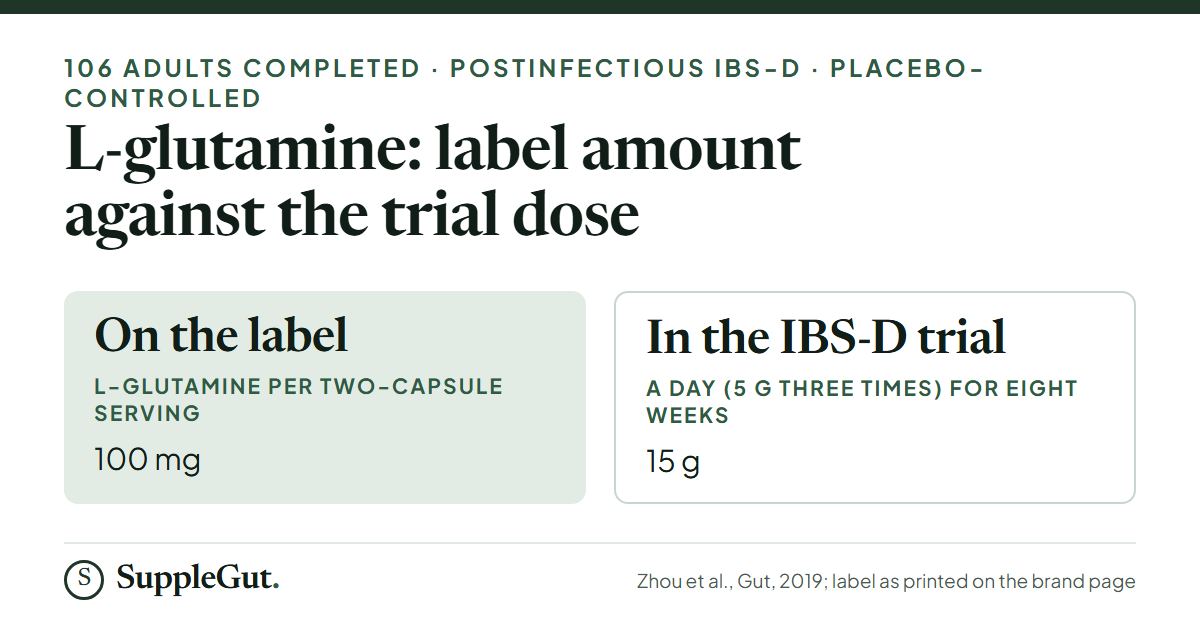
Does Alaya Advanced Synbiotic work? No trial of the finished capsule exists. Three of its seven strains carry a code (BL-05, 6595, BL-04), and the 14 billion CFU is one blend figure at manufacture with no per-strain counts. BL-04’s trials measured respiratory illness and immune response at 2 billion CFU, not gut symptoms. The label’s acacia (300 mg) is 3% of the 10 g a day used in the acacia trials, and its L-glutamine (100 mg) is 1/150 of the 15 g a day used in the one IBS trial we found.
Alaya Naturals Advanced Synbiotic is a 60-capsule bottle of delayed-release capsules from Alaya Naturals of Miami: seven probiotic strains in one blend, 300 mg of acacia fiber and 100 mg of L-glutamine, taken as two capsules once a day. Its draw is the combination and a very large review base on the brand’s own site. This page sets out what the label prints, how much of it matches the amounts used in published trials, and where the reviews split.
What Advanced Synbiotic is, and what it is not
The Supplement Facts panel on the brand site lists, per two capsules: Gum Acacia (Fibregum) 300 mg, Alaya Probiotic Blend 200 mg (14 billion CFU, “at time of manufacture”) and L-glutamine 100 mg. The other ingredients are rice grain powder, hypromellose (the capsule) and L-leucine. There are seven organisms in the blend. Three carry a strain designation: Bifidobacterium longum BL-05, Lactobacillus plantarum 6595 and Bifidobacterium lactis BL-04. Four are species only: B. breve, L. reuteri, L. paracasei and L. salivarius. The 14 billion CFU is one figure for the whole blend; no count is printed for any single strain, and none is given for the end of shelf life.
The listing conflict matters. The brand-site label prints acacia (Fibregum) as the prebiotic. Amazon’s listing is still titled “with Prebiotics from Sunfiber” (partially hydrolyzed guar gum) and says the product “has been reformulated and is now our Advanced Synbiotic”. We could not tell which a bottle holds on a given shelf; the brand-site label is the more recent source we read. The label also says it is made in a facility that handles eggs, wheat, milk, tree nuts, peanuts, soybeans, shellfish and fish, with no “contains” statement, while the brand page carries a “Dairy Free” badge.
The trial of the product itself
There is none. PubMed and ClinicalTrials.gov return nothing under the brand name. The brand page says “3rd Party Lab Tested” but names no lab and shows no certificate. Everything below is evidence for parts of the formula, so it matters how closely the label matches the trial.
The strains
B. lactis BL-04 is the one strain with human trials. In 465 healthy, physically active adults, 2 billion CFU a day for about five months lowered the risk of an upper-respiratory illness episode (hazard ratio 0.73, 95% CI 0.55 to 0.95); there were too few gut-illness episodes to analyze (West et al., 2014). In 152 volunteers given a rhinovirus challenge, it lowered nasal chemokine response and the share shedding virus (76% against 91%), with no difference in symptom scores (Turner et al., 2017). Both trials had strain-owner staff among the authors, and both measured respiratory or immune outcomes, not bloating or bowel habit. We found no trial of BL-04 on gut symptoms. For BL-05 we found only laboratory papers and no human trial.
L. plantarum 6595 is where the code matters. A 1996 paper states that strain 299 is DSM 6595 and strain 299v is DSM 9843 (Adlerberth et al., 1996). The label does not say “DSM”, so matching 6595 to strain 299 is our inference from the number. The IBS trials are of 299v: 214 patients, one capsule a day for four weeks, with pain severity 0.68 against 0.92 on placebo (Ducrotté et al., 2012), and a later 120-patient trial that found no difference (Babar et al., 2022). Neither necessarily applies to the strain on this label. The other four organisms are species only, so no strain-specific evidence can be assigned to them.
The probiotic class in IBS
A 2023 meta-analysis of 52 placebo-controlled trials in 6,289 people with IBS found probiotics raised the overall response rate (risk ratio 1.64) and abdominal-pain relief (1.69), with mixed probiotics at 1.41. It also said evidence for prebiotics and synbiotics in IBS “remained uncertain” for want of trials (Zhang et al., 2023). A 2024 network meta-analysis of 54 probiotic trials and 7 prebiotic or synbiotic trials found probiotics effective (OR 0.53, 95% CI 0.48 to 0.59), said the best strain or combination remains unclear, and found prebiotics and synbiotics did not show significant improvement (Wu et al., 2024). Both reviews are in people with IBS, not the general shopper. The site’s CFU guide covers what 14 billion means.
The prebiotic and glutamine against trial doses
Acacia. In 180 adults with constipation-predominant IBS, 10 g a day for four weeks improved stool frequency, with no change in stool consistency or quality of life (JanssenDuijghuijsen et al., 2024). A gum arabic dose-finding study put the optimum for bifidobacteria and lactobacilli at around 10 g (Calame et al., 2008). The label’s 300 mg is 3% of that dose. We found no trial of Fibregum on bowel outcomes.
L-glutamine. The one IBS trial we found gave 5 g three times a day (15 g) for eight weeks to postinfectious IBS-D patients with raised intestinal permeability: 43 of 54 (79.6%) reached the primary endpoint against 3 of 52 (5.8%) on placebo. It was a small, single-center trial in a specific condition (Zhou et al., 2019). The label’s 100 mg is 1/150 of that dose, so those results cannot be read across to this capsule.
How to take it
The label says two capsules once a day, preferably with a meal. The capsule is delayed-release, shelf-stable and needs no refrigeration. The brand gives no survival data for the strains. A fair test is the four weeks at which probiotic benefit appeared in the IBS meta-analysis.
Side effects and who should not take it
We read only the Supplement Facts image, not the bottle’s warning text. The brand FAQ advises anyone pregnant or breastfeeding to consult a healthcare professional first, and describes L-glutamine as helpful in “leaky gut, malabsorption, or inflammatory bowel disease”, a brand claim we did not find tested at this dose. We found no medication statement. Amazon’s review summary lists digestibility with 28 mentions, 6 negative, and side effects with 12 mentions, 3 negative; a few reviewers there report nausea, bloating or gas.
What the reviews say
The brand’s own widget shows about 4.95 from 1,009 reviews (968 five-star, 37 four, 3 three, 1 two), and 995 of the 1,000 we could read are flagged verified buyers. Amazon shows 4.5 from 410 ratings (76% five-star, 10% four, 7% three, 2% two, 5% one). Brand-wide, Trustpilot shows 4.8 on a claimed profile where the company replies to reviews.
Reviewers praise less bloating and more regular bowels (about 180 of the 1,000 mention bloating), small easy-to-swallow capsules with no stomach upset, and the price. The recurring complaint is no noticeable difference: five of the 1,000 say so, and three of those five carry four or five stars. On Trustpilot, recent complaints concern unclear monthly shipping charges and an auto-ship-only discount, across all products rather than this one.
Cost, subscription and refund terms
One bottle is $34.95 on the brand site, which is $1.17 a day. The subscription is 15% off at $29.71 ($0.99 a day), with delivery every 30, 45, 60 or 90 days and the text “Pause, skip, or cancel anytime”. Amazon lists $36.95 ($1.23 a day), or $33.25 on Subscribe & Save. The refund policy allows a return within 30 days of receipt with proof of purchase, refunded to the original payment method with a prepaid label arranged by email. It does not say whether opened products qualify or how to cancel a subscription, and we found no shipping charge stated on the pages we read; a company reply on Trustpilot says the monthly shipping cost “wasn’t clear”. Amazon marks the listing non-returnable.
Who is behind it, and Jillian Michaels
Her own site says “The only supplement company I work with is Alaya Naturals”, and she appears in an Alaya TV spot for its Multi Collagen. Alaya’s Trustpilot profile says it was “Founded by a wellness entrepreneur” without a name. No source we read names her as founder or owner, and her name is not on the Advanced Synbiotic page; a search summary said her site lists Alaya among companies she invested in, but we did not find that on her About page.
Who Advanced Synbiotic is for
- Someone who wants a once-a-day seven-strain capsule at about $1.17 a day and accepts that no strain count is printed.
- A person who values a large review base, with the brand-site and Amazon figures read separately.
- Someone comparing synbiotics who has checked that the acacia and glutamine amounts are label amounts, not trial amounts.
For a probiotic with a different structure, the Seed DS-01 guide covers a 24-strain product, and the catalog pages for Culturelle Digestive Daily and Align Extra Strength cover two other probiotics.
The products in this catalog
Common questions
Does Alaya Advanced Synbiotic work?
No trial of the finished product was found. Its B. lactis BL-04 strain lowered respiratory illness at 2 billion CFU in healthy adults, but we found no gut-symptom trial of it, and the label’s acacia (300 mg) and L-glutamine (100 mg) are far below trial doses. Most reviewers on the brand’s site and Amazon describe less bloating and better regularity, and a minority say they noticed nothing.
What strains are in Alaya Advanced Synbiotic, and how many CFU?
Seven organisms in one 200 mg blend of 14 billion CFU at time of manufacture: B. longum BL-05, L. plantarum 6595 and B. lactis BL-04, plus B. breve, L. reuteri, L. paracasei and L. salivarius with no strain designation. No count is printed for any single strain. The CFU guide covers how to read the figure.
Is the prebiotic acacia or Sunfiber?
The brand-site label prints Gum Acacia (Fibregum) 300 mg. Amazon’s listing is still titled with Sunfiber (partially hydrolyzed guar gum) and says the product was reformulated. We could not tell which a given bottle holds, and the brand-site label is the more recent source we read.
Is Alaya Advanced Synbiotic safe, and what are its side effects?
The brand advises anyone pregnant or breastfeeding to consult a healthcare professional. The label says it is made in a facility that handles milk, eggs, wheat, tree nuts, peanuts, soybeans, shellfish and fish. A few Amazon reviewers report nausea, bloating or gas, while many brand-site reviewers say they had no side effects.
Alaya Advanced Synbiotic vs Seed DS-01?
No study compares them. Alaya has seven strains at 14 billion CFU with 300 mg of acacia and 100 mg of L-glutamine, three strains with designations, at about $1.17 a day. Seed DS-01 is a 24-strain product priced at $59.99 on Amazon; the Seed DS-01 guide covers it.
How much does it cost, and what is the refund policy?
A 60-capsule bottle is $34.95 on the brand site ($1.17 a day), $29.71 on a 15% subscription, and $36.95 on Amazon. The brand allows a return within 30 days of receipt with proof of purchase and says subscriptions can be paused, skipped or cancelled anytime; its policy page does not say whether opened products qualify. Amazon marks the listing non-returnable.
Is Jillian Michaels behind Alaya Naturals?
Her own site says Alaya is the only supplement company she works with, and she appears in an Alaya TV spot for its Multi Collagen. No source we read names her as founder or owner, and her name is not on the Advanced Synbiotic page.
Sources
- West NP, Horn PL, Pyne DB, et al. "Probiotic supplementation for respiratory and gastrointestinal illness symptoms in healthy physically active individuals." Clinical Nutrition, 2014;33(4):581–587. doi.org/10.1016/j.clnu.2013.10.002
- Turner RB, Woodfolk JA, Borish L, et al. "Effect of probiotic on innate inflammatory response and viral shedding in experimental rhinovirus infection – a randomised controlled trial." Beneficial Microbes, 2017;8(2):207–215. doi.org/10.3920/BM2016.0160
- Adlerberth I, Ahrne S, Johansson ML, Molin G, Hanson LA, Wold AE. "A mannose-specific adherence mechanism in Lactobacillus plantarum conferring binding to the human colonic cell line HT-29." Applied and Environmental Microbiology, 1996;62(7):2244–2251. doi.org/10.1128/aem.62.7.2244-2251.1996
- Ducrotté P, Sawant P, Jayanthi V. "Clinical trial: Lactobacillus plantarum 299v (DSM 9843) improves symptoms of irritable bowel syndrome." World Journal of Gastroenterology, 2012;18(30):4012–4018. doi.org/10.3748/wjg.v18.i30.4012; Babar AN, Hassan MK, Ullah F, Ullah A. "Role of Lactobacillus plantarum 299v versus Placebo in symptomatic improvement of irritable bowel syndrome patients." JPMA, 2022;72(3):404–408. doi.org/10.47391/JPMA.0758
- Zhang WX, Shi LB, Zhou MS, Wu J, Shi HY. "Efficacy of probiotics, prebiotics and synbiotics in irritable bowel syndrome: a systematic review and meta-analysis of randomized, double-blind, placebo-controlled trials." Journal of Medical Microbiology, 2023;72(9). doi.org/10.1099/jmm.0.001758
- Wu Y, Li Y, Zheng Q, Li L. "The Efficacy of Probiotics, Prebiotics, Synbiotics, and Fecal Microbiota Transplantation in Irritable Bowel Syndrome: A Systematic Review and Network Meta-Analysis." Nutrients, 2024;16(13):2114. doi.org/10.3390/nu16132114
- JanssenDuijghuijsen L, van den Belt M, Rijnaarts I, et al. "Acacia fiber or probiotic supplements to relieve gastrointestinal complaints in patients with constipation-predominant IBS: a 4-week randomized double-blinded placebo-controlled intervention trial." European Journal of Nutrition, 2024;63(5):1983–1994. doi.org/10.1007/s00394-024-03398-8; Calame W, Weseler AR, Viebke C, Flynn C, Siemensma AD. "Gum arabic establishes prebiotic functionality in healthy human volunteers in a dose-dependent manner." British Journal of Nutrition, 2008;100(6):1269–1275. doi.org/10.1017/S0007114508981447
- Zhou Q, Verne ML, Fields JZ, et al. "Randomised placebo-controlled trial of dietary glutamine supplements for postinfectious irritable bowel syndrome." Gut, 2019;68(6):996–1002. doi.org/10.1136/gutjnl-2017-315136
- Brand page: label, directions and price (alayanaturals.com/products/advanced-synbiotic); refund policy (alayanaturals.com/policies/refund-policy); Amazon listing: price, ratings and title (amazon.com/dp/B07KQNWZG9); Trustpilot, brand-wide (trustpilot.com/review/alayanaturals.com); Jillian Michaels, About page (jillianmichaels.com/about)
Not sure which product fits your situation?
This guide covers the mechanics. The quiz takes your specific symptoms, routine and preferences and matches you to one product from the catalog.
Take the quiz →