
Guide
Does Seed's DS-01 work for bloating? What a 350-person trial found
Quick answer
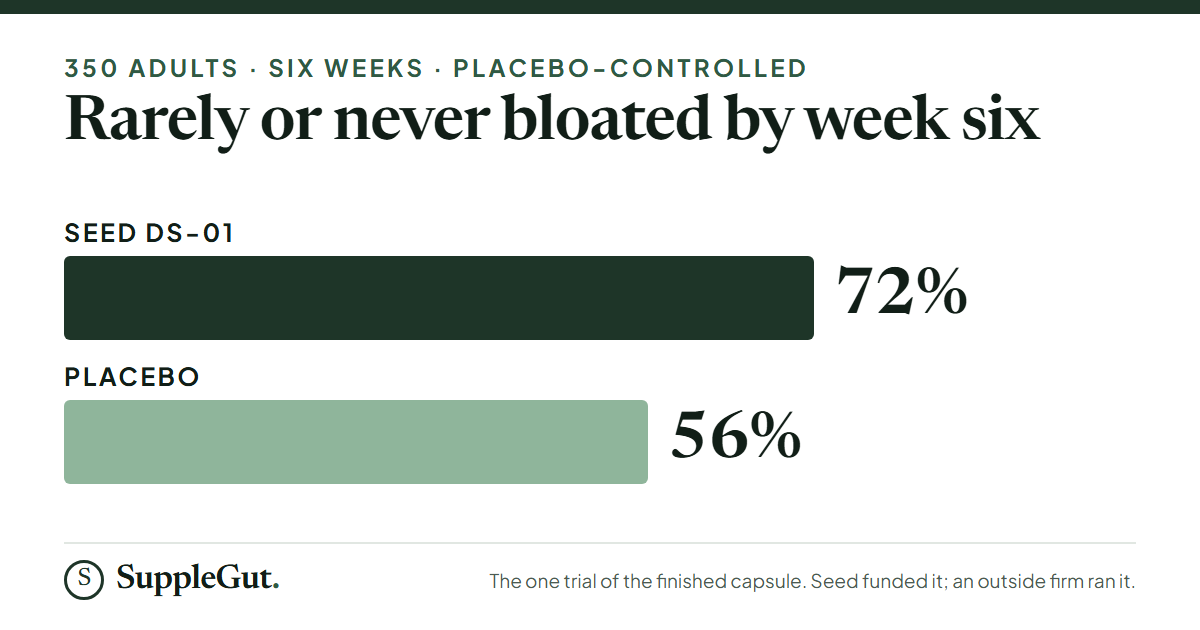
Does Seed DS-01 work for bloating? In the one placebo-controlled trial of the finished capsule (350 adults, six weeks), 72% of the DS-01 group said they rarely or never felt bloated by week six, against 56% on placebo, with the gap opening by weeks three to four. It made no measurable difference to anxiety, mood or libido. Seed funded the trial; an outside research firm ran it.
What DS-01 is
DS-01 is a two-capsule daily synbiotic: 24 bacterial strains at 53.6 billion AFU (active fluorescent units, Seed’s count of viable cells) in an inner capsule, with 400 mg of Indian pomegranate extract as the prebiotic in the outer one. The label directs one capsule a day for the first three days, then two, with or without food. It is sold by subscription from seed.com at $49.99 a month, which is about $1.67 a day; the product card below carries the price the catalog uses.
What the trial actually tested
In January 2026, the journal Nutrients published a study on Seed's DS-01 Daily Synbiotic — the actual capsule people buy, not just one ingredient tested on its own (Allegretti et al., Nutrients, 2026). 350 adults who said they dealt with bloating or indigestion were split randomly into two groups: one took DS-01 for 6 weeks, the other took a fake pill (placebo) that looked identical, and neither the participants nor the researchers scoring the results knew who got which. 219 of them had usable data by the end. The study is registered at ClinicalTrials.gov as NCT06009614 and was run by an independent research firm, Radicle Science, with Seed Health paying for the study and two of its employees listed as co-authors.
The results, in plain terms
- Bloating: by week 6, 72% of the DS-01 group said they rarely or never felt bloated, compared with 56% of the placebo group.
- Stomach discomfort: people on DS-01 reported less abdominal pain and discomfort than the placebo group.
- Regularity: the DS-01 group reported more consistent, comfortable bowel movements than the placebo group.
- Day-to-day quality of life: DS-01 users said digestion interfered less with eating and daily activities than placebo users said.
The placebo group improved too on every one of these — that happens in almost any trial where people track their own symptoms — but the DS-01 group improved by more on all of them, by a margin the researchers judged too large to be a coincidence.
How long does Seed take to work?
In the bloating trial the DS-01 and placebo groups separated on the questionnaire scores by weeks three to four, and the primary result is measured at week six. There is no evidence for a faster effect, and no evidence about what happens after six weeks, because that is where the trial ended. If nothing has changed after six weeks at the full two-capsule dose, the trial gives no reason to expect it to start.
Side effects
The trial reports no serious adverse events, and no significant difference between DS-01 and placebo on total adverse events or on any single one asked about: dizziness, drowsiness, dry mouth, headache, insomnia, nausea, numbness or tingling, or other gut symptoms. The usual first-week gas and bloating from a new probiotic did not show up as a difference from placebo here. For what probiotics as a class can do, see probiotic side effects.
The other DS-01 trials
Two more studies of the same capsule exist, neither about bloating. A 2025 trial in Nutrients gave DS-01 or placebo to 32 healthy adults for 91 days and measured stool chemistry rather than symptoms: urolithin A, a metabolite made from the pomegranate extract by gut bacteria, rose 12-fold by day 7 and 49-fold by day 91 against placebo, microbial diversity rose, and fecal butyrate rose (Napier et al., Nutrients, 2025). Those are laboratory markers, not outcomes a person would feel. A trial of DS-01 during and after a course of antibiotics was presented at Digestive Disease Week 2024 as a conference abstract; Seed reports gut-barrier and diversity results from it, but it has not appeared as a peer-reviewed paper, so this guide does not count it.
Where it didn't move the needle
The trial also asked about anxiety, depression, and sex drive. For the group as a whole, DS-01 made no measurable difference on any of the three — people on the synbiotic reported roughly the same anxiety, mood, and libido as people on placebo. There was one narrow exception: among the smaller group who already had mild anxiety when the trial started, more people on DS-01 said it got easier to stop fixating on their anxiety than people on placebo did (66% versus 46%). That's one result, in one subgroup, on one question about anxiety — not evidence that DS-01 treats anxiety generally, and nobody has tried to reproduce it yet.
What limits how far this goes
The authors flagged several caveats themselves. Everyone signed up online and reported their own symptoms through questionnaires — no doctor examined anyone or confirmed a diagnosis first, so some participants may have had a real digestive condition rather than ordinary bloating. Nothing was measured directly (like actually checking someone's stomach); it was all self-report, which the authors say likely explains why the placebo group also improved a fair amount. Because it ran online instead of in a clinic, more people dropped out than a typical in-person trial would see — 131 of the 350 who started didn't have data left by week 6. And Seed Health, the company that sells DS-01, funded the study and had two employees as co-authors, though an outside research firm ran the actual trial and Seed says it had no say in how it was conducted.
None of that erases the result. A trial of 350 people, comparing the real product against a placebo, is more evidence than most probiotics on store shelves have behind them. For a prebiotic route to the same complaint, see what the human milk oligosaccharide trials found on bloating and the kēpos entry, the one such product in this catalog. It just means "reduced bloating in this trial" is a fair way to describe what happened, while "proven to treat anxiety" or "improves libido" would not be — those weren't shown here.
To set this trial against a single-strain probiotic with a longer IBS record, read Align vs Seed DS-01. If the bloating follows particular foods rather than turning up most days, digestive enzymes vs probiotics for bloating covers the other route.
The product in this catalog
Common questions
Does Seed probiotic work?
For bloating, the one placebo-controlled trial of the finished DS-01 capsule says yes, by a modest margin: after six weeks, 72% of people on DS-01 said they rarely or never felt bloated against 56% on placebo, with smaller gains on abdominal discomfort and regularity. It made no measurable difference to anxiety, mood or libido. Seed funded the trial and an outside research firm ran it.
How long does Seed DS-01 take to work?
In the trial, the DS-01 and placebo groups separated by weeks three to four, and the main result was measured at week six. Nothing in the evidence supports a faster effect.
What are the side effects of Seed DS-01?
The trial found no serious adverse events and no difference from placebo on total adverse events or on dizziness, drowsiness, dry mouth, headache, insomnia, nausea, numbness or tingling, or other gut symptoms.
What is in Seed DS-01?
24 bacterial strains at 53.6 billion AFU in an inner capsule and 400 mg of Indian pomegranate extract in the outer capsule. The dose is two capsules a day after a three-day start on one, with or without food.
Does Seed DS-01 help with constipation?
The bloating trial asked about it as a secondary outcome: 79% of the DS-01 group reported constipation relief against 72% on placebo, and 50% against 34% reported improved bowel regularity. It was not designed as a constipation trial, so those are supporting results rather than the main finding.
Is Seed DS-01 worth the price?
It is one of the more expensive products in this catalog per day, and the evidence behind it is one six-week trial of the finished capsule plus a 32-person marker study. Whether that trade is worth it depends on how much bloating is costing you; the quiz weighs the price against the evidence for your own symptoms.
Sources
- Allegretti JR, Kassam Z, Kelly CR, et al. "A Randomized, Placebo-Controlled Trial Evaluating Multi-Species Synbiotic Supplementation for Bloating, Gas, and Abdominal Discomfort." Nutrients, 2026;18(2):255. pmc.ncbi.nlm.nih.gov/articles/PMC12845427
- ClinicalTrials.gov. "Study to Investigate a Probiotic/Prebiotic Blend on GI Health." NCT06009614. clinicaltrials.gov/study/NCT06009614
- Napier BA, et al. "Multi-Species Synbiotic Supplementation Enhances Gut Microbial Diversity, Increases Urolithin A and Butyrate Production, and Reduces Inflammation in Healthy Adults: A Randomized, Placebo-Controlled Trial." Nutrients, 2025. pubmed.ncbi.nlm.nih.gov/40944126
- Seed Health. DS-01 Daily Synbiotic product page: 24 strains, 53.6 billion AFU, directions, price. seed.com/daily-synbiotic
Not sure which product fits your situation?
This guide covers the mechanics. The quiz takes your specific symptoms, routine and preferences and matches you to one product from the catalog.
Take the quiz →