Guide
Does Banyan Hingvastak work? Eight classical herbs, nine on the label, and the asafoetida trials
Quick answer
Does Banyan Hingvastak work? No trial tested this powder. Two placebo-controlled trials of 43 and 62 adults with functional dyspepsia used 250 mg doses of asafoetida formulations, and Banyan says its asafoetida is present in relatively small proportion with no amounts printed. An open-label registry trial of the classical eight-herb formula in 60 adults had no placebo group. Amazon shows 4.7 from 173 ratings, with reviewers describing it as a seasoning on beans and lentils.
Banyan Botanicals sells Hingvastak as a loose organic powder, a blend of cumin, celery seed, black pepper, ginger, nigella, long pepper, fenugreek, salt and asafoetida. It is sold as a food-grade spice mix: the page shows no Supplement Facts panel, only an ingredient list, and it tells you to sprinkle it on meals.
The classical eight and Banyan’s nine
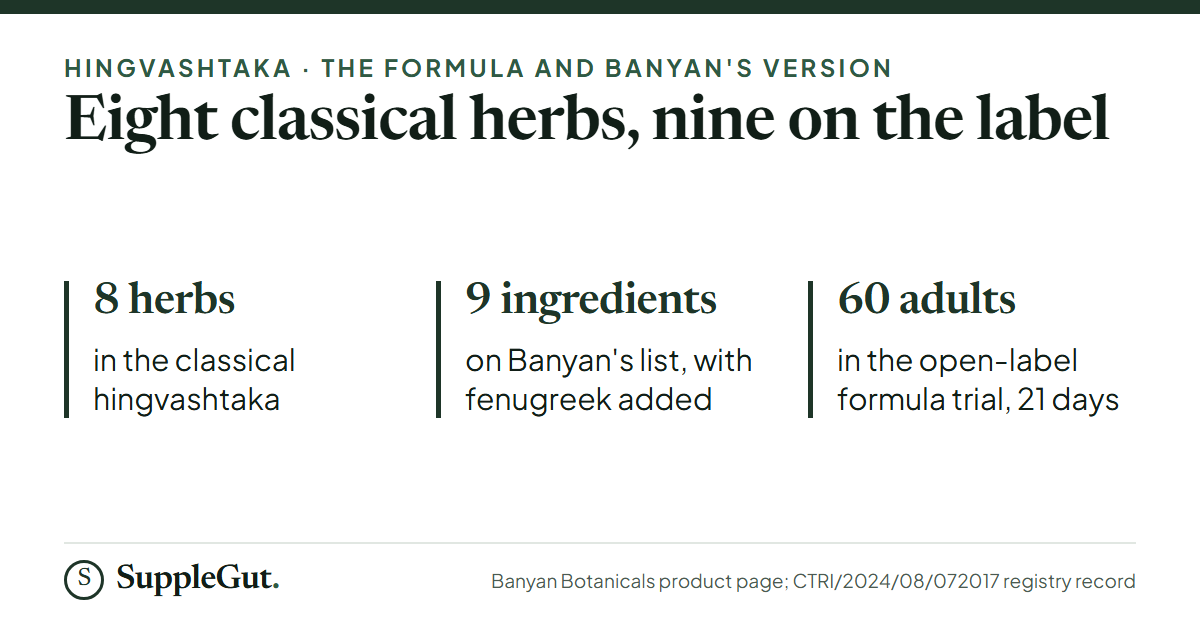
Hingvashtaka churna is a classical Ayurvedic powder whose name means asafoetida (hingu) plus eight. A churna is a dry powder of herbs taken with warm water, ghee or buttermilk. A registry record for a Jamnagar trial and an Ayurveda reference page list the eight as below, next to what Banyan prints.
| Classical ingredient | On Banyan’s list |
|---|---|
| Shunthi (ginger) | Ginger rhizome |
| Maricha (black pepper) | Black pepper fruit |
| Pippali (long pepper) | Pippali fruit |
| Ajamoda | Celery seed, Apium graveolens, named as ajamoda |
| Saindhava lavana (rock salt) | “Mineral Salt,” not identified |
| Shweta jiraka (white cumin) | Cumin seed |
| Krishna jiraka (black cumin) | Nigella seed, Nigella sativa |
| Hingu (asafoetida) | Asafoetida resin, Ferula assa-foetida |
| Not in the classical list | Fenugreek seed |
Two lines deserve a note. Sanskrit sources apply the name ajamoda to several plants of the celery family, among them celery, ajwain and caraway, so a formula that lists ajamoda may not contain ajwain; Banyan states that it means celery seed. And sources differ on whether krishna jiraka is nigella or caraway. Banyan’s list is 99% certified organic, and the one non-organic ingredient is asafoetida, for which the company says it has found no organic source. The order of ingredients differs slightly between Banyan’s page, Amazon and a Banyan staff reply, so it is a loose guide to proportion.
The tradition’s description
Banyan calls the blend a traditional digestive formula “for vata.” In Ayurveda, vata is the principle of movement, and the tradition gives it the qualities of cold, light and dry; the page says an excess of them hinders digestion and brings gas, bloating and hard stools after a meal. It lists the blend’s rasa (taste) as pungent and salty, its virya (action) as heating and its vipaka (post-digestive effect) as pungent, and says it balances vata and kapha and may aggravate pitta. Those are the tradition’s categories, reported as the brand reports them, and we found no trial that measured a dosha. One reviewer on Banyan’s page describes themself as vata and cannot imagine going without it.
The asafoetida trials, against a proportion nobody prints
We found no trial of Banyan’s powder. The nearest evidence is for asafoetida alone. In a randomized, double-blind, placebo-controlled trial, 43 adults with moderate to severe functional dyspepsia took 250 mg twice a day of a food-grade asafoetida formulation (n=21) or placebo (n=22) for 30 days; the asafoetida group’s symptom-score improvement ranged from 5.67 to 25.29 points against 1.55 to 6.0 on placebo (p ≤ 0.001), with no adverse events. Its authors are from the company that makes the formulation (Mala et al., 2018). A second trial gave 62 adults with dyspepsia symptoms 250 mg a day of a hydrogel asafoetida for 14 days and found significant effects on early satiety, bloating and heartburn (Das et al., 2025).
Now the arithmetic. Banyan’s own serving count (227 g in the half-pound bag, 96 half-teaspoon servings) makes one serving about 2.4 g. For 250 mg of asafoetida to sit in 2.4 g, it would have to be roughly a tenth of the powder, and Banyan says its share is relatively small and late in the list. The trial products were also formulations, not the raw resin, so the comparison is a rough one in either direction. The page gives no way to settle it.
The classical formula has its own registry-listed study: 60 adults with functional dyspepsia in two open-label arms of 30, given 3 g of hingwashtaka churna twice a day for 21 days, one arm with ghee and one with buttermilk. The Dyspepsia Symptom Severity Index fell from 12.42 to 0.57 with ghee and from 12.94 to 0.53 with buttermilk, with no difference between the arms (P=0.409). It had no placebo or untreated group, and the source is a registry-derived summary, not a peer-reviewed paper (record CTRI/2024/08/072017). The dose was 6 g a day, a quarter more than the 4.8 g of the label’s highest use.
One PubMed paper names the classical formula: an aqueous extract of hingwashtak churna protected rats against ibuprofen and ethanol ulcers, at 84.96% and 91.12% against 95.54% and 95.2% for ranitidine (Shirwaikar et al., 2006). It is animal data and says nothing about dyspepsia in people.
The other spices, and the piperine question
For ginger, an 11-patient crossover trial in functional dyspepsia found faster gastric emptying with 1.2 g and no change in symptoms (Hu et al., 2011). For cumin, a case series of 57 people with irritable bowel syndrome used 20 drops a day of cumin essential oil for four weeks, with no placebo; pain, bloating and urgency decreased (Agah et al., 2013). That was the oil, not the seed in this powder. Black and long pepper bring piperine, and 20 mg a day raised the blood levels of propranolol, theophylline and curcumin in small groups of healthy volunteers (Bano et al., 1991; Shoba et al., 1998). Banyan prints no piperine figure, so the powder’s share is unknown.
Using it as a seasoning
The directions are a quarter to a half teaspoon with warm water, once or twice a day, or as a practitioner directs, and the page also calls it a versatile spice mix to sprinkle on food. Asafoetida is a standard tempering spice for dal in Indian cooking, and the reviewers who like the powder describe exactly that use: one writes that they can enjoy lentils and mung beans again, and another calls it a garnish and flavored salt. On Amazon, 21 reviewers mention taste and 18 of them are positive.
Because it is a seasoning, the sodium counts. Banyan staff give approximately 64 mg a half teaspoon, so two half-teaspoon servings add about 128 mg. Complaints are about heat (“too hot for me so throws off my sleep”) and about taste, and a few reviewers expected more asafoetida or prefer the tablet form of Vata Digest.
Safety, testing and regulation
The label says not to use it during pregnancy and asks anyone nursing, taking medications or living with a medical condition to consult a health care practitioner. That is the one clear statement; the piperine data above explain why the medication line matters.
Banyan states that its herbs are tested for arsenic, cadmium, lead and mercury by independent third party laboratories, within ANSI/NSF 173 and AHPA guidelines, with identity checked by HPTLC and species verified by botanists in India. It names no laboratory and posts no certificate, and says it adds a California Proposition 65 warning to products sold in that state; we saw none in the product text. We found no country of manufacture. “Mineral salt” is not identified, and nothing on the page suggests a bhasma. The category figures come from surveys of other products: 20.7% of 193 Ayurvedic medicines bought online had detectable lead, mercury or arsenic (95% CI 15.2 to 27.1) (Saper et al., JAMA, 2008). The guide to Ayurvedic supplement safety lists what a buyer can check.
In the United States, Ayurvedic products sold as dietary supplements come under the 1994 law known as DSHEA, which means no FDA approval before sale, and no state licenses Ayurvedic practitioners. In India, Ayurveda is a state-recognized system with a degree (BAMS) and the ministry AYUSH. Banyan’s allergen statement says its herbs are free of gluten, soy, egg, dairy, tree nuts and fish, that no wheat or peanuts are on the premises, and that the facility also makes sesame, sunflower, almond and coconut oils, kept separate.
Ratings, page and Amazon
Banyan’s page runs the Judge.me review app and shows 4.58 from 26 reviews, of which 25 are marked as collected from another provider. Amazon shows 4.7 from 173 ratings: 86% five-star, 8% four, 3% three, 1% two and 2% one, and Amazon’s summary has 16 reviewers on digestive health, all positive. Amazon is independent of the brand, and the page feed is the brand’s own. A two-star reviewer on the page wanted mostly hing, and a one-star review from years ago is about shipping time.
Prices and terms
| Size and route | Price | Per half teaspoon |
|---|---|---|
| Spice jar, Banyan site | $12.99 | $0.43 (about 30 servings) |
| Half pound, Banyan site | $22.99 | $0.24 (about 96 servings) |
| 8 oz, Amazon | $22.99 | $0.24 |
| 1 lb, Banyan site | $41.99 | Serving count not stated |
The page offers no subscription. It prints free shipping over $60, a satisfaction guarantee and a 90 day return policy, and we found no billing complaints.
Who the powder suits
- Readers who cook with lentils and beans and want a seasoning built on asafoetida and warming spices.
- Readers who follow Ayurveda and want the classical churna in its nearest commercial form, knowing the changes in the table above.
- Readers who prefer a tablet can read Banyan’s Vata Digest, which has a similar spice base.
Himalaya’s Organic Trikatu covers the pepper trio alone. The full label and review record for this powder are on its product page.
The catalog entries behind this guide
Common questions
Does Banyan Hingvastak work for gas and bloating?
We found no trial of this powder. Reviewers on Amazon (4.7 from 173 ratings) describe less gas when it goes on beans, lentils and heavy meals, and of the 16 who mention digestive health there, all are positive. The nearest trials tested asafoetida alone in functional dyspepsia at 250 mg doses, a quantity Banyan’s page does not let a buyer calculate.
How does Banyan Hingvastak differ from the classical hingvashtaka?
The classical formula has eight ingredients: ginger, black pepper, long pepper, ajamoda, rock salt, white cumin, black cumin and asafoetida. Banyan uses celery seed under the name ajamoda, prints “mineral salt” without saying it is rock salt, and adds fenugreek. Sources differ on what black cumin means, so that line is not settled either.
How much asafoetida is in it?
No amount is printed for any ingredient. Banyan staff told a reviewer that asafoetida is late in the ingredient list and so is present in relatively small proportion, and that the powder is cut with fenugreek, not rice. A reviewer who expected mostly hing wrote that the product is not for someone wanting just hing.
Does the powder contain sodium?
Yes. Banyan staff put it at approximately 64 mg of sodium per half teaspoon serving, from the mineral salt. At the label’s highest use, half a teaspoon twice a day, that is about 128 mg.
Is Hingvastak safe with medicines or in pregnancy?
The label says not to use it during pregnancy, and to consult a health care practitioner when nursing, taking medications or living with a medical condition. Black and long pepper contain piperine, which raised blood levels of some drugs at 20 mg a day in small studies, and the page gives no piperine amount. Banyan states testing for arsenic, cadmium, lead and mercury but names no laboratory.
How much does Banyan Hingvastak cost?
The half-pound bag is $22.99 on Banyan’s site and on Amazon, about 96 half-teaspoon servings or $0.24 each. Across the label’s quarter to half teaspoon once or twice a day, that is $0.12 to $0.48 a day. The spice jar is $12.99 for about 30 servings.
Sources
- Mala et al. Randomized double-blind placebo-controlled trial of a food-grade asafoetida formulation in functional dyspepsia. Evidence-Based Complementary and Alternative Medicine, 2018. PMID 30224930. pubmed.ncbi.nlm.nih.gov/30224930
- Das et al. Randomized double-blind placebo-controlled trial of a self-emulsifying hydrogel asafoetida in functional dyspepsia symptoms. Medicine, 2025. PMID 41054174. pubmed.ncbi.nlm.nih.gov/41054174
- Registry record CTRI/2024/08/072017: Hingwashtaka churna in functional dyspepsia, ghee against buttermilk (I.T.R.A., Jamnagar), registry-derived summary. trial.medpath.com
- Shirwaikar et al. Aqueous extract of hingwashtak churna against experimental gastric ulcers in rats. Indian Journal of Experimental Biology, 2006. PMID 16784118. pubmed.ncbi.nlm.nih.gov/16784118
- Hu ML, et al. Effect of ginger on gastric motility and symptoms of functional dyspepsia. World Journal of Gastroenterology, 2011. PMID 21218090. pubmed.ncbi.nlm.nih.gov/21218090
- Agah et al. Cumin essential oil in irritable bowel syndrome, case series. Middle East Journal of Digestive Diseases, 2013. PMID 24829694. pubmed.ncbi.nlm.nih.gov/24829694
- Bano G, et al. Effect of piperine on bioavailability and pharmacokinetics of propranolol and theophylline in healthy volunteers. European Journal of Clinical Pharmacology, 1991. PMID 1815977. pubmed.ncbi.nlm.nih.gov/1815977; Shoba G, et al. Planta Medica, 1998. PMID 9619120. pubmed.ncbi.nlm.nih.gov/9619120
- Saper RB, Phillips RS, Sehgal A, et al. “Lead, mercury, and arsenic in US- and Indian-manufactured Ayurvedic medicines sold via the Internet.” JAMA, 2008;300(8):915–923. PMID 18728265. pubmed.ncbi.nlm.nih.gov/18728265
- Satyori: Hingvastak churna formulation page (classical ingredient list). satyori.com
- FDA. Dietary supplements and the Dietary Supplement Health and Education Act of 1994. fda.gov/food/dietary-supplements; Ministry of Ayush, Government of India. ayush.gov.in
- Banyan Botanicals: Hingvastak powder product page (ingredients, directions, price, reviews, staff answers). banyanbotanicals.com
- Banyan Botanicals: herbs quality control and testing page. banyanbotanicals.com
- Amazon: Banyan Botanicals Hingvastak Powder listing, ratings and allergen statement. amazon.com/dp/B008X730XG
Which of these fits you?
Three minutes with the quiz turns this background into one named product, with the reasons shown.
Take the quiz →