Guide
Are Ayurvedic supplements safe? Heavy metals, bhasmas, interactions and what to check on a label
Quick answer
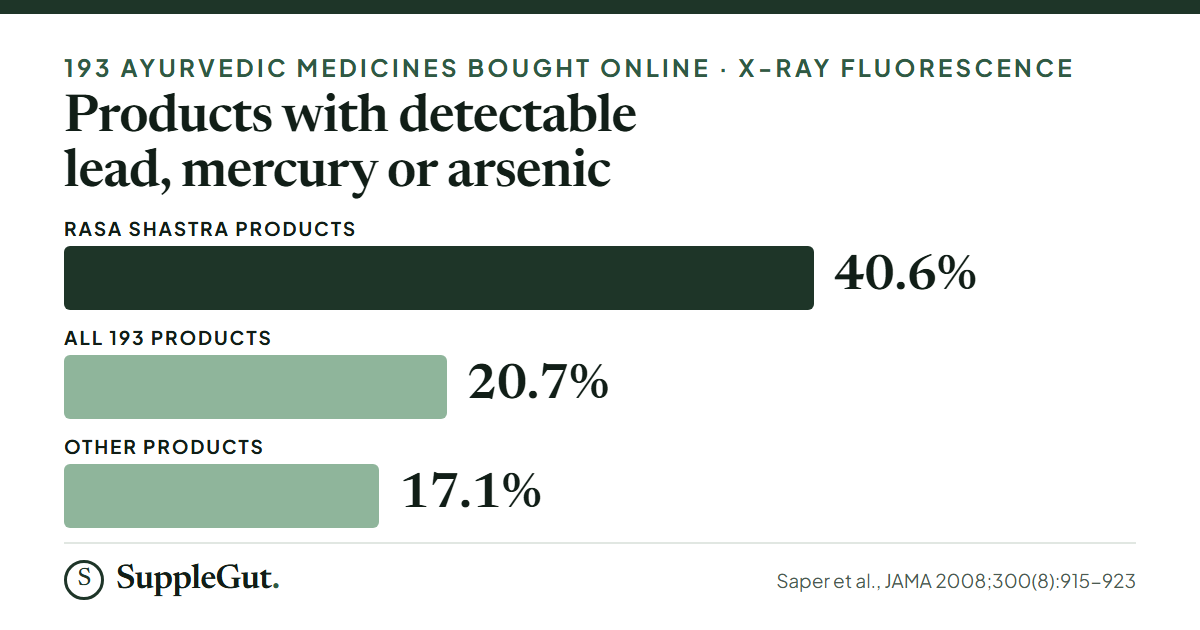
Are Ayurvedic supplements safe? It depends on the product, and the surveys put numbers on it. Of 193 Ayurvedic medicines bought from websites, 20.7% held detectable lead, mercury or arsenic: 40.6% of rasa shastra products (herbs combined with metals) against 17.1% of the others. Herb-only products have their own findings, including case series of liver injury from ashwagandha, guduchi and turmeric and a blood pressure rise with licorice. A label can show Latin names, amounts and a laboratory certificate; 75% of the metal-containing products claimed Good Manufacturing Practices.
Ayurvedic supplements run from plain herb capsules, such as a triphala or ashwagandha product, to traditional preparations that combine herbs with processed metals and minerals. The documented risks differ between the two: metals in the second group, and case series of liver injury and a few drug interactions in the first. This page sets out the published surveys with their percentages, the herb and drug findings, and what a label can and cannot tell a buyer.
What the heavy-metal surveys found
| Study | Sample | Finding |
|---|---|---|
| Saper et al., 2004 | 70 South Asian products from Boston-area stores | 14 (20%) held lead, mercury or arsenic; median lead 40 µg/g (range 5 to 37,000); each of the 14 could exceed regulatory intake limits if taken as directed |
| Saper et al., 2008 | 193 products bought from 25 websites | 20.7% held a metal: 21.7% of US-made and 19.5% of Indian-made; 40.6% of rasa shastra products against 17.1% of the others |
| Mikulski et al., 2017 | 252 samples from a lead poisoning investigation | Lead in 65%, mercury in 38%, arsenic in 32%; not a random sample |
| Breeher et al., 2015 | 115 adherents screened after an index case | 46 (40%) had blood lead of 10 µg/dl or more; 9.6% had 50 µg/dl or more |
| CDC, 2012 | Six foreign-born pregnant women in New York City | Blood lead 16 to 64 µg/dl, linked to 10 Indian-made medications with up to 2.4% lead |
| Mehta et al., 2017 | 786 adults in India tested for unexplained abdominal pain | 75 (9.5%) had high blood lead; 73 had taken Ayurvedic medicines; five analyzed medicines held 14 to 34,950 ppm lead |
| Ernst, 2002 | Review of case reports and series | 15 case reports and 6 case series; one study found lead in 64% of samples collected in India |
These are not random samples of the market. The two Saper surveys sampled by store and by website, the cluster and New York figures start from people who were ill, and the Indian series comes from one hospital. They show what was found in those products. Most of the 193 products bought online, 79.3%, had no detectable metal, and the surveys do not say which brands were affected.
Rasa shastra and bhasmas, and why they matter
Rasa shastra is the branch of Ayurveda that combines herbs with metals, minerals and gems. Its preparations include bhasmas, calcined minerals made by heating a metal or mineral to an ash. The tradition describes this processing as making the material suitable for medicine; the measurements are of what is in the finished product. In the 193-product survey, rasa shastra products had detectable metal in 40.6% against 17.1% of the others (P = 0.007), with median mercury among the metal-containing products of 20,800 µg/g against 34.5. A test that mimicked stomach and intestinal fluid in 42 medicines found bioaccessible lead in 76% and bioaccessible arsenic in 29%, and a product compounded with lead bhasma released close to all of its lead (Koch et al., 2011). Detectable metal is not always absorbed metal, and in some products it was.
The 17.1% matters for a herb-only product such as triphala: a plant label is not an exemption, and we found no survey that tests triphala products by name.
The Proposition 65 warning US buyers see
Some Ayurvedic labels carry a California warning. The Organic India Triphala listing at Vitacost reads that the product can expose you to lead, a carcinogen and reproductive toxicant. The warning comes from Proposition 65, and California’s OEHHA gives a safe harbor level for lead of 0.5 µg a day for reproductive harm. A warning can appear because a product is above a level or because the maker chose to warn rather than test, and the label does not say which or give an amount.
Herb and drug interactions
- Licorice and blood pressure. A meta-analysis of 18 studies of products with at least 100 mg of glycyrrhizic acid a day found systolic pressure up 5.45 mmHg (95% CI 3.51 to 7.39), diastolic up 3.19 mmHg and plasma potassium down. That moves pressure in the direction opposite to blood pressure medicines. NCCIH also reports interactions with corticosteroids.
- Turmeric and anticoagulants. We found one case report, a rise in INR in a person on the vitamin K antagonist fluindione, called a probable interaction by its authors.
- Ashwagandha and thyroid medicine. In 50 adults with subclinical hypothyroidism, 600 mg a day for eight weeks changed TSH, T3 and T4 against placebo (p < 0.001, 0.0031 and 0.0096). A Japanese report describes painless thyroiditis in a 47-year-old man two months after he started it. NCCIH advises against it with autoimmune or thyroid disorders and lists interactions with immunosuppressants and sedatives. We found no trial pairing it with levothyroxine.
- Aloe latex. NCCIH says overuse may raise the risk of side effects from cardiac glycosides such as digoxin.
- Triphala. Nothing in people is well documented. In a laboratory test it inhibited the liver enzymes CYP3A4 and CYP2D6, at concentrations near 120 and 105 µg/ml.
- Piperine from black pepper. Twenty milligrams of piperine raised the bioavailability of 2 g of curcumin by 2,000% in healthy volunteers, which shows it can change how much of another compound reaches the blood.
Pregnancy and breastfeeding
The documented harm in pregnancy is lead: the New York report covers six pregnant women whose blood lead reached 64 µg/dl, and the CDC notes that fetal exposure to lead can adversely affect neurodevelopment and fetal growth and raise the risk of premature birth and miscarriage. NCCIH advises against ashwagandha in pregnancy and breastfeeding, says turmeric supplements in pregnancy may be unsafe, and says oral aloe may be unsafe. For licorice, it says large amounts of oral extract in pregnancy can raise the risk of delivery before 38 weeks.
Liver injury reports
These are herb reports, not metal reports. For ashwagandha, five cases from Iceland and the US DILIN registry developed jaundice after 2 to 12 weeks, with cholestatic or mixed injury that normalized in 1 to 5 months in four patients. An Indian series found 23 patients with ashwagandha liver injury, 8 on single-ingredient products; three of the five with underlying chronic liver disease presented with acute-on-chronic liver failure and died, and chemical analysis found no adulteration. For guduchi (Tinospora cordifolia), 43 patients at 13 Indian centers developed liver injury after a median of 46 days, with causality probable in 67.4% and autoimmune features on testing. For turmeric, 10 DILIN cases since 2011 included one death from acute liver failure, seven of the patients carried HLA-B*35:01, and 3 of 7 products tested also held piperine. Ashwagandha and guduchi have encyclopedia pages. Case series cannot give a rate.
What a label can show, and what it cannot
- Latin binomials. The Organic India Triphala label names Phyllanthus emblica, Terminalia bellirica and Terminalia chebula. A common name alone leaves the species open.
- Amounts per serving. That label gives 320 mg of each fruit; a proprietary blend, such as the 300 mg Cape aloe and triphala blend in Move Easy, gives a total with no split.
- Part and extract ratio. Fruit powder, root extract and a 10:1 extract are different quantities.
- A third-party heavy-metal test. A batch certificate from a named laboratory is the only item here that measures metals. A line saying “third-party tested” with no laboratory or certificate is a claim.
- GMP and country of manufacture. Of the metal-containing products in the 2008 survey, 75% claimed Good Manufacturing Practices, and US-made and Indian-made products carried metals at 21.7% and 19.5% (P = 0.86). Neither is a screen.
A label cannot show that a given bottle is free of metals or of an undeclared ingredient. People who are pregnant, take prescription medicines or have a liver or thyroid condition can ask a doctor or pharmacist before using any of these herbs; this page reports findings and does not tell any reader what to take.
How regulation differs: India, the US and Europe
In the US these products are dietary supplements under the 1994 Dietary Supplement Health and Education Act, with no FDA pre-market approval, and NCCIH states that no state licenses Ayurvedic practitioners. In India they are Ayurveda, Siddha and Unani drugs under the Drugs and Cosmetics Act, with Good Manufacturing Practices set in its Schedule T, and classical formulations made strictly to the authoritative texts are generally exempt from pre-market safety and efficacy studies, while new formulations and new indications can be asked for evidence. In the European Union a traditional herbal medicinal product can be registered by showing 30 years of use, 15 of them in the EU, with no clinical trials, and EU pharmacopoeia monographs include heavy-metal tests. A 2026 comparison summarizes it as Europe and Japan stressing pre-market validation, the US relying on post-market monitoring, and India and China integrating traditional practice with modern frameworks. The details for buyers are in Ayurveda in the West.
Where this leaves the series
Terms such as rasa shastra and agni are explained in Ayurveda key concepts for the gut and what Ayurveda is. The herbs are covered trial by trial in Ayurvedic herbs for digestion, and the section is at Ayurveda for the gut.
The products in this catalog
Common questions
Do Ayurvedic supplements contain lead?
Some do. In a survey of 193 Ayurvedic medicines bought from websites, 20.7% held detectable lead, mercury or arsenic, and an earlier survey of 70 products from Boston-area stores found 20%. Most products in the first survey, 79.3%, had no detectable metal.
What are rasa shastra and bhasmas?
Rasa shastra is the branch of Ayurveda that combines herbs with metals, minerals and gems, and bhasmas are calcined minerals used in it. In the 193-product survey, 40.6% of rasa shastra products held a metal against 17.1% of the others. The tradition describes processing meant to make them suitable for medicine; the surveys measure the finished product.
What does the Proposition 65 warning on a label mean?
It is a California notice that the product can expose a person to lead, a carcinogen and reproductive toxicant. OEHHA gives a safe harbor level for lead of 0.5 µg a day for reproductive harm. The warning does not state an amount, and it can appear when a maker chooses to warn rather than test.
Which Ayurvedic herbs have liver injury reports?
Ashwagandha, guduchi (Tinospora cordifolia) and turmeric all have case series. For guduchi, 43 patients at 13 Indian centers; for ashwagandha, five cases in Iceland and the US DILIN registry and 23 in India; for turmeric, 10 DILIN cases. Case series show that injury occurs, not how often.
Are Ayurvedic herbs safe in pregnancy?
The documented harm is lead: six pregnant women in New York City had blood lead of 16 to 64 µg/dl after using Indian-made Ayurvedic medications. NCCIH advises against ashwagandha in pregnancy and says turmeric supplements and oral aloe may be unsafe. Large amounts of licorice extract were linked to delivery before 38 weeks.
Which Ayurvedic herbs interact with medicines?
Licorice with at least 100 mg of glycyrrhizic acid a day raised systolic pressure by 5.45 mmHg across 18 studies, which runs against blood pressure medicines. Turmeric has a case report with a vitamin K antagonist, ashwagandha changed thyroid hormone levels in a trial, and aloe latex may add to digoxin. For triphala we found only a laboratory enzyme test, and no human report.
What should a buyer look for on an Ayurvedic supplement label?
Latin names, an amount for each herb rather than a blend total, the part used and the extract ratio, and a heavy-metal certificate from a named laboratory. A Good Manufacturing Practices statement does not rule out metals, since 75% of the metal-containing products in the 2008 survey claimed it. Ayurveda in the West covers how these products reach shelves.
Sources
- Saper RB, Kales SN, Paquin J, et al. “Heavy metal content of ayurvedic herbal medicine products.” JAMA, 2004;292(23):2868–2873. PMID 15598918. pubmed.ncbi.nlm.nih.gov/15598918
- Saper RB, Phillips RS, Sehgal A, et al. “Lead, mercury, and arsenic in US- and Indian-manufactured Ayurvedic medicines sold via the Internet.” JAMA, 2008;300(8):915–923. PMID 18728265. pubmed.ncbi.nlm.nih.gov/18728265
- Mikulski MA, Wichman MD, Simmons DL, et al. “Toxic metals in ayurvedic preparations from a public health lead poisoning cluster investigation.” International Journal of Occupational and Environmental Health, 2017;23(3):187–192. PMID 29528276. pubmed.ncbi.nlm.nih.gov/29528276
- Breeher L, Mikulski MA, Czeczok T, Leinenkugel K, Fuortes LJ. “A cluster of lead poisoning among consumers of Ayurvedic medicine.” International Journal of Occupational and Environmental Health, 2015;21(4):303–307. PMID 25843124. pubmed.ncbi.nlm.nih.gov/25843124
- CDC. “Lead poisoning in pregnant women who used Ayurvedic medications from India—New York City, 2011–2012.” MMWR, 2012;61(33):641–646. PMID 22914225. pubmed.ncbi.nlm.nih.gov/22914225
- Mehta V, Midha V, Mahajan R, et al. “Lead intoxication due to ayurvedic medications as a cause of abdominal pain in adults.” Clinical Toxicology, 2017;55(2):97–101. PMID 27957879. pubmed.ncbi.nlm.nih.gov/27957879
- Ernst E. “Heavy metals in traditional Indian remedies.” European Journal of Clinical Pharmacology, 2002;57(12):891–896. PMID 11936709. pubmed.ncbi.nlm.nih.gov/11936709
- Koch I, Moriarty M, House K, et al. “Bioaccessibility of lead and arsenic in traditional Indian medicines.” Science of the Total Environment, 2011;409(21):4545–4552. PMID 21864885. pubmed.ncbi.nlm.nih.gov/21864885
- Penninkilampi R, Eslick EM, Eslick GD. “The association between consistent licorice ingestion, hypertension and hypokalaemia: a systematic review and meta-analysis.” Journal of Human Hypertension, 2017;31(11):699–707. PMID 28660884. pubmed.ncbi.nlm.nih.gov/28660884
- Daveluy A, Géniaux H, Thibaud L, et al. “Probable interaction between an oral vitamin K antagonist and turmeric (Curcuma longa).” Therapie, 2014;69(6):519–520. PMID 25230280. pubmed.ncbi.nlm.nih.gov/25230280
- Sharma AK, Basu I, Singh S. “Efficacy and Safety of Ashwagandha Root Extract in Subclinical Hypothyroid Patients: A Double-Blind, Randomized Placebo-Controlled Trial.” Journal of Alternative and Complementary Medicine, 2018;24(3):243–248. PMID 28829155. pubmed.ncbi.nlm.nih.gov/28829155
- Hayashi M, Hamada H, Azuma SI, Hayashi K. “Painless Thyroiditis by Withania somnifera (Ashwagandha).” Cureus, 2024;16(3):e55352. PMID 38559552. pubmed.ncbi.nlm.nih.gov/38559552
- Ponnusankar S, Pandit S, Babu R, et al. “Cytochrome P450 inhibitory potential of Triphala: a Rasayana from Ayurveda.” Journal of Ethnopharmacology, 2011;133(1):120–125. PMID 20883765. pubmed.ncbi.nlm.nih.gov/20883765
- Shoba G, Joy D, Joseph T, et al. “Influence of piperine on the pharmacokinetics of curcumin in animals and human volunteers.” Planta Medica, 1998;64(4):353–356. PMID 9619120. pubmed.ncbi.nlm.nih.gov/9619120
- Björnsson HK, Björnsson ES, Avula B, et al. “Ashwagandha-induced liver injury: A case series from Iceland and the US Drug-Induced Liver Injury Network.” Liver International, 2020;40(4):825–829. PMID 31991029. pubmed.ncbi.nlm.nih.gov/31991029
- Philips CA, Valsan A, Theruvath AH, et al. “Ashwagandha-induced liver injury: A case series from India and literature review.” Hepatology Communications, 2023;7(10):e0270. PMID 37756041. pubmed.ncbi.nlm.nih.gov/37756041
- Kulkarni AV, Hanchanale P, Prakash V, et al. “Tinospora Cordifolia (Giloy)-Induced Liver Injury During the COVID-19 Pandemic: Multicenter Nationwide Study From India.” Hepatology Communications, 2022;6(6):1289–1300. PMID 35037744. pubmed.ncbi.nlm.nih.gov/35037744
- Halegoua-DeMarzio D, Navarro V, Ahmad J, et al. “Liver Injury Associated with Turmeric: A Growing Problem: Ten Cases from the Drug-Induced Liver Injury Network.” American Journal of Medicine, 2023;136(2):200–206. PMID 36252717. pubmed.ncbi.nlm.nih.gov/36252717
- Pawar AT, Chandrasekar SB, Venkatesh MP. “Navigating the regulatory landscape of herbal medicines: A global comparison of India, China, Europe, the United States and Japan.” Journal of Ayurveda and Integrative Medicine, 2026;17(3):101343. PMID 42190612. pubmed.ncbi.nlm.nih.gov/42190612
- European Medicines Agency. Herbal medicinal products: traditional use registration (30 years of use, at least 15 in the EU, no clinical trials required). ema.europa.eu
- NCCIH. Ayurvedic medicine: safety, regulation and practitioner licensing. nccih.nih.gov/health/ayurvedic-medicine-in-depth
- NCCIH. Licorice root; Aloe vera; Turmeric; Ashwagandha (safety, pregnancy and interactions). licorice root; aloe vera; turmeric; ashwagandha
- California OEHHA. Lead: Proposition 65 listing and safe harbor level. oehha.ca.gov/chemicals/lead
- Vitacost: Organic India Triphala, 180 vegetarian capsules (Supplement Facts, warnings and California Proposition 65 notice as listed). vitacost.com
- Bluegrass Supplements: Move Easy label and directions. bluegrassvitamins.com/products/move-easy
Which of these fits you?
Three minutes with the quiz turns this background into one named product, with the reasons shown.
Take the quiz →