Discomfort and cramping
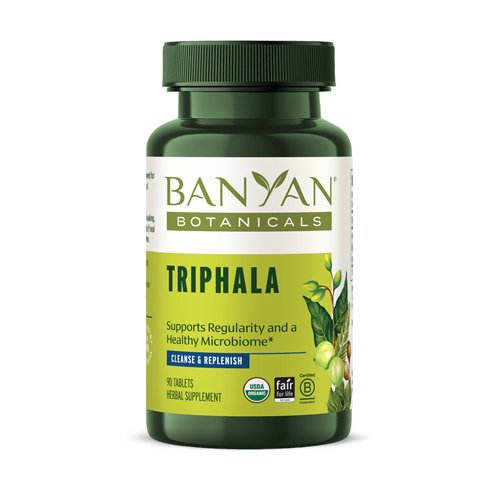
Banyan Botanicals Triphala Tablets
A once-a-day organic triphala tablet (amla, bibhitaki, haritaki) for daily digestive support in the Ayurvedic tradition, with third-party heavy-metal testing stated.
- Format
- Tablet, once a day
- Type
- Herbal and traditional herbal
- Tradition
- Ayurvedic formula
- Cost
- $0.51 per day at two tablets ($22.99 for 90 on the brand site, $21.99 on Amazon); $0.26 at the one-tablet low end of the label range
- Customer rating
- 4.6 out of 5 from 2,123 ratings from Amazon
The themes in the reviews
- Regular, comfortable bowel movements
- Less bloating and better digestion
- An easy-to-swallow tablet with no capsule shell
Those are the themes that recur across the reviews. Moderate review confidence — Amazon shows 4.6 from 2,123 independent ratings, and Banyan’s own page shows 4.88 from 223 reviews through the Judge.me review app; no Trustpilot profile could be checked.
Why it might work
Triphala is a traditional Ayurvedic blend of three fruits, amla, bibhitaki and haritaki, taken for digestion and regular elimination. Banyan says the fruits are rich in vitamin C, tannins and polyphenols such as gallic and chebulagic acid, and that together they gently stimulate digestion while supporting elimination. Banyan describes it as tridoshic, meaning it is meant to suit all three Ayurvedic body types, and as kindling the digestive fire the tradition calls agni. Human trials of triphala for bowel symptoms are small or mixed with other herbs, and this label cannot show how much of each fruit is in a tablet, so the amount that reaches the gut is unknown.
What the trials show
The evidence is for the ingredient class, not this product. A 4-week placebo-controlled pilot of 2,000 mg a day of triphala in 31 healthy adults found no consistent change in gut bacteria, and the one constipation study found used a formula that also contained senna and psyllium. This label gives a 1,000 mg blend per two tablets and lets you take one or two a day, below that pilot’s dose. No trial of this tablet was found.
What the label discloses
The three fruits are listed as one 1,000 mg organic blend with no per-herb amounts and no extract or standardization. Banyan states that every product is tested for arsenic, cadmium, lead and mercury by independent third-party labs and meets the ANSI 173 standard, but names no lab and posts no certificate. The label says made in India and certified organic by QAI.
Read more on the plants in the formula: Triphala, Amla, Bibhitaki, Haritaki, with the trials, doses and cautions for each.
Who this tends to suit
Its symptom profile covers irregular bowel habits, constipation, bloating and a feeling of incomplete emptying. It is scored for a goal of a steady daily routine, regularity or day-to-day comfort. Symptoms get Triphala Tablets onto the shortlist; what you have tried, the format you will keep up and your medicines decide whether it stays there.
Where it may not fit
The label supports gluten-free, dairy-free, vegan and minimal ingredient list. For people pregnant or breastfeeding or taking prescription medication, the quiz excludes it rather than naming it, because that choice belongs with a prescriber. It is a caution about the decision, not a verdict on the product. The honest question before buying Triphala Tablets: will you take a tablet once a day, every day?
Reactions and warnings
A minority report no effect, and a few mention gas, bloating or stomach upset or that the tablet is large. The label says not to use it for chronic constipation and to ask a practitioner first if pregnant, nursing, taking medications or with a medical condition.
The questions that come up
Does Banyan Triphala work?
Reviewers on Amazon mostly say it helps with regularity: 241 of 295 who mention effectiveness are positive, while 54 say it did nothing. The only trials of triphala are small, and none tested this tablet or triphala alone for constipation.
Is Banyan Triphala safe?
The label says to ask a practitioner first if you are pregnant, nursing, taking medications or have a medical condition, and not to use it for chronic constipation. Banyan states every product is tested for lead, mercury, arsenic and cadmium by third-party labs, though it publishes no lab name or results. A 4-week study of a triphala extract at 2,500 mg a day in 20 healthy adults found no serious adverse effects.
What are Banyan Triphala side effects?
Banyan says loose stools or stomach discomfort can occur, especially at higher doses, and advises lowering the dose. Reviewers mention gas, bloating or stomach upset, and a few found the tablet large.
How much does Banyan Triphala cost?
A 90-count bottle is $22.99 on Banyan’s site and $21.99 on Amazon, which is 45 servings of two tablets, about $0.51 a serving and about $0.26 a day at the label’s low end of one tablet. Banyan’s subscription takes 15 percent off each delivery.
Banyan Triphala vs Himalaya or Planetary Herbals triphala?
Banyan lists three fruits as a 1,000 mg blend per two tablets. Himalaya prints 438 mg of chebulic myrobalan leaf powder plus 250 mg of triphala extract in one caplet, and Planetary Herbals prints a 2 g blend per two tablets taken twice daily. Only Banyan’s site states third-party heavy-metal testing, and only Banyan uses dosha language.
One check first. Banyan Botanicals sells a supplement, not a treatment, and if you are pregnant or breastfeeding, or taking prescription medication the decision belongs with a doctor or pharmacist, not with this page.
Is this the right one for you?
The quiz checks Triphala Tablets against your symptoms, your routine and what you have already tried, and says plainly if something else fits better.
Take the quiz →Free, private, and it names one product.
Alternatives in the same role
If Banyan Botanicals Triphala Tablets is on your list, these belong on it too; each is researched for the same job, discomfort and cramping.
See all the products we have researched →
Background reading
Where the numbers on this page come from, explained at length.