
Guide
Does Belly Beans work? A DGL gummy with three labels, and what the licorice trials used
Quick answer
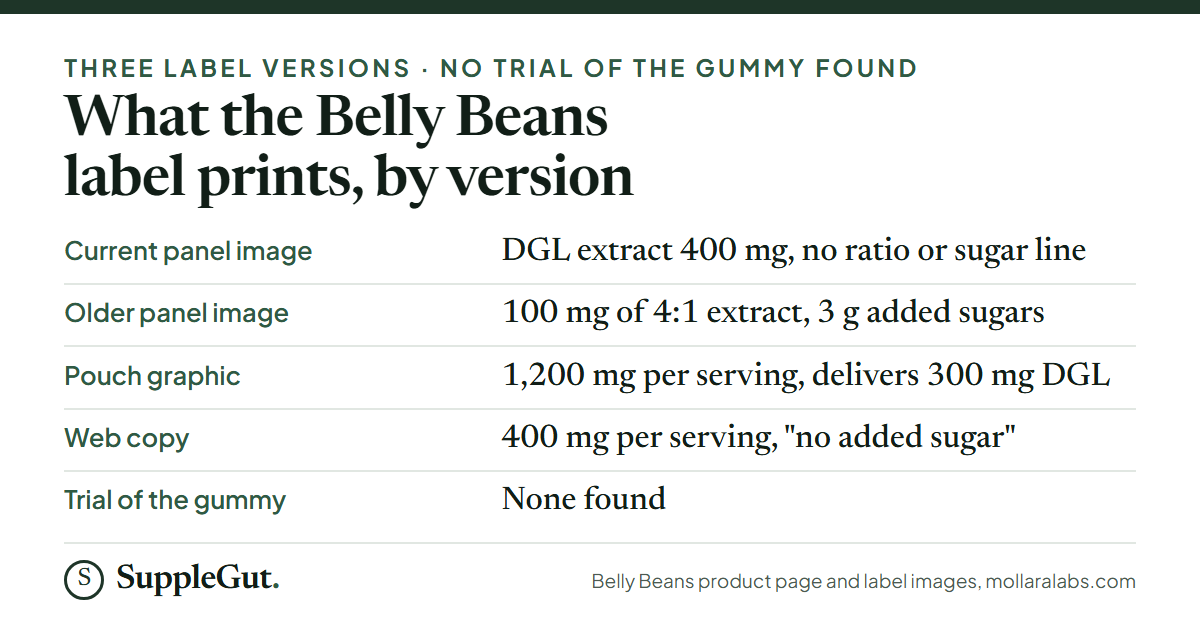
Does Belly Beans work? No trial of Belly Beans was found. The positive reflux trials are of GutGard, a standardized branded licorice extract, and this label names no extract; the older trials of plain DGL in ulcers, at 760 mg three times a day, found no benefit over placebo. The brand shows three label versions (400 mg of extract; 100 mg of a 4:1 extract with 3 g of added sugar; a pouch reading 1,200 mg delivering 300 mg). Reviews split: 4.8 as typed text on the brand’s pages, 2.75 from 728 on its own review feed, where about 108 of 376 low-star reviews concern subscription billing.
Belly Beans DGL Gummies is a berry-flavored pectin gummy sold at mollaralabs.com, taken two at a time before meals and marketed for heartburn and reflux. Its single active is deglycyrrhizinated licorice (DGL), licorice root with most of the glycyrrhizin removed, and the thing that sets it apart from the DGL tablets on the next shelf is that the brand shows three different versions of its own label. This page sets out what each version prints, what the licorice trials used, how the page says to take it alongside acid medicine, what reviewers on the brand’s own feed report, and what the billing and refund pages say.
What Belly Beans is, and the three labels
The only active ingredient is licorice root extract, and there is one active, so no proprietary blend. The pouch holds 60 gummies and a serving is two, 30 servings to the pouch. Beyond that, the brand’s own images disagree about how much is in a serving:
| Where it appears | What it prints |
|---|---|
| Current product-page Supplement Facts image | DGL extract (Glycyrrhiza glabra) 400 mg. No calories, sugar, other-ingredients line or extract ratio. |
| Panel image on the older listing | DGL extract (root) 4:1, 100 mg, with “400 mg” in brackets; 15 calories; 3 g added sugars a serving; organic cane sugar listed first among the other ingredients, then organic tapioca syrup, water and pectin. |
| Pouch graphic on the current listing | “1200mg per serving, Delivers 300mg DGL.” |
Read together, one version prints 400 mg of extract, one prints 100 mg of a 4:1 extract equal to 400 mg of root, and one prints 1,200 mg of extract delivering 300 mg of DGL. We had no pouch in hand, so which version is on the physical product is not established. The web copy says “no added sugar” and “naturally flavored and sweetened”, while the older panel prints 3 g of added sugar. None of the images we read gives an extract name, a glabridin or flavonoid content, or the glycyrrhizin left in the gummy. A “Third-Party Tested” tile is on the page, with no laboratory named and no certificate of analysis that we could find. There is no pregnancy, nursing, medication, blood pressure or age statement on any panel image, and no allergen statement; the web copy says gluten-free and non-GMO and the page footer says to consult a healthcare provider before starting any supplement.
The trial of the product itself
We searched PubMed and ClinicalTrials.gov for Belly Beans and its earlier names and found no trial of the gummy. The page’s wording is “clinically studied DGL” and “backed by 100+ clinical studies”, with the line that this is the same 400 mg dose used in the clinical studies. We could not match the second claim: the DGL trials in PubMed are mostly peptic ulcer studies from the 1960s to the 1980s, several of them negative, and we found no randomized trial of a DGL gummy or chewable for reflux. The brand also quotes survey figures, such as 78% of surveyed customers feeling relief, from a customer survey whose tenure figures count only people who stayed on the product, so the survey cannot show how many stopped.
What the licorice trials used
The modern trials that favor licorice for upper-gut symptoms are of one standardized, branded extract, GutGard, described as a flavonoid-rich DGL root extract standardized to at least 3.5% glabridin and at least 10% total flavonoids, with glycyrrhizin at 3.0% or less. This label names no extract and prints no standardization.
- Reflux, 200 people, 28 days. A single-center, double-blind, placebo-controlled phase III trial of GutGard in GERD found better quality of life at the end (p = 0.014), less heartburn at day 14 (p = 0.017) and day 28 (p = 0.005), and less regurgitation at days 7, 14 and 28. The dose is not in the abstract we read, so it cannot be compared with the label dose (Complementary Medicine Research, 2025).
- Functional dyspepsia, 30 days. A randomized, double-blind, placebo-controlled trial of the same extract at 75 mg twice daily (150 mg a day) lowered the total symptom score more than placebo at days 15 and 30. That is dyspepsia rather than reflux, and the dose is below the 400 mg printed on the current panel, but the extracts are not the same material (Evidence-Based Complementary and Alternative Medicine, 2012).
- Plain DGL in ulcers, negative. A 1971 double-blind trial in 47 people with duodenal ulcer found no advantage over placebo, and a 1973 double-blind crossover in gastric ulcer, at 760 mg three times a day of the extract Caved-S, found none either; the authors wrote that they could not demonstrate any healing effect (Gut, 1971; Gut, 1973).
The positive trials are of a standardized branded extract; the older trials of plain DGL were negative. Which of those two this gummy resembles cannot be told from a label that names no extract. The brand’s argument is that DGL coats and protects the stomach lining instead of blocking acid. That mechanism comes from lab and animal work, and a gummy that is chewed and swallowed in seconds has not been shown to coat the esophagus.
How to take Belly Beans
The directions on the page are to take two gummies before a meal, up to six a day: two before each meal for daily reflux, or two before a trigger meal or before bed for occasional heartburn. The bundle text says most people do best at around four a day, the 400 mg is described as taken 20 minutes before meals or at bedtime, and the panel graphic says “before or after meals”. The brand’s own directions are therefore one to three servings a day, not one. No trial gives a time to effect for this product; reviewers who report relief describe days to about a month.
On acid medicine, the page FAQ says Belly Beans can be taken while on a proton pump inhibitor (PPI) and that DGL does not interfere with PPIs, and the page says to take it alongside a PPI while working with a doctor. The ads go further, with first-person stories of coming off omeprazole. No trial of this product tests stopping a PPI, and changes to a PPI belong with a doctor.
Side effects and who should not take it
The page says there are no known interactions or side effects at recommended doses, and describes glycyrrhizin as the compound that can affect blood pressure and says it has been removed. It does not print how much remains. One reviewer on the brand feed reports that her blood pressure rose; a handful report nausea or an upset stomach. The label gives no guidance for anyone on blood pressure medicine, a diuretic or a heart medicine, or for anyone pregnant or nursing. People who track sugar should note the 3 g of added sugar on the older panel; a diabetic reviewer reports blood sugar rising. About 10 low-star reviews mention teeth, including a broken tooth, and about 23 describe the gummies as sticky or chewy.
What the ads say
In Meta’s ad library, US, a keyword search for the store’s domain returned about 420 results, a keyword match count rather than an exact ad count. The 30 ad cards we loaded all link to mollaralabs.com and come from four pages: “Enhanced Living” (23 cards), “Amanda Walker” (4), “Digestive Wellness Network” (2) and the brand’s own “Belly Beans” page (1). We matched none of the first three to a named person or company and verified no narrator.
- One long first-person story, posted by “Enhanced Living”, has a narrator who says she is 61, lives near Dayton, Ohio, and took omeprazole, Tums, Pepcid and Gaviscon for eleven years. It claims you do not have too much acid but too little protection, and that the pill’s “rebound” is worse when stopped. Other ads from the same page tell different first-person stories, including one narrator who says he has been off PPIs for three months.
- A video post from “Amanda Walker” describes an uncle on omeprazole who went two days without it and sat up choking. It ends with the line that he is not telling anybody to stop anything.
- A “Digestive Wellness Network” ad says “50,000+ customers, 4.8 stars”. The store’s own pages also say 50,000+ customers; the review feed we could read holds 728 reviews.
- One ad quotes $23.33 a pouch on the 3-pack, and another says 3 pouches for $59.99. The product page shows different prices, below.
These are claims, recorded as claims, not trial data.
What the reviews say
Two review pictures exist, and they differ by two stars. The brand’s pages say 4.8 from 2,877+ reviews as typed text; we found no review widget that produces that figure. The brand’s own review app (Junip) feed, read through the endpoint the widget calls, holds 728 reviews across two listings with an average of 2.75: 213 five-star, 73 four-star, 66 three-star, 70 two-star and 306 one-star. All but two carry a verified-buyer flag, none is imported, and none has a brand reply. That is 39% four or five stars (286) and 52% one or two stars (376). We could not establish whether these reviews are shown to shoppers on the live page. We found no Trustpilot profile for mollaralabs.com, morealabs.com or tryglowme.com, no Better Business Bureau profile for the store’s names, and no Amazon listing mentioned by the brand; the Amazon search page returned an error and was not read. Reddit was not readable with our tools.
Among the 286 favorable reviews, about 150 mention less heartburn or reflux, often within days to a month, and about 56 mention coming off or cutting back on a PPI or antacid as the reviewer reports it; several of those add that they remain on a PPI for Barrett’s esophagus or went back on a drug temporarily. About 39 mention the taste and 14 mention sleeping through the night. Among the 376 low-star reviews, the largest group is billing: about 108 mention subscriptions, unexpected charges, cancelling or refunds. About 80 report no effect, and others describe orders that never came or arrived short.
How do I cancel a Belly Beans subscription or get a refund?
Cancelling: the subscription policy says the subscription renews automatically until you cancel, and that you can manage, skip, pause or cancel in the Recharge customer portal or by emailing support@mollaralabs.com with the subject “Cancel Subscription”, effective immediately. A refund for a subscription renewal must be requested within 7 days of the charge. The interval is stated differently on different pages: every 30 days in the policy, and 4 weeks, 28 days or 60 days on the product page depending on the plan. The first order ships immediately. Support is by email only.
Refunds: the product page, cart banner and ads advertise a 60-day money-back guarantee with no questions asked. The refund policy page says something narrower: returns within 30 days of delivery, product unopened with the safety seal intact, opened or partly used products not eligible unless defective or damaged, return shipping paid by the customer, and refunds issued within 10 business days. A reviewer who asked for a refund reports being told to pay return shipping. A single pouch cannot be bought one time on the live page; the one-time choices are bundles.
The store is also run under several names. The page header says Mollara Labs, the subscription policy says Belly Beans by Morea Labs, the refund and shipping policies say Morea Labs, and the terms of service say the site is operated by TryGlowME, whose contact page gives an address in Sheridan, Wyoming under the name Trendy Teddys LLC. The store data also lists the product under the vendor names MoreaLabs and TryGlowME, and earlier listings called it Belly Jellys.
Cost
The live product page shows the following, with free shipping on subscriptions and multi-packs:
- Subscribe and save, 2 pouches (120 gummies), renewing every 4 weeks: $59.99, $30.00 a pouch.
- Subscribe and save, 3 pouches (180 gummies), renewing every 60 days: $79.99, $26.66 a pouch.
- One time, 3 pouches: $99.99, $33.33 a pouch.
- One time, 5 pouches (300 gummies): $149.99, $30.00 a pouch.
A pouch holds 60 gummies. At the brand’s “around 4 a day” a pouch lasts 15 days, which is about $2.22 a day on the $33.33 pouch and $2.00 on the $30.00 pouch. At one two-gummy serving a day it is about $1.11, and at six a day about $3.33. The shipping policy gives 8 to 15 business days for standard delivery.
Who Belly Beans is for
- Someone who wants a DGL product in gummy form and accepts that no trial of this gummy exists and that its label names no extract.
- A buyer who will pick a one-time bundle, or keep the cancellation steps and the 7-day renewal window in mind if they subscribe.
- Someone who will keep taking any acid medicine as directed by a doctor while trying it.
Other DGL and reflux products are on their own pages: Natural Factors Chewable DGL is a sugar-free chewable tablet, Designs for Health GastroMend-HP combines DGL with mastic gum, vitamin U and zinc carnosine, and Reflux Gourmet Rescue Alginate is an alginate gel, a different mechanism with its own trials. The acid reflux guide compares the options by evidence, and the quiz matches a product to your main symptom. Heartburn that comes with trouble swallowing, vomiting, weight loss or black stools needs a clinician, whatever is taken for it.
The products in this catalog
Common questions
Does Belly Beans work?
No trial of Belly Beans was found. A placebo-controlled trial of a standardized deglycyrrhizinated licorice extract (GutGard) found less heartburn and regurgitation over 28 days in 200 people, but this label names no such extract. On the brand’s own review feed 39% of 728 reviews are four or five stars, many describing relief within a week to a month, and 52% are one or two stars, about 80 of them reporting no effect.
Is Belly Beans safe, and what are the side effects?
The label images we read show one active, DGL extract, and no pregnancy, nursing, medication or blood pressure warning; the page footer says to consult a healthcare provider before starting any supplement. The brand says the glycyrrhizin that can affect blood pressure has been removed but does not print how much remains, and one reviewer reports a blood pressure rise. The older panel lists 3 g of added sugar a serving.
How much does Belly Beans cost?
The page offers 3 pouches one time for $99.99 ($33.33 a pouch) and 5 for $149.99 ($30.00 a pouch), or subscriptions at $59.99 for 2 pouches and $79.99 for 3. A pouch holds 60 gummies, so at the brand’s “around 4 a day” a pouch lasts 15 days, about $2.22 a day at $33.33 a pouch; at one two-gummy serving a day it is about $1.11.
Belly Beans vs omeprazole or Tums: what is the difference?
Omeprazole and Tums are over-the-counter medicines with Drug Facts panels that reduce stomach acid; Belly Beans is a dietary supplement with a Supplement Facts panel and no acid-reducing ingredient. The ads say it protects the stomach lining so people can come off acid medicine, but no trial of this product tests that, and the page says to take it alongside a PPI while working with a doctor. Changes to a prescription belong with a doctor.
How do I cancel a Belly Beans subscription or get a refund?
The subscription policy says to cancel in the Recharge customer portal or by emailing support@mollaralabs.com, effective immediately, and to request a renewal refund within 7 days of the charge. The refund page offers a 30-day return of unopened product with customer-paid return shipping, while the product page and ads advertise a 60-day “no questions asked” guarantee. About 108 of 376 low-star reviews on the brand’s feed concern unexpected renewals, cancelling or refunds, and a one-time bundle can be bought instead.
What is the difference between the three Belly Beans labels?
One image prints DGL extract 400 mg, an older panel prints 100 mg of a 4:1 extract with 3 g of added sugar, and the pouch graphic prints 1,200 mg of extract delivering 300 mg of DGL. We could not check which is on the physical pouch. The web copy says “no added sugar”, which the older panel contradicts.
Is DGL the same as the licorice in the reflux trials?
Not necessarily. The positive modern trials used GutGard, a branded extract standardized to at least 3.5% glabridin and 10% flavonoids, and Belly Beans names no extract. The older trials of plain DGL in ulcers, at 760 mg three times a day, found no advantage over placebo. For the wider evidence see the acid reflux guide.
Sources
- GutGard in GERD: randomized, double-blind, placebo-controlled phase III trial, 200 participants, 28 days. Complementary Medicine Research, 2025. PMID 39929150. pubmed.ncbi.nlm.nih.gov/39929150
- GutGard in functional dyspepsia: randomized, double-blind, placebo-controlled trial, 75 mg twice daily, 30 days. Evidence-Based Complementary and Alternative Medicine, 2012. PMID 21747893. pubmed.ncbi.nlm.nih.gov/21747893
- Deglycyrrhizinated liquorice in duodenal ulcer: double-blind trial in 47 patients. Gut, 1971. PMID 4933135. pubmed.ncbi.nlm.nih.gov/4933135
- Deglycyrrhizinated liquorice (Caved-S) in gastric ulcer: double-blind crossover trial, 760 mg three times a day. Gut, 1973. PMID 4584640. pubmed.ncbi.nlm.nih.gov/4584640
- Belly Beans DGL Gummies: product page with label image, directions, prices and claims. mollaralabs.com/pages/belly-jelly-pdp
- Mollara Labs policies: subscription policy, refund policy, shipping policy, terms of service and contact information.
- Brand review feed (Junip) for the Belly Beans listings, read through the store’s public review endpoint. api.juniphq.com
- Meta Ad Library, United States, keyword search for mollaralabs.com. facebook.com/ads/library
Not sure which product fits your situation?
This guide covers the mechanics. The quiz takes your specific symptoms, routine and preferences and matches you to one product from the catalog.
Take the quiz →