
Guide
Does bovine colostrum help gut health? What 6 human trials found
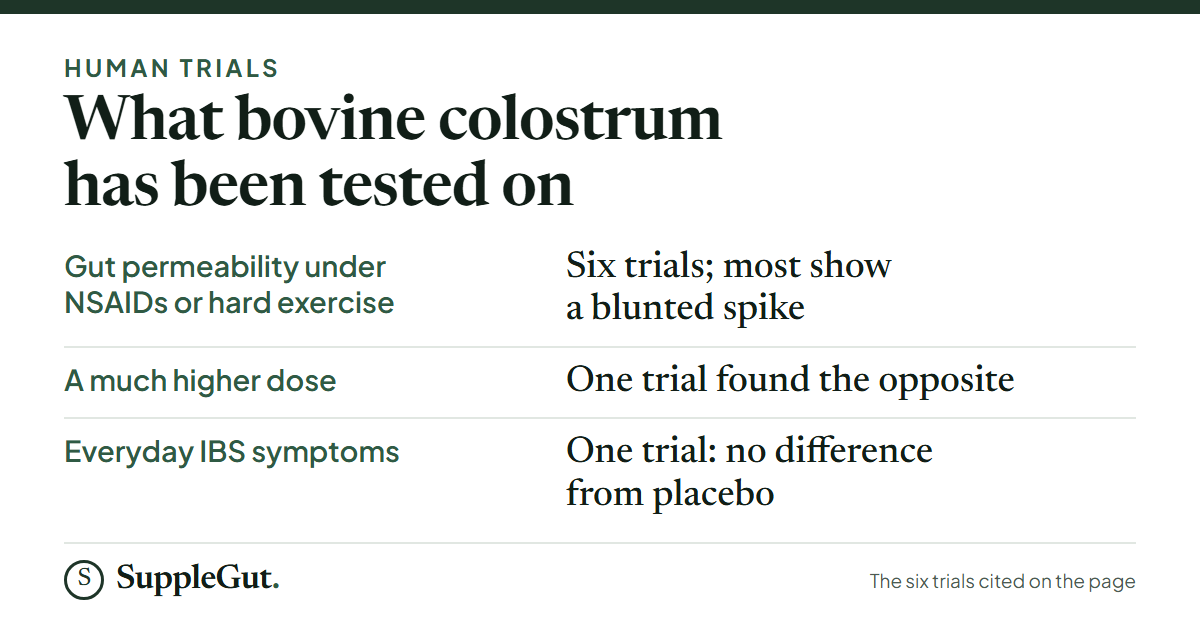
Bovine colostrum's best evidence is for one specific measurement, intestinal permeability, under two kinds of stress: NSAID use and heavy exercise. Six human trials test it directly, and they don't all agree — most show colostrum blunting the permeability spike, one shows the opposite at a much higher dose, and the one trial that tested everyday IBS symptoms rather than a permeability marker found no difference from placebo.
What these trials actually measure
Most of the trials below don't ask "did people feel better." They give someone two sugars, lactulose and either rhamnose or mannitol, and measure how much of each shows up in urine afterward. A healthy gut lining lets almost none of the larger sugar (lactulose) through; a leakier lining lets more through, raising the ratio. Some trials also measure zonulin, a blood/stool marker linked to gut barrier function. These are lab measurements of a barrier property, not symptom scores — a trial can show a better permeability ratio without showing less bloating or pain, and none of the trials below tested a consumer colostrum product at its labeled dose.
Blocking an NSAID-induced permeability spike
A randomized crossover trial gave 7 healthy men 50 mg of the NSAID indomethacin three times a day for 5 days, alongside either colostrum (125 mL three times a day) or a whey control, with a 2-week washout between arms. On the control arm, indomethacin tripled gut permeability (lactulose:rhamnose ratio 0.36 to 1.17, p<0.01). When colostrum was taken alongside the same NSAID dose, there was no significant rise. A second arm of the same trial gave colostrum or control to 15 patients already on long-term, high-dose NSAID therapy for 7 days; their baseline permeability was already low and wasn't changed by either solution (Playford et al., Clinical Science, 2001).
Truncating an exercise-induced permeability spike
Heavy exercise raises gut permeability on its own, and two trials tested whether colostrum blunts that rise. In a double-blind, placebo-controlled crossover of 12 healthy volunteers, 14 days of colostrum before standardized exercise cut the usual rise by about 80% compared with placebo, where exercise raised the permeability ratio 2.5-fold (Marchbank et al., American Journal of Physiology, 2011). A separate double-blind, placebo-controlled trial in 16 male MMA fighters (8 per arm) gave 500 mg of colostrum twice a day for 20 days. Every fighter in the colostrum group had their permeability ratio return to normal by the end (p=0.01 versus baseline), a significantly bigger improvement than placebo. Zonulin, a related marker, also improved significantly more with colostrum — but only 3 of the 8 fighters saw zonulin fully normalize; the other 5 stayed elevated (Hałasa et al., Nutrients, 2017).
The trial that found the opposite
Not every exercise trial agrees. In 30 healthy men split into colostrum (n=9), whey (n=8) and untrained control (n=13) groups, 8 weeks of running training with 60 grams a day of colostrum increased gut permeability by 251%, versus a 21% rise on whey and a 7% drop in the untrained control group (p<0.05 and p<0.02). That dose is roughly 100 times the one used in the MMA fighter trial above. This is a genuine contradiction, not a rounding difference, and it lines up with a much higher dose than any other trial here used (Buckley et al., Nutrients, 2009).
Where the evidence gets thin: everyday symptoms
The one trial that tested colostrum against IBS symptoms directly, rather than a permeability marker, found nothing. In 18 IBS patients (9 colostrum, 9 placebo) given 15 mL of colostrum once daily for 4 weeks with a 4-week follow-up, there was no significant difference between groups in symptom relief (55.5% colostrum versus 44.4% placebo), overall symptom score, quality-of-life score, or endotoxin levels at either 4 or 8 weeks (Cheon et al., Intestinal Research, 2014).
A different population showed a narrower positive result. In 62 ICU patients (32 treatment, 30 control) given 20 g of colostrum three times a day for 10 days alongside their enteral feeding formula, blood endotoxin and zonulin were significantly lower by day 10, and diarrhea was less common (9% versus 33%). There was no significant difference in abdominal distention, vomiting, constipation, or ICU mortality (Eslamian et al., Clinical Nutrition, 2018). That's a critically ill, tube-fed population on a specific high dose — not evidence that applies to someone taking a capsule for everyday bloating.
Six trials, side by side
| Trial | Who / how many | Dose & duration | Result |
|---|---|---|---|
| Playford 2001 | 7 healthy men, crossover | 125 mL 3x/day, 5 days, with an NSAID | Blocked the NSAID permeability spike |
| Marchbank 2011 | 12 healthy adults, crossover | Not stated per-dose, 14 days, before exercise | Cut the exercise permeability spike by ~80% |
| Hałasa 2017 | 16 MMA fighters (8/8) | 500 mg 2x/day, 20 days | Permeability normalized; zonulin only partly |
| Buckley 2009 | 30 healthy men (9/8/13) | 60 g/day, 8 weeks, with training | Permeability got worse, not better |
| Cheon 2014 | 18 IBS patients (9/9) | 15 mL/day, 4 weeks | No difference from placebo on symptoms |
| Eslamian 2018 | 62 ICU patients (32/30) | 20 g 3x/day, 10 days | Lower endotoxin/zonulin, less diarrhea |
What two systematic reviews conclude
A 2022 review pooling 9 athlete studies found the permeability ratio improved in 4, got worse in 1 (the Buckley trial above), and didn't change in 1, concluding colostrum "helps reverse" exercise-induced permeability but calling for more well-designed randomized trials (Kasperska et al., Nutrients, 2022). A broader 2024 review across gastrointestinal disease trials, covering 22 studies and 1,427 patients in total, described the evidence as conflicting rather than settled (Tamizifar et al., Systematic Reviews, 2024).
What none of this shows
Doses across these trials range from 500 mg a day to 60 g a day — more than 100-fold — and the direction of the effect isn't consistent across that range. None of the six trials tested a packaged consumer colostrum supplement at its labeled dose, so a product's IgG content or capsule count can't be matched against any of these results. And a better lab permeability ratio is not the same finding as fewer digestive symptoms; the one trial that measured symptoms directly (Cheon 2014) found no benefit at all.
Products in this catalog
Common questions
Where does ARMRA colostrum come from?
ARMRA states that its colostrum is collected from grass-fed cows on family-owned dairy farms in the United States, that calves are fed first and only the surplus is collected, that the cows’ diet is mostly grasses and hay with seasonal supplementation and no GMO feed, and that the powder is processed by a proprietary low-temperature method rather than high-heat pasteurization. The brand reports third-party testing for glyphosate, heavy metals and microbes. These are the company’s own statements; none of them is independently verified on the label.
Does bovine colostrum reduce gut permeability?
In most trials, yes, at doses of 500 mg to 125 mL per serving. It blocked an NSAID-induced permeability spike in one trial and cut an exercise-induced spike by about 80% in another. One trial using a much higher dose, 60 grams a day, found permeability got worse instead — so the effect is not the same at every dose.
Does colostrum help with IBS or general digestive symptoms?
The one trial that tested colostrum against IBS symptoms directly, rather than a lab permeability marker, found no significant difference from placebo in symptom relief, quality of life, or endotoxin levels at 4 or 8 weeks. Most of colostrum’s evidence is for permeability markers in athletes and NSAID users, not everyday digestive symptoms.
What dose of colostrum has been tested in gut trials?
Doses in human trials range from 500 mg a day up to 60 grams a day, more than a 100-fold spread, and results don’t move consistently with dose — the highest-dose trial found the worst result. That range makes it hard to compare any single consumer product’s label dose against the trial evidence.
Is more colostrum better for gut health?
Not based on the trial evidence. The trial using the highest dose, 60 grams a day for 8 weeks, found gut permeability got worse rather than better, while trials using far smaller doses (500 mg to 125 mL) found permeability improved. Higher dose has not been shown to work better for this outcome.
For an alternative that is not dairy-derived at all, see the evidence behind human milk oligosaccharides as an adult prebiotic, and our read of kēpos, the one human milk oligosaccharide powder in this catalog.
Sources
- Playford RJ, et al. "Co-administration of the health food supplement, bovine colostrum, reduces the acute non-steroidal anti-inflammatory drug-induced increase in intestinal permeability." Clinical Science, 2001;100(6):627–633. pubmed.ncbi.nlm.nih.gov/11352778
- Marchbank T, et al. "The nutriceutical bovine colostrum truncates the increase in gut permeability caused by heavy exercise in athletes." American Journal of Physiology-Gastrointestinal and Liver Physiology, 2011;300(3):G477–G484. pubmed.ncbi.nlm.nih.gov/21148401
- Hałasa M, et al. "Oral Supplementation with Bovine Colostrum Decreases Intestinal Permeability and Stool Concentrations of Zonulin in Athletes." Nutrients, 2017;9(4):370. pmc.ncbi.nlm.nih.gov/articles/PMC5409709
- Buckley JD, et al. "Bovine Colostrum Supplementation During Running Training Increases Intestinal Permeability." Nutrients, 2009;1(2):224–234. mdpi.com/2072-6643/1/2/224
- Cheon JH, et al. "A Randomized, Double blind, Placebo-controlled Trial of Bovine Colostrum in Patients with Irritable Bowel Syndrome." Intestinal Research, 2014;12(1):80–88. pmc.ncbi.nlm.nih.gov/articles/PMC4204680
- Eslamian G, et al. "Effects of bovine colostrum administration on intestinal permeability in critically ill patients." Clinical Nutrition, 2018. sciencedirect.com/science/article/abs/pii/S0899900718305185
- Kasperska A, et al. "Role of Bovine Colostrum in Nutrition of Athletes." Nutrients, 2022;14(12):2512. pmc.ncbi.nlm.nih.gov/articles/PMC9227274
- Tamizifar B, et al. "The effect of bovine colostrum on gastrointestinal diseases: a systematic review." Systematic Reviews, 2024;13:39. pmc.ncbi.nlm.nih.gov/articles/PMC10898101
Not sure which product fits your situation?
This guide covers the mechanics. The quiz takes your specific symptoms, routine and preferences and matches you to one product from the catalog.
Take the quiz →