
Daily gut routine
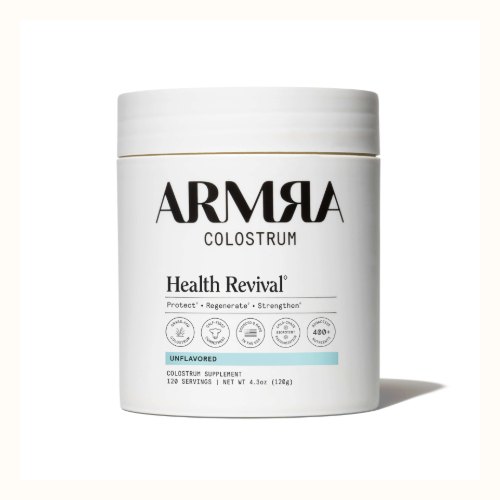
ARMRA Colostrum
A single-ingredient bovine colostrum powder with solid ingredient-level evidence for gut permeability, though the product itself has only one open-label, company-funded trial behind it.
- Format
- Powder, once a day
- Type
- Food-based
- Cost
- $1.00 a day
- Customer rating
- 4.1 out of 5 from 3,236 ratings from Amazon
What customers consistently report
- Noticeable easing of bloating within the first few weeks for many users
- Visible skin and hair changes reported alongside gut improvements
- A single clean ingredient that mixes easily into water or a smoothie
Those are the themes that recur across the reviews. Moderate review confidence — the 30-serving Amazon listing shows 4.1 stars from 3,236 ratings, other pack sizes on Amazon range from 4.2 to 4.4, and the brand’s own site reports 4.7 from more than 15,000 reviews.
Why it might work
ARMRA's single bovine-colostrum powder is built on the idea that colostral immunoglobulins and growth factors can help support the intestinal barrier. A powder is a simple way to take the ingredient in water or a smoothie, and the formula has no fillers, added sugar or artificial ingredients; the brand also states glyphosate testing and Non-GMO Project Verification. Yet the crucial biological step remains unresolved: these proteins need to survive digestive enzymes and reach the gut in an active form. The label gives a marketing claim of over 40% IgG but no independently verified IgG figure or milligram amount on the panel, so its active exposure cannot be matched to defined-dose colostrum studies. It also contains milk. Colostrum’s mechanism is not confirmation that this powder changes gut symptoms, particularly since it also contains milk.
What the research supports
Bovine colostrum as an ingredient class has some trial support for gut permeability: a randomized crossover in 7 healthy men found colostrum blocked the gut-permeability spike normally caused by an NSAID, a placebo-controlled trial in 62 ICU patients (32 given colostrum, 30 control) found lower blood endotoxin and zonulin markers after 10 days of colostrum, and a placebo-controlled trial in 16 athletes over 20 days found the colostrum group's permeability ratio returned to normal, though a related marker, zonulin, only fully normalized in some of them. A separate systematic review of this evidence concluded that well-designed, placebo-controlled, randomized studies are still needed before firmer conclusions can be drawn. Those trials used defined colostrum doses in athletes or hospital patients under physical or clinical stress, not everyday bloating in a general population, and none tested this specific product. The product itself has one company-funded, open-label trial registered on ClinicalTrials.gov (NCT05831527) that followed 60 people for 12 weeks with self-reported symptom tracking rather than a placebo arm or blinding; a majority of the digestive-complaints group reported improvement, but the design cannot rule out a placebo response, and the results have not been published in a peer-reviewed journal.
What the label discloses
The formula is a single ingredient — proprietary bovine colostrum concentrate — with no fillers, added sugar or artificial ingredients, and the brand states testing for glyphosate and Non-GMO Project Verification. The label does not disclose an IgG percentage or milligram figure, only a marketing claim of over 40% IgG that is not independently verified on the panel itself. It contains milk as an allergen. On sourcing, the brand states that the colostrum comes from grass-fed cows on family-owned dairy farms in the United States, that calves are fed first and only surplus is collected, that the cows’ diet is mostly grasses and hay with seasonal supplementation, that the powder is processed by a proprietary low-temperature method rather than high-heat pasteurization, and that batches are third-party tested for glyphosate, heavy metals and microbes. Those are the company’s statements; none is independently verified on the label.
Who this tends to suit
We match this product to people reporting bloating, general abdominal discomfort and irregular bowel habits. It fits someone whose priority is day-to-day comfort or resetting after a course of antibiotics or an upset. Whether it is the best fit for you depends on the rest of your answers — what you have already tried, what format you will take, and anything that has to be ruled out.
Where it may not fit
The label supports gluten-free, no added sweeteners and minimal ingredient list. We flag this product for anyone pregnant or breastfeeding, and the quiz removes it rather than recommending it in those cases. That is a caution about who should be deciding, not a claim about the product. A powder only works if you will take it once a day, every day.
Side effects and what to be aware of
ARMRA recommends one to four servings a day for full effect, and the price scales with that — a single serving from the bulk jar runs close to a dollar a day, but the brand’s own multi-serving protocol pushes the daily cost toward three to five dollars. Its self-reported star rating and review count on its own site run well above what independent Amazon listings show, and the brand carries an F grade and a 1.14-star customer rating on the Better Business Bureau site from 28 reviews and 48 complaints over three years. It contains milk and is not suitable for a dairy-free or vegan diet.
Before you take this. Speak to a doctor or pharmacist first if you are pregnant or breastfeeding. Nothing on this page is medical advice, and no supplement diagnoses, treats, cures or prevents disease.
Is this the right one for you?
The quiz works out which of the products we have researched fits your symptoms, your routine and what you have already tried — and tells you plainly if none of them do.
Take the quiz →Free. Private. Nothing to sign up for.
Others we researched for the same job
These sit in the same role as ARMRA Colostrum — daily gut routine — so they are the sensible things to weigh it against.
See all the products we have researched →
Related reading
Background on how this type of product works, read from the trial evidence.