Guide
Does Buddha Teas Digestive Nirvana work? Five herbs in one 1.5 g bag, and trials in other forms
Quick answer
Does Buddha Teas Digestive Nirvana work? We found no trial of the blend. Anise, its first herb, eased symptoms in a 107-person dyspepsia trial at 9 g of powder a day, while one bag holds 1.5 g of all five herbs together. Ginger, fennel and licorice have trials as capsules, extracts or stronger tea, and papaya leaf has no gut trial. Amazon shows 4.5 from 441 ratings.
Buddha Teas Organic Digestive Nirvana Blend is a caffeine-free tea bag of five organic herbs: anise seed, ginger root, papaya leaf, licorice root and fennel seed. None of the studies found tested this blend, but four of the five herbs have human trials in other forms. This page sets the label beside those trials, the brand’s claims, the reviews, the price per cup and the return terms.
Five herbs, a 1.5 g bag and three certification marks
The box back prints the ingredients in this order: organic anise seed, organic ginger root, organic papaya leaf, organic licorice root and organic fennel seed. The brand page gives the Latin names for the same five (Pimpinella anisum, Zingiber officinale, Carica papaya, Glycyrrhiza glabra and Foeniculum vulgare). A serving is one tea bag of 1.5 g, and a box holds 18 bags at a net 0.95 oz (27 g). The Nutrition Facts panel shows zero for calories, fat, sodium, carbohydrate and protein. No weight is printed for any single herb, so the 1.5 g is the total for all five.
The box carries the USDA Organic seal, a CCOF organic certification and an OU kosher mark, along with the statement “No Artificial Flavors, Colors, or Preservatives.” Those three certifiers are the only ones it names. It states no testing for contaminants or potency. The bags are described as compostable, plastic-free and bleach-free. The box has no allergen statement of either kind, neither a “contains” line nor a shared-facility line.
Trials of the blend, and the closest trial of anise
Searches of PubMed and ClinicalTrials.gov under the product and brand names turned up no study of Digestive Nirvana, and none of the five herbs is a branded ingredient with trials of its own. The research is about the herbs one at a time, in forms that differ from a tea bag.
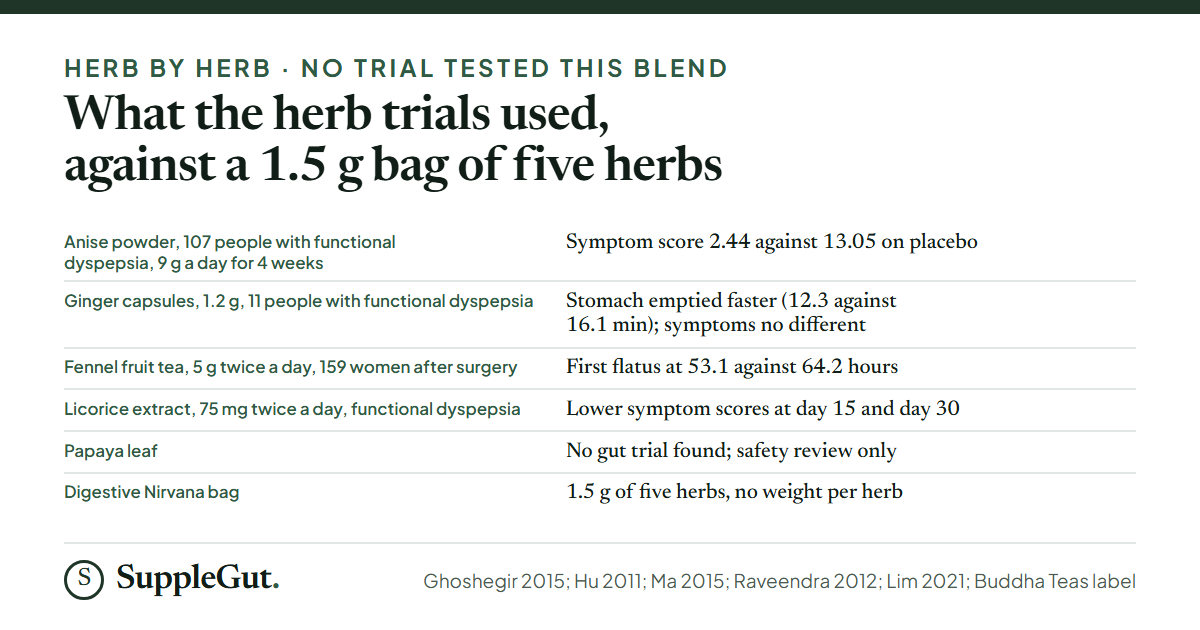
The closest trial to the blend’s first herb enrolled 107 people with the postprandial distress type of functional dyspepsia, 47 on anise and 60 on placebo. They took 3 g of anise powder after each meal, three times a day (9 g a day), or corn starch, for four weeks. The symptom severity score was 2.44 on anise against 13.05 on placebo at week 4, and 1.08 against 13.30 at week 12 (p = 0.0001) (Ghoshegir et al., Journal of Research in Medical Sciences, 2015).
One Digestive Nirvana bag is 1.5 g of all five herbs together. Even if a bag were entirely anise, it would be one-sixth of that trial’s daily powder, and the box gives no number of cups a day. A Cochrane review of non-Chinese herbal medicines for functional dyspepsia (41 trials, 4,477 people) lists this anise trial as a single study of 107 people with low-certainty evidence (Báez et al., 2023). A separate trial gave 120 people with irritable bowel syndrome three enteric-coated anise oil capsules a day for four weeks: 75% were symptom-free against 35% on placebo and 52.5% on peppermint oil capsules (Mosaffa-Jahromi et al., Journal of Ethnopharmacology, 2016). That was an oil in capsules, not a tea.
Ginger, fennel, licorice and papaya leaf in other forms
- Ginger. Eleven people with functional dyspepsia took 1.2 g of ginger in capsules or a placebo in a crossover. Half of the soup meal left the stomach in 12.3 minutes after ginger against 16.1 after placebo, and symptoms did not differ (Hu et al., World Journal of Gastroenterology, 2011). The ginger tea guide goes through the wider ginger trials, which mostly used capsules and powder.
- Fennel. In 159 women after surgery for gynecologic cancer, a cup of fennel fruit tea (5 g of fruit in 130 mL of water) twice a day, against plain water, brought first flatus at 53.1 against 64.2 hours, first defecation at 4.3 against 5.4 days and hospital stay at 5.6 against 6.7 days (all p < 0.001) (Ma et al., 2015). That was a tea, but in surgical patients and at 5 g of fennel per cup, more than three times the weight of a whole Digestive Nirvana bag. A 30-day trial of curcumin plus fennel essential oil capsules in 121 people with IBS cut the IBS symptom score by 50.05% against 26.12% (Portincasa et al., 2016).
- Licorice root. An extract of Glycyrrhiza glabra (GutGard) at 75 mg twice a day for 30 days gave lower symptom scores than placebo in functional dyspepsia at day 15 and day 30 (Raveendra et al., 2012). That is an extract at 150 mg a day; the amount of licorice root in the bag is not printed.
- Papaya leaf. No human trial of papaya leaf for a gut symptom was found. The study that links papaya to digestion tested Caricol, a papaya fruit preparation, at 20 mL a day for 40 days against placebo. Among volunteers who returned within two days of the end of the intake period, constipation and bloating improved (Muss et al., Neuroendocrinology Letters, 2013). The leaf has been studied mainly for safety, covered below.
So four of the five herbs have human data, mostly as capsules, oils, extracts or larger amounts of herb than one bag holds, and the fifth has none for the gut. How the five behave together in one 1.5 g bag has not been studied.
What the brand page says that the box does not
The brand’s product page lists “Supports Digestion,” “Reduces Bloating,” “Soothes the Gut” and “Antimicrobial & Antibacterial.” The box front reads “A Warm and Spicy Blend to Support the Gut” and carries no other health claim. The page also describes each herb in similar terms: anise “supports healthy digestion and gastrointestinal comfort,” fennel “helps ease occasional bloating,” and papaya leaf “supports digestive balance and everyday wellness.” Its flavor notes mention “peppermint’s cooling notes,” though peppermint is not in the ingredient list. The page footer states that the statements have not been evaluated by the FDA and that the product is not intended to diagnose, treat, cure or prevent any disease.
Amazon’s own attribute fields for this listing do not match the box. Tea Variety reads “Chamomile,” its use field reads “Relaxation,” Allergen Information reads “Allergen-Free,” and the ingredients field holds a marketing line about the kosher and organic marks and 18 bleach-free bags. The box lists no chamomile and has no allergen statement. The printed list on the box is the one used on this page.
Brewing it, side effects and the label warning
The box says to use one tea bag per cup of boiling water, cover and steep for 3 to 5 minutes. The brand page adds a water temperature of 205°F and says to enjoy it any time of day; the Amazon page says during or after a meal. The box does not state a number of cups a day or whether to drink it with food.
The box warning reads: “Consult with a healthcare provider prior to use if you are currently pregnant, nursing, taking medication, or if you have a medical condition.” Two of the herbs have research behind that caution:
- Licorice root. In a meta-analysis of 18 studies and 337 people who took products with at least 100 mg of glycyrrhizic acid a day, chronic licorice raised systolic blood pressure by 5.45 mm Hg and diastolic by 3.19, and lowered potassium by 0.33 mmol/L (Penninkilampi et al., Journal of Human Hypertension, 2017). The glycyrrhizin in a Digestive Nirvana bag is not stated, so its place on that scale is unknown.
- Papaya leaf. A scoping review of 41 articles found leaf juice and standardized aqueous extract well tolerated by adults for under five days, with minor gastrointestinal side effects the most common. It reports concerns about liver and reproductive toxicity with long-term use, from animal studies, possible interactions with metformin, glimepiride, digoxin, ciprofloxacin and artemisinin, and caution in pregnancy and liver impairment (Lim et al., 2021). Those data come from juice and extract, not tea bags.
The groups named across the label and these sources are people who are pregnant or nursing, who take medication, who have liver impairment, or who have a medical condition such as raised blood pressure. A pharmacist or doctor can check a specific medicine against all five herbs.
What reviewers say
Amazon shows 4.5 out of 5 from 441 ratings on the brand’s own listing: 74% five-star, 14% four, 5% three, 4% two and 3% one. Amazon’s summary of review text counts 30 mentions of taste (24 positive, 6 negative), 20 of flavor (13 positive, 7 negative), 14 of stomach relief (12 positive, 2 negative), 12 of digestibility (11 positive, 1 negative) and 5 of value for money (2 positive, 3 negative). Praise centers on a stomach ache calming quickly, feeling less bloated or heavy after meals, and a smooth, warm taste with organic ingredients. Complaints are a flavor some call weak and others call strong, little noticeable effect, and the price.
The brand’s own review widget on the product page holds 0 reviews for this tea, so the brand site gives no rating. Trustpilot shows 3.5 from 476 reviews for buddhateas.com as a whole, not for this tea; reviewers there describe unanswered customer-service calls, slow or refused refunds and tea bags that tore. Full Amazon review text sits behind a sign-in, so only the page’s summary snippets were read.
Price per cup, order discounts and the return terms
| Where | Price per box of 18 | Per cup |
|---|---|---|
| Brand site, one box | $7.95 | $0.44 |
| Brand site, 6 or more teas in an order | $7.56 each (5% off) | $0.42 |
| Brand site, 10 or more teas | $7.16 each (10% off, free shipping) | $0.40 |
| Amazon, one box | $8.24 | $0.46 |
| Fullscript (practitioner store) | $7.99 | $0.44 |
One bag makes one cup, so a box is 18 cups. The brand site has no subscription for this tea, and no Subscribe & Save line was shown on the Amazon listing.
The brand’s refund policy gives 30 days to request a return of an item in the condition received and in its original packaging, with the customer paying return shipping unless the item arrived damaged or wrong. It lists perishable goods (such as food and tea products), opened or used consumable items, sale items and gift cards as non-returnable. The Amazon listing says non-returnable for food safety reasons, with damaged or defective items refundable or replaceable through Your Orders. One Amazon reviewer objects that the tea cannot be returned.
Digestive Nirvana beside the Traditional Medicinals ginger and peppermint teas
The Traditional Medicinals ginger, peppermint and chamomile teas are each a single herb, sold as 16 bags, at $0.37 a bag on Amazon. Their Amazon ratings are 4.6 from 3,880 (ginger), 4.7 from 3,922 (peppermint) and 4.7 from 1,401 (chamomile).
The weights are the clearest difference. The Traditional Medicinals ginger bag holds 1,500 mg of ginger by label weight, which equals the entire 1.5 g of Digestive Nirvana, where ginger is one of five herbs of unstated share. Digestive Nirvana adds anise, papaya leaf, licorice root and fennel, and with them the licorice and papaya cautions above; the single-herb teas carry neither. Digestive Nirvana costs $0.44 a cup on the brand site, against $0.37 for the Traditional Medicinals bags.
Who Digestive Nirvana is for
- Someone who wants a warm, spicy-tasting, caffeine-free tea with a licorice finish, as the brand describes it, and who accepts that no trial tested the blend.
- Someone who prefers five herbs in one bag to a single herb, and is comfortable with weights that are not printed.
- Someone not covered by the label’s warning, or who has checked it with a provider first.
- Someone who accepts that an opened box cannot be returned under the brand’s and Amazon’s terms.
For a single herb, the Traditional Medicinals ginger and peppermint teas are the comparison pages, and the ginger tea guide sets the ginger trial doses beside one bag. The quiz starts from your symptoms instead of a product.
The catalog entries behind this guide
Common questions
Is there evidence that Digestive Nirvana eases bloating?
None of the studies found tested the blend. Anise powder lowered symptom scores in 107 people with functional dyspepsia, but at 9 g a day against a 1.5 g bag of five herbs. The brand page says the tea “reduces bloating”; the box says only “a warm and spicy blend to support the gut.” On Amazon, 12 of 14 mentions of stomach relief in the review summary are positive.
Which herbs are in Digestive Nirvana, and how much of each?
The box lists organic anise seed, ginger root, papaya leaf, licorice root and fennel seed, in that order. A bag is 1.5 g in total and no weight is printed for any single herb, so the share of each cannot be read from the label. It is caffeine free, USDA Organic, CCOF organic and OU kosher.
Who is asked to check with a clinician before drinking it?
The box says to consult a healthcare provider before use if you are pregnant, nursing, taking medication or have a medical condition. Two of the herbs carry research cautions: licorice, which raised blood pressure and lowered potassium in a meta-analysis at 100 mg or more of glycyrrhizic acid a day, and papaya leaf, which a safety review cautions against in pregnancy and liver impairment and lists interactions with five drugs.
How many cups of Digestive Nirvana a day does the box allow?
The box does not give a number of cups a day. Its directions are one tea bag per cup of boiling water, covered and steeped for 3 to 5 minutes. The brand page adds a water temperature of 205°F and says any time of day, and the Amazon page says during or after a meal.
What does one cup cost on the brand site and on Amazon?
A box of 18 bags is $7.95 on the brand site, about $0.44 a cup, and $8.24 on Amazon, about $0.46. The brand takes 5% off an order of six or more teas ($7.56 each, about $0.42 a cup) and 10% off ten or more ($7.16 each, about $0.40 a cup) with free shipping. There is no subscription.
Can an opened box of Digestive Nirvana be sent back?
The brand’s refund policy lists perishable goods such as food and tea products, and opened or used consumable items, as non-returnable. The Amazon listing says non-returnable for food safety reasons, with refunds for damaged or defective items through Your Orders.
Why does Amazon list Digestive Nirvana as a chamomile tea?
Amazon’s Tea Variety field reads “Chamomile” and its use field reads “Relaxation,” but the box lists no chamomile. Its ingredients field holds a marketing line rather than the herbs. The box’s printed list of anise, ginger, papaya leaf, licorice root and fennel is the one used on this page.
How does it differ from a plain ginger or peppermint tea bag?
Digestive Nirvana puts five herbs in a 1.5 g bag. The Traditional Medicinals ginger and peppermint teas are each a single herb. The ginger bag holds 1,500 mg of ginger by label weight, the same weight as this entire five-herb bag.
Sources
- Ghoshegir SA, Mazaheri M, Ghannadi A, et al. “Pimpinella anisum in the treatment of functional dyspepsia: A double-blind, randomized clinical trial.” Journal of Research in Medical Sciences, 2015;20(1):13–21. PubMed 25767516
- Mosaffa-Jahromi M, Lankarani KB, Pasalar M, et al. “Efficacy and safety of enteric coated capsules of anise oil to treat irritable bowel syndrome.” Journal of Ethnopharmacology, 2016;194:937–946. PubMed 27815079
- Hu ML, Rayner CK, Wu KL, et al. “Effect of ginger on gastric motility and symptoms of functional dyspepsia.” World Journal of Gastroenterology, 2011;17(1):105–110. PubMed 21218090
- Ma HW, Zhao JT, Zhao X. “The effect of fennel tea drinking on postoperative gut recovery after gynecological malignancies operation.” Sichuan Da Xue Xue Bao Yi Xue Ban, 2015;46(6):940–943. PubMed 26867333
- Portincasa P, Bonfrate L, Scribano ML, et al. “Curcumin and fennel essential oil improve symptoms and quality of life in patients with irritable bowel syndrome.” Journal of Gastrointestinal and Liver Diseases, 2016;25(2):151–157. PubMed 27308645
- Raveendra KR, Jayachandra, Srinivasa V, et al. “An extract of Glycyrrhiza glabra (GutGard) alleviates symptoms of functional dyspepsia: a randomized, double-blind, placebo-controlled study.” Evidence-Based Complementary and Alternative Medicine, 2012;2012:216970. PubMed 21747893
- Penninkilampi R, Eslick EM, Eslick GD. “The association between consistent licorice ingestion, hypertension and hypokalaemia: a systematic review and meta-analysis.” Journal of Human Hypertension, 2017;31(11):699–707. PubMed 28660884
- Muss C, Mosgoeller W, Endler T. “Papaya preparation (Caricol) in digestive disorders.” Neuroendocrinology Letters, 2013;34(1):38–46. PubMed 23524622
- Lim XY, Chan JSW, Japri N, et al. “Carica papaya L. leaf: a systematic scoping review on biological safety and herb-drug interactions.” Evidence-Based Complementary and Alternative Medicine, 2021;2021:5511221. PubMed 34040647
- Báez G, Vargas C, Arancibia M, Papuzinski C, Franco JV. “Non-Chinese herbal medicines for functional dyspepsia.” Cochrane Database of Systematic Reviews, 2023;(6):CD013323. PubMed 37323050
- Buddha Teas Digestive Nirvana Blend: product page, box front and back and Nutrition Facts images, and price. buddhateas.com
- Buddha Teas refund policy. buddhateas.com
- Amazon listing for Buddha Teas Organic Digestive Nirvana Blend (ASIN B00QQVB5YM): attribute fields, price, ratings and review summary. amazon.com
- Trustpilot profile for buddhateas.com. trustpilot.com
- Fullscript listing for Digestive Nirvana Blend. fullscript.com
One answer for your symptoms
If this page raised more questions than it settled, the quiz asks the ones that matter for you and answers with one product.
Take the quiz →