Guide
Does ginger tea help nausea, bloating and digestion? The trial doses beside one tea bag
Quick answer
Does ginger tea help nausea, bloating and digestion? The trials behind ginger used capsules and powder, mostly 0.5 to 1.5 g a day, and found lower nausea scores in pregnancy, after surgery and with chemotherapy; vomiting and dyspepsia symptoms were less consistent. Only one non-randomized study of 100 women tested ginger tea. A Traditional Medicinals bag holds 1,500 mg of ginger by label weight, but how much reaches the cup was not measured.
Ginger has a sizable trial record for nausea, and tea is a common way to take it. The two are not the same thing. The trials gave dried ginger powder in capsules, and almost none tested a brewed cup. This page lays the trial doses beside what one Traditional Medicinals bag holds, then covers what the European monograph says about safety.
What one Traditional Medicinals ginger bag holds
The label on Traditional Medicinals Organic Ginger, as shown in a retailer listing of the package, has one ingredient: organic ginger rhizome, 1,500 mg per tea bag. The serving is one bag in 8 fl oz of freshly boiled water, covered and steeped for 10 to 15 minutes, with 1 to 2 cups a day suggested. The warning line asks anyone pregnant or breastfeeding to consult a healthcare practitioner first. The label prints no gingerol or shogaol content, the pungent compounds usually credited for the effect, so there is no figure for how much of them reaches the cup.
Amazon shows 4.6 out of 5 from 3,880 ratings on the 16-bag listing. Reviewers describe an upset stomach settling within a cup, a strong ginger heat with no sweetener, and the price against fresh root.
Nausea in pregnancy
This is the setting with the most trials. A 2014 systematic review pooled 12 randomized trials in 1,278 pregnant women and found that orally taken ginger improved nausea compared with placebo (mean difference 1.20 points, 95% CI 0.56 to 1.84), with no significant change in vomiting episodes. Its subgroup analysis seemed to favor daily amounts under 1,500 mg for nausea. The authors rated the evidence low quality because the trials were few, varied in how they reported outcomes, and differed in dose. They also found no significant increase in spontaneous abortion, heartburn or drowsiness (Viljoen et al., Nutrition Journal, 2014).
The Cochrane review of all treatments for early-pregnancy nausea, with 41 trials in 5,449 women, reached a more guarded verdict on ginger: products “may be helpful,” but the evidence was limited and not consistent, with three recent studies favoring ginger over placebo (Matthews et al., Cochrane Database of Systematic Reviews, 2015). The EMA assessment report describes that review’s 13 ginger studies as using syrup, capsules or powder in biscuits, not tea.
Nausea after chemotherapy and surgery
The largest single dose-finding trial randomized 744 cancer patients to placebo or to 0.5, 1.0 or 1.5 g of ginger a day, all taking a standard anti-nausea drug. The capsules ran for six days, starting three days before chemotherapy. In the 576 patients analyzed, every ginger dose lowered nausea on the first day of chemotherapy, and the biggest drops came at 0.5 g and 1.0 g, not at 1.5 g (Ryan et al., Supportive Care in Cancer, 2012).
A 2024 meta-analysis of 35 trials, 22 of them using ginger capsules, found that capsules added to standard anti-nausea drugs lowered the rate of grade 3 acute nausea (risk ratio 0.19) and of high-grade overall vomiting (risk ratio 0.47). The other 13 trials tested ginger-partitioned moxibustion, a heat treatment over slices of ginger on the skin, which is not a drink (Lin et al., Cancer Nursing, 2024).
After surgery, 14 randomized trials in 1,506 patients showed lower nausea scores in the ginger groups at 2, 6 and 12 hours. Vomiting, the combined nausea-and-vomiting rate and antiemetic use did not differ significantly, apart from a difference in the recovery room (Lu et al., International Journal of Nursing Studies, 2021). Across all three settings the pattern repeats: nausea scores move more reliably than vomiting counts.
Stomach emptying, indigestion and the symptom trials
Ginger’s tie to “digestion” rests mainly on stomach emptying. In 24 healthy volunteers, 1,200 mg of ginger in capsules cut the gastric half-emptying time from 26.7 to 13.1 minutes, with no difference in any digestive sensation (Wu et al., European Journal of Gastroenterology & Hepatology, 2008). The same group gave the same 1.2 g to 11 people with functional dyspepsia: half-emptying fell from 16.1 to 12.3 minutes, but symptoms and gut hormone levels did not change (Hu et al., World Journal of Gastroenterology, 2011). A 1993 crossover of 1 g in 16 healthy volunteers, using acetaminophen absorption as the gauge, found no effect on emptying at all (Phillips et al., Anaesthesia, 1993).
The trials that did measure indigestion symptoms used standardized extracts, not plain powder:
- 126 people with functional dyspepsia took two capsules a day of a combined ginger and artichoke leaf extract for four weeks. Nausea, fullness, pain and bloating scores favored the extract over placebo. Several authors work for Indena, the extract’s maker (Giacosa et al., Evidence-Based Complementary and Alternative Medicine, 2015).
- 50 people took 200 mg twice a day of a gingerol-standardized extract made with a proprietary delivery technology for four weeks; 79% were rated responders against 21% on placebo. All five authors list Olene Life Sciences, the company behind the extract, as their affiliation (Panda et al., Journal of Dietary Supplements, 2022).
- 80 people took 480 mg a day of a steamed ginger extract for 12 weeks, and a gastrointestinal symptom score improved more than on placebo (Baek et al., Food & Function, 2025).
A Cochrane review of non-Chinese herbal medicines for functional dyspepsia (41 trials, 27 herbs) listed the ginger and artichoke combination at a risk ratio of 1.64 (95% CI 1.27 to 2.13) for symptom improvement, from one study of 126 people, with low certainty (Báez et al., 2023). None of these trials tested a tea.
Has ginger tea itself been tested?
Brewed ginger has almost no randomized record. A title search of PubMed for “ginger tea” returned six records, and apart from one cancer-nursing study they were laboratory, food-chemistry, animal or pulse-measurement papers. That study enrolled 100 women with gynecologic cancers on cisplatin-based chemotherapy, 50 in each group, and gave ginger tea alongside the standard anti-nausea regimen. It was quasi-experimental, meaning the groups were not randomly assigned. Nausea, vomiting and retching scores were lower in the tea group at every measurement, with differences reaching significance at the third, fourth and fifth, and no ginger-related side effects were noted (Wazqar et al., Cancer Nursing, 2021). The abstract does not state how much ginger went into the cup.
A 2022 systematic review of dietary strategies for chemotherapy nausea (21 studies) reported a statistically significant, very large effect of ginger tea on overall nausea and vomiting severity, and rated the certainty very low (Gala et al., Clinical Nutrition, 2022). For pregnancy, indigestion and bloating, no randomized trial of ginger tea turned up. In short, the evidence is for capsules, powder and extracts, and tea is read onto it by analogy.
One cup beside the trial doses
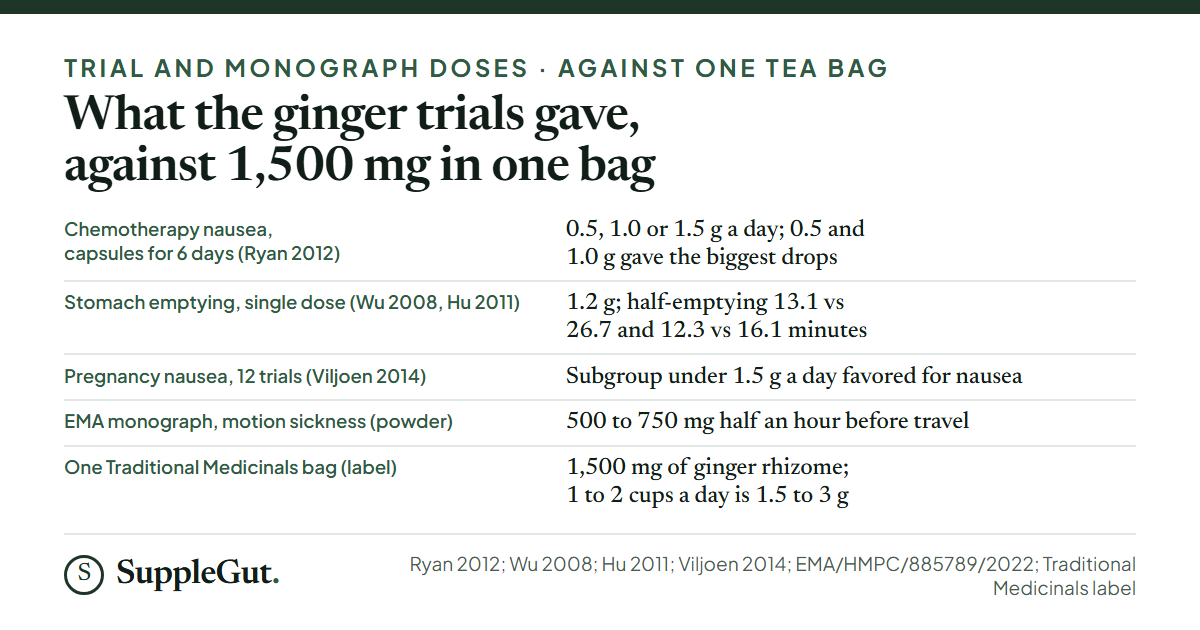
On label weight, a bag holds 1.5 g of ginger. The trial amounts and the monograph’s traditional doses are in the table.
| Source | Form | Amount |
|---|---|---|
| Ryan 2012, chemotherapy nausea | Capsules, six days | 0.5, 1.0 or 1.5 g a day |
| Wu 2008 and Hu 2011, stomach emptying | Capsules, single dose | 1.2 g |
| Phillips 1993, stomach emptying | Powder, single dose | 1 g |
| Viljoen 2014, pregnancy nausea | Mixed forms | Subgroup under 1.5 g a day favored |
| EMA monograph, motion sickness (traditional use) | Powder | 500 to 750 mg half an hour before travel |
| EMA monograph, mild spasmodic complaints with bloating (traditional use) | Powder | 0.18 to 1 g, three times daily |
| Traditional Medicinals label | Tea bag in 8 fl oz | 1.5 g per bag; 1 to 2 cups a day is 1.5 to 3 g |
By weight, one bag sits at the top of the 0.5 to 1.5 g range of the chemotherapy trial and at the 1.5 g line that the pregnancy review’s lower-dose subgroup stayed under. What the weight cannot tell you is how much of the root’s active compounds dissolve into a cup in 10 to 15 minutes, and how that compares with swallowing the whole powder. No measurement of extraction for this tea turned up, and the monograph’s doses are for powdered root and alcohol tinctures, with no dose given for an infusion. A bag is a nominal match to the trials, not a verified one.
Two cups a day is 3 g of root by label weight, above the 2.5 g daily ceiling the monograph sets for repeat doses of powder on a long journey. That ceiling is a limit on powder for motion sickness, not a rule for tea, and how much of the 3 g reaches the cup is unknown.
Bloating and the traditional-use indications
The European Medicines Agency’s herbal committee lists ginger, on the basis of long-standing use alone, for mild spasmodic gastrointestinal complaints including bloating and flatulence, for temporary loss of appetite and for motion sickness. Its well-established medical use, which rests on clinical studies, is narrower: preventing nausea and vomiting in motion sickness, at 1 to 2 g taken an hour before travel. The monograph adds that if complaints last longer than two weeks, a doctor should be consulted (EMA/HMPC/885789/2022).
No trial of tea was found for bloating. The one human measurement of ginger and the esophagus used 1 g of powder stirred into 100 ml of water in 14 healthy men: relaxation of the lower esophageal sphincter at swallowing increased, which the authors suggested might help gas leave the stomach (Lohsiriwat et al., Journal of the Medical Association of Thailand, 2010). That change is why heartburn is the first caution below, although the study did not measure reflux.
Heartburn, gallstones, blood thinners and pregnancy
Heartburn and stomach upset. The monograph lists stomach upset, belching, dyspepsia, heartburn and nausea as common effects (between 1 in 100 and 1 in 10 people). It ties them to no specific dose, and it gives no upper limit for tea. The sphincter finding is one possible mechanism, though that study did not measure reflux. The product page on this site notes that ginger can worsen heartburn in some people.
Gallstones. The monograph carries no gallstone warning. The assessment report records that German product labeling says to contact a doctor first in case of gallstone disease.
Blood thinners. The monograph says no interactions are known, and the assessor judged the clotting data too sparse to add a bleeding warning. The same report records the evidence on the other side: two case reports of an international normalized ratio (INR) near 10 in older women on phenprocoumon or warfarin who had started eating ginger and drinking ginger tea, which settled when ginger stopped (Krüth 2004; Lesho 2004); a 16-week study of 171 warfarin users in which self-reported ginger use went with more bleeding (odds ratio 3.20) but not with high INR (Shalansky 2007); and a case report of a skin rash in an 81-year-old woman taking edoxaban while drinking ginger tea. Against that, 12 healthy volunteers taking 0.4 g of ginger three times daily for a week showed no change in warfarin handling or INR (Jiang 2005), and 39 healthy adults drinking tea made from 4 g of powder once or twice a day for five days showed no change in platelet aggregation (AlAskar 2020). Dutch and German product labeling cited in the report advise caution with anticoagulants, and the German text advises stopping before planned surgery. Anyone on a blood thinner is the person to check with a prescriber first.
Pregnancy. The monograph says 300 to 1,000 pregnancy outcomes show no malformation or newborn toxicity from ginger root, yet advises avoiding it in pregnancy as a precaution, and says safety during breastfeeding has not been established. The label asks the same: consult a practitioner. The monograph calls the animal data insufficient. One rat study of ginger tea in drinking water (20 or 50 g per liter) found embryo loss double that of controls, with no gross malformations in the fetuses (Wilkinson, Reproductive Toxicology, 2000).
Tea, capsules or a blend
Capsules deliver a measured weight of root: Nature’s Way Ginger Root Capsules are 550 mg each, so two supply 1,100 mg, close to the 1 to 1.2 g used in the stomach-emptying trials. They are whole root powder, not standardized to gingerols, so potency varies. Tea delivers whatever dissolves, with the heat and fluid of the cup, and no trial has separated those effects from ginger itself. Blended “digestive” teas that list ginger among several herbs without amounts, such as the eight-herb mix in the It’s Health Tea GERD tea guide, cannot be compared with any trial dose. For capsule details, see the Nature’s Way ginger page.
Peppermint is the other common gut tea. The peppermint results in the dyspepsia Cochrane review above were for peppermint and caraway oil, not leaf tea, and the peppermint tea guide sets out what exists for the tea. If heartburn is the complaint, the acid reflux guide covers what has been tested.
Products this guide draws on
Common questions
Does ginger tea help with nausea?
The nausea trials used capsules and powder, not brewed tea. Pooled trials found ginger lowered nausea scores in pregnancy (12 trials, 1,278 women), after surgery (14 trials, 1,506 patients) and alongside chemotherapy drugs, with vomiting less consistent. One non-randomized study of 100 women gave ginger tea during cisplatin chemotherapy and found lower nausea scores, without stating the amount of ginger.
How does a cup of ginger tea compare with the doses in the studies?
A Traditional Medicinals bag holds 1,500 mg of ginger rhizome by label weight, at the top of the 0.5 to 1.5 g a day range of the chemotherapy trial and at the 1.5 g line that the pregnancy review’s lower-dose subgroup stayed under. How much of that dissolves into the cup was not measured in anything found, so the match is by weight only.
Is there research on ginger tea for bloating or indigestion?
No randomized trial of ginger tea for bloating or indigestion was found. The dyspepsia symptom trials used extracts: 126 people on a ginger and artichoke extract, 50 on a gingerol-standardized extract and 80 on a steamed ginger extract. A 1.2 g capsule dose sped stomach emptying in 11 people with functional dyspepsia without changing their symptoms.
Can you drink ginger tea while pregnant?
Pregnancy is where ginger has the most trials, mostly at under 1.5 g a day. Even so, the European monograph advises avoiding ginger in pregnancy as a precaution, and the Traditional Medicinals label asks pregnant and breastfeeding users to consult a healthcare practitioner first. Rat data on ginger tea showed doubled embryo loss. Dose and timing are a question for a midwife or doctor.
Can ginger tea cause heartburn?
Heartburn is listed among the common effects of ginger (between 1 in 100 and 1 in 10 people) in the European monograph. In 14 healthy men, 1 g of ginger powder in water increased relaxation of the lower esophageal sphincter at swallowing, a change the study linked to gas rather than reflux, which it did not measure. The 12-trial pregnancy review found no significant increase in heartburn.
Is ginger tea safe with blood thinners?
The European monograph lists no known interactions, but its assessment report records two case reports of an INR near 10 in women on warfarin or phenprocoumon who had started ginger and ginger tea, and a warfarin cohort in which ginger use went with more self-reported bleeding. Small studies in healthy volunteers found no change in INR or platelet aggregation. Check with a prescriber first.
How long should ginger tea steep, and how many cups a day?
The Traditional Medicinals label directs one bag in 8 fl oz of freshly boiled water, covered, steeped 10 to 15 minutes, with 1 to 2 cups a day. By label weight that is 1.5 to 3 g of root a day. The monograph’s own limits are for powder, not tea.
Is ginger tea or ginger capsules the closer match to the trials?
Capsules. The trials gave capsules or powder of known weight. Nature’s Way Ginger Root Capsules supply 1,100 mg in two capsules of whole root powder. Tea gives the compounds that dissolve in the cup, in an amount nobody has measured for this product.
Sources
- Viljoen E, Visser J, Koen N, Musekiwa A. “A systematic review and meta-analysis of the effect and safety of ginger in the treatment of pregnancy-associated nausea and vomiting.” Nutrition Journal, 2014;13:20. PubMed 24642205
- Matthews A, Haas DM, O’Mathúna DP, Dowswell T. “Interventions for nausea and vomiting in early pregnancy.” Cochrane Database of Systematic Reviews, 2015;(9):CD007575. PubMed 26348534
- Ryan JL, Heckler CE, Roscoe JA, et al. “Ginger (Zingiber officinale) reduces acute chemotherapy-induced nausea: a URCC CCOP study of 576 patients.” Supportive Care in Cancer, 2012;20(7):1479–1489. PubMed 21818642
- Lin CY, Huang SH, Tam KW, Huang TW, Gautama MSN. “Efficacy and Safety of Ginger on Chemotherapy-Induced Nausea and Vomiting: A Systematic Review and Meta-analysis of Randomized Controlled Trials.” Cancer Nursing, 2024;48(6):455–466. PubMed 38625733
- Lu C, Chen X, Yan X, He J, Nie Z. “The preventive and relieving effects of ginger on postoperative nausea and vomiting: A systematic review and meta-analysis of randomized controlled trials.” International Journal of Nursing Studies, 2021;125:104094. PubMed 34700257
- Wu KL, Rayner CK, Chuah SK, et al. “Effects of ginger on gastric emptying and motility in healthy humans.” European Journal of Gastroenterology & Hepatology, 2008;20(5):436–440. PubMed 18403946
- Hu ML, Rayner CK, Wu KL, et al. “Effect of ginger on gastric motility and symptoms of functional dyspepsia.” World Journal of Gastroenterology, 2011;17(1):105–110. PubMed 21218090
- Phillips S, Hutchinson S, Ruggier R. “Zingiber officinale does not affect gastric emptying rate. A randomised, placebo-controlled, crossover trial.” Anaesthesia, 1993;48(5):393–395. PubMed 8317647
- Giacosa A, Guido D, Grassi M, et al. “The Effect of Ginger (Zingiber officinalis) and Artichoke (Cynara cardunculus) Extract Supplementation on Functional Dyspepsia: A Randomised, Double-Blind, and Placebo-Controlled Clinical Trial.” Evidence-Based Complementary and Alternative Medicine, 2015;2015:915087. PubMed 25954317
- Panda SK, Nirvanashetty S, Parachur VA, Krishnamoorthy C, Dey S. “A Randomized, Double-Blind, Placebo Controlled, Parallel-Group, Comparative Clinical Study to Evaluate the Efficacy and Safety of OLNP-06 versus Placebo in Subjects with Functional Dyspepsia.” Journal of Dietary Supplements, 2020;19(2):226–237. PubMed 33305631
- Baek HI, Ha NR, Kim C, et al. “Efficacy and safety of steamed ginger extract for gastric health: a randomized, double-blind, placebo-controlled multi-center clinical trial.” Food & Function, 2025;16(18):7316–7329. PubMed 40878144
- Báez G, Vargas C, Arancibia M, Papuzinski C, Franco JV. “Non-Chinese herbal medicines for functional dyspepsia.” Cochrane Database of Systematic Reviews, 2023;(6):CD013323. PubMed 37323050
- Wazqar DY, Thabet HA, Safwat AM. “A Quasi-Experimental Study of the Effect of Ginger Tea on Preventing Nausea and Vomiting in Patients With Gynecological Cancers Receiving Cisplatin-Based Regimens.” Cancer Nursing, 2021;44(6):E513–E519. PubMed 33867429
- Gala D, Wright HH, Zigori B, Marshall S, Crichton M. “Dietary strategies for chemotherapy-induced nausea and vomiting: A systematic review.” Clinical Nutrition, 2022;41(10):2147–2155. PubMed 36067586
- Lohsiriwat S, Rukkiat M, Chaikomin R, Leelakusolvong S. “Effect of ginger on lower esophageal sphincter pressure.” Journal of the Medical Association of Thailand, 2010;93(3):366–372. PubMed 20420113
- Wilkinson JM. “Effect of ginger tea on the fetal development of Sprague-Dawley rats.” Reproductive Toxicology, 2000;14(6):507–512. PubMed 11099876
- European Medicines Agency, Committee on Herbal Medicinal Products. “European Union herbal monograph on Zingiber officinale Roscoe, rhizoma,” Final, Revision 1, 2025 (EMA/HMPC/885789/2022). ema.europa.eu
- European Medicines Agency, Committee on Herbal Medicinal Products. “Assessment report on Zingiber officinale Roscoe, rhizoma,” Final, Revision 1, 2025 (EMA/HMPC/765220/2022). Source for the Krüth 2004, Lesho 2004, Shalansky 2007, Jiang 2005 and AlAskar 2020 findings, the edoxaban case report, and the German and Dutch product labeling cited above. ema.europa.eu
- Traditional Medicinals Organic Ginger tea: label and Supplement Facts as shown in a retailer listing. vitacost.com
- Amazon listing for Traditional Medicinals Organic Ginger (16 bags): ratings. amazon.com
Still deciding between products?
The guide gives the background. For a single answer, the quiz asks about your symptoms, your routine and what you have tried, then names one product.
Take the quiz →