Guide
Does Calming Blends Diverticulitis Tea work? A four-herb blend, a pouch that disclaims its own name, and no trial in diverticulitis
Quick answer
Does Calming Blends Diverticulitis Tea work? No trial has tested this blend, or peppermint, chamomile, marshmallow leaf or wild yam root, in diverticulitis. The one herbal-tea trial in the condition used burdock, which is not in this tea: an open-label study of 161 people. The peppermint evidence is for oil capsules in IBS. The pouch says the name “reflects traditional herbal inspiration only” and that the tea is not intended to affect disease. Amazon shows 4.5 from 4,259 ratings.
Calming Blends Diverticulitis Tea is a caffeine-free loose-leaf blend of peppermint, chamomile, marshmallow leaf and wild yam root, sold in a 2 oz pouch with directions for two to three cups a day. Its name is a disease name. This page covers what the pouch says about that, what is and is not printed about the herbs, what the trials do and do not cover, and what the reviews and the price look like.
A tea named for a gut condition
Diverticulosis means small pouches, called diverticula, have formed in the wall of the colon. Many people have them without symptoms. Diverticulitis is what the term describes when one of those pouches becomes inflamed or infected, which can bring abdominal pain, fever and changes in bowel habit. A diagnosed flare-up is managed by a doctor.
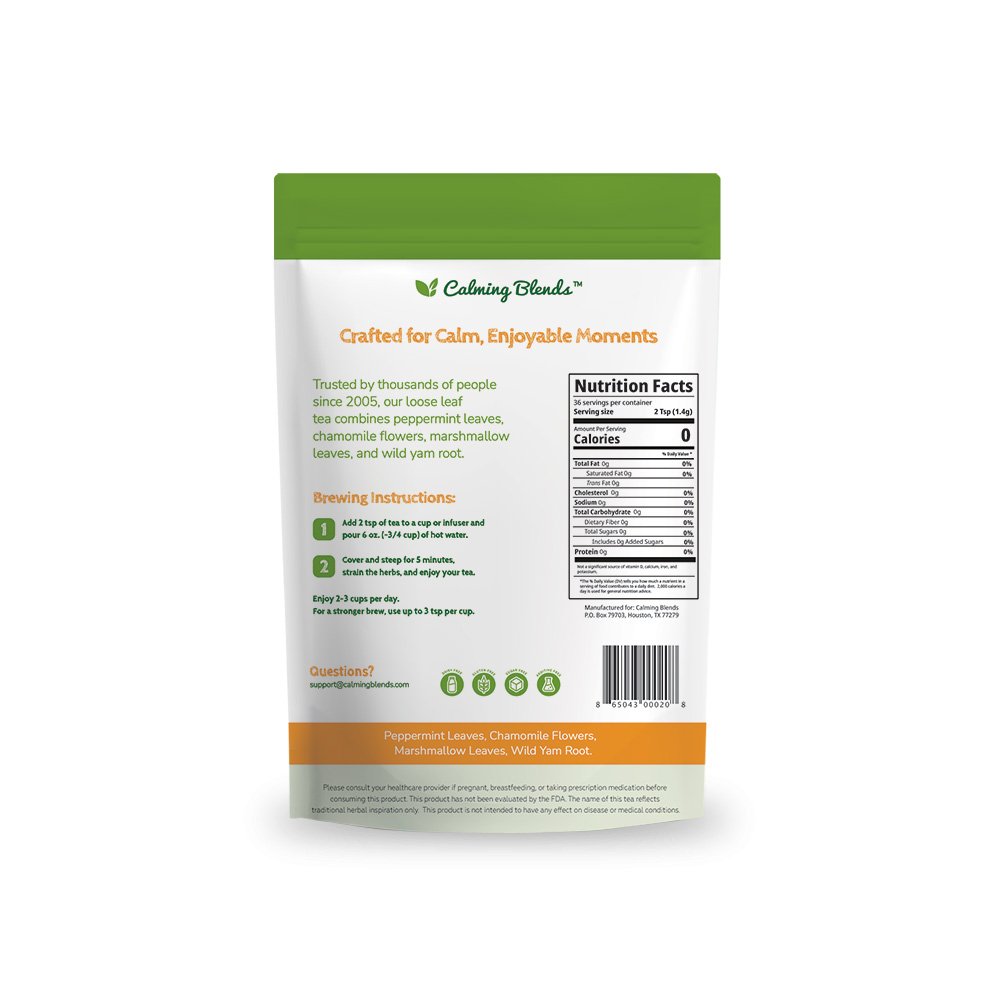
The pouch’s fine print speaks to the name directly: “The name of this tea reflects traditional herbal inspiration only. This product is not intended to have any effect on disease or medical conditions.” The brand’s website words it differently. There, the brand says the blend “may relieve cramping and griping associated with Diverticulitis or Diverticulosis,” and its FAQ says it “may help relieve the symptoms or prevent inflammation from occurring,” both marked with an asterisk. Amazon’s safety text adds that the product is not designed to diagnose, treat, cure or prevent any disease.
Three statements sit side by side: a name that is a condition, site wording about relieving its symptoms, and a pouch that says the product is not intended to affect disease. This page reads the pouch as the label, since that is the text printed on the product.
Four herbs, no weights, and some mismatched details
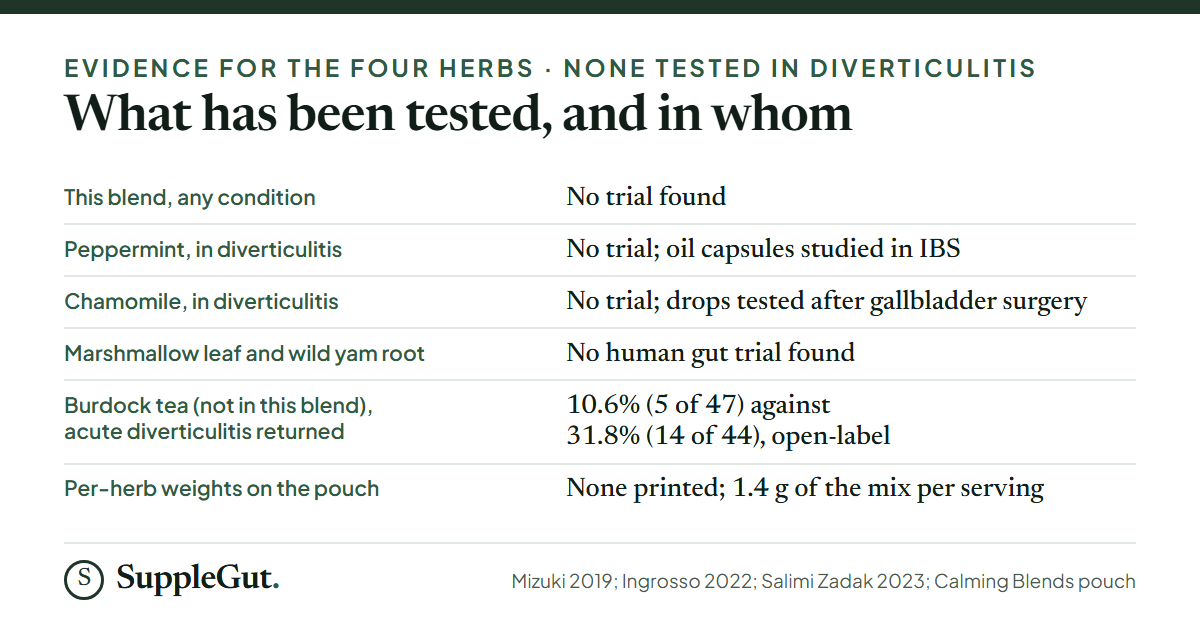
The back of the pouch prints one ingredient line: “Peppermint Leaves, Chamomile Flowers, Marshmallow Leaves, Wild Yam Root.” There are no added flavors or sweeteners, and none of the laxative herbs found in some gut teas, such as senna or cascara. The Nutrition Facts panel lists 36 servings per container, a serving of 2 teaspoons (1.4 g), and zeros for calories, fat, sodium, carbohydrate and protein. Icons mark it dairy free, gluten free, sugar free and additive free. No per-herb weight appears on the pouch, the brand page or Amazon, so the share of each herb in a cup is unknown.
The brand’s page describes each herb. Chamomile is “traditionally used for its calming, soothing qualities,” marshmallow leaves are “known for their mucilage content,” peppermint is “valued for its soothing effect on the stomach,” and wild yam root “helps to maintain a balance of hormones” and contains alkaloids that are muscle relaxants for the abdomen and pelvis. That last statement is starred, and no source is given on the page.
A few details differ between sources:
- Ingredient order. The pouch lists peppermint first. The brand page and Amazon’s bullets list chamomile first, and Amazon’s ingredient field reads chamomile, peppermint, wild yam, marshmallow.
- Organic. Amazon’s title says “Organic Loose Leaf Tea” and its specialty field says organic. The pouch image has no USDA Organic seal, and the brand’s FAQ says only that its suppliers are certified organic. The strainer-bundle listing is titled “All Natural.”
- Weights. 36 servings of 1.4 g come to about 50 g in a pouch labeled 2 oz (57 g).
- Testing. No third-party test or certificate is named on the pouch, the brand page or Amazon.
Has any trial looked at this blend or its herbs in diverticulitis?
PubMed and ClinicalTrials.gov searches for the brand name and for “diverticulitis tea” returned no study of this product. A wider search of diverticular disease with peppermint, chamomile, marshmallow, wild yam, tea and herbal terms returned 10 records, and none was a trial of these herbs. No human trial of the finished blend or of any of the four herbs in diverticulitis or diverticular disease was found.
The one herbal-tea trial in the condition used a different plant. In an open-label randomized trial, newly diagnosed people were split between 1.5 g of burdock tea three times a day and no treatment. Of the 161 people, 91 had diverticular bleeding and 70 had acute diverticulitis, and follow-up was a median of 22.0 and 30.3 months. Acute diverticulitis returned in 5 of 47 people (10.6%) on burdock tea against 14 of 44 (31.8%) untreated (log-rank p = 0.012), and there was no effect on bleeding recurrence (Mizuki et al., Scientific Reports, 2019).
That result belongs to burdock. Burdock is not in this blend, and the trial had no blinding and no placebo, so participants knew whether they were drinking tea. It shows that a tea trial in diverticulitis can be run. It says nothing about peppermint, chamomile, marshmallow or wild yam.
Peppermint oil capsules in IBS, and why they are not a cup of this tea
Peppermint is listed first on the pouch, and it is the one herb here with a body of trials, though in a different condition and form. A 2022 meta-analysis pooled 10 randomized trials in 1,030 people with irritable bowel syndrome (IBS). Peppermint oil beat placebo for global symptoms (relative risk of not improving 0.65, 95% confidence interval 0.43 to 0.98, number needed to treat 4) and for abdominal pain (0.76, 0.62 to 0.93, number needed to treat 7). Adverse events were more frequent on the oil (relative risk 1.57, 1.04 to 2.37), and the authors rated the quality of evidence very low (Ingrosso et al., Alimentary Pharmacology & Therapeutics, 2022). A network meta-analysis of 51 trials in 4,644 people ranked peppermint oil capsules first for global IBS symptoms (relative risk 0.63, 0.48 to 0.83) and noted considerable uncertainty (Black et al., The Lancet Gastroenterology & Hepatology, 2019).
Three differences keep those results from transferring to this pouch. The condition is IBS, not diverticulitis. The product was an oil in capsules, not leaf steeped in water. And the label here gives no peppermint weight, only 1.4 g of the four-herb mix per cup, so no trial dose can be compared with it. The peppermint tea guide goes through the capsule trials and the question of what a brewed cup holds.
Chamomile, marshmallow leaf and wild yam root
Chamomile. No human trial of chamomile tea for a gut symptom was found. Related work exists, but in other forms. A liquid called STW 5 (Iberogast), which contains peppermint, chamomile and other herbs, was better than placebo for the most bothersome symptom in a pooled analysis of 3 trials in functional dyspepsia, with 138 people on the liquid and 135 on placebo (Melzer et al., Alimentary Pharmacology & Therapeutics, 2004). A 2023 Cochrane review of non-Chinese herbal medicines for functional dyspepsia (41 trials, 4,477 people) said STW 5 may moderately improve symptoms, with very uncertain evidence (Cochrane, 2023). That is a multi-herb liquid extract, not a tea. In a triple-blind trial of 64 people, chamomile drops given before gallbladder surgery were followed by less flatulence than placebo (Salimi Zadak et al., Journal of Ayurveda and Integrative Medicine, 2023). Those were drops in surgical patients.
Marshmallow leaf. A PubMed search of Althaea and marshmallow with human, patient and trial terms returned laboratory work, cough-syrup studies and one vulvovaginal candidiasis trial, but no human gut trial. The brand’s mention of mucilage describes the plant; it is not a result in people.
Wild yam root. A search of Dioscorea and wild yam with randomized, patient and women terms returned diosgenin laboratory work and menopause reviews, and no human gut trial. The muscle-relaxing alkaloid statement on the brand’s page has no citation.
| Herb | Human gut trial found | Form tested |
|---|---|---|
| Peppermint | Yes, in IBS | Oil capsules, not tea |
| Chamomile | Partial | Drops after surgery; one ingredient of a multi-herb liquid in dyspepsia |
| Marshmallow leaf | None found | Not applicable |
| Wild yam root | None found | Not applicable |
| Any of the four in diverticulitis | None found | Not applicable |
Brewing it, and what the pouch cautions about
The pouch directions: add 2 teaspoons of tea to a cup or infuser, pour 6 oz (about three-quarters of a cup) of hot water, cover and steep for 5 minutes, strain the herbs, and drink 2 to 3 cups a day. For a stronger brew the pouch allows up to 3 teaspoons per cup. The brand site and Amazon give a 5 to 7 minute steep and word the frequency as 2 to 3 times a day, or as needed. Nothing is stated about taking it with food. The tea is labeled caffeine free.
The pouch’s one caution reads: “Please consult your healthcare provider if pregnant, breastfeeding, or taking prescription medication before consuming this product. This product has not been evaluated by the FDA.” The brand site carries the same pregnancy, breastfeeding and prescription-medication line. The pouch makes no statement about allergens beyond the dairy-free and gluten-free icons, and gives no facility statement.
On side effects, Amazon’s review summary counts 46 mentions, 31 positive and 15 negative, and some reviewers describe cramps, diarrhea, nausea, headaches or stomach pain. In the peppermint oil trials, adverse events were more frequent than on placebo, though that was oil in capsules. The reflux caution that applies to peppermint is covered in the peppermint tea guide.
What reviewers report
The brand’s own Amazon listing shows 4.5 out of 5 from 4,259 ratings: 74% five-star, 13% four, 8% three, 2% two and 3% one. A second Amazon listing that bundles the tea with a strainer shows 4.5 from 1,357 ratings. Amazon’s summary of review text counts 255 mentions of soothing (234 positive), 236 of taste (200 positive), 106 of value for money (45 positive, 61 negative), 46 of side effects (31 positive), and 21 of effectiveness, all positive.
Praise falls into three groups. Many reviewers describe the tea as soothing during a flare-up, for example “very calming and helpful for a diverticulitis attack.” Others like the chamomile and peppermint taste and aroma, and several add honey. A third group notes that a small amount goes a long way. Complaints are about price for the pouch size (one reviewer writes that it cost too much and did nothing to help), a taste some dislike, and stomach upset in a minority.
Reviewer accounts are experiences, not measurements,. The brand’s site has no review app: its Reviews page is a set of about 17 curated testimonials, several dated 2018, with a link to Amazon. No Trustpilot profile for calmingblends.com exists (the page returned 404), and a Walmart listing is referred to by the brand but its pages could not be read, so no rating from there is included.
On returns, the brand says it accepts opened or unopened product bought from its own site within 30 days, with the customer paying return shipping unless the item arrived damaged or wrong. The Amazon route lists the tea as non-returnable for food safety reasons, with refunds or replacements for damaged or defective items. A monthly delivery option is offered on the brand site, and Amazon Subscribe & Save has no fees and can be cancelled at any time. No pattern of billing complaints was found.
Price per cup and per day
A 2 oz pouch is $18.95 on the brand’s site and on Amazon. At 36 cups that is $0.53 a cup, or $1.05 to $1.58 a day at the pouch’s 2 to 3 cups, and a pouch lasts 12 to 18 days. Amazon Subscribe & Save was $17.05, about $0.47 a cup, with a 5% coupon on the first subscription order. Using the 3-teaspoon strong brew, the same arithmetic gives about 24 cups a pouch, or about $0.79 a cup. Bundles on the brand site pair the tea with a probiotic or with other teas and an infuser, from $33.95 to $67.43. Orders from the brand site ship by USPS within 24 hours.
Who it is for
- Someone who wants a caffeine-free peppermint and chamomile tea with a plain four-herb list and no sweeteners, and who understands the pouch says the name is not a claim.
- Someone looking for a warm drink alongside whatever their doctor has advised for diverticular disease, including after a flare-up has settled.
- Someone who accepts that amounts are unprinted and that no trial covers the blend.
Anyone with a diagnosed flare-up is under a doctor’s care, and this tea is not a treatment for diverticulitis. People who are pregnant, breastfeeding or taking prescription medication are asked by the pouch to consult a healthcare provider first. For single-herb teas with printed leaf weights, the Traditional Medicinals peppermint tea and chamomile tea pages set out their labels, and the It’s Health GERD tea page covers another multi-herb blend. The Calming Blends page has this tea’s label summary, and the quiz starts from your symptoms.
Products researched for this topic
Common questions
Has anyone studied Calming Blends Diverticulitis Tea in people with diverticulitis?
No study of the tea turned up in PubMed or ClinicalTrials.gov, and none of its four herbs has a human trial in diverticular disease. The nearest herbal-tea trial used burdock, which is not in this blend. The pouch itself states that the name reflects traditional herbal inspiration only.
Which herbs are in the pouch, and how much of each?
The pouch prints peppermint leaves, chamomile flowers, marshmallow leaves and wild yam root, in that order. It prints no weight for any herb, only 1.4 g of the mixed tea per 2-teaspoon serving and 36 servings in a 2 oz pouch. It lists no flavors, sweeteners or laxative herbs.
Is the tea organic?
Amazon’s title says “Organic Loose Leaf Tea,” but the pouch image shows no USDA Organic seal. The brand’s FAQ says only that its suppliers are certified organic, and the other Amazon listing is titled “All Natural.” No certificate is named.
What do the pouch directions say about how often to drink it?
Two teaspoons in a cup or infuser, 6 oz of hot water, covered and steeped for 5 minutes, then strained, for 2 to 3 cups a day, or up to 3 teaspoons per cup for a stronger brew. The brand site and Amazon say 5 to 7 minutes.
Does the tea cause cramps or other stomach upset?
Some Amazon reviewers say it did, including cramps and diarrhea, and 15 of the 46 side-effect mentions in the review summary are negative. The pouch asks people who are pregnant, breastfeeding or taking prescription medication to consult a healthcare provider first.
What does a cup cost?
A 2 oz pouch is $18.95 and makes 36 cups, about $0.53 a cup, or $1.05 to $1.58 a day at 2 to 3 cups. Amazon Subscribe & Save was $17.05, about $0.47 a cup. At the 3-teaspoon strong brew, the same pouch makes about 24 cups.
How does it differ from burdock tea, which has a diverticulitis trial?
Burdock is a different plant and is not an ingredient here. Its one trial gave 1.5 g of burdock tea three times a day to people after a diagnosis and compared them with untreated people, without blinding. This blend has no trial, and a result for one herb does not carry over to another.
Can the tea replace seeing a doctor during a flare-up?
No. Diverticulitis that has been diagnosed is managed by a doctor, and the pouch says the tea is not intended to have any effect on disease or medical conditions. Pain with fever, vomiting or blood in the stool is a reason to get medical care, not to wait on a tea.
Sources
- Mizuki A, Tatemichi M, Nakazawa A, et al. “Effects of Burdock tea on recurrence of colonic diverticulitis and diverticular bleeding: An open-labelled randomized clinical trial.” Scientific Reports, 2019;9(1):6793. PubMed 31043657
- Ingrosso MR, Ianiro G, Nee J, et al. “Systematic review and meta-analysis: efficacy of peppermint oil in irritable bowel syndrome.” Alimentary Pharmacology & Therapeutics, 2022;56(6):932–941. PubMed 35942669
- Black CJ, Yuan Y, Selinger CP, et al. “Efficacy of soluble fibre, antispasmodic drugs, and gut-brain neuromodulators in irritable bowel syndrome: a systematic review and network meta-analysis.” The Lancet Gastroenterology & Hepatology, 2019;5(2):117–131. PubMed 31859183
- Melzer J, Rösch W, Reichling J, et al. “Meta-analysis: phytotherapy of functional dyspepsia with the herbal drug preparation STW 5 (Iberogast).” Alimentary Pharmacology & Therapeutics, 2004;20(11–12):1279–1287. PubMed 15606389
- Cochrane review of non-Chinese herbal medicines for functional dyspepsia, 2023. PubMed 37323050
- Salimi Zadak R, Khalili G, Motamedi M, Bakhtiari S. “The effect of chamomile on flatulence after the laparoscopic cholecystectomy: A randomized triple-blind placebo-controlled clinical trial.” Journal of Ayurveda and Integrative Medicine, 2023;14(3):100735. PubMed 37336118
- Calming Blends: product page, brewing guide, FAQ, shopping guarantee, refund policy and reviews page. calmingblends.com
- Calming Blends pouch, front and back images (ingredients, Nutrition Facts, directions and warnings). calmingblends.com
- Amazon listing for Calming Blends Diverticulitis Tea (ASIN B01DTH9K0G): price, ratings and review summary; and the tea-plus-strainer listing (ASIN B088J32YXC). amazon.com
Which of these fits you?
Three minutes with the quiz turns this background into one named product, with the reasons shown.
Take the quiz →