Guide
Does peppermint tea help IBS and bloating? What the capsule trials tested, and what a cup holds
Quick answer
Does peppermint tea help IBS and bloating? Peppermint oil capsules have IBS trials: a 2022 meta-analysis pooled 10 trials in 1,030 people, with very low quality evidence and more side effects than placebo. We found no randomized trial of peppermint tea for IBS, bloating or gas. The capsules held 180 mg of oil and were coated to release in the small intestine; a tea bag holds 1,500 mg of leaf with no printed menthol figure. The EU monograph lists the tea for dyspepsia and flatulence on traditional use, and advises people with reflux to avoid it.
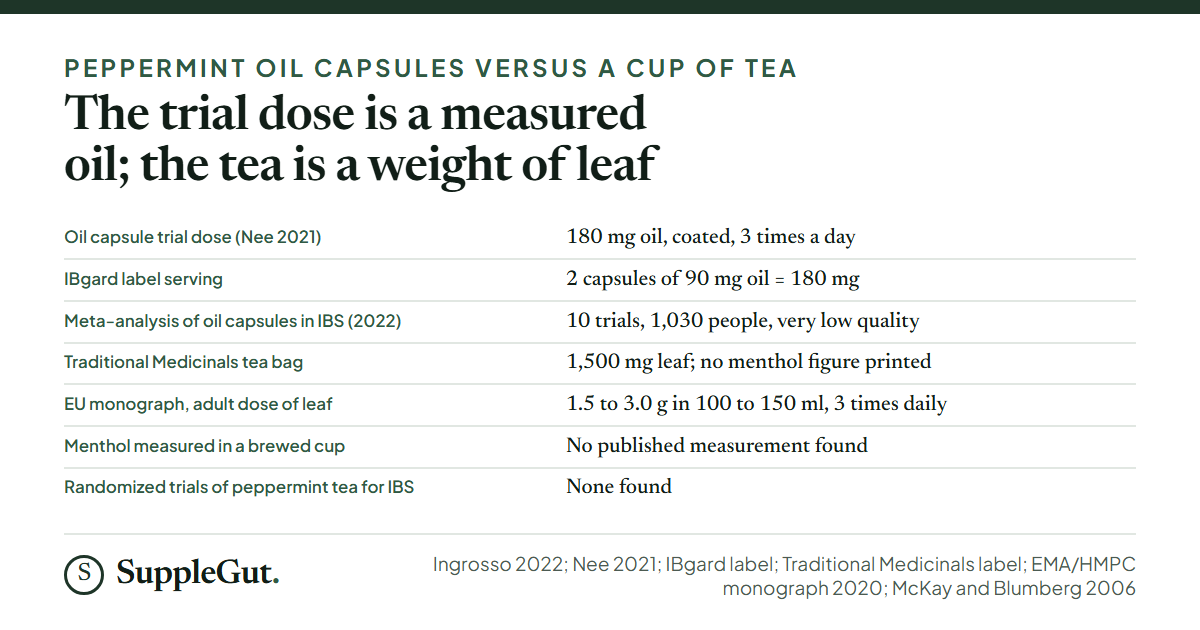
Peppermint is one of the few herbs with a meta-analyzed trial record in irritable bowel syndrome (IBS). The catch is the form: those trials gave peppermint oil in coated capsules, not leaf steeped in hot water. This page sets out what the capsule trials found, whether anyone has tested the tea, how much menthol a cup can carry, and where the reflux caution comes in.
What the capsule trials found
Three large analyses cover the peppermint oil trials in IBS, and they express the result in different ways. A 2022 meta-analysis pooled 10 randomized trials in 1,030 people. Peppermint oil beat placebo for global IBS symptoms (relative risk of not improving 0.65, 95% confidence interval 0.43 to 0.98, number needed to treat 4) and for abdominal pain (0.76, 0.62 to 0.93, number needed to treat 7). Side effects were more frequent on the oil (relative risk 1.57, 1.04 to 2.37), and the authors called the quality of evidence very low (Ingrosso et al., Alimentary Pharmacology & Therapeutics, 2022).
A 2019 meta-analysis of 12 trials in 835 patients reports the same direction as a chance of improving: a relative risk of 2.39 for global symptoms across seven trials and 1.78 for abdominal pain across six, with side effects not significantly more common (9.3% against 6.1%) (Alammar et al., BMC Complementary and Alternative Medicine, 2019). A network meta-analysis of 51 trials in 4,644 people ranked peppermint oil capsules first for global symptoms (relative risk of not improving 0.63, 0.48 to 0.83), while noting that only 13 of the 51 trials were at low risk of bias and that the findings carry considerable uncertainty (Black et al., The Lancet Gastroenterology & Hepatology, 2019). The 2021 American College of Gastroenterology guideline lists peppermint oil among the therapies it suggests for overall IBS symptoms and rates the certainty as low (Lacy et al., American Journal of Gastroenterology, 2021).
Individual trials vary. In 57 patients with IBS, two enteric-coated capsules twice a day for four weeks produced a more than 50% fall in total symptom score in 75% of the oil group against 38% on placebo (Cappello et al., Digestive and Liver Disease, 2007). In 72 adults, a small-intestine-release capsule cut the total IBS symptom score by 40% against 24.3% on placebo over four weeks (Cash et al., Digestive Diseases and Sciences, 2016). A six-week trial of enteric-coated oil at 180 mg three times a day, in people with moderate to severe IBS, found no difference from placebo; both groups improved by roughly 90 to 100 points on the IBS severity score (Nee et al., American Journal of Gastroenterology, 2021).
Why capsule results do not carry over to a cup
Two things separate the trial products from a tea bag: the amount and the place of release.
Amount. The trial products delivered a measured quantity of oil. The 2021 null trial used 180 mg per dose, three times a day. The IBgard label serving is two capsules of 90 mg, so 180 mg, up to three times a day. A Traditional Medicinals bag is labeled by leaf weight, 1,500 mg of dried peppermint leaf, with no figure for the oil or the menthol in it.
Place of release. The capsules in these trials were enteric-coated or built for sustained release in the small intestine (Khanna et al., Journal of Clinical Gastroenterology, 2014, a meta-analysis limited to enteric-coated capsules, and the Cash trial above). The coating keeps the oil out of the stomach. In tea the oil is in the liquid you swallow, so it is in the stomach first and passes through without a coating.
What oil does in the stomach has been measured in healthy people, and it is modest. In 13 volunteers, a single 182 mg peppermint oil capsule lowered pressure in the upper stomach while fasting, but during an infused nutrient drink, pressure and epigastric symptom scores did not differ from placebo (Papathanasopoulos et al., Neurogastroenterology & Motility, 2013). A 2024 single-blind trial in 32 healthy adults found that a peppermint oil and caraway oil combination left stomach pressure and emptying unchanged, while ratings of epigastric burning, bloating and fullness were lower than on placebo (Masuy et al., Neurogastroenterology & Motility, 2024). Both used oil, not tea, and neither enrolled people with IBS.
The IBS benefit in the meta-analyses belongs to the capsule: a set oil dose in a release-controlled shell. None of those trials used a drink, so none of their figures can be applied to a cup of tea.
Has anyone tested peppermint tea?
We searched PubMed for peppermint tea, Mentha piperita infusion and peppermint leaf, combined with IBS, dyspepsia, bloating, gas, colic, nausea and ileus. We found no randomized trial of peppermint tea for any gut symptom. That matches a review of the herb, which concluded that human studies of peppermint leaf are limited and that clinical trials of peppermint tea are absent (McKay and Blumberg, Phytotherapy Research, 2006). A French drug bulletin on herbal remedies for dyspepsia reached the same split: the randomized trials in IBS concern the essential oil, and the tea has no known adverse effects (Prescrire International, 2008).
The nearest studies are all different in kind:
- Peppermint tea in a trial, not for the gut. A single-blind placebo-controlled trial gave 200 mL of peppermint tea to 25 adults and measured cognition and cerebral blood flow (Netzler and Lovell, Human Psychopharmacology, 2025).
- Children. A systematic review of herbal medicines for gastrointestinal disorders in children found 14 trials in 1,927 participants. Peppermint oil had evidence in functional abdominal pain, and the tea evidence was for fennel in infantile colic, not peppermint (Anheyer et al., Pediatrics, 2017).
- After surgery. The peppermint study we found for postoperative nausea used an aromatherapy clip with a blend of peppermint, lavender, spearmint and ginger, in a before-and-after project in which 290 participants provided data, not a drink (Brennan et al., Holistic Nursing Practice, 2025).
- Dyspepsia. The peppermint trials in functional dyspepsia are of a peppermint oil and caraway oil combination, with five randomized trials in 580 patients (Madisch et al., Digestive Diseases, 2022).
How much menthol is in a cup
Nobody appears to have published the answer. We found no measurement of the oil or menthol in a brewed cup of peppermint tea, the Traditional Medicinals label prints none, and the EU herbal monograph states its dose as a weight of leaf, not as oil.
What can be compared is leaf weight. The European Medicines Agency monograph on peppermint leaf gives an adult single dose of 1.5 to 3.0 g of leaf in 100 to 150 ml of boiling water as an infusion, 3 times daily (EMA/HMPC/572705/2014). The Traditional Medicinals bag holds 1.5 g of leaf, the low end of that single dose, brewed in a larger 8 fl oz (about 240 ml) cup, and the label allows 3 to 4 cups a day. Three bags a day is 4.5 g of leaf; the monograph's schedule works out to 4.5 to 9.0 g a day.
That comparison tells you how the bag sits against the traditional dose, not how much menthol you drink. The monograph is also a traditional-use document: it records long-standing use for dyspepsia and flatulence and says the product is used exclusively on that basis. It does not cite trials of the tea, and it does not list IBS as an indication.
A capsule dose is a number printed on the label. A tea dose is a weight of dried leaf, and the oil that reaches the water has not been published for this product. Any claim that a cup matches a capsule has no measurement behind it.
Reflux, gallstones and other cautions
The reflux caution is the one the sources agree on. The EU monograph says that patients with gastroesophageal reflux should avoid peppermint leaf preparations because heartburn may increase, lists worsening reflux as an undesirable effect with unknown frequency, and advises caution in people with gallstones or other biliary disorders. It records no interactions with other medicines and no reported overdose.
The capsule literature shows the same signal. A 2014 meta-analysis of nine studies in 726 patients found that heartburn was the most commonly reported adverse event on peppermint oil, though the events were mild and transient (Khanna et al., above). The 2022 meta-analysis counted reflux among its safety outcomes and found adverse events more frequent on the oil (Ingrosso et al., above). A review of the tea noted that caution is urged for peppermint oil in people with reflux, hiatal hernia or kidney stones, and that adverse reactions to the tea had not been reported (McKay and Blumberg, above).
The mechanism is less settled in the data we read. In a small manometry study of 8 patients with esophageal spasm, a solution of five drops of peppermint oil did not change lower esophageal sphincter pressure but eliminated simultaneous contractions in the esophageal body (Pimentel et al., Journal of Clinical Gastroenterology, 2001). The monograph's advice rests on the heartburn reports, and the Traditional Medicinals label asks anyone with gallstones, bile duct obstruction, a hiatal hernia or acid reflux to consult a practitioner before use.
Steeping, timing and what to expect
The Traditional Medicinals directions are one bag in 8 fl oz of freshly boiled water, covered, steeped for 10 to 15 minutes, with the bag squeezed and removed, and 3 to 4 cups a day, especially after meals. The monograph's pattern is similar, three infusions a day, and says to see a doctor if symptoms persist longer than 2 weeks or worsen during use.
Two timing points come from other sources. The capsule trials and the IBgard label work from a different schedule: IBgard directs taking its capsules 30 to 90 minutes before a meal, and its guide explains why. A post-meal cup is therefore a different pattern from the trial pattern. Separately, a radio-iron study in adult volunteers found that peppermint tea cut non-heme iron absorption from a bread meal by 84% (Hurrell et al., British Journal of Nutrition, 1999). People who are watching their iron may want to keep the cup away from iron-rich meals.
The tea contains no caffeine. It has no trial-measured onset or duration for gut symptoms, so there is no figure for how soon a cup should act or how many days make a fair test.
Pregnancy, children and other groups
The EU monograph says safety during pregnancy and lactation has not been established and does not advise use in either. It does not advise use in children under 4 because of a lack of data, and it gives a lower leaf dose of 1.0 to 2.0 g per cup for ages 4 to 11 and adolescents, three times daily. Its one contraindication is a known sensitivity to peppermint leaf or menthol. The Traditional Medicinals label asks people who are pregnant or breastfeeding to consult a practitioner.
The monograph's listed indication is dyspepsia and flatulence. IBS is a diagnosis made by a clinician, and the tea has no trial in it. Symptoms that worsen, or last past 2 weeks of use, are the monograph's cue to see a doctor.
Tea, coated capsules and IBgard-type products side by side
| Form | Amount stated | Release | IBS evidence |
|---|---|---|---|
| Trial capsule (Nee 2021) | 180 mg oil per dose, 3 times a day | Enteric-coated | No difference from placebo at 6 weeks |
| IBgard | Two 90 mg capsules per serving (180 mg) | Triple-coated beads for the small intestine | Four-week trial of the capsule, 72 adults |
| Traditional Medicinals peppermint tea | 1,500 mg leaf per bag; no oil or menthol figure | Dissolved in the cup, swallowed | No trial of the tea found |
The IBgard guide covers the capsule's trial, the label directions and the reviews. The wholier guide covers a five-oil capsule that has no trial of its own. For another herb brewed as a tea, the ginger tea page has its label, and the bloating and gas guide starts from the symptom.
Traditional Medicinals Organic Peppermint Tea on the label
The Supplement Facts panel lists one ingredient, 1,500 mg of organic peppermint leaf per bag, with a serving of one bag made into 8 fl oz. The brand states Non-GMO Project verification, kosher certification and compostable bags. It prints no menthol or oil content and publishes no third-party testing certificate. Amazon shows 4.7 out of 5 from 3,922 ratings on the 16-bag listing, and reviewers praise a settled stomach after a heavy meal and a clean peppermint flavor that is not overpowering. The full label read is on the product page, and the capsule most often compared with it is IBgard. If the question is which product fits a particular symptom pattern, the quiz starts from your answers.
The catalog entries behind this guide
Common questions
Is there any evidence that peppermint tea helps IBS?
Not directly. The IBS evidence is for peppermint oil in coated capsules: 10 trials in 1,030 people in a 2022 meta-analysis, rated very low quality. A 2006 review of peppermint tea noted that clinical trials of the tea were absent, and our PubMed searches found no randomized trial of peppermint tea for IBS, dyspepsia, bloating or gas.
Will a cup of peppermint tea ease bloating or trapped gas?
No trial has measured it. The EU herbal monograph lists peppermint leaf tea for symptomatic relief of dyspepsia and flatulence, and says that listing rests on long-standing use rather than trial proof. Reviewers of the Traditional Medicinals bag describe a settled stomach after a heavy meal, which is a reported experience, not a measured result.
Why would peppermint oil capsules work when the tea has no trial?
The capsule trials gave a measured dose of oil, such as 180 mg three times a day, in coatings built to open in the small intestine. A cup is a liquid swallowed into the stomach, from a bag holding 1,500 mg of leaf, and no published measurement of the menthol in a brewed cup was found. The result of one product does not transfer to the other.
How strong should peppermint tea be, and how long should it steep?
The Traditional Medicinals label directs one bag in 8 fl oz of freshly boiled water, covered, for 10 to 15 minutes, up to 3 to 4 cups a day. The EU monograph's adult dose is 1.5 to 3.0 g of leaf in 100 to 150 ml of boiling water, 3 times daily, and says to see a doctor if symptoms last longer than 2 weeks.
Can peppermint tea cause or worsen heartburn?
The EU monograph says reflux may worsen and heartburn may increase, and advises people with gastroesophageal reflux to avoid peppermint leaf preparations. A 2014 meta-analysis of oil capsules named heartburn as the most commonly reported adverse event. The Traditional Medicinals label asks people with acid reflux or a hiatal hernia to consult a practitioner first.
Is peppermint tea safe during pregnancy or for children?
The EU monograph says safety in pregnancy and breastfeeding has not been established and does not advise use. It also does not advise use under age 4, and gives a lower leaf dose of 1.0 to 2.0 g per cup for ages 4 to 11 and adolescents. The Traditional Medicinals label asks pregnant or breastfeeding users to consult a practitioner.
How does peppermint tea compare with IBgard or other peppermint capsules?
IBgard has a four-week trial of the finished capsule in 72 adults, and its label serving is two 90 mg capsules of oil. Peppermint tea has no trial of its own and prints no oil amount. The IBgard guide and the wholier guide set out the capsule evidence.
Does peppermint tea contain caffeine?
No. Peppermint leaf is not from the tea plant, and the Traditional Medicinals listing is labeled caffeine free. The only ingredient on its Supplement Facts panel is 1,500 mg of organic peppermint leaf per bag.
Sources
- Ingrosso MR, Ianiro G, Nee J, et al. “Systematic review and meta-analysis: efficacy of peppermint oil in irritable bowel syndrome.” Alimentary Pharmacology & Therapeutics, 2022;56(6):932–941. PubMed 35942669
- Alammar N, Wang L, Saberi B, et al. “The impact of peppermint oil on the irritable bowel syndrome: a meta-analysis of the pooled clinical data.” BMC Complementary and Alternative Medicine, 2019;19(1):21. PubMed 30654773
- Black CJ, Yuan Y, Selinger CP, et al. “Efficacy of soluble fibre, antispasmodic drugs, and gut-brain neuromodulators in irritable bowel syndrome: a systematic review and network meta-analysis.” The Lancet Gastroenterology & Hepatology, 2019;5(2):117–131. PubMed 31859183
- Khanna R, MacDonald JK, Levesque BG. “Peppermint oil for the treatment of irritable bowel syndrome: a systematic review and meta-analysis.” Journal of Clinical Gastroenterology, 2014;48(6):505–512. PubMed 24100754
- Lacy BE, Pimentel M, Brenner DM, et al. “ACG Clinical Guideline: Management of Irritable Bowel Syndrome.” American Journal of Gastroenterology, 2021;116(1):17–44. PubMed 33315591
- Cappello G, Spezzaferro M, Grossi L, et al. “Peppermint oil (Mintoil) in the treatment of irritable bowel syndrome: a prospective double blind placebo-controlled randomized trial.” Digestive and Liver Disease, 2007;39(6):530–536. PubMed 17420159
- Cash BD, Epstein MS, Shah SM. “A Novel Delivery System of Peppermint Oil Is an Effective Therapy for Irritable Bowel Syndrome Symptoms.” Digestive Diseases and Sciences, 2016;61(2):560–571. PubMed 26319955
- Nee J, Ballou S, Kelley JM, et al. “Peppermint Oil Treatment for Irritable Bowel Syndrome: A Randomized Placebo-Controlled Trial.” American Journal of Gastroenterology, 2021;116(11):2279–2285. PubMed 34319275
- Papathanasopoulos A, Rotondo A, Janssen P, et al. “Effect of acute peppermint oil administration on gastric sensorimotor function and nutrient tolerance in health.” Neurogastroenterology & Motility, 2013;25(4):e263–e271. PubMed 23489975
- Masuy I, Verbeure W, Ruilova Sosoranga E, et al. “The combination of L-menthol and caraway oil does not affect gastric function but increases hunger in healthy subjects.” Neurogastroenterology & Motility, 2024;36(10):e14880. PubMed 39056471
- McKay DL, Blumberg JB. “A review of the bioactivity and potential health benefits of peppermint tea (Mentha piperita L.).” Phytotherapy Research, 2006;20(8):619–633. PubMed 16767798
- “Herbal remedies for dyspepsia: peppermint seems effective.” Prescrire International, 2008;17(95):121–123. PubMed 18630390
- Netzler L, Lovell B. “A Randomized Placebo-Controlled Clinical Trial Exploring the Short-Term Cognitive and Cerebrovascular Effects of Consuming Peppermint Tea: A Mediation Study.” Human Psychopharmacology, 2025;40(3):e70005. PubMed 40189738
- Anheyer D, Frawley J, Koch AK, et al. “Herbal Medicines for Gastrointestinal Disorders in Children and Adolescents: A Systematic Review.” Pediatrics, 2017;139(6):e20170062. PubMed 28562281
- Brennan JA, Brennan R, Bojka S, et al. “Impact of an Aromatherapy Program on Managing Surgical Patients’ Perceived Nausea and Vomiting.” Holistic Nursing Practice, 2025. PubMed 40971728
- Madisch A, Frieling T, Zimmermann A, et al. “Menthacarin, a Proprietary Peppermint Oil and Caraway Oil Combination, Improves Multiple Complaints in Patients with Functional Gastrointestinal Disorders: A Systematic Review and Meta-Analysis.” Digestive Diseases, 2022;41(3):522–532. PubMed 36502789
- Pimentel M, Bonorris GG, Chow EJ, Lin HC. “Peppermint oil improves the manometric findings in diffuse esophageal spasm.” Journal of Clinical Gastroenterology, 2001;33(1):27–31. PubMed 11418786
- Hurrell RF, Reddy M, Cook JD. “Inhibition of non-haem iron absorption in man by polyphenolic-containing beverages.” British Journal of Nutrition, 1999;81(4):289–295. PubMed 10999016
- European Medicines Agency, Committee on Herbal Medicinal Products. European Union herbal monograph on Mentha x piperita L., folium, Final, Revision 1. EMA/HMPC/572705/2014, 2020. ema.europa.eu
- Traditional Medicinals Organic Peppermint tea: Supplement Facts, steeping directions and warnings as listed by a retailer. vitacost.com
- Amazon listing for Traditional Medicinals Organic Peppermint tea (ASIN B008AI4FE6): rating and review count. amazon.com
Which product is right for you?
This page explains how the products work. The quiz does the matching: it takes your symptoms, routine and preferences and names one product.
Take the quiz →