
Guide
Does Double Wood Akkermansia work? A named strain with no human trial, and a label that does not say live or pasteurized
Quick answer
Does Double Wood Akkermansia work? No trial of this product exists, and its strain, AH39, has only cell and mouse work behind it. The human trials of Akkermansia used other strains, mostly pasteurized MucT at 10 to 30 billion cells a day, and measured metabolic outcomes: a 32-person trial improved insulin sensitivity about 29%, while a 142-person trial missed its main endpoint. The label gives 5 billion TFU and does not say live or pasteurized. Amazon shows 4.6 from 363 ratings at $0.25 a day.
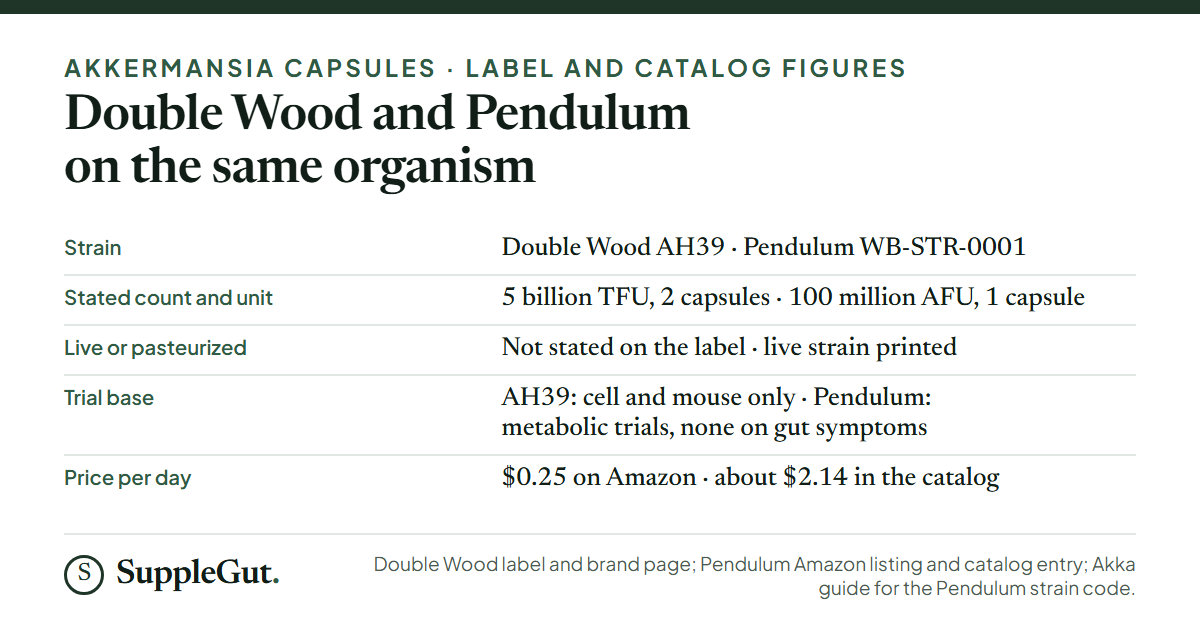
Double Wood Akkermansia is a 120-capsule bottle of one organism, Akkermansia muciniphila, taken as two capsules a day. What sets it apart from the Akkermansia capsule next to it is a strain code on the label and a price of $0.25 a day on Amazon; what it leaves open is whether the cells are alive. This page covers the label, the trials of the organism, the reviews and the refund terms.
What Double Wood Akkermansia is, and what it is not
The Supplement Facts panel lists one active: Akkermansia, 50 mg per two-capsule serving, with Akkermansia muciniphila AH39 at 5 billion TFU. There are 60 servings in the 120-capsule bottle. The other ingredients are rice flour, hypromellose (the capsule) and maltodextrin. The label claims are gluten free, non-GMO and third-party tested; it makes no allergen statement beyond gluten.
It is not a symptom product on its face. The brand’s lead claim, repeated in the Amazon titles, is GLP-1 support, a hormone involved in appetite and blood sugar. The bloating and digestion language comes from Amazon’s review summary, not the label.
Live or pasteurized: the label does not say
The label uses the unit TFU, never CFU, and never the words live or pasteurized. The pages around it disagree. The brand’s product page describes “live probiotics” and says third-party testing shows all of the units are living. The Amazon single-bottle title says Postbiotic, and the three-pack title says “Probiotic and Postbiotic”. No page we read uses the word pasteurized for this product.
The distinction matters because it changes what the product is. The consensus definition of a postbiotic is a preparation of inanimate microorganisms that confers a health benefit (Salminen et al., 2021); a live product would not fit it, and a pasteurized one would. It also changes which trials apply, since most of the human trials below used pasteurized cells. We could not settle the question from the label or the brand’s pages. For how TFU, CFU and AFU differ, see the CFU guide and the unit explanation in the Akka guide.
Five billion TFU, and the brand’s 50 billion CFU
The brand states its product yields 50 billion CFU per gram, which it says proves the whole 5 billion TFU is alive. The numbers do not match. A 50 mg serving holding 5 billion TFU is 100 billion TFU per gram, and the brand’s CFU figure is half of that: 2.5 billion CFU per serving, if it applies to this ingredient. A visitor to the brand page asks whether the 5 billion cells are all active, and the posted reply gives only an email address. The brand does not say how the TFU is counted or whether it holds at expiry.
What the testing shows
The brand page names a laboratory, Canyonside Labs in Twin Falls, Idaho, and prints results for one lot: potency of 51.9 mg per serving against a 50 mg specification, heavy metals (arsenic at 0.208 ppm) and microbial counts within limits. The potency row is in milligrams of Akkermansia, not cells; no TFU, CFU or viability result appears. A certificate PDF is linked; we could not extract its text.
The strain AH39 and the trials
AH39 is a strain designation, a code for one specific isolate. The only paper we found on it used a lymph node cell model and mice (Feng et al., 2023). We found no human trial of AH39 and no trial of the finished product. Akka carries the same strain code and describes it as pasteurized.
The human trials of Akkermansia muciniphila that do exist used other strains, mostly pasteurized MucT, and measured metabolic outcomes:
| Trial | People and length | Dose | Result |
|---|---|---|---|
| Depommier 2019 | 40 enrolled, 32 finished; 3 months | 10 billion bacteria a day, pasteurized or live MucT | Pasteurized vs placebo: insulin sensitivity up 28.6%, cholesterol down 8.7%; weight change not significant |
| Suenaert 2026 | 142 adults with metabolic syndrome; 4 months | 30 billion pasteurized cells a day | Main endpoint, insulin sensitivity, did not differ from placebo |
| Mount 2026 | 90 adults after a low-energy diet; 24 weeks | Pasteurized MucT daily | Weight regain 1.2 kg vs 3.2 kg on placebo |
| Kang 2024 | 100 adults aged 60 and over; 12 weeks | 10 billion pasteurized cells a day, strain HB05 | Leg muscle torque improved vs placebo |
| Zhang 2025 | 58 adults with type 2 diabetes; 12 weeks | AKK-WST01 | No significant difference between groups in weight or HbA1c |
In the 2019 pilot, the pasteurized arm, not the live arm, was the one reported to improve against placebo, and only 9 people finished the live arm, so the comparison rests on small groups. The label’s 5 billion is half the 10 billion used in two of the trials and one sixth of the 30 billion in the largest, although those papers count bacteria or cells, a different method from TFU, so the comparison is approximate. We found no trial of Akkermansia for bloating, IBS, constipation or any gut symptom.
The GLP-1 and appetite framing
The brand’s reasoning runs from the organism’s biology: Akkermansia lives in the gut’s mucus layer and has been linked to GLP-1 release. That is a mechanism, not a result for this capsule. The one trial figure that touches GLP-1 is a higher GLP-1 response than placebo in exploratory subgroups of the 142-person MucT trial, which missed its main endpoint overall.
How to take it
The label says to take one serving, two capsules, a day with or without food, and not to exceed six capsules a day. The trials above ran 12 weeks to six months.
Side effects and who should not take it
The bottle’s warning says to consult a physician before use and not to use it if pregnant, nursing or under 18. It says to stop if any adverse reaction occurs. Amazon’s safety text lists upset stomach, headaches, nausea and possible allergies, and says to get approval from a physician if taking other medications. The 2019 pilot reported the supplement as safe and well tolerated, and the 2026 weight-regain trial reported no related serious adverse events. In Amazon’s summary of review text, 5 of 28 digestive-effect mentions are negative, and one reviewer reports a bloated stomach within a day.
What the reviews say
Amazon shows 4.6 from 363 ratings (78% five-star, 6% one or two stars), shared by the single bottle and the three-pack. Amazon’s review summary counts 23 of 28 digestive-effect and 25 of 28 effectiveness mentions as positive. Reviewers praise less bloating and fewer cravings, a small capsule and the price; the complaints are little or slow effect, and bloating in a few. The brand’s own widget shows 4.67 from 3 reviews. Trustpilot, about the company across all its products and on a claimed profile, shows 3.2 from 189 reviews with 25% one-star, driven by service, return shipping and subscription complaints.
Price, refund and billing terms
| Where | Price | Per day |
|---|---|---|
| Amazon, one bottle (60 servings) | $14.95 | $0.25 |
| Amazon, pack of 3 (180 servings) | $44.85 | $0.25 |
| Brand site, one bottle | $24.95, backordered when read | $0.42 |
| Brand site, double pack | $47.41 | $0.40 |
| Brand site, triple pack | $67.37 | $0.37 |
The same bottle costs $10.00 more on the brand’s site than on Amazon,. Pendulum’s live capsule is about $2.14 a day in the catalog, roughly 8.6 times the Amazon price here; the strain and unit differ (Pendulum Akkermansia prints 100 million AFU on Amazon).
The brand’s refund policy gives a money-back guarantee on the first bottle of a product within 30 days. For multipacks you keep the first bottle and can return the unopened rest. The customer pays return shipping, and subscription orders not canceled or skipped before processing are not refundable. For Amazon purchases the policy says to contact that seller. Trustpilot reviewers of the company report unwanted auto-refill charges, a missing order and refused refunds, which the brand disputes; these are unverified accounts about the company, not this product.
Who Double Wood Akkermansia is for
- Someone who wants Akkermansia for the metabolic reasoning behind it and accepts that the strain and the form are unconfirmed.
- A buyer choosing by price per day who will order from Amazon and check the seller’s return terms there.
- A person who is not pregnant, nursing or under 18 and has checked with a physician.
If bloating or loose stools are the main complaint, no Akkermansia trial addressed them. The quiz starts from symptoms, and a once-daily single-strain probiotic such as Culturelle Digestive Daily sits at about $0.75 a day in the catalog.
The products in this catalog
Common questions
Does Double Wood Akkermansia work?
No trial of this product was found, and its strain, AH39, has only cell and mouse work behind it. Human trials of pasteurized Akkermansia muciniphila MucT at 10 to 30 billion cells a day were mixed: insulin sensitivity improved in a 32-person trial over three months, but a 142-person trial missed its main endpoint. No trial tested Akkermansia for bloating or other gut symptoms.
Is Double Wood Akkermansia live or pasteurized?
The label does not say. The brand’s product page calls it a live probiotic and says all 5 billion TFU are alive, while the Amazon single-bottle title calls it a postbiotic. The brand’s 50 billion CFU per gram works out to 2.5 billion CFU per 50 mg serving, half the 5 billion TFU.
What does TFU mean, and what is AH39?
TFU is total fluorescent units, and the brand does not say on the label which method counts them; CFU and AFU count live cells, so the units are not interchangeable. AH39 is the strain code printed on the label. The only paper we found on it studied immune cells and mice, and the human trials used other strains such as MucT. The Akka guide covers another product with the same strain code.
Does Double Wood Akkermansia raise GLP-1 or help with appetite?
That is the brand’s reasoning from the organism’s biology, not a result for this capsule. A higher GLP-1 response than placebo appeared in exploratory subgroups of a 142-person MucT trial that missed its main endpoint. Reviewers mention steadier appetite and fewer cravings, and a 90-person trial of pasteurized MucT found less weight regained after a diet, 1.2 kg against 3.2 kg.
Is Double Wood Akkermansia safe, and what are the side effects?
The bottle says to consult a physician before use and not to use it if you are pregnant, nursing or under 18. Amazon’s safety text lists upset stomach, headaches and nausea. The 2019 pilot reported the supplement as safe and well tolerated, and on Amazon 5 of 28 digestive-effect mentions are negative, including one reviewer who reports bloating.
How much does Double Wood Akkermansia cost, and how does it compare with Pendulum?
A 120-capsule bottle is 60 servings: $14.95 on Amazon ($0.25 a day) and $24.95 on the brand’s site ($0.42 a day, backordered when read). Pendulum is live Akkermansia at about $2.14 a day in the catalog. The units and strains differ, this label printing TFU and Pendulum’s Amazon listing printing AFU, and neither has a trial on gut symptoms. See Pendulum Akkermansia.
What is the Double Wood refund policy, and are there billing complaints?
The brand site gives a money-back guarantee on the first bottle of a product within 30 days, with the customer paying return shipping; subscription orders not canceled or skipped before processing are not refundable. Its Trustpilot page (3.2 from 189 reviews) includes complaints about unwanted auto-refill, a missing delivery and a refused refund, which the brand disputes. Amazon purchases follow Amazon’s terms for that seller.
Sources
- Depommier C, Everard A, Druart C, et al. "Supplementation with Akkermansia muciniphila in overweight and obese human volunteers: a proof-of-concept exploratory study." Nature Medicine, 2019;25(7):1096–1103. PMID 31263284. pubmed.ncbi.nlm.nih.gov/31263284
- Suenaert P, et al. Pasteurized Akkermansia muciniphila MucT in 142 adults with metabolic syndrome. Gut Microbes, 2026. PMID 42343233. pubmed.ncbi.nlm.nih.gov/42343233
- Mount S, et al. Pasteurized Akkermansia muciniphila MucT for weight loss maintenance in 90 adults. Nature Medicine, 2026. PMID 42120725. pubmed.ncbi.nlm.nih.gov/42120725
- Kang CH, et al. Pasteurized Akkermansia muciniphila HB05 in 100 adults aged 60 and over. Nutrients, 2024. PMID 39683431. pubmed.ncbi.nlm.nih.gov/39683431
- Zhang Y, et al. Akkermansia muciniphila AKK-WST01 in 58 adults with type 2 diabetes. Cell Metabolism, 2025. PMID 39879980. pubmed.ncbi.nlm.nih.gov/39879980
- Feng S, et al. Akkermansia muciniphila AH39 in a mesenteric lymph node cell model and mice. Journal of Genetics and Genomics, 2023. PMID 36356718. pubmed.ncbi.nlm.nih.gov/36356718
- Salminen S, et al. "The International Scientific Association of Probiotics and Prebiotics (ISAPP) consensus statement on the definition and scope of postbiotics." Nature Reviews Gastroenterology & Hepatology, 2021. PMID 33948025. pubmed.ncbi.nlm.nih.gov/33948025
- Brand page: label, directions, claims, lot results, prices and refund policy. doublewoodsupplements.com; refund policy at doublewoodsupplements.com/policies/refund-policy
- Amazon listings: single bottle amazon.com/dp/B0DP37Q665, pack of 3 amazon.com/dp/B0GHPCFY7W, Pendulum amazon.com/dp/B0938T6XHR; Trustpilot, doublewoodsupplements.com
Not sure which product fits your situation?
This guide covers the mechanics. The quiz takes your specific symptoms, routine and preferences and matches you to one product from the catalog.
Take the quiz →