
Guide
Does Akka work? Pasteurized Akkermansia, the botanical doses and the two brand sites
Quick answer
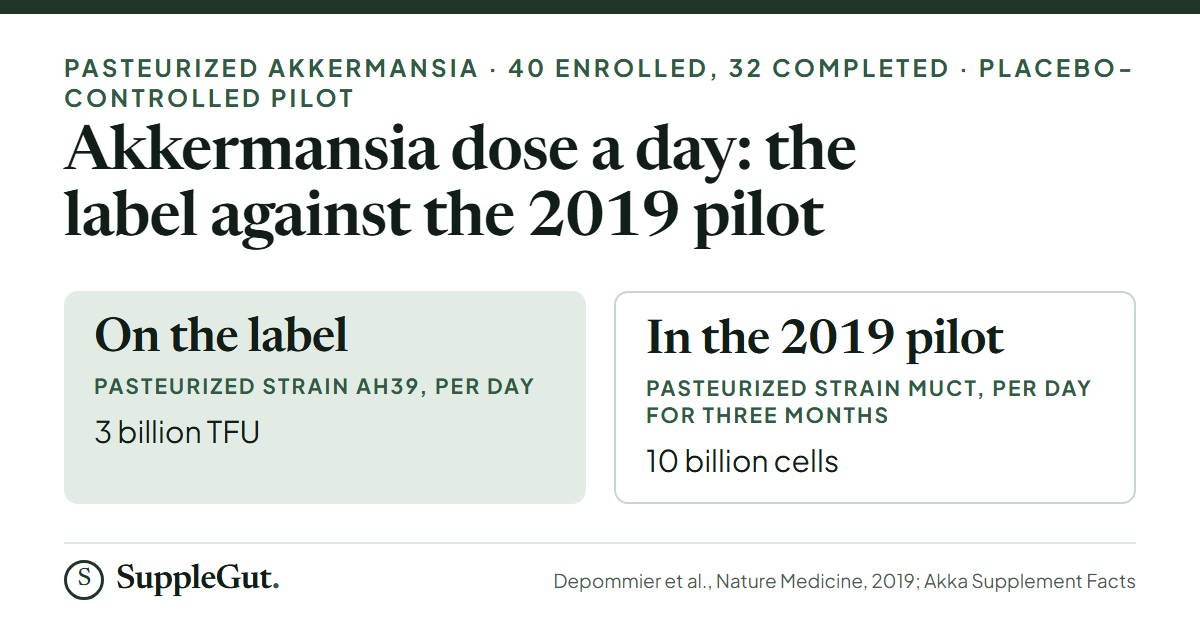
Does Akka work? No trial of Akka itself exists. Its Akkermansia is pasteurized strain AH39 at 3 billion TFU; the 2019 pilot the brand cites gave 10 billion pasteurized cells of a different strain (MucT) to 32 adults for three months, and a 2026 trial of 142 adults at 30 billion cells missed its main endpoint. The artichoke and quercetin amounts are half the doses trialed in fatty liver. Amazon shows 4.4 from 1,107 ratings and Trustpilot 2.9 from 42.
Akka is a 60-capsule bottle from Enclave BioActives, sold for liver and digestive support. Each two-capsule serving pairs pasteurized Akkermansia muciniphila, a heat-treated gut bacterium, with milk thistle, artichoke leaf, quercetin and resveratrol. What sets it apart from the Akkermansia capsule next to it is that every active has its own printed amount and the bacteria are not alive. This page covers the label, the trials at their doses, and the two brand sites that sell it at different prices.
What Akka is, and what the label says
We read the Supplement Facts in the GNC listing, which Amazon’s other ingredients match; the brand’s own pages show the panel as an image. Serving size is two capsules, 30 servings per bottle.
| Active | Per serving |
|---|---|
| Milk thistle extract, 80% silymarin | 400 mg (about 320 mg silymarin) |
| Artichoke leaf extract | 300 mg |
| Quercetin dihydrate | 250 mg |
| Resveratrol (Polygonum cuspidatum root) | 150 mg |
| Akkermansia muciniphila AH39 | 30 mg (3 billion TFU) |
There is no proprietary blend; the actives total 1,130 mg. The label states gluten free, dairy free, soy free and non-GMO; vegan is not stated. The brand says Akka is made in an FDA-registered, GMP-following facility with testing for identity, purity and potency; we found no laboratory, certificate or manufacturer name.
Pasteurized or live, and what TFU means
The brand’s pages say “Preserved Pasteurized Akkermansia”, non-living cells; the panel text we read does not. The unit signals it. CFU (colony-forming units) and AFU (active fluorescent units) count live cells. TFU (total fluorescent units) counts live and dead particles and is the unit used for heat-treated cells, so a TFU count cannot be read against a CFU or AFU count.
AH39 is a supplier strain, listed at 1.0 x 10¹¹ TFU per gram, which makes 30 mg equal to 3 billion (our arithmetic). The European Food Safety Authority found 3.4 x 10¹⁰ pasteurized cells a day safe for healthy adults; Akka is under that. Live Pendulum Akkermansia is strain WB-STR-0001 at 100 million AFU in one capsule with inulin. Akka’s number is 30 times larger, but the forms, strains and units differ. At Amazon and catalog prices, Akka is about $2.13 a day and Pendulum $2.17.
The Akkermansia trials
No trial of Akka, or of its five ingredients together, exists; we searched PubMed and ClinicalTrials.gov. The brand’s own text says “Much of the liver-specific evidence comes from preclinical research”. The study it cites is a 2019 Brussels pilot: 40 adults with overweight, insulin resistance and metabolic syndrome enrolled, 32 finished, across placebo, live and pasteurized arms. The dose was 10 billion bacteria a day for three months of strain MucT (Depommier et al., 2019). Against placebo, the pasteurized group’s insulin sensitivity rose 28.6% (P=0.002), total cholesterol fell 8.7% and the liver enzyme gamma-GT fell about 24% (P=0.009). Weight fell 2.27 kg, not significant (P=0.091), and ALT did not change. The live form did not move these markers. The authors call it exploratory.
Two 2026 MucT trials are not on the brand’s pages. In 142 adults with metabolic syndrome, 30 billion cells a day for four months did not beat placebo on the primary endpoint, insulin sensitivity (Suenaert et al., 2026). In 90 adults after a low-energy diet, less weight was regained over 24 weeks, 1.2 kg against 3.2 kg (Mount et al., 2026).
Akka’s 3 billion TFU is about 30% of the 2019 dose and a tenth of the 2026 dose, in a different strain; we found no peer-reviewed human trial of AH39. Every trial enrolled people with metabolic or liver disease, and we found no randomized trial of Akkermansia on liver fat. The brand’s liver case rests on animals, such as a rat study with quercetin (Juárez-Fernández et al., 2021).
The botanicals against the trial doses
| Ingredient | Label | Trials in fatty liver |
|---|---|---|
| Artichoke leaf | 300 mg | 600 mg a day, 2 months, 100 adults: ALT, AST and liver size lower than placebo |
| Quercetin | 250 mg | 500 mg a day, 12 weeks, 41 adults: liver fat 11.5% to 9.6%, tracking a 1.5 kg weight loss |
| Resveratrol | 150 mg | 500 to 3,000 mg a day, 7 trials, 302 adults: no effect except a rise in ALT |
| Silymarin | about 320 mg | 26 trials, 2,375 adults: lower ALT and AST, better steatosis grade (OR 3.25, 1.80 to 5.87) |
Sources: Panahi et al., 2018 with a five-trial meta-analysis; Li et al., 2024; Jakubczyk et al., 2020; Li et al., 2024. The label is half the trial dose for artichoke and quercetin and 5 to 30% of the resveratrol range. Silymarin’s authors say the effects need confirming, a 41-trial analysis found benefit “specifically with long-term and high-dose” use (Mohammadi et al., 2024), and NCCIH says high-quality evidence is lacking.
How to take Akka
Two capsules daily with 6 to 8 oz of water, per the brand page. Amazon says after meals; enclavebioactives.com says preferably before. The brand states the capsules are enteric coated. The 2019 pilot ran three months.
Side effects and who should not take it
The label says pregnant or nursing mothers, anyone under 18 and anyone with a medical condition should consult a physician; the brand page adds anyone taking medication.
- Artichoke carries a bile duct obstruction contraindication and a gallstone caution in the drug references we read. The brand’s pages describe bile-flow benefits and mention neither. One Trustpilot reviewer reports right upper abdominal pain after three to four months; the cause is unknown.
- Milk thistle and artichoke are both daisy-family plants; NCCIH says milk thistle may cause reactions in people allergic to ragweed and relatives, and lists bloating, nausea and gas.
- Quercetin has possible interactions with CYP3A4 substrate drugs, losartan and tamoxifen; resveratrol may add to bleeding risk with warfarin.
What the reviews say
Amazon shows 4.4 from 1,107 ratings (71% five-star) on a listing sold by Enclave itself. enclavebioactives.com shows 4.7 from 272 reviews on its own widget; a lower widget says 212. Trustpilot for tryakka.com shows 2.9 from 42 (33% one-star), and for the parent store, covering all its products, 1.9 with 84% one-star among 31 recent reviews. Reviewers praise less bloating, steadier energy and capsules with no taste. They report no noticeable effect or weight change, the price, and billing: duplicate or extra orders, charges after cancellation, slow refunds and return-shipping costs of $23.40 to $40.
Two brand sites, two sets of prices
| Where | One bottle | Packs and subscriptions |
|---|---|---|
| tryakka.com | $69 list | Subscription pre-selected: $50 monthly, $42 a bottle every 90 days, $33 every 180 days |
| enclavebioactives.com | $59 plus $4.95 shipping | One time $49 a bottle for 3, $39 for 6; subscription 15% off |
| Amazon | $64.00 | Non-returnable |
| GNC | $69.99 | 10% off on subscription |
A copy block lower on tryakka.com says “pay just $49 per bottle”, “50% off the regular retail price”, which implies about $98, not the $69 list; we could not read that page’s one-time toggle. Per day: $1.97 for one bottle on enclavebioactives.com, $1.67 on a one-bottle subscription, $1.10 on the six-bottle subscription at tryakka.com.
Both policy pages state a 90-day money-back guarantee. A single bottle is refunded without return after a form, once per product per year; multi-packs need unopened bottles returned, and shipping and handling fees are deducted. Company replies on Trustpilot cite 30 days in some cases and 90 in others. We found no separate subscription-terms page for tryakka.com.
Who makes Akka
The footer reads Enclave BioActives; the terms name Konscious LLC and related companies in San Juan, Puerto Rico. The same company sells Emma Relief. The brand credits Dr. Gina Sam, a gastroenterologist, with helping formulate Akka. The CMS NPI Registry lists a Gina Sam, MD, in gastroenterology with a New York license; we could not confirm the Mount Sinai role the page describes, and the brand does not say whether she is paid.
Who Akka is for
- Someone who wants a pasteurized Akkermansia and knows the trial strain and dose differ from this label.
- A person without gallstones, bile duct problems, daisy-family allergy or blood-thinning medication.
- A buyer who will check the order total and the refund terms on the site where they order.
For a live Akkermansia, see Pendulum; for a single-ingredient metabolic option, Thorne Berberine. If bloating is the concern, the bloating guide starts from the cause.
The products in this catalog
Common questions
Does Akka work?
No trial of Akka itself exists. The 2019 pilot the brand cites gave 10 billion pasteurized cells a day of a different strain (MucT) to 32 adults with metabolic syndrome for three months, and a 2026 trial of 142 adults at 30 billion cells did not meet its main endpoint. Akka has 3 billion TFU of strain AH39, and the liver claims rest mainly on animal studies. Amazon buyers rate it 4.4 from 1,107 ratings; Trustpilot shows 2.9 from 42 reviews.
Is Akka pasteurized or live, and what does TFU mean?
Pasteurized: the brand’s pages call it “Preserved Pasteurized Akkermansia”, non-living cells. TFU is total fluorescent units, which counts live and dead particles and is the unit used for heat-treated cells. CFU and AFU count live cells, so Akka’s 3 billion TFU cannot be compared with a live product’s count.
Is Akka safe, and what are the side effects?
The label says to consult a physician if pregnant, nursing, under 18 or with a medical condition. Drug references list bile duct obstruction as a contraindication and gallstones as a caution for artichoke, and milk thistle can cause reactions in people allergic to ragweed and related plants. Quercetin and resveratrol have noted interactions with some prescription drugs and blood thinners. One Trustpilot reviewer reports right upper abdominal pain.
Akka vs Pendulum Akkermansia: what is the difference?
Pendulum is live strain WB-STR-0001, 100 million AFU in one capsule with chicory inulin. Akka is pasteurized strain AH39, 3 billion TFU in two capsules, plus milk thistle 400 mg, artichoke 300 mg, quercetin 250 mg and resveratrol 150 mg. The units differ, so the counts cannot be compared. On Amazon prices Akka is about $2.13 a day and Pendulum about $2.17. See Pendulum Akkermansia.
How much does Akka cost, and why do the two sites differ?
A 60-capsule bottle is $64.00 on Amazon ($2.13 a day), $59 plus $4.95 shipping on enclavebioactives.com, $69 list on tryakka.com and $69.99 at GNC. tryakka.com pre-selects a subscription at $50 a month, $42 a bottle every 90 days or $33 every 180 days; enclavebioactives.com lists one-time packs at $49 and $39 a bottle for 3 and 6. The brand’s Shopify feed shows several prices for the same bottle.
What is Akka’s refund policy, and how do I cancel?
Both policy pages state a 90-day money-back guarantee on supplements: a single bottle is refunded without return after a form, once per product per year, and multi-packs need unopened bottles sent back, with shipping and handling fees deducted. Company replies on Trustpilot cite 30 days in some cases. The product page says cancel anytime; we found no separate subscription-terms page for tryakka.com. Amazon marks the listing non-returnable.
Who makes Akka, and is Dr. Gina Sam a real doctor?
Enclave BioActives, whose terms name Konscious LLC in San Juan, Puerto Rico; the same company sells Emma. The CMS NPI Registry lists a Gina Sam, MD, in gastroenterology with a New York license on file. We could not confirm the Mount Sinai role the page describes, and the brand does not say whether she is paid.
Sources
- Depommier C, Everard A, Druart C, et al. "Supplementation with Akkermansia muciniphila in overweight and obese human volunteers: a proof-of-concept exploratory study." Nature Medicine, 2019;25(7):1096–1103. doi.org/10.1038/s41591-019-0495-2
- Suenaert P, Segers A, Rymenans L, et al. "Effect of pasteurized Akkermansia muciniphila MucT on insulin sensitivity, body composition, and GLP-1 production in subjects with metabolic syndrome." Gut Microbes, 2026;18(1):2690689. doi.org/10.1080/19490976.2026.2690689
- Mount S, Canfora EE, Jocken JW, et al. "Pasteurized Akkermansia muciniphila Muc(T) for weight loss maintenance in people with overweight and obesity: a controlled randomized trial." Nature Medicine, 2026;32(6):2107–2116. doi.org/10.1038/s41591-026-04394-7
- EFSA Panel on Nutrition, Novel Foods and Food Allergens. "Safety of pasteurised Akkermansia muciniphila as a novel food." EFSA Journal, 2021;19(9):6780. PMC8409316
- Juárez-Fernández M, Porras D, Petrov P, et al. "The Synbiotic Combination of Akkermansia muciniphila and Quercetin Ameliorates Early Obesity and NAFLD through Gut Microbiota Reshaping and Bile Acid Metabolism Modulation." Antioxidants, 2021;10(12):2001. doi.org/10.3390/antiox10122001
- Li S, Duan F, Li S, et al. "Administration of silymarin in NAFLD/NASH: a systematic review and meta-analysis." Annals of Hepatology, 2024;29(2):101174. doi.org/10.1016/j.aohep.2023.101174; Mohammadi S, Ashtary-Larky D, Asbaghi O, et al. "Effects of silymarin supplementation on liver and kidney functions: a systematic review and dose-response meta-analysis." Phytotherapy Research, 2024;38(5):2572–2593. doi.org/10.1002/ptr.8173
- Panahi Y, Kianpour P, Mohtashami R, et al. "Efficacy of artichoke leaf extract in non-alcoholic fatty liver disease: a pilot double-blind randomized controlled trial." Phytotherapy Research, 2018;32(7):1382–1387. doi.org/10.1002/ptr.6073; Kamel AM, Farag MA. "Therapeutic potential of artichoke in the treatment of fatty liver: a systematic review and meta-analysis." Journal of Medicinal Food, 2022;25(10):931–942. doi.org/10.1089/jmf.2022.0025
- Li N, Cui C, Xu J, et al. "Quercetin intervention reduced hepatic fat deposition in patients with nonalcoholic fatty liver disease: a randomized, double-blind, placebo-controlled crossover clinical trial." American Journal of Clinical Nutrition, 2024;120(3):507–517. doi.org/10.1016/j.ajcnut.2024.07.013; Jakubczyk K, Skonieczna-Żydecka K, Kałduńska J, et al. "Effects of resveratrol supplementation in patients with non-alcoholic fatty liver disease: a meta-analysis." Nutrients, 2020;12(8):2435. doi.org/10.3390/nu12082435
- NIH National Center for Complementary and Integrative Health, "Milk Thistle" (nccih.nih.gov/health/milk-thistle); Memorial Sloan Kettering Cancer Center, "Quercetin" (mskcc.org) and "Resveratrol" (mskcc.org)
- Brand pages: label, directions, claims, prices and refund policy (tryakka.com, enclavebioactives.com); Amazon listing (amazon.com/dp/B0DCKGHM4N); GNC listing with the Supplement Facts (gnc.com); Trustpilot (tryakka.com, enclavebioactives.com); CMS NPI Registry (npiregistry.cms.hhs.gov)
Not sure which product fits your situation?
This guide covers the mechanics. The quiz takes your specific symptoms, routine and preferences and matches you to one product from the catalog.
Take the quiz →