
Guide
Does Equip Core Colostrum work? Three grams of one ingredient, two IgG figures, and trials in athletes rather than bloating
Quick answer
Does Equip Core Colostrum work? No trial of this product was found, and the colostrum trials that exist measured gut permeability after hard exercise in athletes, not bloating. Doses ran from 500 mg to 60 g a day: a 10-trial meta-analysis found a lower permeability ratio with very high heterogeneity, one trial found no benefit at 1.7 g per kg, and one found higher permeability at 60 g. Equip supplies 3 g, and its IgG share is 20% on the brand page and 40% on Amazon, with neither on the panel. Amazon shows 4.6 from 500 ratings, and a day costs $1.67 there.
Equip Core Colostrum is one ingredient: 3,000 mg of grass-fed bovine colostrum powder in a scoop, 30 scoops in a tub, and nothing else on the panel. The detail to know first is the pair of IgG figures around it. The brand page puts the immunoglobulin share at 20% and the Amazon listing at 40%, and the label prints neither. This page sets out what is on the label, what the colostrum trials measured and at what doses, what the reviews say, and what a day costs by route.
What Equip Core Colostrum is, and what it is not
The Supplement Facts panel has two lines. One scoop, about 3 g, holds 3,000 mg of colostrum powder and 2 g of protein. Other ingredients: none. The panel states Contains: Milk. There is no proprietary blend, and the only active line carries its weight. The tub front calls it grass-fed bovine colostrum from calves “fed first,” which is the brand’s sourcing claim, and the colostrum supplier and the manufacturer are not named. The Amazon listing calls it “a lactose-free dairy product”, a brand statement about a milk product. The brand also sells gummies; this page covers the powder.
The two IgG figures and the testing claims
Immunoglobulin G, or IgG, is the antibody fraction colostrum products are often sold on. Equip gives two answers. The brand’s own FAQ says the IgG concentration is 20%. The Amazon bullet says the powder has 40% IgG. Read as a share of a 3 g scoop, 20% would be about 600 mg and 40% about 1,200 mg of IgG. The statements disagree, no assay is posted and the panel is silent. Lactoferrin and growth-factor amounts are not stated either.
The brand says every batch is third-party tested and that the powder is cold-processed; no laboratory is named and we found no certificate of analysis or NSF or USP mark. A footnote on the brand page reads “Based on a randomized, double-blind clinical trial” and is not attached to any named study. It is a claim; the PubMed search described below found no trial of this product.
What colostrum is, and why the trials measure permeability
Colostrum is the first milk a cow produces after calving. It is rich in immunoglobulins, lactoferrin and growth factors such as IGF-1. The idea behind taking it for the gut is that these proteins support the lining and its immune defenses. Most human trials therefore test a narrow, measurable thing: whether colostrum blunts the rise in intestinal permeability that follows hard exercise. Permeability is measured by giving a drink of sugars (lactulose with mannitol or rhamnose) and counting how much appears in urine. That is a laboratory marker, not a bloating score.
The trials, by dose
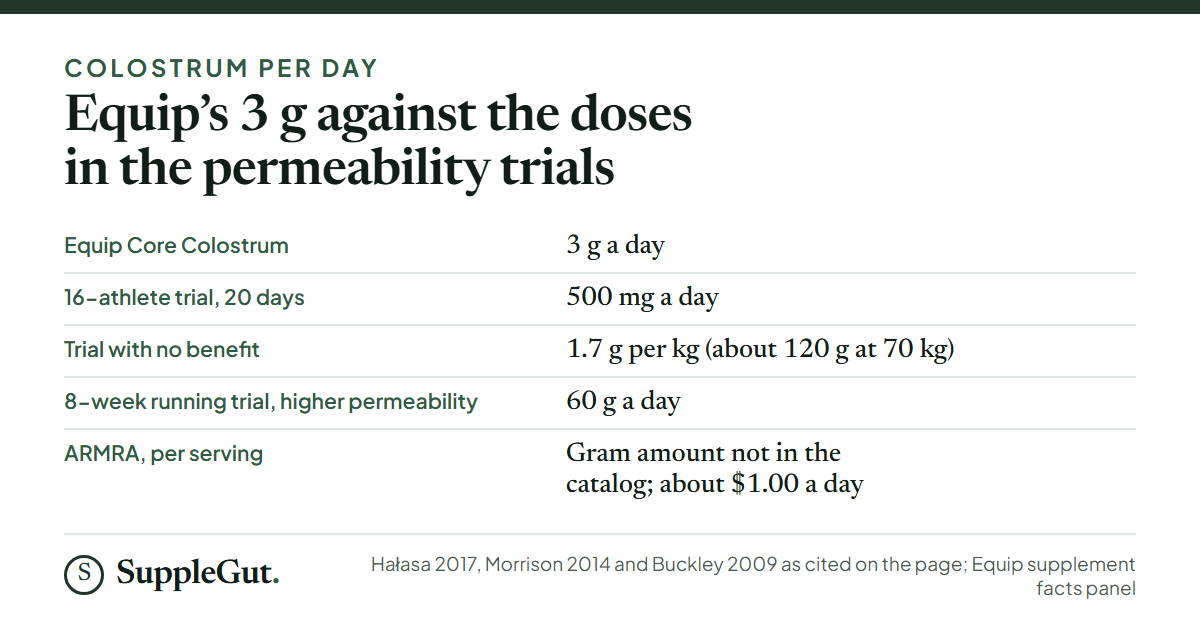
Equip supplies 3 g a day. The adult trials used 0.5 g to 60 g a day, mostly in athletes under exercise stress, and point in different directions.
- The meta-analysis. A 2024 analysis pooled 10 randomized trials of bovine colostrum and gut permeability in healthy athletes and patients. It found a lower 5-hour urinary lactulose/rhamnose ratio (mean difference −0.24, 95% CI −0.43 to −0.04) and no difference in plasma I-FABP. Heterogeneity was very high (I² = 99%), meaning the trials disagreed widely (Hajihashemi et al., Digestive Diseases and Sciences, 2024).
- 12 volunteers. In a placebo-controlled crossover, exercise raised permeability about 2.5-fold on placebo (0.38 to 0.92), and 14 days of colostrum cut that rise by 80% (0.38 to 0.49). The abstract does not give the dose (Marchbank et al., American Journal of Physiology, 2011).
- 16 athletes at 500 mg. Over 20 days at peak training, 500 mg a day lowered the lactulose/mannitol test and stool zonulin compared with a whey placebo. It is a small trial (Hałasa et al., Nutrients, 2017).
- 1.7 g per kg, no benefit. In 15 men exercising for 90 minutes at 30 degrees C after seven days of colostrum, the authors reported no observable benefit on physiology or performance. For a 70 kg man, 1.7 g per kg is about 120 g a day (Morrison et al., Applied Physiology, Nutrition, and Metabolism, 2014).
- 60 g a day, higher permeability. In 30 healthy men in eight weeks of running training, the lactulose/rhamnose ratio rose 251% with colostrum against 21% with whey and −7% in the control group (Buckley et al., Nutrients, 2009).
A systematic review of nine athlete studies calls for better-designed trials (Dziewiecka et al., Nutrients, 2022), and a review of eight studies in children concluded that no conclusion can be drawn about gut-health benefits (Oswal et al., Journal of Pediatric Gastroenterology and Nutrition, 2025).
Three grams is six times the 500 mg of the small athlete trial and far below the other two doses. We found no trial of colostrum at 3 g a day in bloating, and the brand’s “gut lining repair” wording describes colostrum as an ingredient, not a test of this tub. The one trial that measured IBS symptoms directly is covered in the bovine colostrum guide and found no difference from placebo.
The trial of the product itself
There is none. A PubMed search for Equip or Core Colostrum with colostrum returned no study of this product, and the brand pages name none. Its evidence is the ingredient-class record above, in healthy exercisers at doses that bracket 3 g without matching it.
How to take it
The brand’s directions are one scoop daily, on an empty stomach when possible, stirred into a smoothie, water, juice or coffee. The brand states no length of use; the athlete trials ran 7 days to 8 weeks.
Side effects and who should not take it
The label states it contains milk, which matters for a milk allergy. The label images we read showed no pregnancy, medication, age or medical-condition warning, though only the panel side and front of the tub were visible. The brand page carries the standard FDA statement and a general note to contact a health care provider. The Amazon review summary mentions clumping and taste rather than digestive side effects; review text beyond those excerpts was not readable.
What the reviews say
Amazon shows 4.6 from 500 ratings for the powder, sold by the brand and shipped by Amazon: 81% five-star, 7% four, 6% three, 1% two and 5% one-star. Amazon’s summary counts mentions by topic, and the positive shares were 104 of 116 for taste, 98 of 104 for health benefits, 86 of 96 for mixability and 58 of 60 for gut health. The recurring praise is a powder with no taste or smell that goes into drinks, a single ingredient at 3 g, and less bloating and steadier digestion.
The recurring complaint is clumping: 10 of 96 mixability mentions are negative, with some reviewers saying it does not dissolve in hot or cold liquids. Twelve of the taste mentions are negative, and a small group report no effect. The brand page’s review widget did not render for us, and the Trustpilot page could not be read.
Price, subscription and refunds
| Route | Price | Per day |
|---|---|---|
| Brand site, one tub | $47.99 | $1.60 |
| Brand site, 3 tubs | $138.97 | $1.54 |
| Brand site, 5 tubs | $229.95 | $1.53 |
| Brand site, subscription | $40.79 | $1.36 |
| Amazon, one tub | $49.99 | $1.67 |
| Amazon, Subscribe & Save | $44.99 | $1.50 |
The brand’s subscription takes 15% off, ships every 30, 45, 60 or 90 days and can be skipped or canceled. Its refund policy allows a return or exchange within 30 days of purchase for the purchase price less outbound and return shipping. The product page also says “90-day money back guarantee” beside the subscription option, a figure the refund policy page does not repeat. On Amazon, the listing offers a 30-day refund or replacement and says Amazon does not accept food returns, so returns go to the brand directly.
Who Equip Core Colostrum is for
- Someone who wants plain colostrum powder with its weight printed and nothing added, and who accepts that the IgG share is stated two ways.
- A person who trains hard and is interested in the exercise-permeability research, whose trial doses ran from 0.5 g to 60 g with mixed results.
The catalog’s other colostrum products: ARMRA Colostrum, a powder at about $1.00 a day; Heart & Soil Grass-Fed Colostrum, a capsule at about $2.47 a day; and Designs for Health IgGI Shield, a serum bovine immunoglobulin powder. If the goal is a particular symptom, the quiz starts from the symptom instead of the ingredient.
The products in this catalog
Common questions
Does Equip Core Colostrum work for gut health?
No trial of this product was found. Trials of bovine colostrum in athletes show a lower rise in gut permeability after hard exercise in some studies and no benefit or a higher permeability in others, at doses from 500 mg to 60 g a day. Equip supplies 3 g a day, and we found no trial at that dose in bloating. See the bovine colostrum guide for the wider evidence.
What is in Equip Core Colostrum, and how much IgG?
One scoop (about 3 g) holds 3,000 mg of grass-fed bovine colostrum powder and 2 g of protein, with no other ingredients, and the label states it contains milk. The brand page says the IgG concentration is 20% and the Amazon listing says 40%; neither figure is on the panel, and no assay is posted.
How much does Equip Core Colostrum cost per day?
A 30-serving tub is $47.99 on the brand site, about $1.60 a day, or $40.79 on its 15% subscription, about $1.36 a day. On Amazon it is $49.99, about $1.67 a day, or $44.99 on Subscribe & Save, about $1.50 a day.
Equip Core Colostrum vs ARMRA: what is the difference?
Both are single-ingredient bovine colostrum powders. Equip prints 3 g of colostrum powder per scoop at about $1.60 to $1.67 a day, while the catalog lists ARMRA at about $1.00 a day. Neither has a trial of its own product at its own dose that matches the athlete permeability trials. See the ARMRA page.
Does Equip Core Colostrum have side effects?
The label states it contains milk, so it is not suitable for a milk allergy. The label images we read showed no other warning, and the Amazon review summary mentions clumping and taste rather than side effects. Anyone pregnant, nursing or on medication can ask a health care provider, as the brand page advises in general terms.
Can I return Equip Core Colostrum, and what is the guarantee?
The brand’s policy is a return or exchange within 30 days for the purchase price less outbound and return shipping. The product page also states a 90-day money back guarantee beside the subscription option, which the refund policy page does not repeat. On Amazon the listing offers a 30-day refund or replacement, and returns go to the brand directly because Amazon does not accept food returns.
Why does Equip Core Colostrum clump, and does it dissolve in hot drinks?
Clumping is the most common complaint in the Amazon summary: 10 of 96 mixability mentions are negative, and one reviewer reports clumps in both hot and cold liquids. 86 of the 96 mixability mentions are positive, and the brand says to stir one scoop into a smoothie, water, juice or coffee.
Sources
- Hajihashemi P, et al. Bovine colostrum and gut permeability: meta-analysis of 10 randomized trials. Digestive Diseases and Sciences, 2024. PMID 38361147
- Marchbank T, et al. Colostrum and exercise-induced gut permeability in 12 volunteers. American Journal of Physiology. Gastrointestinal and Liver Physiology, 2011. PMID 21148400
- Hałasa M, et al. Colostrum, 500 mg a day, in 16 athletes. Nutrients, 2017. PMID 28397754
- Morrison SA, et al. Colostrum at 1.7 g per kg a day, training status and permeability in the heat. Applied Physiology, Nutrition, and Metabolism, 2014. PMID 25068884
- Buckley JD, et al. Colostrum at 60 g a day and permeability during running training in 30 men. Nutrients, 2009. PMID 22253980
- Dziewiecka H, et al. Systematic review of colostrum and exercise-related gut permeability in athletes. Nutrients, 2022. PMID 35745242
- Oswal D, et al. Systematic review of bovine colostrum and gut health in children. Journal of Pediatric Gastroenterology and Nutrition, 2025. PMID 40150801
- Equip Foods: Core Colostrum product page, label, directions, subscription and price. equipfoods.com/products/core-colostrum
- Equip Foods: refund policy. equipfoods.com/policies/refund-policy
- Amazon listing for Equip Core Colostrum: price, rating, star split and review summary. amazon.com/dp/B0BQJ9VR1S
Not sure which product fits your situation?
This guide covers the mechanics. The quiz takes your specific symptoms, routine and preferences and matches you to one product from the catalog.
Take the quiz →