Guide
Does GutPersonal The Mover work? A ginger and artichoke capsule, tested for indigestion rather than constipation
Quick answer
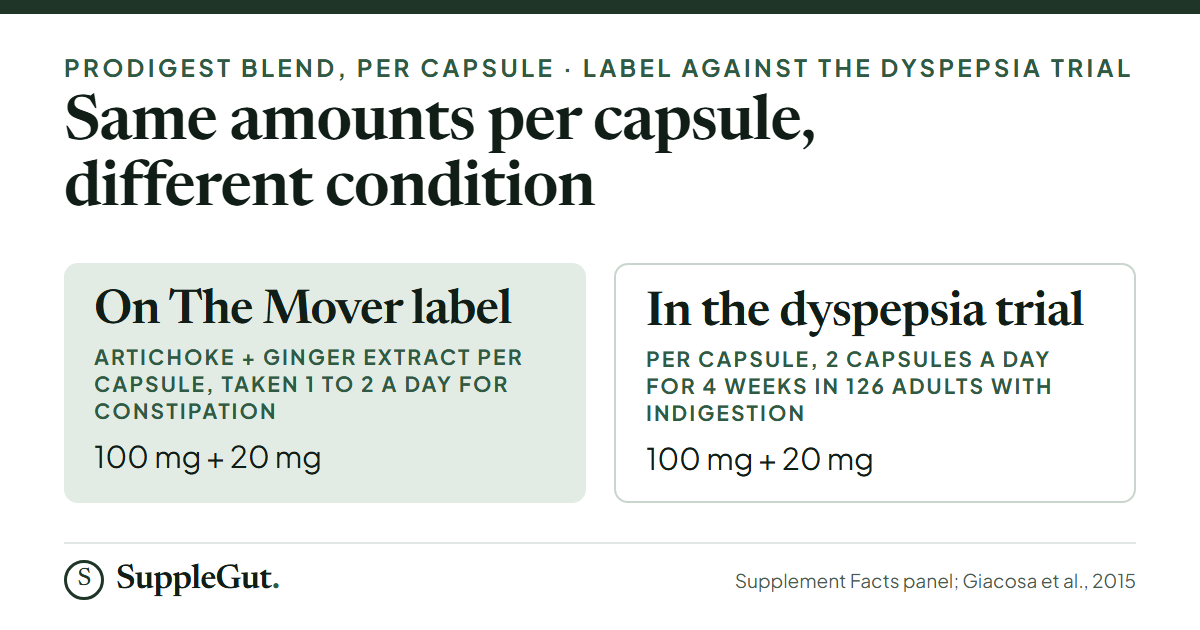
Does The Mover work for constipation? We could find no trial of The Mover itself or of its blend in constipation. The blend, sold as Prodigest, holds 100 mg of artichoke leaf extract and 20 mg of ginger root extract per capsule, the same amounts as this label. It was tested in 126 adults with functional dyspepsia (two capsules a day for 4 weeks) and in an 11-person stomach emptying study. The brand’s own review widget shows 4.68 from 25 reviews.
The Mover is GutPersonal’s ginger and artichoke capsule, jar-labeled “Support for Occasional Constipation & Bloating” and sold as a laxative-free evening supplement. It differs from most constipation products on the shelf because its two actives are herbs studied for indigestion, and the published work on this exact blend sits in the stomach rather than the bowel.
A 320 mg blend with 120 mg named
GutPersonal is a registered-dietitian brand that sells supplements next to coaching and testing services. The Mover is a vegetable capsule, 60 to a bottle, with a serving of one capsule. The page describes it as “gentle, natural relief (without laxatives)” that is “perfect for travel and daily use,” and says ginger supports motility while artichoke extract “stimulates bile flow.” Those are the brand’s claims.
The panel is headed Supplement Facts, and it lists 30 mg of calcium and a 320 mg “Motility Blend (Prodigest)”. Inside the blend it names 100 mg of artichoke leaf extract and 20 mg of ginger root extract. Those two sum to 120 mg, and the remaining 200 mg is not itemized; it may be carrier or standardization material, though the panel does not say. The page lists the product as free from gluten, dairy, soy and GMOs, and shows a “Third-Party Tested” badge without naming a laboratory.
Where the trials sit: dyspepsia, not constipation
Prodigest is a standardized artichoke and ginger extract combination developed by Indena, and two human studies of it exist. The larger was a double-blind, placebo-controlled trial in 126 adults with functional dyspepsia (65 on the blend, 61 on placebo). Each capsule held 100 mg of artichoke and 20 mg of ginger extract, the same per-capsule amounts as The Mover, and people took two a day, before lunch and dinner, for four weeks. The blend group improved on the clinical assessment score at 14 days (+1.195 units, P = 0.017) while placebo did not change significantly (+0.347, P = 0.513). By the end the advantage over placebo held for nausea, epigastric fullness and epigastric pain, and for bloating (P = 0.017) (Giacosa et al., Evidence-Based Complementary and Alternative Medicine, 2015). The authors include Indena staff.
The second was a small crossover study in 11 healthy volunteers. One capsule or placebo went in ten minutes before a standard meal, and ultrasound afterward showed a stomach area of 8.4 cm² with the blend against 11.0 cm² with placebo, a 24% difference (P < 0.001) (Lazzini et al., European Review for Medical and Pharmacological Sciences, 2016). That is a measure of how fast the stomach empties, which sits upstream of the bowel.
A PubMed search for the product name and brand returned nothing, and we found no trial of the blend in people with constipation. The brand’s page makes its constipation case without citing a paper, so the trial results above bear on the capsule’s amounts, not on its intended use.
Ginger and artichoke on their own for constipation
The closest ginger result we read is a 12-week double-blind trial in 52 people with relapsing-remitting multiple sclerosis. They took 500 mg of ginger three times a day against placebo, and constipation frequency fell by 23.63 points on a 0 to 100 scale against a rise of 14.81 on placebo, with severity falling by 24.15 against a rise of 11.39 (Foshati et al., BMC Complementary Medicine and Therapies, 2023). The population was different, and the dose was a ginger powder at roughly 1.5 g a day, against 20 mg of extract in a capsule here. A second trial gave 480 mg a day of a steamed ginger extract to 80 adults with functional dyspepsia for 12 weeks, and its gastrointestinal symptom score, including a constipation sub-score, improved against placebo (Food & Function, 2025); that extract and dose also differ from this label.
For artichoke leaf extract, PubMed lists five records for dyspepsia, and we opened only the 126-person trial above. We found no artichoke trial for constipation.
Evening dosing, and a fair length of trial
The brand’s directions for constipation are 1 to 2 capsules as part of an evening routine. For bloating or gas after meals it says 1 capsule 30 minutes before eating, starting once a day. The trial dose of 2 capsules a day, split across two meals, falls inside the top of that range, and the gastric emptying study used a single capsule ten minutes before a meal. The page does not say whether to take it with food. Reviewers who mention the ginger say it can feel strong on an empty stomach, and one takes it with a meal.
The dyspepsia trial ran four weeks, with the first measured change at two weeks, which gives a rough yardstick for how long to keep a log of bowel movements before judging. Several reviewers also take the brand’s magnesium or probiotic, so any change they report may not come from this capsule alone.
Tolerability, pregnancy and what the page says
The panel image carries no warning text, and the product page carries none beyond the standard FDA disclaimer; the side of the bottle in the brand photo is cropped, so its small print could not be read. The brand’s FAQ says the capsule is safe for daily use and that its dietitian “formulated and approved” it for pregnancy and breastfeeding, without citing a study. In the dyspepsia trial the authors reported the blend as safe, and the 11-person study reported no notable adverse effects. Both were short and small. Ginger and artichoke are food herbs, though, and anyone who is pregnant, nursing or taking medicines can check with a doctor or pharmacist first.
25 reviews on the brand’s own page
The product page runs a Judge.me widget showing 4.68 out of 5 from 25 reviews: 21 five-star, 1 four-star, 2 three-star, 1 two-star and no one-star. All 25 are flagged as verified buyers, and the brand has replied to seven. This is a feed the brand hosts, and we found no Amazon, Walmart, Target or iHerb listing and no Trustpilot profile to set it beside. The reviews arrived at a slowing pace, with 10 in 2023 and 2 in 2024. Star entries do not always match the text: one five-star review says the product did not work, and one two-star review says it “does seem to help to keep things moving.”
The recurring praise:
- gentle relief with no urgency (“does get things moving but doesn’t scare me”);
- easier regular movements, including while traveling or under stress;
- a small capsule whose dose can be adjusted up or down.
The recurring complaints are modest or uneven effect (“not life-changing” from a three-star reviewer who went to two capsules a day), a funny taste, ginger that is strong on an empty stomach, and one report of a subscription order shipped after a cancellation request. Constipation comes up in 5 of the 25 reviews, bloating in 2.
Price by route, and the pre-selected plan
| Route | Price | Per day at 1 / 2 capsules |
|---|---|---|
| 60 capsules, one time | $54.95 | $0.92 / $1.83 |
| Monthly delivery (10% off) | $49.46 | $0.82 / $1.65 |
| 3-month delivery (15% off), 180 capsules | $140.12 | $0.78 / $1.56 |
| 6-month delivery (20% off), 360 capsules | $263.76 | $0.73 / $1.47 |
On the page the monthly delivery card is marked active by default, with “One Time Purchase” as a separate choice below the delivery cards. The 3-month and 6-month plans include free shipping. A banner offers $15 off a first order, and the page says deliveries can be skipped, delayed or canceled at any time.
The brand’s refund policy gives 30 days to return unopened products for a full refund, handles opened ones by email, and does not refund shipping. The Happy Gut Guarantee describes a full refund of a first order within 30 days, limited to purchases made on gutpersonal.com, to one unit when several of the same product are ordered, and to people who used the product as directed.
Other routes to the same goal
The brand sells The Mover next to magnesium, and its Miracle Worker magnesium guide sets that powder against the oxide trials. A plain oxide tablet such as Nature Made Magnesium Oxide 250 mg and a fiber like Yerba Prima Psyllium Husks Powder are the kinds of product the constipation trials are built around. Constipation treatments with strong evidence lists those options, and psyllium vs magnesium for constipation compares two of them. No head-to-head trial of The Mover against any of them exists that we could find.
Who The Mover suits
- Someone who wants a herbal capsule with no laxative herbs, since the panel shows none and the brand says it is laxative-free.
- Someone whose constipation comes with fullness, nausea or bloating after meals, the symptoms the dyspepsia trial measured.
- Someone who likes an adjustable dose of one or two capsules at night.
- Someone comfortable buying direct from the brand, the only place it turned up.
The quiz matches symptoms to products.
Products this guide draws on
Common questions
Has The Mover been tested for constipation?
We could find no study of The Mover or of its Prodigest blend in constipation. The two published studies of the blend looked at functional dyspepsia in 126 adults and at stomach emptying in 11 healthy volunteers. The brand’s page carries a “Clinically Researched” badge and cites no paper for it.
What is in a capsule of The Mover?
One capsule lists 30 mg of calcium and a 320 mg “Motility Blend (Prodigest)” that names 100 mg of artichoke leaf extract and 20 mg of ginger root extract. Those two add up to 120 mg, and the panel does not itemize the other 200 mg of the blend. There are no laxative herbs such as senna, and no sweetener.
How many capsules should I take, and when?
The brand says to take 1 to 2 capsules in the evening for constipation, or 1 capsule 30 minutes before a meal for bloating or gas, starting with once a day. The dyspepsia trial used 2 capsules a day, before lunch and dinner. One reviewer takes it with food because the ginger feels strong on an empty stomach.
How much does The Mover cost per day?
A bottle of 60 capsules is $54.95 one time, which is $0.92 a day at one capsule and $1.83 at two. The pre-selected monthly plan is $49.46, the 3-month plan $140.12 for 180 capsules and the 6-month plan $263.76 for 360.
Can I cancel the subscription or get a refund?
The brand’s refund policy gives 30 days to return unopened products for a full refund, and handles opened ones by email. A separate Happy Gut Guarantee describes a full refund of a first order within 30 days. One of the 25 reviews says an order shipped after a cancellation request, and the page pre-selects the monthly plan, so the one-time option is a separate choice.
Is The Mover safe in pregnancy or with medicines?
The brand says it is formulated for pregnancy and breastfeeding and cites no study for that. We read no warning text on its page or panel. The studies of the blend reported no safety problems, but they were short and did not include pregnant women, so a doctor or pharmacist can answer for your situation, particularly if you take other medicines.
Where is The Mover sold?
We found it on the brand’s own site only. Searches turned up no Amazon, Walmart, Target or iHerb listing carrying the brand name and no Trustpilot profile, so the 4.68 rating exists only in the review widget on the brand’s page.
Sources
- Giacosa A, et al. Ginger and artichoke extract supplementation in functional dyspepsia: a randomized, double-blind, placebo-controlled trial in 126 adults. Evidence-Based Complementary and Alternative Medicine, 2015. PMID 25954317. pubmed.ncbi.nlm.nih.gov/25954317
- Lazzini S, et al. Ginger and artichoke extract on gastric motility: a randomized crossover pilot study in 11 healthy volunteers. European Review for Medical and Pharmacological Sciences, 2016. PMID 26813467. pubmed.ncbi.nlm.nih.gov/26813467
- Foshati S, et al. Ginger and gastrointestinal symptoms in 52 people with relapsing-remitting multiple sclerosis: a double-blind, placebo-controlled trial. BMC Complementary Medicine and Therapies, 2023. PMID 37891539. pubmed.ncbi.nlm.nih.gov/37891539
- Steamed ginger extract in functional dyspepsia, 80 adults, 12 weeks. Food & Function, 2025. PMID 40878144. pubmed.ncbi.nlm.nih.gov/40878144
- GutPersonal: product page for The Mover (claims, directions, ingredients, price, delivery options). gutpersonal.com
- GutPersonal: Supplement Facts panel image for The Mover. panel image
- GutPersonal: Judge.me review widget on the product page, the source of the 4.68 rating from 25 reviews. gutpersonal.com
- GutPersonal refund policy and Happy Gut Guarantee pages. refund policy; Happy Gut Guarantee

Which of these fits you?
Three minutes with the quiz turns this background into one named product, with the reasons shown.
Take the quiz →