
Comparison
Psyllium vs magnesium for constipation: which works better?
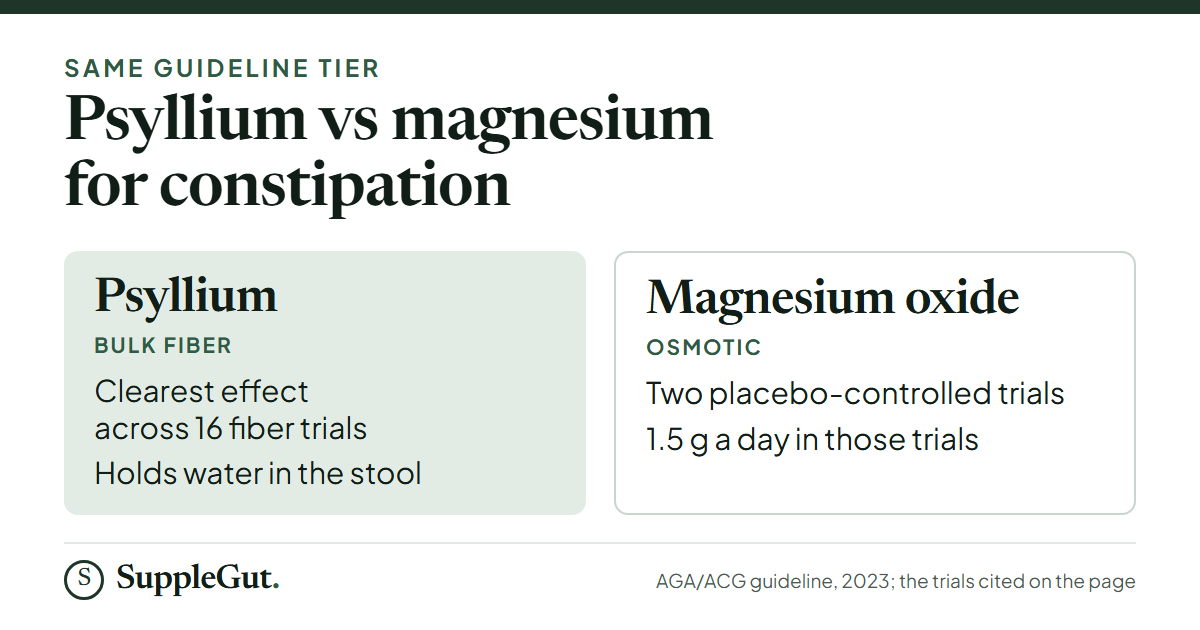
Psyllium bulks and softens stool by holding water; magnesium pulls water into the bowel osmotically. Both have a place in the 2023 gastroenterology guideline, and the guideline puts them in the same tier. The differences are in how much evidence each has, how fast each works, and one detail that is easy to miss: the trials used magnesium oxide at 1.5 g a day, not the citrate most people buy.
Quick answer
Psyllium first for most people: the largest evidence base of any constipation supplement, the guideline’s fiber of choice, and safe to take every day for years.
Magnesium oxide second, when fiber is not enough or you want a faster effect: two placebo-controlled trials at 1.5 g a day. The catch is that the magnesium powder on the shelf is usually citrate at 350 mg a serving, which is not the product the trials tested, and anyone with kidney disease should leave magnesium alone without advice.
The short answer
Plain psyllium husk powder
$0.31 a day · 4.7★ from 23,144 ratings at iHerb
A meta-analysis of 16 randomized fiber trials in 1,251 people found 66% responded to fiber against 41% on placebo, with psyllium doing better than fiber as a whole, and the 2023 AGA/ACG guideline names it as the fiber that appears to work. One serving is 7 g of fiber; the trials found the effect needed four weeks and doses above roughly 10 g a day, so two servings is the evidence-matched dose.
- Hard, dry stools that need softening
- You want something safe to take indefinitely
- You also want the cholesterol effect
Magnesium oxide
Trial dose 1.5 g a day · pharmacy tablets
Two placebo-controlled trials in Japan: 1.5 g of magnesium oxide a day for 28 days improved overall symptoms in 70.6% of people against 25.0% on placebo (33 women, 2019). A larger three-arm trial of 90 patients (2021) found 68.3% against 11.7%, with more spontaneous bowel movements and a shorter colonic transit time. The guideline gives it the same conditional recommendation as fiber.
- Fiber alone has not done it
- You want a result within days rather than weeks
- Your kidneys are healthy
Not sure which of the two fits you? The quiz asks about your symptoms before it names one.
About the magnesium powder in your cupboard. The product in our catalog for this job is Natural Vitality CALM Magnesium Powder, Unflavored: 350 mg of magnesium as citrate per two-teaspoon serving, $0.19 a day, 4.8★ from 4,511 ratings at iHerb. It is marketed for relaxation and sleep, not constipation, and no trial of it for constipation exists. Citrate is osmotic too, and plenty of people find it loosens things, but it is about a third of the trial dose in a better-absorbed form. If you want the evidence, buy magnesium oxide tablets from a pharmacy and follow the pack.
Side by side
✓ marks the product with the advantage on that row. Rows with no mark are a genuine tie or a matter of preference.
Where they differ
1. Mechanism, and what it means for the stool
Psyllium forms a gel that resists fermentation and keeps holding water all the way through the colon, so stools become softer and bulkier. Magnesium is not absorbed well in large amounts; what stays in the gut pulls water after it, which is an osmotic effect. The first makes stool easier to pass; the second makes it wetter and faster. That is why magnesium acts sooner and why too much of it causes diarrhea.
2. The size of the evidence
A sixteen-trial review against two trials. The fiber meta-analysis pooled 1,251 people, and psyllium was the fiber with the clearest effect in it. The magnesium oxide evidence is a 2019 trial in 34 randomized women (33 analyzed) and a 2021 three-arm trial in 90 patients, both from the same research group in Japan. Their results are strong, and the guideline accepted them, but they are two trials in one population, and they have not yet been repeated elsewhere.
3. Oxide, citrate and the dose gap
The trials used 1.5 g of magnesium oxide a day. Magnesium oxide is poorly absorbed, which for constipation is the point: more stays in the bowel. Magnesium citrate is absorbed better, and the powders sold as citrate supply about 350 mg of magnesium per serving. So a citrate powder is a smaller dose of a form that leaves less behind. It may still work — many people say it does — but it is not what was tested.
4. Who should not take magnesium for this
Both trials excluded anyone with kidney disease or high blood magnesium, and for a reason: the kidneys clear magnesium, and when they cannot, blood levels rise. Anyone with reduced kidney function, and anyone over about 65 taking it daily, should have that conversation with a doctor first. Psyllium has no equivalent caution beyond the choking warning and medicine spacing that every bulk fiber carries.
5. Where magnesium wins
Speed, and the person for whom fiber has already failed. If two servings of psyllium a day for a month has not done it, the guideline’s next tier is an osmotic, and magnesium oxide is the cheapest one on the shelf.
Where they are the same
- Both sit in the guideline’s conditional tier, with low certainty of evidence, below polyethylene glycol and the prescription options.
- Both should be spaced from other medicines by about two hours.
- Both need fluid. Psyllium because it swells; magnesium because it pulls water out of you.
- Neither has been tested against the other.
Read the full research
Common questions
Which is better for constipation, psyllium or magnesium?
Psyllium for daily, long-term use: the clearest effect in a meta-analysis of sixteen fiber trials in 1,251 people, where 66% responded to fiber against 41% on placebo, and the guideline’s first-line fiber. Magnesium oxide when fiber is not enough or you need a faster effect: two placebo-controlled trials at 1.5 g a day found 68–71% of people improved against 12–25% on placebo, within four weeks. No trial has compared the two head-to-head.
Is magnesium citrate as good as magnesium oxide for constipation?
Both are osmotic and both draw water into the bowel, but the placebo-controlled constipation trials used magnesium oxide at 1.5 g a day. A typical citrate powder serving is 350 mg of magnesium, well under the trial dose. Citrate is better absorbed, which means less of it stays in the bowel to do the job. The evidence is for oxide.
How much magnesium should I take for constipation?
The trials used 1.5 g of magnesium oxide a day, taken as 0.5 g three times. That is far more elemental magnesium than a supplement serving, and it is why anyone with kidney disease should not take magnesium for constipation without medical advice: the kidneys clear it, and blood levels can rise when they cannot.
Can I take psyllium and magnesium together?
They work by different mechanisms and are often combined in practice, but no trial has tested the pair. If you do, keep the psyllium with a full glass of water and space both from other medicines by about two hours.
How long do psyllium and magnesium take to work?
A single dose of either can produce a bowel movement within 12 to 72 hours. Settled regularity is a different clock: the psyllium trials found the benefit needed at least four weeks of daily use, and the magnesium oxide trials measured their result at four weeks too.
In one line: Plain psyllium husk powder — the daily, long-term answer.
Which fiber for constipation, on one page
Which fibers have the trials, the dose that worked, and how to take it without the gas. Sent by email, then two short follow-ups over ten days. Unsubscribe any time.
Your address is used for these three emails and nothing else. How we handle it.
Speak to a doctor first if you are pregnant, breastfeeding, trying to conceive, immune-suppressed, or taking prescription medication — and before starting anything if you have blood in your stool, unexplained weight loss, persistent vomiting, or pain severe enough to wake you at night. Those are signs to get looked at, not to try a supplement.
Constipation with something else going on?
If bloating, pain or reflux come with it, the right first product may be neither of these. Our quiz asks what you are experiencing before it names anything.
Find your match →Free · Private · No sign-up · 1–3 minutes
Related guides
Other comparisons
Where these numbers come from
- NOW psyllium husk powder, fiber per serving, 4.7 from 23,144 — www.iherb.com/pr/now-foods-psyllium-husk-powder-12-oz-340-g/89
- Natural Vitality (MaxCalm) supplement facts: 350 mg magnesium as citrate per 2 tsp; 4.8 from 4,511 — www.amazon.com/dp/B000OQ2DL4?tag=supplegut-20
- Fiber constipation meta-analysis, 16 trials, 1,251 people — pubmed.ncbi.nlm.nih.gov/35816465
- Mori S et al. Magnesium oxide 1.5 g/day vs placebo in chronic constipation, 28 days. J Neurogastroenterol Motil 2019 — pmc.ncbi.nlm.nih.gov/articles/PMC6786451
- Morishita D et al. Senna vs magnesium oxide vs placebo in 90 patients with chronic constipation. Am J Gastroenterol 2021 — doi.org/10.14309/ajg.0000000000000942
- Chang L et al. AGA-ACG guideline on chronic idiopathic constipation, 2023 — pubmed.ncbi.nlm.nih.gov/37211380
- FDA authorized health claim, 7 g/day soluble psyllium, 21 CFR 101.81 — www.law.cornell.edu/cfr/text/21/101.81
Prices and star ratings are point-in-time snapshots and move around. Where a figure could not be confirmed from a manufacturer label or retailer listing, this page says so rather than estimating.