Guide
Does GutPersonal The Miracle Worker magnesium work? 300 mg a scoop against trials that used about 900
Quick answer
Does The Miracle Worker magnesium work for constipation? No study of this product turned up, and none of its bisglycinate for constipation either. The placebo-controlled constipation trials used magnesium oxide at 1.5 g a day (about 905 mg of magnesium), where 68.3% improved against 11.7% on placebo. One scoop here holds 300 mg of magnesium as bisglycinate. The brand’s own review widget shows 4.83 from 403 reviews, and sleep comes up in 214 of them against 44 for bowel movements.
The Miracle Worker is GutPersonal’s magnesium supplement, sold as a strawberry or lemon lime powder and as capsules, and marketed for easier bowel movements, sleep and calm. This page sets its panels beside the trials of magnesium for constipation and sleep, then covers the dose, the reviews and the price.
Where this product comes from and how it is sold
GutPersonal is a registered-dietitian brand that sells supplements alongside coaching and testing services. The jar reads “Magnesium to Calm, Support Bowel Movements & Overall Wellness,” and the product page says it is called “The Miracle Worker for a reason,” and promises to help you “say goodbye to constipation, sleep soundly, and stress less every day.” Its benefit list includes “Daily, effortless poops,” and under “How It Works” it says the product “relaxes your digestive tract” and “supports natural motility without urgency.” Those are the brand’s claims, and the page cites no study for them.
The powder serving is one scoop (5.7 g for strawberry, 6.2 g for lemon lime), about 30 scoops to the tub. The capsule serving is two capsules. The panels are headed Supplement Facts, with no proprietary blend and no Drug Facts panel. They list no laxative herbs, and the brand’s page for a related bundle says “Absolutely no laxatives.” The page lists the product as free from gluten, dairy, soy, GMOs and artificial fillers. It names no allergen statement beyond that and no outside laboratory for testing.
Powder and capsules carry different magnesium
The two formats are not the same product inside. Both powder panels print 300 mg of magnesium (71% of the Daily Value) as Albion magnesium bisglycinate chelate and nothing else as a magnesium source. The other ingredients are citric acid, natural flavor and a stevia sweetener (organic rebaudioside A in the strawberry, organic stevia leaf extract in the lemon lime). The capsule panel prints 235 mg of magnesium (56%) per two capsules, as dimagnesium malate, magnesium citrate and Albion magnesium lysinate glycinate chelate, with no bisglycinate and no split among the three sources.
The brand’s ingredients section describes the magnesium as “a gentle, highly absorbable blend of Bisglycinate Chelate, Malate, and Citrate.” The powder panels show bisglycinate alone, and the capsule panel shows no bisglycinate, so the page copy matches neither panel exactly. Which one describes the powder in the tub is not something the pages settle, and the tub itself was not read.
Has any study tested it, or its bisglycinate, for constipation?
A PubMed search for the product name and the brand returned nothing. The page states that “every person our dietitians have tested was deficient in magnesium” and links no paper to that or to the bowel claim. For the form, a search for magnesium bisglycinate chelate with constipation or bowel found seven records, all case reports of magnesium-containing laxatives and high blood magnesium, and no trial of a bisglycinate chelate. That is a result of one search, and it means none turned up, not that none exists.
The magnesium oxide trials, and the gap in dose and salt
The controlled trials of magnesium for constipation tested magnesium oxide. In 90 adults with chronic idiopathic constipation (mean age 42, 93% women), oxide at 1.5 g a day, senna at 1.0 g or placebo for 28 days gave an overall improvement in 68.3% on oxide, 69.2% on senna and 11.7% on placebo, with no severe treatment-related adverse events (Morishita et al., American Journal of Gastroenterology, 2021). In 34 women with mild to moderate constipation, oxide at 0.5 g three times a day for 28 days met the primary endpoint in 70.6% against 25.0% on placebo, with better stool form and a shorter colonic transit time (Mori et al., Journal of Neurogastroenterology and Motility, 2019). A 2023 meta-analysis of eight randomized trials of supplements in 787 adults pooled the two oxide trials at 68% responding against 19% on control (relative risk 3.32, 95% CI 1.59 to 6.92), with stool frequency up by 3.72 a week (van der Schoot et al., Neurogastroenterology & Motility, 2023). That review looked at oxide only; it held no trial of bisglycinate, malate or citrate.
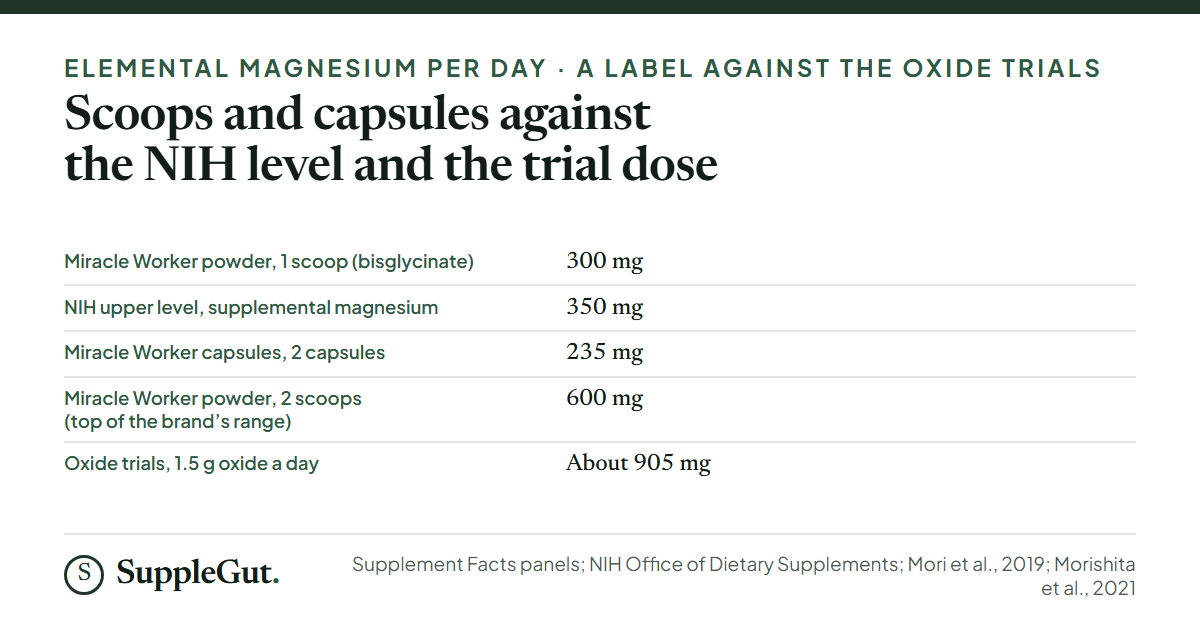
Oxide is about 60.3% magnesium by weight, so 1.5 g a day is about 905 mg of elemental magnesium. One scoop of The Miracle Worker is 300 mg, about a third of that, and two scoops at 600 mg are about two thirds. The Organics Ocean magnesium citrate guide walks through the same oxide trials against a 250 mg capsule.
The trials tested a different salt, at a different amount of magnesium, in people with diagnosed chronic constipation. Their results are a reference point for what magnesium can do in the bowel, not a measurement of this powder.
The sleep claim and the 2026 review
Sleep is the second claim on the page (“Fall asleep easier, wake up rested”), and the one reviewers mention most. A 2026 systematic review pulled together 12 randomized trials of oral magnesium for sleep in adults. It found results that were inconsistent across subjective measures, brain-wave recordings and wearable data, rated the certainty of the evidence low to very low, and concluded that current evidence does not support oral magnesium as a routine treatment for insomnia, while noting it may give modest benefits on some subjective outcomes in some adults (Lopresti et al., Journal of Dietary Supplements, 2026). The trials varied in forms, doses and durations, and the review does not single out bisglycinate.
How to take it, and the 350 mg upper level
The brand’s directions: start with one scoop of powder (or two to three capsules) in the evening, and “gradually increase up to 4-5 capsules (or 2 scoops) per day if needed.” For daytime support it says to add two capsules or one scoop in the morning. The page does not say whether to take it with food.
The NIH Office of Dietary Supplements sets the tolerable upper intake level for magnesium from supplements at 350 mg a day for adults, a level based on diarrhea. Set against that:
- One scoop, 300 mg, is under it.
- Two scoops, 600 mg, is above it.
- The capsule panel works out to 117.5 mg per capsule, so four to five capsules is about 470 to 590 mg.
The top of the brand’s own range therefore exceeds the NIH figure for both formats. The NIH adds that high supplemental doses can cause diarrhea, nausea and abdominal cramping.
Side effects and interactions
The panel images carry no warning text, and the product page carries none beyond the standard FDA disclaimer; the side of the tub was not read. The store markets a pregnancy collection and the brand calls its constipation bundle “fully pregnancy-safe,” but the Miracle Worker page itself says nothing on pregnancy. The brand states no pregnancy, kidney or medication guidance for this product.
General magnesium cautions apply regardless. The NIH lists interactions between magnesium supplements and bisphosphonates, tetracycline and quinolone antibiotics, and some diuretics and acid reducers, and kidney disease changes how the body clears magnesium. Anyone on those medicines or with kidney disease can check with a doctor or pharmacist before starting. Among the 403 reviews, loose stool or urgency appears in none, nausea or stomach upset in three and headache in two, and one reviewer wrote that the stated dose “was way too strong.”
The review record
The brand’s product page runs a Judge.me review widget showing 4.83 out of 5 from 403 reviews: 365 five-star, 22 four-star, 7 three-star, 2 two-star and 7 one-star. Of the 403, 367 are flagged as verified buyers, and the brand has replied to 157. The reviews run from 2022 to 2026. This is a feed the brand hosts; we found no Amazon, Target or Walmart listing and no Trustpilot profile for the brand to compare it with. At least three of the seven one-star reviews carry favorable text, so some star entries may have been recorded wrongly.
By keyword, sleep appears in 214 reviews, taste or flavor in 102, bowel movements in 44, bloating in 27 and constipation in 20. Praise centers on:
- sleep, often alongside easier bowel movements;
- regularity within days to weeks;
- a strawberry or lemon lime flavor that mixes into water.
Complaints center on a flavor some find very sweet, a citric acid aftertaste, little or no noticeable effect for a few reviewers, one reviewer who found the dose too strong, and the size and number of capsules. Four reviews mention the subscription, all neutral or positive, and none describes a billing or cancellation problem.
Price: powder, capsules and the subscription tiers
| Route | Price | Per day at one serving |
|---|---|---|
| Powder, one time (about 30 scoops) | $49.95 | $1.67 |
| Powder, 1-month delivery (10% off) | $44.96 | $1.50 |
| Powder, 3-month delivery (15% off) | $127.37 | $1.42 |
| Powder, 6-month delivery (20% off) | $239.76 | $1.33 |
| 60 capsules, one time | $35.95 | $1.20 |
| 120 capsules, one time | $54.95 | $0.92 |
At the brand’s two-scoop top of range the one-time powder runs $3.33 a day. The three-month and six-month plans carry free shipping, and the brand lists free gifts at the second, fourth and sixth subscription orders and a $15 first-order discount. The page says a subscription can be skipped, delayed or cancelled at any time, and mentions a “GP Wellness Club” whose terms were not clear from the page.
Refunds, as the brand prints them: 30 days to return unopened products for a full refund, opened products handled case by case by email, and no refund of shipping. A separate Happy Gut Guarantee page describes a full refund on a first order within 30 days.
The Miracle Worker against magnesium citrate and oxide
Magnesium oxide is the salt with the constipation trials, and it is also the most concentrated in magnesium by weight; a plain tablet such as Nature Made Magnesium Oxide 250 mg sits in that group. Citrate is the salt most capsule products use, for example Organics Ocean Real Magnesium Citrate, which gives 250 mg of magnesium from citrate across three capsules. Sandhu Herbals Magnesium Complex blends six forms with zinc. The Miracle Worker powder is bisglycinate, a form bound to the amino acid glycine, while its capsule is a malate, citrate and glycinate blend.
No head-to-head trial of any of these for constipation was found, so the differences here are differences in label and form, not in measured effect. For the doses the trials used, constipation treatments with strong evidence lists options, and psyllium vs magnesium for constipation sets the two side by side.
The rest of GutPersonal’s gut range
The brand’s store lists other gut products beside this one: a ginger and artichoke motility capsule called The Mover, a non-fiber prebiotic, several probiotics, digestive enzymes, an L-glutamine powder, a greens powder and bundles that combine the Miracle Worker with a probiotic or with The Mover. Their panels and reviews were not read for this page.
Who The Miracle Worker is for
- Someone who wants one magnesium product for evening use and mainly takes it for sleep, which is what most reviewers describe.
- Someone comfortable with constipation evidence borrowed from oxide at a larger dose, since nothing tests this powder.
- Someone choosing between powder and capsules who has noted that the two carry different magnesium forms and amounts.
- Someone content to buy direct from the brand, the only place the product turned up.
The quiz matches symptoms to products.
The catalog entries behind this guide
Common questions
Can The Miracle Worker magnesium relieve constipation?
Nothing published tests this product or its bisglycinate for constipation. The trials that found a benefit used magnesium oxide at about 905 mg of magnesium a day, three times the 300 mg in a scoop, and a different salt. On the brand’s review widget the product holds 4.83 from 403 reviews, and reviewers mention sleep more often (214 reviews) than bowel movements (44).
Which magnesium forms are in the powder and which are in the capsules?
The two powder panels list one source, Albion magnesium bisglycinate chelate, at 300 mg of magnesium a scoop. The capsule panel lists dimagnesium malate, magnesium citrate and Albion magnesium lysinate glycinate chelate, 235 mg per two capsules. The brand’s page copy describes a blend of bisglycinate, malate and citrate, which the powder panels do not show.
How many scoops a day, and is that above the NIH limit?
The brand says to start with one scoop in the evening and go up to two scoops a day if needed, with one of those scoops in the morning for daytime support. One scoop is 300 mg of magnesium, under the NIH upper level of 350 mg a day for supplemental magnesium. Two scoops are 600 mg, above it.
What does a month of The Miracle Worker cost?
The powder is $49.95 for about 30 scoops, or $1.67 a day. The one-month plan is $44.96 ($1.50 a day), the three-month plan $127.37 ($1.42) and the six-month plan $239.76 ($1.33). Capsules are $35.95 for 60 and $54.95 for 120. At the two-scoop top of the brand’s range the powder runs $3.33 a day.
Does the brand take opened tubs back?
The refund policy gives 30 days to return unopened products for a full refund and handles opened ones case by case by email, with no refund of shipping. A separate Happy Gut Guarantee page describes a full refund on a first order within 30 days. The 403 reviews we read hold no complaint about charges or cancellation.
Is it sold on Amazon or in stores?
We found it on the brand’s own site only. Searches turned up no Amazon, Target or Walmart listing carrying the brand name, so the 4.83 rating exists only in the review widget on the brand’s page, and no Trustpilot profile for the brand was found.
How does it differ from plain magnesium citrate or magnesium oxide?
Magnesium oxide is the salt the constipation trials used, at a much higher amount of magnesium. The powder here is bisglycinate, a form bound to an amino acid, and the capsule blends malate, citrate and a glycinate chelate. No head-to-head trial of these forms for constipation was found.
Sources
- Morishita D, Tomita T, Mori S, et al. “Senna Versus Magnesium Oxide for the Treatment of Chronic Constipation: A Randomized, Placebo-Controlled Trial.” American Journal of Gastroenterology, 2021;116(1):152–161. PMID 32969946. pubmed.ncbi.nlm.nih.gov/32969946
- Mori S, Tomita T, Fujimura K, et al. “A Randomized Double-blind Placebo-controlled Trial on the Effect of Magnesium Oxide in Patients With Chronic Constipation.” Journal of Neurogastroenterology and Motility, 2019;25(4):563–575. PMID 31587548. pubmed.ncbi.nlm.nih.gov/31587548
- van der Schoot A, Creedon A, Whelan K, Dimidi E. “The effect of food, vitamin, or mineral supplements on chronic constipation in adults: A systematic review and meta-analysis of randomized controlled trials.” Neurogastroenterology & Motility, 2023;35(11):e14613. PMID 37243443. pubmed.ncbi.nlm.nih.gov/37243443
- Lopresti AL, Smith SJ, Drummond PD. “Magnesium Supplementation for Sleep in Adults: A Systematic Review of Randomized Controlled Trials.” Journal of Dietary Supplements, 2026;23(5):553–581. PMID 42661485. pubmed.ncbi.nlm.nih.gov/42661485
- NIH Office of Dietary Supplements. Magnesium fact sheet for health professionals: upper level for supplemental magnesium, adverse effects and interactions. ods.od.nih.gov/factsheets/Magnesium-HealthProfessional
- GutPersonal: product page for The Miracle Worker (claims, directions, ingredients, price, subscription tiers, Judge.me reviews) and the three Supplement Facts panel images. gutpersonal.com
- GutPersonal refund policy and Happy Gut Guarantee pages. refund policy; Happy Gut Guarantee
One answer for your symptoms
If this page raised more questions than it settled, the quiz asks the ones that matter for you and answers with one product.
Take the quiz →