
Guide
Does Liáo Herbal work for reflux? The three herbs, the trial it cites and what the label leaves out
Quick answer
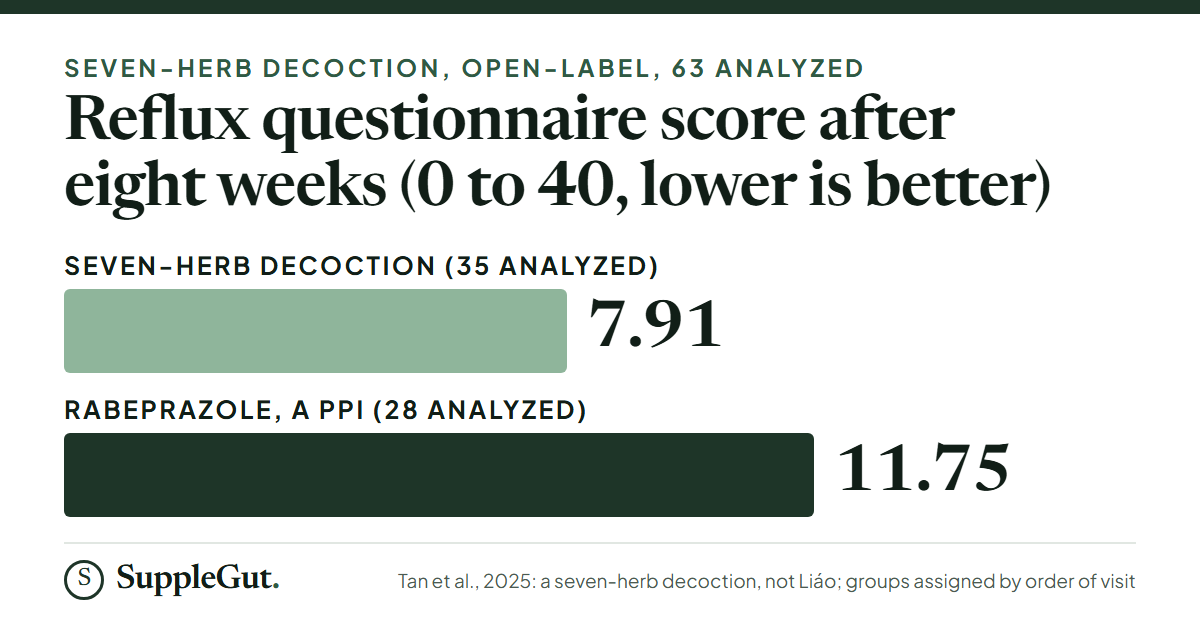
Does Liáo Herbal work? No trial of Liáo itself exists; the brand says so. The trial it cites compared a seven-herb decoction with the PPI rabeprazole in 72 people for eight weeks, and the reflux questionnaire score ended at 7.91 against 11.75 (0 to 40, lower is better). It was open-label, grouped patients by order of visit, and 1 versus 8 dropped out. Liáo keeps three of the seven herbs with no amounts printed, and its whole licorice carries the usual glycyrrhizin cautions for blood pressure and potassium.
Liáo Reflux Relief is a 120 ml bottle of herbal syrup from Liao Herbal LLC in San Diego. It is built on a classical Chinese formula, Xuanfu Daizhe Tang, keeping three of its seven herbs: inula flower, whole licorice root and hematite, an iron-oxide mineral. Unlike most herbal products, the brand cites a human trial. That trial tested the seven-herb version, and the label prints no amount for any herb, so this page sets out what each fact means.
What Liáo is, and what the label leaves out
The Supplement Facts panel has one line: a proprietary blend, described as a 10:1 extract, of inula flower (Xuan Fu Hua), licorice root (Gan Cao) and hematite (Dai Zhe Shi). The only other ingredient is isomalto-oligosaccharides (IMO), a sweet prebiotic fiber. The brand states about 20 g of raw-herb equivalent per 2 ml serving across all three, but the split between herbs is not printed. Also not printed: whether the licorice is honey-fried or the hematite calcined, and the glycyrrhizin content. The licorice is whole root, not DGL.
Xuanfu Daizhe Tang (Inula and Hematite Decoction) comes from the Shang Han Lun, a text about 1,800 years old, now used for reflux esophagitis and gastritis (Li et al., 2022). It has seven herbs. In the 2025 trial the daily doses were:
| Herb | Grams a day in the trial | In Liáo |
|---|---|---|
| Inula flower | 15 | Yes, amount not printed |
| Hematite | 5 | Yes, amount not printed |
| Licorice (honey-fried) | 15 | Yes, whole root |
| Pinellia | 15 | No |
| Ginger, ginseng, jujube | 25, 10, 10 | No |
The three herbs Liáo keeps make up 35 g of the trial’s 95 g. The brand’s research page calls Liáo a “three-herb interpretation”, not the seven-herb decoction the study tested. The trial authors argue the sweet tonic herbs (ginseng, honey-fried licorice, jujube) are the formula’s material basis; Liáo has only the licorice.
What the brand claims and what the evidence shows
| Brand claim | What we found |
|---|---|
| “Retrain your acid downward” | A Chinese-medicine description of digestion pushing up instead of down. The 2025 trial scored symptoms and endoscopy, not acid. |
| “Coats the esophagus instantly and absorbs 3x faster than powder and capsules” | We found no coating or absorption study of Liáo. |
| “No rebound effect when you stop” | The cited trial ran eight weeks, and its authors name the short observation period as a limit. We found no study of stopping Liáo. |
| Meta ad: “The formula scored better than the PPI” | True of the seven-herb decoction in one open-label trial (below). It is not a result for Liáo. |
The brand states the limit itself: “No independent clinical trial of Liao’s specific formula has been published.” It also reports an internal test in which 26 of 30 people on its 90-day protocol reported less reflux, and calls it a small test, not a controlled trial; participants also followed its lifestyle guide.
The trial the brand cites
Tan and colleagues ran a single-center trial in Jiangsu: 72 adults with GERD, 36 per group, the seven-herb decoction against the PPI rabeprazole for eight weeks (Tan et al., 2025). On the reflux disease questionnaire (0 to 40, lower is better) the decoction group fell from 23.17 to 7.91 and the rabeprazole group from 22.32 to 11.75, a 3.8-point gap (P<0.05). In the reflux esophagitis subgroup the endoscopic effective rate was 85.7% against 45.8%.
The design limits: no placebo and no blinding; patients were grouped by order of visit rather than by a concealed draw; 9 of 72 were dropped, 1 from the decoction group and 8 from the rabeprazole group, so the 63 analyzed (35 against 28) are a per-protocol set; the rabeprazole strength is not stated; and we did not find adverse-event results in the text we read. The authors give the short observation period and small sample as their limits.
The brand also lists a 2022 meta-analysis of seven trials, a 2010 trial of 120 patients and a 2016 study of 110; we could not locate them.
What reviews of Chinese herbal formulas show
A meta-analysis of 14 trials in 1,444 people with non-erosive reflux found Chinese formulas alone beat a single PPI or prokinetic on total effective rate (RR 1.19, 95% CI 1.07 to 1.31), matched a PPI plus prokinetic (RR 1.14, 1.00 to 1.29), and lowered recurrence (RR 0.38, 0.28 to 0.52) (Xiao et al., 2018). An overview of six reviews of another formula, Banxia Xiexin, found “No high-quality evidence” for it in GERD (Liu et al., 2022). A 2025 review of 19 trials found Chinese herbs added to conventional drugs helped refractory GERD, with no serious adverse events reported (Zhang et al., 2025). We found no Cochrane review of Chinese herbs for GERD, and none of these reviews included the three-herb combination.
Safety: licorice, hematite and the amounts that are not printed
Licorice. Whole licorice contains glycyrrhizin, which blocks an enzyme that keeps cortisol in check; at higher doses or with long use this can cause sodium retention, low potassium, swelling and high blood pressure (Shibata, 2000). NIH’s NCCIH says large amounts or long use can cause irregular heartbeat, that even small amounts have been linked to severe effects in people with high blood pressure, heart or kidney conditions, and that about 250 g of licorice extract a week in pregnancy is unsafe and can raise the risk of delivery before 38 weeks. Memorial Sloan Kettering lists interactions with diuretics (more potassium loss), digoxin (toxicity may rise), corticosteroids, blood pressure drugs, warfarin (possibly faster clearance) and cyclosporine (lower absorption in one study) (MSKCC). Liáo does not print its glycyrrhizin content, so none of this can be matched to a dose. The brand says it has not seen a rise in blood pressure in its own testing; that is an internal statement, not data.
Hematite. Chinese pharmacy texts record it as toxic and not for long-term use. In mice, large doses of decoction damaged the lungs, while clinically used doses did not, and the authors judged it relatively safe for routine doses and short-term use (Lu et al., 2024). We found no human data on long-term use. A survey of 279 Chinese herbs found hematite among six whose raw material had a heavy-metal hazard quotient above 1.0 (Yang et al., 2021). Neither paper tested Liáo. The brand says it is third-party tested for heavy metals; we found no certificate or lab name.
The brand’s own warnings. Ask a doctor first if you are pregnant or breastfeeding, have high blood pressure, heart or kidney concerns, or take diuretics, corticosteroids or heart medication; The brand reports mild nausea in a few customers at the start.
How to take Liáo
The label says 2 ml (one wooden spoon) twice a day, 30 minutes before meals, dissolved in 2 oz of warm water; refrigeration is optional. The brand recommends a 90-day course and 30 to 60 minutes between Liáo and medicines; its guide allows a third daily dose after two weeks without change. The cited trial ran eight weeks.
What the reviews say
The brand’s own site shows 4.8 from 94 ratings on a widget it hosts, none below three stars; 15 of the 31 reviews on the product page are flagged verified buyers. Amazon shows 4.2 from 30 ratings (49% five-star, 30% four, 14% three, 7% two), with the review text behind a sign-in. We found no Trustpilot or Better Business Bureau profile.
Reviewers praise heartburn easing within weeks, the taste and fewer night-time symptoms. They complain of no clear effect, a thick liquid that sticks the lid, and the price.
Cost, subscription and refund terms
One bottle is $49.00 one time ($1.63 a day at two spoons), with $5 shipping under $55, or $41.65 on subscribe and save ($1.39 a day). Three bottles are $132.30 one time or $110.25 on a plan renewing every 90 days ($1.23 a day), and the three-bottle subscription is the option selected when the page loads; a shopper switches to one bottle and unticks the toggle to buy once. The brand states a 30-day money-back guarantee on a first order. The buyer requests the return first and pays return shipping, and sale items cannot be returned. The page says pause or cancel anytime; we found no separate subscription-terms page. Amazon lists $49.00 and marks the bottle non-returnable.
Who Liáo is for
- Someone drawn to a traditional Chinese herbal approach who knows the cited trial tested seven herbs.
- A person the safety section’s cautions do not apply to.
The site’s reflux guide covers the options with their own evidence, including alginate, DGL (licorice with the glycyrrhizin removed) and melatonin. The catalog pages are Natural Factors Chewable DGL and Hartspan KHelp, an alginate product.
The products in this catalog
Common questions
Does Liáo Reflux Relief work?
No trial of Liáo itself exists, and the brand says so. The trial it cites tested a seven-herb decoction against rabeprazole in 72 people for eight weeks (questionnaire score 7.91 against 11.75), but it was open-label, grouped patients by order of visit and lost 1 versus 8 people. Liáo keeps three of the seven herbs. Reviews on the brand’s site average 4.8 from 94 ratings and Amazon shows 4.2 from 30.
Is Liáo safe, and does it raise blood pressure?
The brand reports mild nausea in a small number of customers at the start. The licorice is whole root, which contains glycyrrhizin, and glycyrrhizin can raise blood pressure and lower potassium at higher doses or with long use; the amount in Liáo is not printed. The brand tells people who are pregnant, breastfeeding, have high blood pressure, heart or kidney concerns, or take diuretics, corticosteroids or heart medication to ask a doctor first, and the licorice literature also lists digoxin, warfarin and cyclosporine.
Liáo vs omeprazole: can it be taken with a PPI?
Liáo is sold as a supplement, and the brand says it is not a replacement for prescribed medication and to leave 30 to 60 minutes between Liáo and medicines. The cited trial compared the seven-herb decoction with rabeprazole, not Liáo with a PPI, and we found no study of the two together. For other options see the reflux guide.
What is in Liáo?
A proprietary 10:1 extract blend of inula flower, whole licorice root and hematite, with no amount printed for any of them, plus isomalto-oligosaccharides (IMO), a prebiotic fiber that sweetens it. The brand states about 20 g of raw-herb equivalent per 2 ml serving across the three. It lists no sugar, alcohol, gluten, dairy or soy.
How do you take Liáo, and how long does it take?
The label says 2 ml (one wooden spoon) twice a day, 30 minutes before meals, in 2 oz of warm water. The brand recommends a 90-day course and says balance builds over 30 days, and the trial it cites ran eight weeks. Its dosage guide allows a third daily dose after two weeks without change.
How much does Liáo cost, and what is the subscription default?
One 120 ml bottle is $49.00 one time, which is $1.63 a day, plus $5 shipping under $55. The three-bottle subscription is $110.25 every 90 days ($1.23 a day) and is the option selected when the brand page loads; one bottle on subscription is $41.65. Amazon lists $49.00 and $41.65 on Subscribe & Save.
Who makes Liáo, and what is the refund policy?
Liao Herbal LLC in San Diego, founded by Dr. Lyda Kermani, a Doctor of Acupuncture and Chinese Medicine according to the brand; we did not check the license. The brand offers a 30-day money-back guarantee on a first order, with the buyer requesting the return first and paying return shipping, and sale items are not returnable. Amazon marks the listing non-returnable.
Sources
- Tan S, Wang Y, Li X, Yuan H, Liu J. Xuanfu Daizhe Tang versus rabeprazole in GERD, 72 patients. Chinese Journal of Integrated Traditional and Western Medicine on Digestion, 2025;33(6):577–581, 587. doi 10.3969/j.issn.1671-038X.2025.06.02 (ChiCTR2300077523)
- Li SS, Hou YJ, Zhang L, et al. "[Historical evolution of Xuanfu Daizhe Decoction]." Zhongguo Zhong Yao Za Zhi, 2022;47(15):4033–4041. doi.org/10.19540/j.cnki.cjcmm.20210927.301
- Xiao J, Yang Y, Zhu Y, et al. "Efficacy and Safety of Traditional Chinese Medicine on Nonerosive Reflux Disease: A Meta-Analysis of Randomized Controlled Trials." Evidence-Based Complementary and Alternative Medicine, 2018;2018:1505394. doi.org/10.1155/2018/1505394
- Liu J, Huang J, Zhang B, et al. "Treatment of the Gastroesophageal Reflux Disease with Chinese Herbal Medicine (BanxiaXiexin Decoction): Evidence from Meta-Analysis." Evidence-Based Complementary and Alternative Medicine, 2022;2022:1500660. doi.org/10.1155/2022/1500660
- Zhang R, Yang Z, Pan X, et al. "The positive role of Chinese herbal medicine as an adjunctive therapy for refractory gastroesophageal reflux disease: A systematic review and network meta-analysis." Medicine, 2025;104(21):e42565. doi.org/10.1097/MD.0000000000042565
- Lu M, Rao J, Ming J, et al. "Toxicity study of mineral medicine haematitum." Journal of Ethnopharmacology, 2024;333:118406. doi.org/10.1016/j.jep.2024.118406
- Yang CM, Chien MY, Chao PC, Huang CM, Chen CH. "Investigation of toxic heavy metals content and estimation of potential health risks in Chinese herbal medicine." Journal of Hazardous Materials, 2021;412:125142. doi.org/10.1016/j.jhazmat.2021.125142
- Shibata S. "A drug over the millennia: pharmacognosy, chemistry, and pharmacology of licorice." Yakugaku Zasshi, 2000;120(10):849–862. doi.org/10.1248/yakushi1947.120.10_849
- NIH National Center for Complementary and Integrative Health, "Licorice Root" (nccih.nih.gov/health/licorice-root); Memorial Sloan Kettering Cancer Center, "Licorice" (mskcc.org)
- Brand page: label, directions, claims, research page, refund policy and price (liaoherbal.com/products/liao-refl); Amazon listing: price, ratings and safety text (amazon.com/dp/B0GTN4Z8QW)
Not sure which product fits your situation?
This guide covers the mechanics. The quiz takes your specific symptoms, routine and preferences and matches you to one product from the catalog.
Take the quiz →