
Guide
Does MagO7 work? What “ozonated” magnesium oxide is and what the constipation trials found
Quick answer
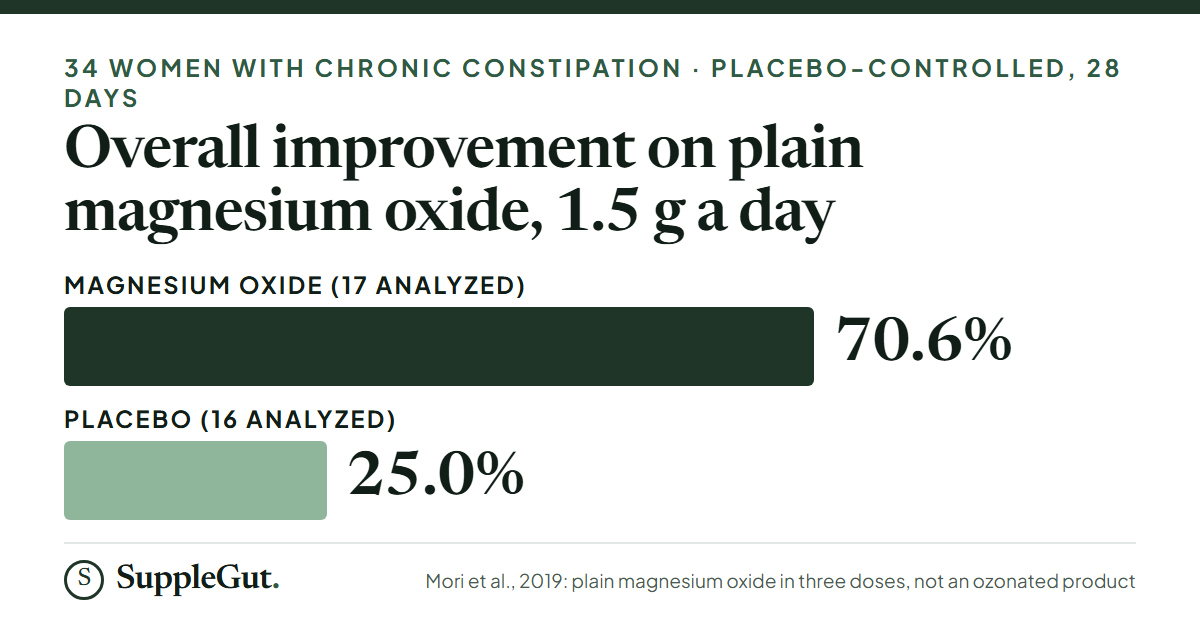
Does MagO7 work? No trial of MagO7 or of ozonated magnesium oxide exists. Plain magnesium oxide at 1.5 g a day beat placebo in two Japanese trials (70.6% against 25.0% improved in 34 women; 68.3% against 11.7% in 90 adults), and a 2023 pooled analysis gave a relative risk of response of 3.32. MagO7’s 1,035 mg of magnesium is about 1.7 g of the oxide, taken once at bedtime rather than in three doses, and it is 2.96 times NIH’s 350 mg upper limit for supplemental magnesium. Amazon shows 4.6 from 48,174 ratings.
MagO7 is a magnesium oxide capsule from NB Pure in Phoenix, sold as an overnight “cleanse” and for occasional constipation and bloating. What sets it apart from the magnesium oxide tablets on the next shelf is one word on the label, “ozonated”, and a serving of three capsules taken once at bedtime. This page sets out what is in it, what that word does and does not have behind it, what the constipation trials of plain magnesium oxide found, and where the dose sits against NIH’s upper limit.
What MagO7 is, and what “ozonated” means
The Supplement Facts panel, as printed in NIH’s label database, lists two lines per three-capsule serving: 1,035 mg of magnesium (246% of the daily value) as ozonated magnesium oxides, and 99 mg of potassium as potassium citrate. The other ingredients are organic rice flour, citric acid and the vegetable-cellulose capsule. It is not a proprietary blend. The label is a dietary-supplement label, not the Drug Facts panel an over-the-counter laxative carries.
The 1,035 mg is elemental magnesium: NIH’s fact sheet says a Supplement Facts panel declares the magnesium, not the weight of the whole compound. Magnesium is 60.3% of magnesium oxide by weight, so one serving is about 1.7 g of magnesium oxide (345 mg of magnesium per capsule).
“Ozonated” refers to MOXiO3, a registered trademark of IP Reserve, LLC, described on the label as “a proprietary process and blend of magnesium oxides standardized for oxygen content.” The brand says the oxides “carry oxygen” that releases over time. We could find no oxygen figure, specification or analysis for the material, and a PubMed search for “ozonated magnesium oxide” returned 21 records, all about water-treatment chemistry.
The trial of MagO7 itself
There is none. We searched PubMed for the ozonated form, for MagO7 and for Aerobic Life, the manufacturer Amazon names, and searched ClinicalTrials.gov for magnesium oxide and constipation; nothing tested MagO7 or ozonated magnesium oxide. The Amazon listing calls it “a clinically effective form of magnesium for constipation relief”; that sentence rests on trials of plain magnesium oxide, below. Whether the oxygen standardization changes the laxative effect at all is, from what we read, untested.
The evidence for plain magnesium oxide
Two placebo-controlled trials in Japan tested magnesium oxide at 1.5 g a day for 28 days, given as 0.5 g three times a day. In the first, 34 women with mild to moderate chronic constipation took magnesium oxide or placebo; overall improvement, the main outcome, was reported by 70.6% on magnesium oxide against 25.0% on placebo (P = 0.015). Spontaneous bowel movements and stool form improved and colonic transit time shortened, though the rate of complete spontaneous bowel movements was not significantly different (Mori et al., 2019).
In the second, 90 adults (mean age 42, 93% women) were split between senna 1.0 g, magnesium oxide 1.5 g and placebo. Overall improvement was 68.3% on magnesium oxide, 69.2% on senna and 11.7% on placebo (P < 0.0001); everyone completed, and no treatment-related adverse event was severe (Morishita et al., 2021). A 2023 pooled analysis of food, vitamin and mineral supplements for chronic constipation counted these as its only two magnesium oxide trials and found 68% responding against 19% on control (relative risk 3.32, 95% CI 1.59 to 6.92), with about 3.7 more bowel movements a week (van der Schoot et al., 2023). The 2025 British Dietetic Association guideline for chronic constipation has five statements on magnesium oxide, and its abstract does not say which evidence grade applies to them (Dimidi et al., 2025).
Two trials, both in Japan, both 28 days. They tested plain magnesium oxide, in three doses across the day. None tested an ozonated product or a single bedtime dose.
Label dose against trial dose
The trial dose of 1.5 g of magnesium oxide is about 905 mg of magnesium. MagO7’s three-capsule serving is 1,035 mg, about 1.14 times that, so at three capsules the label dose is in the trials’ range. At five capsules, the top of the range NIH’s database records (1,725 mg of magnesium, about 2.9 g of oxide), it is about 1.9 times the trial dose. The difference is the schedule: the trials split the dose into three, and MagO7 is taken once, at night.
How to take MagO7
The directions: 3 capsules at bedtime, on an empty stomach, with 8 to 12 ounces of water, for 7 to 10 days or until the desired effect. The label says to increase by up to 2 capsules if needed and to decrease for maintenance. Reviewers describe an effect by morning, and one reviewer suggests starting below three capsules.
Side effects, the upper limit and who should not take it
NIH sets the Tolerable Upper Intake Level for supplemental magnesium at 350 mg a day for adults, and the limit is based on diarrhea: the fact sheet says high doses from supplements or medications often cause diarrhea with nausea and abdominal cramping, and lists magnesium oxide among the forms most often reported to do so. One MagO7 serving is 2.96 times that limit; five capsules is 4.9 times. Looser stools are the intended effect here, and the brand says to use it for 7 to 10 days. NIH also reports toxicity with very large laxative or antacid doses, typically above 5,000 mg of magnesium a day.
Kidney and heart. NIH says the risk of magnesium toxicity rises with impaired kidney function. The Amazon listing’s safety text tells anyone with a cardiac history or kidney disease to consult a physician. The label records in NIH’s database carry the FDA disclaimer and no warning section, and we found no pregnancy, breastfeeding, medication or age statement on the label, Amazon or the brand page.
Medicines. Per NIH, magnesium can reduce absorption of oral bisphosphonates, the osteoporosis drugs, so take them at least 2 hours apart. It can bind tetracycline and quinolone antibiotics: take the antibiotic at least 2 hours before or 4 to 6 hours after magnesium.
What the reviews say
The brand’s own site shows 4.82 from 6,744 reviews on a widget it hosts (88.0% five-star), covering all sizes. Amazon shows 4.6 from 48,174 ratings (81% five-star, 9% four, 5% three, 1% two, 4% one), shared across sizes. We found no Trustpilot profile for the brand, and Reddit could not be read, so independent complaint records are an absence of data, not evidence either way. The brand’s “52,000+ 5-star reviews” line is larger than either platform’s five-star count, so it appears to combine platforms.
The praise: working overnight, no cramping for many, a bedtime routine for travel, and constipation tied to a weight-loss medicine. The complaints, among the 57 one- and two-star reviews on the brand widget, are mostly no effect (about 23 of 57), then cramping, gas, nausea or vomiting at the label dose, then a formula or capsule-size change that reviewers date to 2022 and 2023. On Amazon, value for money draws 557 positive and 433 negative mentions.
Subscription and refund terms
The brand site offers 25% off on subscription. Its subscription terms page is a generic template: orders can be changed or cancelled at any time through links in the confirmation emails. Its shipping policy says processed orders cannot be altered. Of the 57 one- and two-star reviews, 6 mention cancelling or a subscription; one buyer from TikTok Shop says orders kept arriving after cancelling there. The refund policy offers a full refund, excluding shipping, if you reach out within 60 days of purchase, starting with an email to cs@nbpure.com; return shipping is not refunded. Amazon lists Subscribe & Save with no fees and cancel anytime.
Who MagO7 is for
- Someone with occasional constipation who wants a once-a-night capsule and has no kidney or heart condition that calls for a doctor’s sign-off on magnesium.
- A person comfortable that the supporting trials are of plain magnesium oxide, not the ozonated form.
- Someone who can take it away from antibiotics and osteoporosis drugs by the gaps above.
For a daily, non-laxative approach, psyllium has its own evidence: see psyllium vs magnesium for constipation and the constipation treatments guide, and the catalog has NOW Foods Psyllium Husk Powder. For a magnesium without the oxygen claim, the catalog has Natural Vitality CALM, a magnesium citrate powder, and Nature Made Magnesium Oxide, a plain oxide tablet.
Cost
The 90-capsule bottle is $27.95 on the brand site and Amazon: $0.93 a day at three capsules, or about $1.55 a night at five (it lasts 18 nights). The brand’s subscription is $20.96, or $0.70 a day. Shipping is free over $49 and $5.99 under, so one bottle delivered is $33.94, $1.13 a day. The 180-capsule bottle is $41.95 ($0.70 a day), the 30-capsule bottle $19.95 (about $2.00 a day), and Amazon’s Subscribe & Save price for 90 capsules is $25.15.
The products in this catalog
Common questions
Does MagO7 work for constipation?
No trial of MagO7 itself exists. Plain magnesium oxide at 1.5 g a day improved symptoms in two placebo-controlled trials in Japan (70.6% against 25.0% in 34 women; 68.3% against 11.7% in 90 adults), and MagO7’s three-capsule serving is about 1.7 g of the oxide. Those trials gave it in three doses a day, and none tested an ozonated form. Amazon reviews average 4.6 from 48,174 ratings, and the brand site’s one- and two-star reviews are mostly “no effect”.
What is ozonated magnesium oxide, and is it different from plain magnesium oxide?
The label calls the form MOXiO3, a registered trademark described as a proprietary process and blend of magnesium oxides standardized for oxygen content, and the brand says the oxides carry oxygen that releases over time. No oxygen figure is printed, and we could find no study or analysis of the ozonated material. Whether it behaves differently from plain magnesium oxide is untested.
Is MagO7 safe, and is 1,035 mg of magnesium too much?
One serving carries 1,035 mg of magnesium, 2.96 times the 350 mg a day NIH sets as the upper limit for supplemental magnesium; five capsules is 4.9 times. NIH bases that limit on diarrhea, which is the intended effect here, and says nausea and abdominal cramping often come with it. The brand says to use MagO7 for 7 to 10 days or to decrease the serving for maintenance.
Can MagO7 be taken with kidney disease, antibiotics or osteoporosis drugs?
NIH says the risk of magnesium toxicity rises with impaired kidney function, and the Amazon listing tells anyone with a cardiac history or kidney disease to consult a physician. NIH also says magnesium can reduce absorption of oral bisphosphonates (take them at least 2 hours apart) and can bind tetracycline and quinolone antibiotics (take the antibiotic at least 2 hours before or 4 to 6 hours after). We found no pregnancy or breastfeeding statement on the label.
How do you take MagO7, and how many capsules?
The label says 3 capsules at bedtime on an empty stomach with 8 to 12 ounces of water, for 7 to 10 days or until the desired effect, adding up to 2 capsules if needed and decreasing for maintenance. Reviewers describe an effect by morning, and one suggests starting with fewer than three capsules. For other options see the constipation treatments guide.
What do MagO7 reviews say?
Amazon shows 4.6 from 48,174 ratings (81% five-star, 4% one-star) and the brand’s own widget 4.82 from 6,744 reviews. Reviewers praise an overnight effect without cramping; the complaints are no effect, cramping or vomiting at the label dose, and a formula or capsule-size change. We found no Trustpilot profile.
How much does MagO7 cost, and how do you cancel or get a refund?
The 90-capsule bottle is $27.95 one time, which is $0.93 a day at three capsules and about $1.55 a night at five; the brand’s subscription is $20.96 ($0.70 a day). The brand offers a refund excluding shipping within 60 days of purchase by emailing cs@nbpure.com. A few reviewers say a subscription kept shipping after they cancelled, including one who bought through TikTok Shop.
Sources
- Mori S, Tomita T, Fujimura K, et al. "A Randomized Double-blind Placebo-controlled Trial on the Effect of Magnesium Oxide in Patients With Chronic Constipation." Journal of Neurogastroenterology and Motility, 2019;25(4):563–575. doi.org/10.5056/jnm18194
- Morishita D, Tomita T, Mori S, et al. "Senna Versus Magnesium Oxide for the Treatment of Chronic Constipation: A Randomized, Placebo-Controlled Trial." American Journal of Gastroenterology, 2021;116(1):152–161. doi.org/10.14309/ajg.0000000000000942
- van der Schoot A, Creedon A, Whelan K, Dimidi E. "The effect of food, vitamin, or mineral supplements on chronic constipation in adults: A systematic review and meta-analysis of randomized controlled trials." Neurogastroenterology & Motility, 2023;35(11):e14613. doi.org/10.1111/nmo.14613
- Dimidi E, van der Schoot A, Barrett K, et al. "British Dietetic Association Guidelines for the Dietary Management of Chronic Constipation in Adults." Neurogastroenterology & Motility, 2025;37(12):e70173. doi.org/10.1111/nmo.70173
- NIH Office of Dietary Supplements. "Magnesium: Fact Sheet for Health Professionals": upper limit, diarrhea, kidney function and drug interactions. ods.od.nih.gov
- NIH Dietary Supplement Label Database, MagO7 label records: Supplement Facts panel and directions. dsld.od.nih.gov/label/296610, dsld.od.nih.gov/label/274604
- Brand page: label, directions, review widget, price and policies. nbpure.com; refund policy, shipping policy
- Amazon listing: price, ratings, safety information and review summary. amazon.com/dp/B000PKEJR0
Not sure which product fits your situation?
This guide covers the mechanics. The quiz takes your specific symptoms, routine and preferences and matches you to one product from the catalog.
Take the quiz →