
Guide
Does Omyo GLP-1 Digestive Support work? The 22-ingredient label, the herb trials and the subscription terms
Quick answer
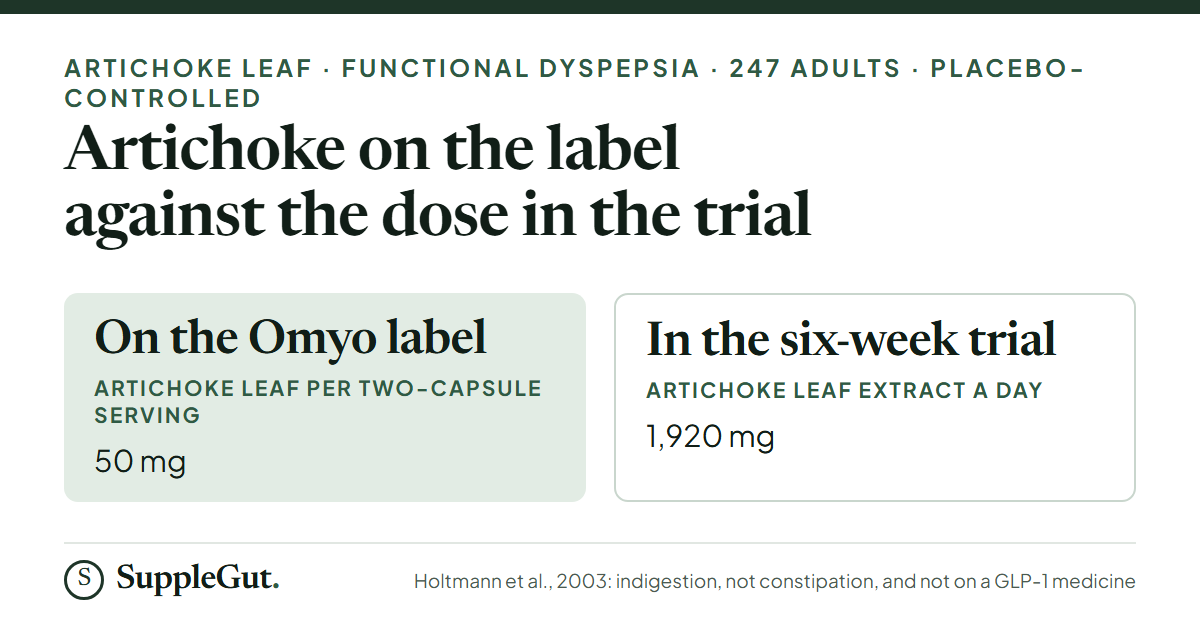
Does Omyo GLP-1 Digestive Support work? No trial of Omyo, or of any of its herbs in GLP-1 constipation, exists that we could find. Artichoke leaf extract helped 247 people with indigestion at 1,920 mg a day, and the label lists artichoke at 50 mg. The panel prints 22 ingredients where the brand’s copy says 14, and ginger and turmeric sit in a 571 mg blend of 13 with no amounts. Standard guidance for GLP-1 constipation centers on fluids, fiber, stool softeners and PEG 3350.
Omyo GLP-1 Digestive Support is a 60-capsule bottle of herbs, amino acids and zinc, sold by DTC Labs LLC for the constipation, nausea and bloating that can come with GLP-1 medicines. What sets it apart from a fiber or a laxative is the explanation the brand gives: that these medicines lower bile flow, and that bile-stimulating herbs put it back.
What Omyo is, and the 14-versus-22 question
The brand’s page says Omyo is “built from 14 natural, clinically studied ingredients”. The Supplement Facts panel lists 22: nine with amounts and 13 inside a proprietary blend. A serving is two capsules.
| Panel line | Per serving |
|---|---|
| Zinc (as zinc oxide) | 30 mg (273% of the Daily Value) |
| Milk thistle seed | 200 mg |
| Beet root, artichoke leaf, Phyllanthus, dandelion root, chicory root, yarrow flowers, jujube seed | 50 mg each |
| Proprietary blend of 13: celery seed, alfalfa, burdock, yellow dock, methionine, grape seed, L-cystine, feverfew, choline, turmeric, raspberry, barberry extract, ginger | 571 mg together |
Eight panel ingredients are never named in the page copy: Phyllanthus, celery seed, alfalfa, yellow dock, methionine, L-cystine, feverfew and raspberry. Ginger and turmeric, the two the ads lead with, sit in the blend with no amounts; 571 mg across 13 ingredients averages at most 43.9 mg each, and the label does not say the order is by weight. It does not say whether each herb is a powder or an extract.
The brand’s age and who sells it
The terms of service name DTC Labs LLC of Sheridan, Wyoming. The domain was registered on 5 March 2026, the brand’s earlier product, a multivitamin, was created on 7 March 2026, and the Omyo product page was created on 30 September 2026 and published on 1 October. The page says “55,000+ Happy Customers” and “#1 Supplement for GLP-1 users”. The manufacturer and testing lab are not named, although the page states third-party testing and a GMP, FDA-registered facility. Amazon carries three listings using the Omyo name under three different brand and seller names, none of them DTC Labs; whether any is the brand’s own channel is unconfirmed.
Is there a trial of Omyo?
No. We searched PubMed and the brand’s site. The page offers a 2025 customer survey (94% reported more regular bowel movements within two weeks, 91% less nausea within 30 days, 82% less bloating) with no sample size and no comparison group.
What the herbs have been tested for
The trials we found are of single herbs, mostly in functional dyspepsia (indigestion without a structural cause), at other doses and forms. None tested GLP-1 constipation.
| Herb | On the label | Best trial found |
|---|---|---|
| Artichoke leaf | 50 mg, form not stated | 247 people, six weeks, 1,920 mg of extract a day: symptom improvement 8.3 against 6.7 on placebo (Holtmann et al., 2003) |
| Ginger | In the 571 mg blend | 11 people, a single 1.2 g dose: stomach half-emptying in 12.3 minutes against 16.1, with no change in symptoms (Hu et al., 2011) |
| Ginger plus artichoke | As above | 126 people, four weeks, a combined extract: better than placebo at two weeks, no difference at the end; authors tied to the extract supplier (Giacosa et al., 2015) |
| Turmeric | In the blend | 31 women with a BMI of 40 or more, 1,500 mg curcumin for 13 weeks: constipation subscale improved (Kattah et al., 2025) |
The artichoke on the label is about 1/38 of the trial amount, and even if the whole blend were ginger it would be under half the 1.2 g dose. A review of 26 turmeric studies in digestive disorders found most at high risk of bias and efficacy “unclear” (Thavorn et al., 2024). We found no constipation or dyspepsia trial for milk thistle, dandelion, beet, yarrow, jujube, burdock, Phyllanthus, celery seed, alfalfa, raspberry or grape seed.
The bile-flow explanation, and what guidance says
The page says GLP-1 medicines slow gastric emptying, which “causes bile flow to drop dramatically”, and that fiber and laxatives “don’t fix it”. It cites no source, and a PubMed search for GLP-1, bile flow and constipation returned nothing. The slowing of gastric emptying is documented. The biliary finding runs the other way: a meta-analysis of 76 trials in 103,371 people found GLP-1 medicines raised gallbladder and biliary disease (RR 1.37; 2.29 in weight-loss trials) (He et al., 2022).
A 2022 expert consensus puts constipation at 4 to 12% of patients overall and 12 to 37% in the semaglutide 2.4 mg program, often in the first 16 weeks, with a median duration of 47 days in people with obesity. Its advice is fiber, water or other sugar-free fluids, activity, stool softeners and a lower dose if symptoms worsen (Gorgojo-Martínez et al., 2022). A Bayer-funded 2026 AAFP bulletin names PEG 3350 as the usual first choice, stimulant laxatives as rescue and magnesium citrate for severe cases, advises against psyllium in gastroparesis, and says much of the guidance reflects expert consensus rather than trials. We found no source recommending bile-promoting herbs. The evidence-graded options are in the constipation treatments guide.
Safety and who should check first
We found no printed warnings on the bottle images. The brand’s terms say to consult a physician if pregnant, nursing, on medication or with a medical condition, and its FAQ says Omyo “will not interfere with your GLP-1”; no interaction study exists. Points from other references:
- Yellow dock root contains anthraquinones, the class senna belongs to; one monograph lists no clinical data and calls it possibly unsafe in pregnancy and breastfeeding. The brand says Omyo is “not a laxative”; the amount in the blend is not printed.
- Feverfew may raise bleeding risk with anticoagulants, and stopping after long use can cause stiffness, anxiety, headache and nausea (Memorial Sloan Kettering).
- Artichoke is listed in herbal references as contraindicated in bile-duct obstruction, with gallstones a reason to seek advice. The page says nothing on gallbladder disease.
- Daisy family: milk thistle, artichoke, dandelion, chicory, yarrow, burdock and feverfew all belong to it; the label carries no allergy line and no allergen statement of any kind.
- Zinc is 30 mg a day, against an adult upper limit of 40 mg from all sources.
How to take it
Two capsules daily with water, preferably before bed; the label gives no food instruction. The brand says most people notice a change in the first week, with full benefit over 60 days. The 2022 consensus above puts the median duration of GLP-1 constipation at 47 days in people with obesity.
What the reviews say
The brand’s site shows 4.8 from 2,814 reviews, with a breakdown that sums to 2,848. The widget says it “has no reviews of its own” and that the merchant grouped it with related products; the brand’s only other product is a multivitamin. On Amazon, one listing shows 5.0 from 4 ratings, all dated 2 October 2026, 11 days after its first-available date, from a third-party seller. The other two listings have no ratings. We could not read Trustpilot (a bot check) and found no Better Business Bureau results.
Reviewers praise regularity returning within days to weeks, less nausea, burping and bloating, and small capsules. They report no effect, one finds every other day enough, and 3 of the 36 widget reviews we read concern cancelling or monthly cost.
Cost, subscription and refund terms
One bottle is $59.99 one time ($2.00 a day), or $149.97 for three ($1.67). The page loads with the monthly auto-refill selected at $39.99 ($1.33 a day); the one-time option is labeled “no free gifts” and the gifts show as locked until the subscription box is ticked. The page’s own plan data lists the monthly plan at $49.99 ($1.67 a day) and the quarterly at $99.99, against $89.99 shown; whether the $10 coupon applies to renewals is not stated. Free shipping starts at $50.
The “60-Day Money Back Guarantee” applies, per the refund policy, to the first order only, less $5, excludes shipping and sale items (the product is on a “Fall Sale”), and needs no return. The policy also says the brand does “not cancel subscriptions for customers” and points to an account portal. The footer’s “Cancellation policy” link returns a 404 page, as does the same name under the store’s pages path. A third-party Amazon listing is $26.99 for 60 capsules ($0.90 a day) and non-returnable.
Who Omyo is for
- Someone whose prescriber has agreed to a botanical capsule alongside the GLP-1 medicine and who has none of the cautions above.
- Someone who prefers one bedtime capsule to a powder.
- Someone comfortable with ginger and turmeric amounts that are not printed.
For ingredients with their own constipation trials, the catalog has NOW Psyllium Husk Powder and Natural Vitality CALM magnesium. Ginger appears in the AAFP bulletin only as an alternative for nausea; the catalog page is Nature’s Way Ginger Root.
The products in this catalog
Common questions
Does Omyo GLP-1 Digestive Support work?
No trial of Omyo exists that we could find. The brand cites a 2025 customer survey with no sample size or comparison group, and the herbs it names have been tested for indigestion at larger doses, not for GLP-1 constipation. Reviews on the brand’s own site average 4.8 and are mostly positive, with some reports of no effect. See the constipation treatments guide for options with trials.
What is in Omyo, and why does the label list 22 ingredients when the page says 14?
A two-capsule serving has 30 mg zinc, 200 mg milk thistle seed, 50 mg each of beet, artichoke leaf, Phyllanthus, dandelion root, chicory root, yarrow and jujube seed, and a 571 mg blend of 13 ingredients with no individual amounts, including ginger, turmeric, barberry extract, yellow dock and feverfew. The page copy names 14 and leaves out eight that the panel prints.
Is Omyo safe with Ozempic, Wegovy, Mounjaro or Zepbound?
The brand says it will not interfere with a GLP-1 medicine, but no interaction study exists and we found no printed warnings on the bottle images. It contains yellow dock (an anthraquinone-containing root), feverfew (bleeding-risk and pregnancy cautions), artichoke (bile-duct and gallstone cautions) and 30 mg of zinc, and GLP-1 medicines themselves raise gallbladder and biliary disease risk (RR 1.37 in a 76-trial meta-analysis). The brand’s terms say to consult a physician if pregnant, nursing, on medication or with a medical condition.
What helps constipation on a GLP-1 medicine?
A 2022 expert consensus lists fiber, water or other sugar-free fluids, activity, stool softeners and a lower GLP-1 dose if symptoms worsen. A Bayer-funded 2026 AAFP bulletin names PEG 3350 as the usual first choice and says much of the guidance is expert consensus rather than trial evidence. We found no source recommending bile-promoting herbs. See the constipation treatments guide.
How do you take Omyo, and how long does it take?
The label says two capsules daily with water, preferably before bed, with no food instruction. The brand says most people notice a change in the first week and full benefits over 60 days. The 2022 consensus puts the median duration of GLP-1 constipation in people with obesity at 47 days.
How much does Omyo cost, and how does the subscription work?
One bottle is $59.99 one time ($2.00 a day) or $39.99 as a monthly auto-refill, which is the option selected when the page loads; the page’s own plan data lists $49.99. Three bottles are $149.97 one time or $89.99 quarterly. The footer’s cancellation-policy link returns a 404 page, and the refund policy says the brand does not cancel subscriptions and points to an account portal.
What is the refund policy, and who makes Omyo?
The 60-day guarantee covers the first order only, less $5, excludes shipping and sale items, and needs no return. The terms name DTC Labs LLC of Sheridan, Wyoming; the domain was registered in March 2026 and the product page was created on 30 September 2026. No manufacturer or lab is named, and Amazon lists three Omyo products from three different third-party sellers.
Sources
- Gorgojo-Martínez JJ, Mezquita-Raya P, Carretero-Gómez J, et al. “Clinical Recommendations to Manage Gastrointestinal Adverse Events in Patients Treated with Glp-1 Receptor Agonists: A Multidisciplinary Expert Consensus.” Journal of Clinical Medicine, 2022;12(1):145. doi.org/10.3390/jcm12010145
- AAFP funded educational content (Bayer). “Managing Constipation in GLP-1 Receptor Agonist Therapy.” aafp.org
- He L, Wang J, Ping F, et al. “Association of Glucagon-Like Peptide-1 Receptor Agonist Use With Risk of Gallbladder and Biliary Diseases: A Systematic Review and Meta-analysis of Randomized Clinical Trials.” JAMA Internal Medicine, 2022;182(5):513–519. doi.org/10.1001/jamainternmed.2022.0338
- Holtmann G, Adam B, Haag S, et al. “Efficacy of artichoke leaf extract in the treatment of patients with functional dyspepsia: a six-week placebo-controlled, double-blind, multicentre trial.” Alimentary Pharmacology & Therapeutics, 2003;18(11–12):1099–1105. doi.org/10.1046/j.1365-2036.2003.01767.x
- Giacosa A, Guido D, Grassi M, et al. “The Effect of Ginger (Zingiber officinalis) and Artichoke (Cynara cardunculus) Extract Supplementation on Functional Dyspepsia.” Evidence-Based Complementary and Alternative Medicine, 2015;2015:915087. doi.org/10.1155/2015/915087
- Hu ML, Rayner CK, Wu KL, et al. “Effect of ginger on gastric motility and symptoms of functional dyspepsia.” World Journal of Gastroenterology, 2011;17(1):105–110. doi.org/10.3748/wjg.v17.i1.105
- Kattah FM, Figueiredo N, Bezerra KK, et al. “Curcumin Supplementation Improves Gastrointestinal Symptoms in Women with Severe Obesity.” Nutrients, 2025;17(13):2064. doi.org/10.3390/nu17132064
- Thavorn K, Wolfe D, Faust L, et al. “A systematic review of the efficacy and safety of turmeric in the treatment of digestive disorders.” Phytotherapy Research, 2024;38(6):2687–2706. doi.org/10.1002/ptr.8189
- Memorial Sloan Kettering Cancer Center, “Feverfew.” mskcc.org; Drugs.com, “Yellow Dock.” drugs.com
- Brand page: label, claims, price and survey (omyohealth.com/products/glp1-digestive-support); refund policy (omyohealth.com/policies/refund-policy); Amazon listing: price and ratings (amazon.com/dp/B0HKJRW1WD)
Not sure which product fits your situation?
This guide covers the mechanics. The quiz takes your specific symptoms, routine and preferences and matches you to one product from the catalog.
Take the quiz →