
Guide
Does Orange Burps work? The 2002 patent behind the 89%, the dosing and what reviewers say
Quick answer
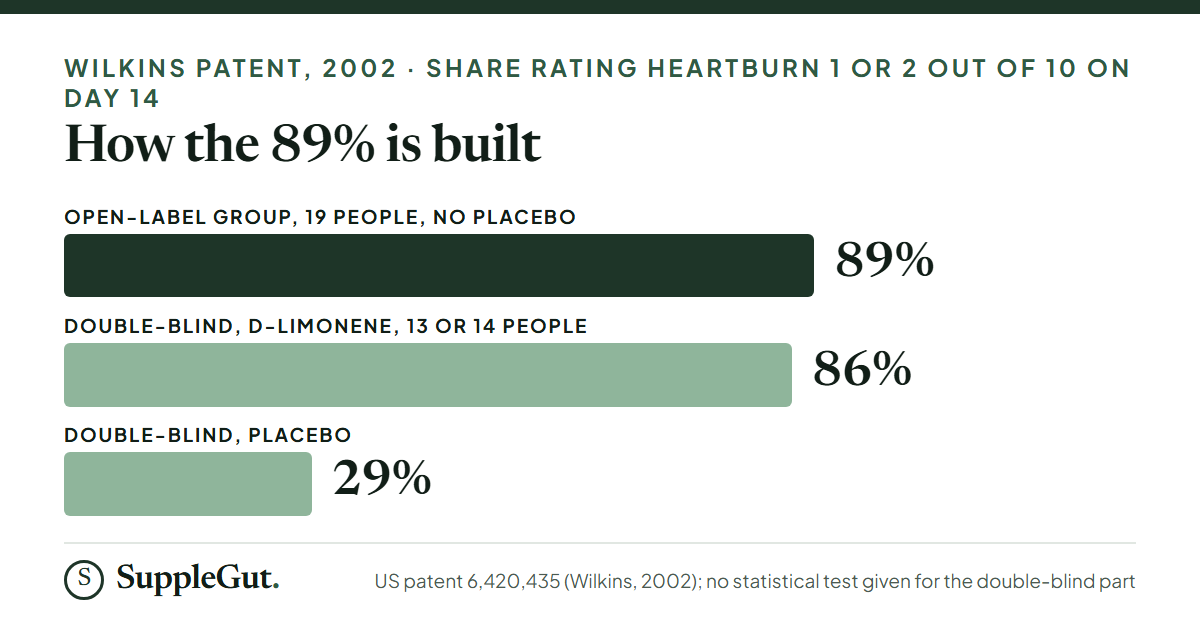
Does Orange Burps work? No trial of Orange Burps itself was found. The “89% in 14 days” comes from a 2002 U.S. patent, not a journal paper: 89% of 19 adults in an open-label group, with no placebo, rated their heartburn 1 or 2 out of 10 on day 14. The patent’s separate double-blind part had 13 or 14 people (86% against 29% on placebo, no statistical test given). The brand’s ads join the 89% to the words double-blind, and we found no peer-reviewed publication of either part.
Orange Burps is a softgel of one ingredient, d-limonene, the main aroma compound in orange peel oil, sold by MIH Products LLC of Plainfield, Illinois. The brand says it does not reduce stomach acid; it says the citrus burps the softgel causes carry the oil up the esophagus. The evidence it points to is a 2002 patent. This page sets out what the patent contains, what the label prints, and how the schedule and the reviews compare.
What Orange Burps is, and what the label prints
Each softgel is 500 mg of d-limonene. The panel’s serving is 2 softgels, 1,000 mg, and a 40-softgel bottle holds 20 servings. There is one active and no blend. The other ingredients are gelatin (bovine, the brand says), glycerin, purified water and annatto extract, so it is not vegetarian. The brand says the d-limonene is steam distilled from orange peels, while one of its ads says cold-pressed. The purity is not printed, whereas the capsules in the patent were 98.5% to 99.3% pure. We found no testing laboratory or certificate; the brand says only that it is made in a GMP facility in the USA. Amazon files the listing under antacids, but the panel reads Supplement Facts.
What the brand claims
| Brand claim | What we found |
|---|---|
| “89% Reported Relief In 14 Days — In A Double-Blind Clinical Study” (homepage and ads) | The 89% is the open-label part of a patent, with no placebo (below). |
| “90% Of People Had Full Relief” | The pages we read name no study for it. The patent’s complete-relief figure at day 14 was 79%. |
| “Clinically proven” to target heartburn “for six months or longer” | A six-month follow-up appears as a secondary outcome in a 2007 registry record with no results, not in the patent’s examples. |
The brand’s own blog calls the study “open-label” and says it “lacked a placebo arm”; its homepage and ads do not.
The patent behind the 89%
“Wilkins 2002”, the study the brand’s blog cites, is not a journal paper. It is US patent 6,420,435, “Method for treating gastrointestinal disorders”, inventor Joe S. Wilkins Jr., filed in October 2000 and granted on 16 July 2002. It has two human examples.
Example 1 was uncontrolled. It describes 19 adults with chronic heartburn or GERD of at least five years, who stopped their usual treatment at least a day before starting. Eleven took one capsule every other day for 20 days and five took one daily for 16 to 20 days; the text does not account for the other three. Each capsule was 1,000 mg of d-limonene. Participants rated severity from 1 (complete relief) to 10. The share rating 1 or 2 was 32% on day 2, 63% on day 7 and 89% on day 14; the share rating 1 alone was 79% on day 14.
Example 2 was the “preliminary double-blind placebo study”. The text says 13 participants, 7 on the product and 6 on placebo, and the next sentence says n=14. The placebo was a gelatin capsule of soybean oil. The share rating 1 or 2 on days 4, 7, 9 and 14 was 29%, 29%, 71% and 86% on d-limonene against 0%, 14%, 29% and 29% on placebo. Those percentages fit 6 of 7 against 2 of 7, which matches n=14. The patent calls the difference significant but gives no statistical test or p-value, and does not describe how people were allocated or blinded.
The patent does not say where the studies were run, who rated what, when they took place, whether an ethics board approved them, or who paid. So the 89% is the 19-person open-label figure. The brand’s ad line “89% reported relief in 14 days, double-blind placebo-controlled clinical study” joins that figure to the double-blind description.
We found no peer-reviewed publication of either part. PubMed has no Wilkins record on d-limonene and heartburn. The brand’s blog says the study appeared in Alternative Therapies in Health and Medicine in 2002 and that a 2005 monograph from WRC Laboratories repeated it in 13 subjects; we could not match either. A 2006 Life Extension magazine article calls the work “anecdotal and as yet unpublished” and gives different numbers for the controlled phase (22 people, 83% at severity 2 or below).
A related registry record, ISRCTN96109983, lists a randomized double-blind placebo-controlled d-limonene study sponsored by WRC Laboratories, enrolling from September 2000 to June 2001 with a target of 50 adults, registered retrospectively in August 2007. Its status is completed, and no results are posted. It does not say whether it is the patent’s Example 2.
What else is known about d-limonene
We found no randomized, peer-reviewed trial of d-limonene alone in reflux, heartburn or dyspepsia. A 2022 trial in 56 people with IBS, some with functional dyspepsia, added a supplement of menthol, limonene and gingerol to standard treatment for 30 days; symptom scores were lower than placebo (P=0.009), but limonene cannot be separated from the other two ingredients (Ivashkin et al., 2022). A 2008 report describes one woman whose symptoms returned after each of three 20-day trials of a proprietary d-limonene blend when she tried to stop her PPI (Werbach, 2008). We found no human study of the coating-by-burping mechanism the brand describes.
Safety and who should check first
D-limonene is listed as generally recognized as safe as a flavoring and appears in juices, soft drinks and baked goods; a 2007 review calls its toxicity “fairly low” and found low toxicity in humans after single and repeated dosing for up to one year (Sun, 2007). The patent’s text says 98% purity d-limonene reduced side effects such as diarrhea and headache in some people, and one ad says “No side effects”.
The brand tells anyone with a medical condition or taking medication to consult a healthcare professional, and anyone using it for an extended period to do the same. We found no pregnancy, breastfeeding or age statement on the label, product page or Amazon. The common report is citrus burps and aftertaste. Softgels can melt together in heat; the brand advises a cool, dry place.
How to take Orange Burps
The label says 1 or 2 softgels daily or every other day, then as needed, and says users typically see results after several days. The brand’s product page cites 1,000 mg (2 softgels) every other day for 20 days as the dose trials suggest, which is the patent’s regimen. Two brand ads say one softgel, which is 500 mg, half that dose; we found no study of a single 500 mg softgel. With food is not stated on the label. The patent’s results are for 14 to 20 days.
What the reviews say
The brand’s own widget shows 4.3 from 78 reviews. Amazon shows 3.8 from 2,523 ratings (52% five-star, 16% one-star), with review text behind a sign-in. Walmart shows 4.6 from 984 reviews, one figure shared across five pack listings. Trustpilot has one review. The homepage says “5,000+ Verified Reviews”; the counts above add up to 3,585.
Reviewers praise heartburn and night-time reflux easing within days to weeks, taking one a day or only as needed after the first course, and an easy-to-swallow softgel in place of antacids. They complain of the orange burps and aftertaste, softgels melting together in hot shipping, and, for some, no effect or worse symptoms.
Cost, subscription and refund terms
| Option (brand site) | Price | Per bottle |
|---|---|---|
| 1 bottle, 40 softgels | $29.49 | $29.49 |
| 3 bottles | $79.47 | $26.49 |
| 5 bottles | $117.45 | $23.49 |
| 1 bottle, subscription (15% off) | $25.07 | $25.07 |
At the label serving of 2 softgels, every other day costs $0.74 a day (a bottle lasts 40 days) and every day costs $1.47. The 20-day course is 10 servings, $14.75. Amazon lists $29.49, or $26.54 on Subscribe & Save. Shipping is free over $30, and the page does not state the charge below that.
The brand states a 30-day money-back guarantee. Its refund policy refunds the first bottle, minus shipping, without a return; further bottles must be sealed and returned within 30 days of approval with a pre-paid label, and you start by email. Amazon marks the listing non-returnable. We found no independent billing complaints, though Amazon review text was not readable.
Who Orange Burps is for
- Someone who wants a single-ingredient softgel and understands the evidence is a patent filing.
- A person who can tolerate citrus burps and has checked with a clinician if on medication.
The reflux guide covers the options with their own evidence. Other pages are Natural Factors Chewable DGL, a licorice with the glycyrrhizin removed that has its own small dyspepsia trials, and Hartspan KHelp. We found no trial comparing any of them with d-limonene.
The products in this catalog
Common questions
Does Orange Burps work?
No trial of Orange Burps itself was found. The “89% in 14 days” comes from a 2002 patent in which 89% of 19 people in an open-label group, with no placebo, rated their heartburn 1 or 2 out of 10 on day 14; a double-blind part with 13 or 14 people gave 86% against 29% on placebo. Amazon shows 3.8 from 2,523 ratings and Walmart 4.6 from 984, with some reviewers reporting relief within days to weeks and others no effect.
Is the Orange Burps 89% from a double-blind study?
The 89% comes from the open-label part of the patent, which had 19 people and no placebo group. The double-blind part had 13 or 14 people and a day-14 result of 86% against 29% on placebo, with no statistical test given. The brand’s ads join the 89% to “double-blind placebo-controlled”, and we found no peer-reviewed publication of either part.
What are the Orange Burps side effects, and is it safe long term?
The common report is citrus-flavored burps or aftertaste. D-limonene is a GRAS food flavoring, and a 2007 review found low toxicity in humans after dosing for up to a year. The brand says to consult a healthcare professional with a medical condition, on medication or before extended use; we found no pregnancy statement, and the softgel is bovine gelatin.
How do you take Orange Burps, every other day or daily?
The label says 1 or 2 softgels daily or every other day, then as needed. The dose the brand cites from trials is 2 softgels (1,000 mg) every other day for 20 days. Two ads show one softgel, which is 500 mg, half that dose, and the label does not say whether to take it with food.
How much does Orange Burps cost per day?
One bottle of 40 softgels is $29.49. At the label serving of 2 softgels that is $0.74 a day every other day, or $1.47 a day if taken daily, and the 20-day course of 10 servings is $14.75. Subscribing on the brand site takes 15% off, which is $25.07 a bottle.
Orange Burps vs DGL: how do they compare?
Orange Burps has one ingredient, d-limonene, and its evidence is a patent filing with 19 and 13 or 14 participants. DGL is deglycyrrhizinated licorice, a different ingredient with its own small dyspepsia trials. We found no trial comparing them; see the reflux guide for the options.
Who sells Orange Burps, and what is the refund policy?
It is sold by MIH Products LLC of Plainfield, Illinois, on the brand site, Amazon and Walmart. The 30-day guarantee refunds the first bottle, minus shipping, without a return, and further bottles only if sealed and returned within 30 days. Amazon marks the listing non-returnable, and the brand tells buyers whose softgels melted in shipping to email info@orangeburps.com.
Sources
- Wilkins JS Jr. "Method for treating gastrointestinal disorders." US Patent 6,420,435 B1, granted 16 July 2002. patents.google.com/patent/US6420435B1
- ISRCTN96109983. "A randomised double blind placebo controlled study to evaluate the effectiveness of purified d-Limonene as an agent to relieve the symptoms of indigestion and heartburn." Sponsor WRC Laboratories LP. isrctn.com/ISRCTN96109983
- Ivashkin VT, Kudryavtseva AV, Krasnov GS, et al. "Efficacy and safety of a food supplement with standardized menthol, limonene, and gingerol content in patients with irritable bowel syndrome: A double-blind, randomized, placebo-controlled trial." PLoS One, 2022;17(6):e0263880. doi.org/10.1371/journal.pone.0263880
- Sun J. "D-Limonene: safety and clinical applications." Alternative Medicine Review, 2007;12(3):259–264. PMID 18072821
- Werbach MR. "Melatonin for the treatment of gastroesophageal reflux disease." Alternative Therapies in Health and Medicine, 2008;14(4):54–58. PMID 18616070
- Life Extension Magazine, 2006, heartburn cover story. lifeextension.com
- Brand pages: homepage, label, directions, claims and price (orangeburps.com/products/orangeburps); blog posts citing the study (dlim-vs-dgl-licorice, ppi-alternatives); refund policy (orangeburps.com/policies/refund-policy)
- Amazon listing: price and ratings (amazon.com/dp/B07CRRCK36); Walmart brand page: ratings (walmart.com/c/brand/orange-burps); Trustpilot (trustpilot.com/review/orangeburps.com)
Not sure which product fits your situation?
This guide covers the mechanics. The quiz takes your specific symptoms, routine and preferences and matches you to one product from the catalog.
Take the quiz →