
Guide
Does Silver Fern Gut Repair work? The 5 g scoop, three sets of directions and what the glutamine trials say
Quick answer
Does Silver Fern Gut Repair work? No trial of Gut Repair itself exists that we could find. One scoop holds 5 g of L-glutamine; the placebo-controlled trial in post-infectious IBS-D used 15 g a day for 8 weeks (79.6% against 5.8% responders), and a 10-trial meta-analysis found no overall change in gut permeability, with an effect only above 30 g a day. The label, the brand page and Amazon give three different directions, from 5 g to 20 g of glutamine and 15 mg to 60 mg of zinc a day. Reviews run 4.04 from 198 on the brand’s site and 4.1 from 344 on Amazon.
Silver Fern Gut Repair is a tub of powder from Silver Fern Brand, LLC. A 5 g scoop is almost all L-glutamine, with 100 mg of a hydrogenated turmeric extract, zinc bound to carnosine and vitamin C added. What sets it apart from a plain glutamine powder is those three extras; what sets it apart on the page is that the label, the brand page and Amazon each give a different number of scoops to take. This guide sets out the label, the dose arithmetic, the trials, the reviews and the terms.
What Gut Repair is, and what it is not
One scoop (5 g, 30 to a tub) lists four actives, each with its own amount, so it is not a proprietary blend: L-glutamine 5 g, Curcumin C3 Reduct turmeric rhizome extract 100 mg, zinc as zinc L-carnosine 15 mg (136% of the Daily Value) and vitamin C 100 mg (111%). The label shows no other-ingredients line, no flavor or sweetener, no allergen or free-from statement and no named testing lab. Reviewers describe an unflavored powder with a strong taste. It has no bacteria in it, so it is not a probiotic, and it is not a fiber.
Three sets of directions
The label image says to mix one scoop into 8 ounces of water, take it twice a day and at least half an hour before eating. The brand page says one scoop a day for maintenance and two scoops a day for a “loading” period of 14 to 28 days. The Amazon description says one scoop a day, or four scoops a day for 7 to 28 days for urgent support. What each instruction delivers per day:
| Per day | 1 scoop | 2 scoops (label) | 4 scoops (Amazon loading) |
|---|---|---|---|
| L-glutamine | 5 g | 10 g | 20 g |
| Curcumin C3 Reduct | 100 mg | 200 mg | 400 mg |
| Zinc | 15 mg | 30 mg | 60 mg |
| Vitamin C | 100 mg | 200 mg | 400 mg |
The zinc arithmetic: the 15 mg is elemental zinc (15 mg against an 11 mg Daily Value is the printed 136%). The adult upper intake level from the NIH Office of Dietary Supplements is 40 mg a day, so two scoops is 30 mg and four scoops is 60 mg, 1.5 times that level. The label carries no zinc-intake statement; its only caution is the general one for pregnancy, nursing, under 18 and known medical conditions.
The trial of the product itself
We found none. We searched PubMed and ClinicalTrials.gov, and the brand page names no study; its only reference is a footnote saying the curcumin absorption claims come from laboratory or pre-clinical studies. We also found no trial of glutamine, curcumin and zinc together.
The glutamine evidence: dose and population
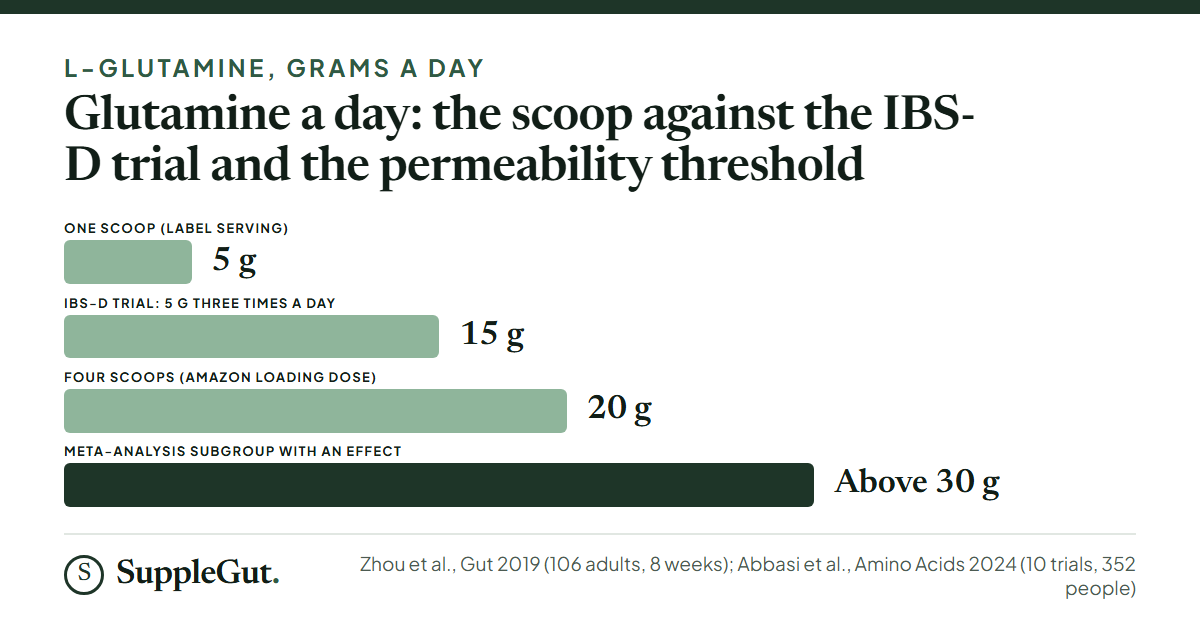
The strongest result is a double-blind trial in adults with post-infectious, diarrhea-predominant IBS and increased intestinal permeability. They took 5 g of glutamine three times a day (15 g a day) or placebo for 8 weeks, and 106 completed. A symptom-score drop of 50 points or more occurred in 43 of 54 (79.6%) on glutamine against 3 of 52 (5.8%) on placebo; adverse events were low and similar. It was funded by the US government and NIH (Zhou et al., 2019).
The comparison to the scoop: one scoop is a third of that dose and two scoops two-thirds; four scoops (20 g) is more than the trial but is a different population and used glutamine alone, without curcumin, zinc or vitamin C. The brand page itself says a high daily dose of glutamine “can range from 20 to 30 grams per day”.
On the gut-barrier idea behind the product, a 2024 meta-analysis of 10 placebo-controlled trials (352 people, mixed conditions, published 1998 to 2014) found no overall change in gut permeability with glutamine (weighted mean difference -0.00, 95% CI -0.04 to 0.03). Only the subgroup taking more than 30 g a day showed a reduction; the interval printed in the abstract for that subgroup does not bracket its estimate, so we do not quote it (Abbasi et al., 2024). Every dose on this label, 5 to 20 g, is below that subgroup.
The curcumin extract: C3 Reduct
Curcumin C3 Reduct is not ordinary curcumin. Sabinsa makes it by catalytic hydrogenation of curcuminoids, standardized to at least 95% tetrahydrocurcuminoids, and it is colorless. The supplier lists a dosage range of 100 to 200 mg and no studies. A positive novel food opinion in Great Britain (announced 8 June 2026) sets a maximum of 140 mg a day for adults; at the label’s twice-a-day direction the extract is 200 mg. A PubMed search for the extract returned zero records.
Turmeric in general has a mixed record. A systematic review of 26 studies of turmeric in digestive disorders found most had a high risk of bias and effects that were inconsistent outside IBD and IBS (Thavorn et al., 2024). An umbrella review of IBS nutrition trials found curcumin improved symptom severity with small effects and low to very low certainty (Zeraattalab-Motlagh et al., 2025). One 99-person IBS trial of a different curcumin product, Xanthofen, saw scores fall 113.0 against 38.7 on placebo over 8 weeks (Alt et al., 2017). None of these tested 100 mg of tetrahydrocurcuminoids.
Zinc carnosine and vitamin C
The best-known zinc carnosine study is a randomized crossover in ten healthy volunteers who took indomethacin, a drug that raises gut permeability, for 5 days. With 37.5 mg of zinc carnosine twice a day the lactulose:rhamnose ratio did not rise significantly; on placebo it rose from 0.35 to 0.88. The authors concluded further studies are warranted (Mahmood et al., 2007). The label prints elemental zinc, not the weight of the compound. On our arithmetic, at about 22% zinc, 15 mg of zinc is roughly 70 mg of compound per scoop, close to the trial’s 75 mg a day, but that is a calculation, not a printed figure. We did not look for gut trials of vitamin C.
Side effects and who should not take it
The label says pregnant or nursing mothers, children under 18 and anyone with a known medical condition should consult a physician. It names no medicine, gallbladder or surgery caution. The reviews below report diarrhea, cramps, bloating, heartburn and a stronger reaction in single cases. One reviewer reports stopping because of an allergy to larch, which the label does not address.
What the reviews say
The brand’s own widget shows 4.04 from 198 reviews (120 five-star, 22 four, 22 three, 11 two, 23 one; 178 flagged verified buyers). Half are from 2020 and 2021, and 6 are from 2026. Amazon shows 4.1 from 344 ratings (62% five-star, 12% four, 14% three, 5% two, 7% one), with the review text behind a sign-in. Trustpilot has two brand-wide reviews, both five-star.
The praise is less bloating, a simple, short formula, and progress when used with other Silver Fern products, which means the effect of this one cannot be read separately. The complaints are the taste and powder that does not dissolve (about 20 of 198), no noticeable effect (56 of 198 are three stars or lower), and digestive upset in a minority.
Cost, subscription and refund terms
The brand’s one-time price for a 30-scoop tub is $31.71; subscriptions take 15% off and the brand says to modify, pause or cancel at any time. Free shipping starts at $49. Per day:
| Option | Price | 1 scoop a day | 2 scoops a day |
|---|---|---|---|
| Brand, 1 tub, one time | $31.71 | $1.06 | $2.11 |
| Brand, 4-pack, one time | $94.06 | $0.78 | $1.57 |
| Brand, 1 tub, subscription | $26.95 | $0.90 | $1.80 |
| Brand, 4-pack, subscription | $79.95 | $0.67 | $1.33 |
| Amazon, 1 tub | $33.96 | $1.13 | $2.26 |
| Amazon, Subscribe & Save | $30.56 | $1.02 | $2.04 |
At the Amazon four-scoop loading dose, one tub lasts 7.5 days and costs $4.23 a day at the brand’s one-time price. The brand’s return policy covers unopened products within 30 days of delivery with a 5% restocking fee; it does not accept returns of opened products, and shipping is non-refundable. A separately purchased “satisfaction guarantee” allows a return within 90 days. Amazon marks the listing non-returnable. We found no billing complaints in the 198 brand reviews and one refund complaint about an opened tub.
Who Gut Repair is for
- Someone who wants glutamine, a turmeric extract, zinc carnosine and vitamin C in one scoop and has settled which of the three directions to follow.
- A person who can mix an unflavored powder with a strong taste into 8 ounces of water.
- Someone for whom the zinc totals above sit comfortably against the 40 mg upper level.
For other glutamine-and-zinc-carnosine products see the guides to Terra Origin Healthy Gut and Total Restore. Plain glutamine is at Thorne L-Glutamine Powder and zinc carnosine alone at Doctor’s Best PepZin GI, which let a shopper set each dose separately.
The products in this catalog
Common questions
Does Silver Fern Gut Repair work?
No trial of Gut Repair itself exists that we could find. Glutamine at 15 g a day beat placebo in 106 people with post-infectious IBS-D, but one scoop here is 5 g and that trial used glutamine alone. On the brand’s own page 120 of 198 reviews are five-star and 56 are three stars or lower, many saying they noticed no change.
How many scoops of Gut Repair should you take a day?
It depends on which instruction you follow. The label says one scoop twice a day, the brand page says one scoop for maintenance and two for a 14 to 28 day loading period, and the Amazon description says four scoops a day for 7 to 28 days. That is 5 g to 20 g of glutamine and 15 mg to 60 mg of zinc a day.
How much zinc is in Gut Repair, and is it too much?
One scoop has 15 mg of elemental zinc as zinc L-carnosine (136% of the Daily Value). Two scoops is 30 mg and the Amazon four-scoop loading dose is 60 mg, against a 40 mg adult upper intake level from the NIH Office of Dietary Supplements. The label gives no zinc-intake statement.
What is Curcumin C3 Reduct?
It is Sabinsa’s hydrogenated turmeric extract, standardized to at least 95% tetrahydrocurcuminoids, which are colorless. The label has 100 mg per scoop. We found no trial of it in a gut condition, and the brand’s absorption claims rest on laboratory or pre-clinical studies by its own footnote.
Does L-glutamine help leaky gut?
A 2024 meta-analysis of 10 placebo-controlled trials (352 people) found no overall change in gut permeability, with a reduction only in the subgroup taking more than 30 g a day. The IBS-D trial that used 15 g a day also measured a permeability test, but it enrolled people with post-infectious IBS-D. For a comparison of two other glutamine and zinc carnosine products see the Terra Origin Healthy Gut guide.
How much does Gut Repair cost?
One 30-scoop tub is $31.71 on the brand site, which is $1.06 a day at one scoop and $2.11 at the label’s twice-a-day direction. Subscriptions take 15% off ($26.95 a tub) and the 4-pack is $94.06. Amazon lists $33.96, or $30.56 on Subscribe & Save.
Who makes Gut Repair, and what is the refund policy?
Silver Fern Brand, LLC, which has listed the product since May 2020. Unopened products can be returned within 30 days with a 5% restocking fee and opened products cannot, though a paid “satisfaction guarantee” at checkout allows a 90-day return. Amazon marks the listing non-returnable.
Sources
- Zhou Q, Verne ML, Fields JZ, et al. "Randomised placebo-controlled trial of dietary glutamine supplements for postinfectious irritable bowel syndrome." Gut, 2019;68(6):996–1002. doi.org/10.1136/gutjnl-2017-315136 (NCT01414244)
- Abbasi F, Haghighat Lari MM, Khosravi GR, et al. "A systematic review and meta-analysis of clinical trials on the effects of glutamine supplementation on gut permeability in adults." Amino Acids, 2024;56(1):60. doi.org/10.1007/s00726-024-03420-7
- Mahmood A, FitzGerald AJ, Marchbank T, et al. "Zinc carnosine, a health food supplement that stabilises small bowel integrity and stimulates gut repair processes." Gut, 2007;56(2):168–175. doi.org/10.1136/gut.2006.099929
- Thavorn K, Wolfe D, Faust L, et al. "A systematic review of the efficacy and safety of turmeric in the treatment of digestive disorders." Phytotherapy Research, 2024;38(6):2687–2706. doi.org/10.1002/ptr.8189
- Zeraattalab-Motlagh S, Ranjbar M, Mohammadi H, et al. "Nutritional Interventions in Adult Patients With Irritable Bowel Syndrome: An Umbrella Review of Systematic Reviews and Meta-analyses of Randomized Clinical Trials." Nutrition Reviews, 2025;83(3):e1343–e1354. doi.org/10.1093/nutrit/nuae107
- Alt F, Chong PW, Teng E, Uebelhack R. "Evaluation of Benefit and Tolerability of IQP-CL-101 (Xanthofen) in the Symptomatic Improvement of Irritable Bowel Syndrome: A Double-Blinded, Randomised, Placebo-Controlled Clinical Trial." Phytotherapy Research, 2017;31(7):1056–1062. doi.org/10.1002/ptr.5826
- Sabinsa, "Curcumin C3 Reduct receives positive opinion as novel food in Great Britain" (sabinsa.com); NXT Ingredients, "Curcumin C3 Reduct by Sabinsa" (nxtingredients.com)
- NIH Office of Dietary Supplements, "Zinc: Fact Sheet for Health Professionals": upper intake level. ods.od.nih.gov
- Brand page: label, directions, claims, price and subscription (silverfernbrand.com/products/gut-repair); return policy (silverfernbrand.com/pages/return-policy); Amazon listing: price, ratings and description (amazon.com/dp/B088VYQXVD)
Not sure which product fits your situation?
This guide covers the mechanics. The quiz takes your specific symptoms, routine and preferences and matches you to one product from the catalog.
Take the quiz →